
Slipping further and further from the light.
This week, I listened to an AI-generated voice recording masquerading as a completed university assignment. The initial task was for students to piece together a news bulletin for a radio show and record a voiceover for their script. At first, I thought maybe I had accidentally clicked something which started an automated reading of the student’s script. I paused. Went back to the beginning. Pressed play, and there it was again. A staccato mess, made up of ones and zeros, “reading” the script to me with all the flair of an instruction manual. I paused again. Surely not. Surely this student had not run their completed script through a programme that generates an AI voiceover. Surely. Why would a curious university student do that? No, why would a curious media student do that? What is the point of them being here if they don’t even want to hear the foibles in their voice, the rhythm of their own words, which should have been carefully constructed to fit into the three minute time limit? Then the take one, take two, take three and maybe take six of it all? “This is the end…” the line from Skyfall started to echo from a distant corner of my mind. Shit. This is it isn’t it? This is the new normal. Forget original thoughts, even original voice is on a slippery slope now.
“Where will we get our ideas?” – been haunted by this quote for months but I have been looking for three days and just can’t find the professor who posted this about a student of his responding to why they use AI to curate their assignments.
For some students, coming up with ideas and academic writing may be tough – and using AI may assist in getting an idea started or help refine a draft – that much or rather that kind of use seems somewhat justified to my mind. But subverting your actual voice, for whatever reason – not wanting to hear your own voice, not wanting to record your own voice or not being bothered to try – seems an incredible waste of an experience. One’s experience as a university student for one, particularly in a country where less than 10% of the total population even has access to a viable shot at higher education. Secondly, one’s experience as a creative (we all have the capacity and need for creativity/play), even more wasteful when your grades are embedded in playful and practical assignments that aim to nurture that trait, what could possibly push towards a machine-assisted “no thanks”? The chilling reality of it is that for many, critical thought and navigation are a chore to be avoided. While I recieve the point that people are overworked, overwhelmed and are just trying to get through ‘it’ as quickly and easily as possible, this seemingly convenient choice stands in the way of the kind of authentic grappling we all need for growth.
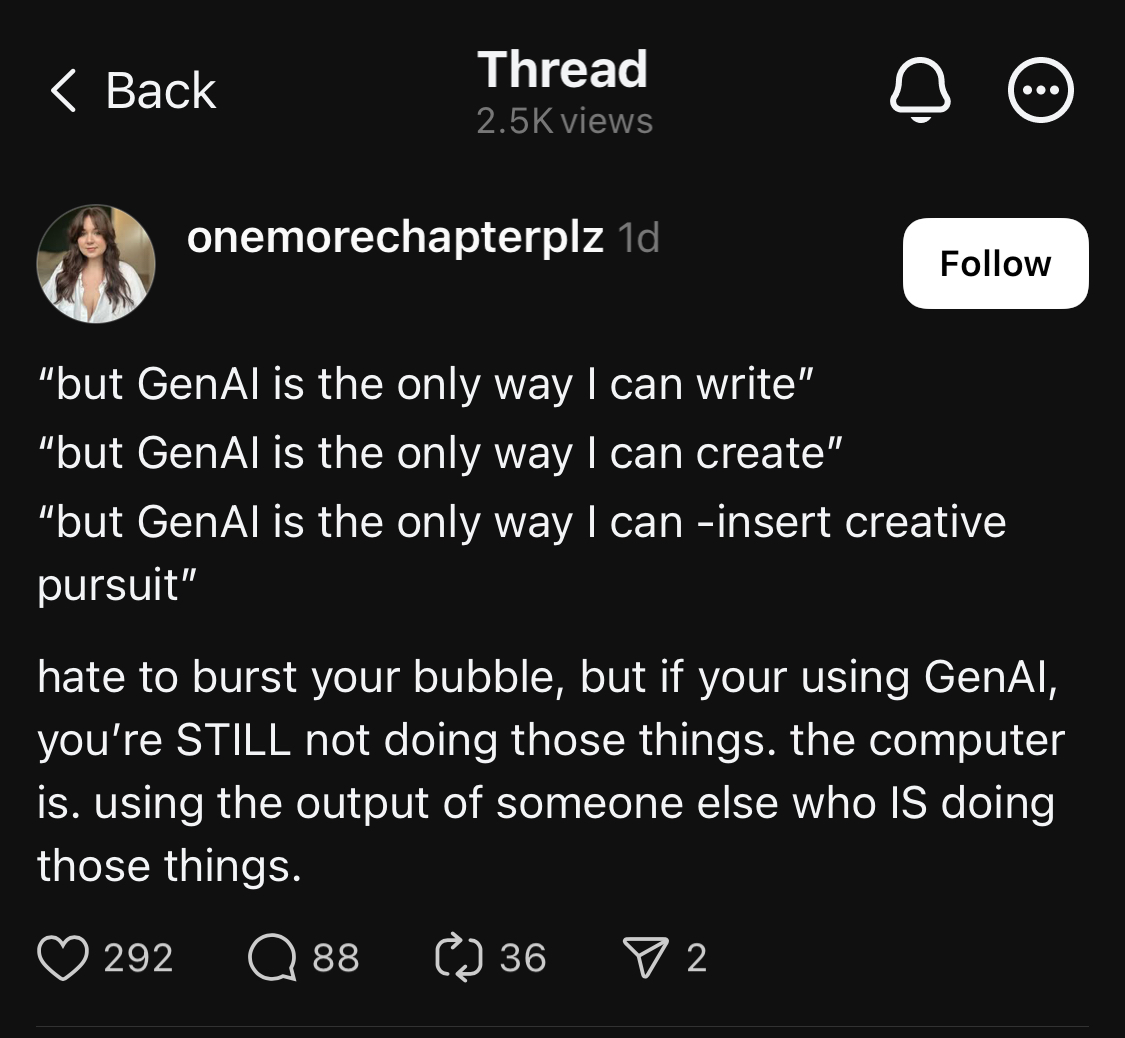
It brought back to mind a video clip I saw on Threads earlier that week, where the creator of an AI music prouction app was claiming that making original work takes up “too much time” and is “too hard” for the average joe to tap in to making music – “yes, it’s meant to be” was the welcome and resounding retort from people responding to the post. Their point being that the process of creation is meant to be developmental, it’s meant to be challenging and all the more rewarding when you ‘figure it out’, and the figuring out in this sense is a finding of oneself through that process. Creating anything worthy of reading, listening to or looking at requires this process. Perhaps what perturbs me most is that ultimately, I think the use of AI in the way mentioned above shows a level of disdain for what it means to be human. It considers the human brain as slow, unoriginal and ultimately not worthy of the effort/investment required to keep it vital through the exercise of reasoning, reading, failing and meaning making.
 Write. Snap. Click.