Literary Postmortem: The Reactive

My excitement and expectations going into this book were quite high and I must say I was not disappointed at all. This debut novel by Masande Ntshanga, is one of the best things I have read in a long time. He is a young, black writer from the Eastern Cape aka everything I want to be one day (save for being from the Eastern Cape).

Anyway so late last year I attended an event where he read an extract from the book and I knew then that I had to read the book. He writes in a way that demands you to carry on reading. If you plan on reading the book and want to be surprised don’t read this – there will be spoilers.

Right.

So I mentioned the high expectations – shattered not long after I had settled into this read. I expected to read about his younger brother, Luthando dying at an initiation school and the guilt his older brother, Lindanathi felt over his compliancy in that. That’s actually why I was so interested in the story to begin with. It’s a horrible thing that happens to young boys out in rural areas in our winter. Luthando’s death is always lingering throughout the book but I still felt I needed to know more about his death.

Initially I thought the immense guilt the protagonist (Lindanathi) feels throughout the book irrational because you know things happen, right? But then the more I read about his drug induced hazy days in Cape Town with his two friends Ruan and Cecelia, the less empathy I felt.

They did drugs. Often. A lot of drugs. Often. It scared me. Scared me because it just happens so easily, they are at the point where it’s routine, they need the drugs to peel themselves off Cecelia’s apartment floor. It also scared me because Ntshanga writes about the drug use/dependency with far too much accuracy to not be drawing from personal experience (or so I think). There’s also quite a bit of kinky bordering on messed up sex, group sex with masculine porn endings *purses lips*.

But anyway in a nutshell, these three are drugged up all the time and sell pharmaceutical drugs (ARVs) on the side – they lead a life that looked like absolute chaos to me. But there are reasons for why they are the way they are, some which we don’t really get to learn about. Personally, Lindanathi making himself reactive was the most chilling for me. There’s a lot of ambiguity in the book, shielded by absolutely beautiful imagery and sentences. I can’t recall how many times I had to stop reading to re-read and mull over the perfect sentences.

To me, Lindanathi redeems himself towards the end of the book when he decides to stop running from his problems and avoiding his family. He goes back to do the thing he promised his brother he would do with him. He decides for a change to look his life in the face and show up. Then we meet Esona, ah I would have loved to have one more chapter for their story – she sounds like the thing he has needed for a long time.

The way the book ends is comforting, still sad (yes, I cried) but it feels like things happen as they should. It really was a brilliant read, it felt extremely honest, therefore heartbreaking but also so necessary.

I am just a girl with a blog who read a book but I would definitely recommend The Reactive.

Literary Postmortem: The Flowers of War

No one ever thinks of war with an air of pleasantry, but I must admit I never stretch my imaginings of the true horrors far enough – a realization that came to me quite early on reading this book.

Everything I assumed would happen never did and every single climatic moment in the novel came as a shock, often accompanied by tears. It was a heart wrenching read. I suspect that it is why it took me so long to read (about five months I think).

It isn’t a long read at all and it’s beautifully written, with a flow that hooked one instantly, but I could only deal with it in small chunks at a time. A way to apportion the pain I think. It was astounding to me how inhumane people became with the power of gunfire in their hands and a band of cowards behind them, cheering their brutish behavior on.

The novel written by Geling Yan is set in China in 1937, during their occupation by the commanding island that is Japan. The novel is set a few months after the Second Sino-Japanese War started – a war that lasted almost ten years. Although the novel is a brief glimpse into a short time during the war, I loved how Yan mixed fiction and history – simultaneously educating and entertaining me.

Yan focuses on a singular location in the novel, an American church in Nanking which is housing a number of orphaned teenage school girls who had not managed to escape the country in time. Throughout the entire book I was under the false illusion that because of where they were the girls would be safe. But chapter by chapter, as the Japanese soldiers’ stomped their way through the pages, that hope waned. I soon realised that these girls couldn’t possibly evade the Nanking Massacre that was happening around them.

Things got all the more dangerous for the girls when a group of prostitutes and wounded Chinese soldiers turn to the church for refuge. What follows are scenes I have had bad dreams about for the past few nights. I recall one particularly grisly chapter set at an execution ground. Shucks, I was never ready for that chapter.

Every death was a blow, as it should be. It’s so easy these days to shrug off death at the hands of violence because “we know it happens” or it’s just all around all the time. But it shouldn’t be like that. It’s not normal to live in a perpetual state of continued violence. I think what this novel taught me was that yes war time is horrible, but it made me realise that maybe wars don’t really end. Yes soldiers leave and there are treaties signed and what not but people don’t necessarily stop living in horrible conditions without the threat of rape and murder. But I digress.

On the positive side this was the second book I have read about women in war and again I was shown what resilient beings we can be. The women in this book were very inspiring, they were “naturally” the most vulnerable people throughout the novel but somehow they survived it and not by chance either.

Anyway this is one I would definitely recommend, for both your intellectual and social edification.

Imbawula: Modern storytelling

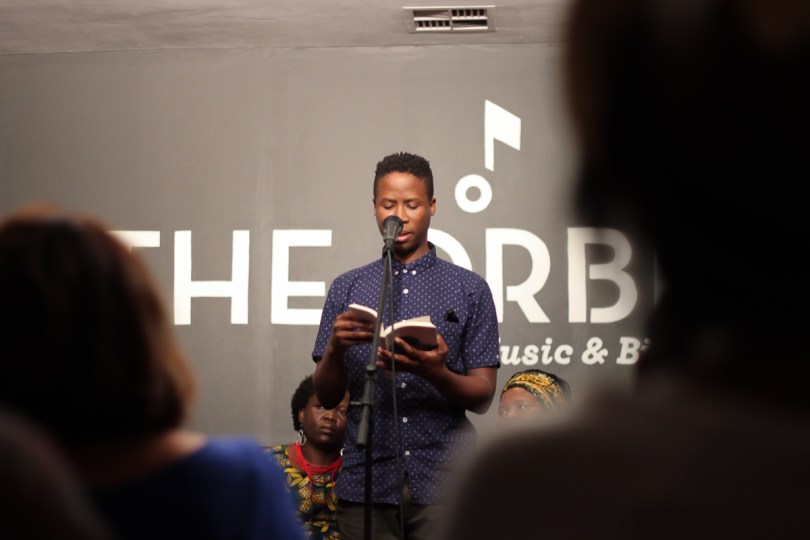
We laughed, we cried, we were enlightened and we were simply enthralled when four vastly different people told us stories in a basement  at Bean Republic, over wine last week Thursday.

It was the first Imbawula event jointly hosted by Random Window and Quarphix Foundation, under the stewardship of Siphiwe Mpye. He got the ball rolling by telling us a tale of how the idea for what will now become a monthly event came about. He remembered always being curious about the time shift that happened as the sun set and he had to run home to when the dark settled leading to older boys taking over street corners to talk sex and politics next to informal fireplaces.

I imagined that people would read something short that they had written – but it was really just four people telling us stories about themselves, which was really something. First we had Lee Molefi, who told a very moving story about being a kid on the cusps of teenage drama, who had to navigate  not black enough, too smart and and an untimely death. He has the kind of voice you can listen to for hours and so it was nice to hear him speaking in such a personal way as opposed to the very serious MC’ing I’ve only ever heard. His story had us gasping, laughing  in one moment  and then suddenly crying.

The second storyteller was, the sultry voiced, Vutomi Mushwana. She spoke about love and used the example of what was one of her most important relationships to illustrate how love can smother, hurt, heal and ultimately make you grow. As a lover of love, her story was my favourite. Not because of the topic but because of the reality of what  a toxic relationship can do to you without you realizing. She definitely hit us with some wisdom. I have read some stuff on her blog and I have become a fast fan.

The third speaker was one of my favourite commentators slash bloggers, Milisuthando Bongela (better known as Miss Milli B). First of all her outfit was fierce and fittingly so because her tale was about where her journey with fashion began. But the bigger story she told was how she met her intuition while on the job, when it seemed that the world was coming crashing down around her. We so often second guess our intuition and if she had that day things would not have worked out as intended.

The night ended of an a light note when Anele Mdoda’s storytelling time turned into a bit of a comedy set. She regaled us with a tale from her early childhood, one I had read before in her book, It Feels Wrong to Laugh, But (part of The Youngsters series) but because of how animated she is in person I loved seeing that story come alive. I cried but not because there was any sad part in the story but because I was laughing so hard.

I loved the intimacy of the evening because it let those who told stories do it so freely and made those of us who listened privy to some the four storyteller’s most telling tales. I am keen for the next event, to hear more stories over wine in a basement.

PS – In between the storytelling, Melo B. Jones serenaded us, here’s a little taste of that:

On Ferguson – The System Isn’t Broken, It Was Built This Way

All of this.

Anne Thériault's avatarThe Belle Jar

I have an uncle who was a cop.

His kids, my cousins, were around my age and when we visited our family in Québec every summer I practically lived at their house. As soon as we got to my grandmother’s house, all rumpled and grumpy from our eight hour drive, I would start dialling my cousins’ number on her beige rotary phone. I spent the whole damn school year waiting for summer, and my time with my cousins, to come; we wrote each other letters all through the dreary winter, hatching plans for new summer exploits. Life with my cousins – swimming in their pool, family barbecues, playing hide-and-seek in my grandmother’s mammoth hedge at twilight – was lightyears better than my boring life in Ontario.

Pretty much every summer my uncle would, at some point, take us to visit the police station. He would pretend that we were criminals and…

View original post 1,109 more words

Debate Club: Gender agenda

Gender not sex. Womanism not feminism. Patriarchy not masculinity.  These were some of the things brought up at the last debate club meeting of the year on November 25, 2014. The panel steering the direction of the conversation was made up by Panashe Chigumadzi, Lee Molefi and Lebohang Nova Masango.

Feminism, what it is and who it speaks to made up a substantial part of the debate on the night. Some described it as movement that seeks justice and equality. As women wanting to live in a world where they don’t have constantly “check” themselves to stay out of harms way. As vaginas and boobs not being the things that dictate where we belong and what we get to do. The most poignant description for me was:

The way patriarchy shapes what men should and can expect from women was another hot topic. I recall one guy in the audience saying he is all for woman empowerment and equality for “other women” just not his woman. He admitted that he had learnt to expect subservience and as a result that is what he now yearned for.

If I recall correctly he said he’s all for his sister becoming and engineer but his wife should have a more “humble job” as to not bruise his ego and mess with his role as the head of the house. The room, filled predominantly with women, was up in arms at that. This is the kind of thinking that reminds women that they are alone in this struggle, black men aren’t really here for us. Agreed with these comments on gender roles made on the night:

My biggest take away from the night was the fact that so few men were willing to understand what feminism is, some suggested that they can never identify because they aren’t women, that they need to be schooled and feel included to get on the train. In response, the panel said acknowledging patriarchy and how as a man you benefit from it, is similar to white people having to acknowledge white privilege. Something that was necessary to start trying to make things better.

https://twitter.com/ShanduMul/status/537288762934714369

There is a lot more that could have been discussed but time rules us all. This is a very short video of the night made by the good people at LiveMag:


VIDEO: My year at The Citizen in 5 minutes

On Thursay, November 29 was the we had to do our end of year graduate presentations for our mentors and fellow graduates.

It was really cool to see what other people did with their year and how much they learnt. There were only three of us at The Citizen – so we only knew each other.

Anyway, I decided to make a short-ish video as my presentation. We were tasked with telling people a little bit about our backgrounds and explaining the ups and downs of our time here:


Black Wednesday: Remembering the pain

About a week ago, I went to a film screening of a short doccie on Black Wednesday, hosted by the Steve Biko Foundation at the Bioscope in Maboneng.

I imagined that it would be enlightening and robust debate would be had. I didn’t imagine that I would cry throughout the entire thing.

I “know” our history, I’ve studied it extensively in school, varsity and in my private time to make sure that I never forget, I never become complacent, complicit and and and. Some say I am obsessed and I think we need to be if we truly want to “fight” the system – but that’s a discussion for another day.

Black Wednesday: On October 19 1977 three newspapers and a number of anit-apartheid journalists were banned. The movie we saw was about that, linking that day to the broader effort by the apartheid government to weaken the Black Consiousness Movement as a whole.

Seeing a grown man cry about how Steve Biko’s death was more than just a loss but something that left an indelible mark – at which point he cried, I cried. Personally I will never ever be able to forgive that. Killing Biko on September 12, a month prior, was more than an act of extreme hate but a convoluted plan to break a people – and it may have worked.

Anyway there was a cool opportunity for a Q&A session with the journalists who were banned that time, Joe Thloloe and Juby Mayet. Some highlights from that discussion:

Q: There’s a dirth intellectual leadership amongst emerging generations. They engage with Pan-African ideas at a very superficial level because it’s the “in” thing. The black rage they feel is fabricated. Thoughts on that?

Joe Thloloe: When you say fabricated anger, I disagree with that. It’s still the same anger. But we tried to sanitize it and in the process we find it erupting in ways we didn’t imagine… Since 1994 we have started to believe we are a rainbow nation, we are a miracle nation – when in fact the issues of the time still haven’t been solved. That’s the tragedy of our history.

Q: If that’s the case, can we be saved?

Juby Mayet: The black rage that exists today is directed at the current leadership, because there is such a vast gap between the haves and the have-nots. The haves are not necessarily white anymore…There is such a simple solution, don’t do it  for the t-shirt and the free food hamper – think. You’ve got the vote now, use it.

Q – asked by my friend, Shandukani Mulaudzi: What would you have liked to see happen in ’94?

JT: The first disaster was at Kempton Park, where a whole nation was hoodwinked into believing that a miracle is happening. The first thing that should have been negotiated was – how do we make up for all these years of suffering? That question wasn’t answered. And it still hasn’t been answered. We just went right to ululating and saying we are free – when in fact the basic issue was not resolved. Today a few of us have been co-opted into the old apartheid structures – we just have a few black faces there. I wanted us to answer the question of what do we do about 300 years of painful oppression.

Q: The term Black is now being used as a divider, rather than a term to unite. In the era of BCM, it was used to identify all people who were oppressed. The term Black is being abused by the current holders of power. How do you identify yourselves?

JM: When I had to fill in forms in those days and I still do this – where it asked for race I used to say human. If all of us do that they’ll soon chuck away all of the forms.

Q: Recently Minister Lindiwe Sisulu that people under 40 were not affected by apartheid, therefore should not benefit from redress measures like receiving RDP houses. Thoughts?

JT: That’s absolute nonsense. The child who is unable to read and write in Soweto today – is a product of the apartheid system. Is a product of Jan van Riebeeck landing in the Cape. So it’s 300 years that you are talking about and that will not be removed by the wave of a magic wand. When we talk about redress we must be talking about how we fix the systems, the hurt and damage that was done – mental, physical and spiritual.

Q: How do we address correcting the wrongs of the past if we don’t identify who is Black, White, Coloured etc, if we go by the human race definition?

JT: Saying we are part of “the human race” is a nice little intellectual trap we have set for ourselves. We have to be Black or Coloured or Indian to redress the past. Ultimately we are looking at all people who were oppressed, people who couldn’t vote, couldn’t get work, live where they wanted to etc.

JM: Millions are spent on nonsense things like Nkandla, expensive clothes, flying here and there. That money could be spent on other simple things like education. They did away with Teacher Training Colleges – where must our teachers learn to do what they do? There also needs to be more emphasis on reading from a very young age. Open more libraries, have mobile libraries in rural areas. My informal education largely came from reading when I was young – I just read everything that was in the house.

Q – asked by me: I’m a new journalist and obviously a black female. I find myself in a space where I am expected to write about Nkandla being so bad and that minister being so corrupt – when I know that that is not the real issue – white supremacy is. I suppose my question is, how today, as a journalist can I move beyond the anger I feel towards Jacob Zuma and focus on the real issue we have had and will probably have for I don’t know how long? It’s so very depressing to me to think that my children and their children and their children will have to live through this. It’s an all-encompassing frustration and depression that emanates from me not knowing what to do.

JM: You used the term “white supremacy” – there’s no such thing. It doesn’t exist in my world. In ’94 when we blacks went to vote for the first time were so blindsided by this rosey image of what was happening. We need to lay blame at Nelson Mandela’s feet. Yes, he was a terrific person and a great inspiration but we blindly voted for his party because of who he was – we didn’t see beyond him. We need to conscentise one another, to change mindsets.

JT: The media is a reflection of society in general. We have come to glorify the sensational. The media are businesses, they provide society with what society wants. As journalists we need to reflect who we are in our writing, not what the powers that be want. We are guerillas operating in enemy territory – the newspapers and radio stations are not ours but we must use them.

Q (asked audience member from Bolivia): I would like to see South Africa become a clour blind society. Because with this rainbow of this rainbow nation thing, there are just too many tribes – like in South America. It’s another form of apartheid to say black or white or coloured. People use “black” to play victim.

In response I said: It’s useful to label ourselves because there is a bigger system that supports those lables. It is not a coincidence that the people who liv e in dire poverty are people of colour. Until that is no longer the situation, the labeling of ourselves is necessary.

It was a lovely evening and much more was discussed in the hour long conversation. Keep learning, keep growing.

Gauteng honours 22 Nigerian church collapse victims

NOTE: Article first appeared on The Citizen website on November 20, 2014. 

Gauteng premier, David Makhura, said families who lost loved ones in the Nigerian collapse should be comforted by the fact that they died doing God’s will, at a mass memorial service held at Johannesburg City Hall this afternoon.

Bereaved families who lost loved ones in the Nigerian SCOAN church building collapse at a mass memorial service held at the Johannesburg City Hall, 20 November 2014. Picture: Valentina Nicol

The memorial service comes two months after a guesthouse connected to prophet TB Joshua’s, Synagogue Church of all Nations collapsed and killed 116 people, eighty of which were South African.

Makhura said the nation is with the 22 families from Gauteng who lost loved ones. “They died in God’s name, they died serving him,” he added.

Seventy four bodies were successfully repatriated on Sunday, with a further 11 left behind. Earlier this week, Phumla Williams, spokesperson for the department of communications said the identification process for those left behind would have to start from scratch to “positively identify” the remains.

Sombre-faced family members made their way into the hall, some holding hands and others holding back tears.

The families have been asked to not view the mortal remains of their loved ones as the bodies were exposed for some time.

Makhura said government did their best in the repatriation process because “Jacob Zuma’s government is a government that cares.” The 22 families who will lay their loved ones to rest this week, need only ask if they need any assistance Makhura said.