Cite me or whatever

Sethusa (2024) or (Sethusa, 2024) or (Sethusa 2024) – any style will do really.

If you haven’t guessed by now, this is my not-so-subtle way of saying I have just published my first academic article in a peer-reviewed journal. Reimagining Through Crisis: How the Covid-19 Pandemic Changed the Fortunes and Futures of Journalism Schools and Graduates, is now available in African Journalism Studies. The open access article is free to read and download.

In this exploratory study, I look into the way the pandemic affected our graduating studies entry and introduction into the working world. In the last few years students had to add a global pandemic to the list which includes shrinking budgets, trust deficits, tanking circulation figures and more. The shifts in journalism make it a challenging industry to actively pursue, but students who eke out postgraduate degrees at journalism schools hoping to buck the trends and pursure their passions regardless. By looking squarely at honours students in the programme I teach in at the Wits Centre for Journalism, I track some emerging trends and discuss what they indicate, with journalism students, educators and practitioners in mind.

We are in the midst of an equally frustrating and interesting time, which means we can either spearhead change or fall victim to it. Give my article a read and let me know what you think.

REVIEW: We are Winnie, Winnie is us.

This is the message that reverberated in my being when I came home from watching The Cry of Winnie Mandela at the Market Theatre last month (May 2024).

The set of The Cry of Winnie Mandela at the Market Theatre in Johannesburg. A quote from Winnie Nomzamo Mandela adorns the wall. Photo: Pheladi Sethusa

Adapted from the novel of the same name written by Njabulo S. Ndebele, the play felt like an apparition straight from the book cracked open at the spine. The novel had been sitting on my bookshelf since a random trip to Clarkes in Cape Town with my brother in 2019, leaving the shop that day with the gifted copy I had imagined I would be giving myself over to its contents soon, but life and living happened – until I had just two weeks before curtains up to get stuck in. Luckily for me once I started, I could barely put it down! It is a form bending, intimate and harrowing account of womanhood, loneliness and the alienation of strength (a strength required, not innate).

I initially bought tickets based off of who was directing the play alone. Momo Motsunyane. A fire. A force. I have never seen Momo on stage and been left unmoved, close to tears and deliriously joyful all at once, which is how I knew this would be a production that would leave me altered after experiencing it. Walking into the intimate theatre, with the pensive writer pacing and muttering to himself, I knew immediatley that we were about to be transported into another realm.

If I had to describe this book in one word it would be: personal, no intimate. From the very first sentence in the introduction – which is inward looking – to the last – which throws forward to a hopeful future – one is thrust into the inner lives of the writer (Njabulo S. Ndebele) and his characters with their noses pressed up against their insecurities, humiliation, longing, hurt and unwavering affections.

Instead of attempting to write a clear-cut biography of a woman almost “too big” to capture fully, the writer chooses to tell the stories of ‘ordinary’ women and through their telling, begin to peel back the layers of a figure steeped in mystery, shrouded in controversy and shielded by personality. Ndebele also writes the stories of four woman in Apartheid South Africa with a tenderness and rawness that was unexpected but most welcome.

While the stories cover themes from adultery, to sacrifice and even sexual liberation, at their core is one constant theme – abandonment. The women chronicled are alone. Some are alone in their marriages, others alone as extras in the lives of others and one alone in her revolutionary persona. Through no decision-making of their own, their circumstances leave them forever altered by their chronic aloneness and their lives turned into waiting rooms.

“When you are waiting, you know the meaning of desire: the desire to be the only woman (even in a illicit relationship); the desire for secrecy and pleasure of remaining unacught; the desire to prolong intimate moments beyond time and circumstances…”

– Delisiwe S’kosana, page 64

The novel felt like it was written to be performed and this became apparent as it unfolded before me in the Barney Simon theatre. Perhaps this was my own bias having just read the novel before watching, no experiencing it on stage, but it felt less like an adaptation and more of a rendering. The cast made up by Lesley “Les” Nkosi (Professor Ndebele), Rami Chuene (Mmannete Mofolo) Mofolo, Pulane Rampoana (Mamello Molete), Siyasanga Papu (Delisiwe Dulcie S’kosana), and Nambitha Mpumlwana (Winnie Nomzamo Mandela) brought Ndebele’s words and Motsunyane’s vision to life perfectly. Using song, wit and conversation to soften the ‘mbhokoto’s’ on stage.

I appreciate how the novel and the play alike aim to move beyond the historic accounts of stoicism and duty where black women are concerned, and instead asks the audience to consider and contemplate their vulnerabilities and extend them grace. They do the same for one another in their otherworldly conversations between Madikizela-Mandela and Cleopatra. I wish I could have seen it on stage one more time before the run was over, but I guess I will always have the novel to return to.

“Hello, I come back!”

“Me I am Thato…” If you haven’t giggled yet, you suck and should probably be more chronically online like the rest of us. Jk jk.

But no, I am not Thato, I am the lady from the url.

Unfortunately, that also means I am the person who has been neglecting this wee blog for a very long time. I was reminded of just how by one of my students last year during his interview and made an internal promise to fix that before they stepped into my classroom, but dear reader they have been in the said classroom for five months already and still. Side eyes self.

In my defence, I have had a lot going on, from teaching to embarking on my own research journey and just trying to be an okay human – kuningi. I hope to use this space to better document the kunigi-ness.

Watch this space 🙂

Thirty days of creative fervour

It was a random Tuesday, the 16th of January to be precise. I was scrolling on my IG timeline when I bumped into a post on New Comma’s page about a creative challenge, in which participants would have to create something, anything, based off of a daily prompt for 30 days. I immediately shared the post and typed in ‘let’s’, and then proceeded to do just that.

For thirty days, my days were filled with turning over a single word or phrase, looking to my immediate surroundings but mostly inside myself for the ‘thing’ I could create that day. Some days were harder than others, with what I considered a ‘boring’ idea only come to me mere hours before the midnight deadline. But some days I could write something, take a photo or shoot and edit a video within hours of seeing the daily prompt. From ‘Play for keeps’ to ‘Jaws of life’ the people from The Rule of Thirds Podcast sure did keep us on our toes.

I would say my favourite part of the process was how intentional I became about carving out to time in my day to plan and execute whatever came to mind; and the knowledge that everything I did end up posting was a first draft that was just given a little love. I hope to carry the patience, confidence and capacity to create doing this challenge has left me with. The daily pressure sometimes drove me to the corner of Give Up and This is Too Hard but so proud of myself for moving through those moments.

Most of my submissions are in the slideshow below, videos excluded because I don’t have a premium account and cannot share the originals as my account is private (let me add that having a public account again was a nightmare – spent half the time blocking porn and Bitcoin accounts).

Special shout out to my girls Premiere Pro and Rush, Photoshop, Audition, VSCO, Canva and the Notes App for making all of this stuff with me 🙂

Podcasting and Stories from Katlehong Township

A couple of months ago I consulted on a project that would see me meet and work with a group of interesting and interested young people from Katlehong on an experimental podcast project.

In collaboration with the African Centre for Migration at Wits University and Frame45, the project used podcast training and production as a means to achieve authentic storytelling. From start to finish we only had about three weeks to fit in the training, pre and post-production – not helped by the daily load-shedding schedule we had to work around throughout.

As an educator, it was a challenging and exciting exercise, as I was teaching a group that had to be taught the basics of storytelling and writing from scratch, introduced to podcasting as a form and then a few days later produce one of their own. In some instances this made for much more robust engagement and I appreciated that. The story ideas and themes that came out of our sessions were really interesting, although not all of our participants managed to produce a full episode by the end of it, I am still very chuffed with what this group was able to produce in a very short space of time.

Read and listen to the work produced on Frame45 or simply use the QR code below.

Women in mining

A couple of months ago I went to the very first premiere of something I made. It was a real premiere replete with a red carpet, popcorn and a screen big enough to have to tilt your head back slightly to watch the documentary film.

The untitled project is a short documentary that attempts to tell a the brief yet compelling story of women who work in the mining industry. It was a commission for Women in Mining South Africa (WiMSA), a non-governmental organisation that through policy, lobbying and mentorship fights for for the inclusivity and empowerment of women in the sector.

The very short trailer is glimpse into what we cover in the 30 minute runtime and has more information where to watch the full version in the caption.

Trailer

Being a two person crew was both challenging and deceptively easy. For this project I worked with a friend and colleague, Lesedi Molefi. I think we got a lot more done and done quicker because of this dynamic but we were both keenly aware of how much better work we would have been able to produce if we had more resources. That said, starting with what you have, where you are remained the guiding principle.

What I can say about this first little documentary of mine is that it tested me in ways I have grown to appreciate. It is my first and I have to constantly remind myself of the fact that it is an experiment, one I will learn and grow from. Am I proud, absolutely! Do I have a way to go, absolutely! It’s taken me a while to share because I had to work my up to believing this myself.

Listen.

One of the coolest things I had the opportunity to do in 2021 was produce and sound engineer podcasts for actual money.

Podcasting was one of my elective subjects while reading for my masters in digital documentary. I chose it because I had never had the opportunity to work in radio at that point in my journalism career and figured if I was going to focus on working on more longform multimedia work, podcasts may be the best way to upskill on the audio side of things. From studying podcasts back in 2019, I now teach it to postgraduate students at Wits University and produce/edit for private clients.

I was lucky enough to work on two independent projects last year, which helped me put my newly minted skills to the test as I helped the podcast host’s launch the first season of their respective shows. It was a real treat to work with people who first and foremost where friends. The trust that already existed between us, helped in fostering working relations that were respectful, vulnerable and enriching. Having clients who truly trust your creative vision is unmatched.

The shows were very different in their subject matter, but the post-production processes were very similar. From coaching the hosts on how to record clear audio, set up interviews and create promos; it was an educational experience all around. The content of both shows also made for easy listening when I had to listen to hours and hours of ‘tape’ while editing and re-editing.

Show Me Your Friends and The Mindful and Messy Podcast, will always hold a special place in my heart as being my ‘firsts’ and I cannot wait to work on others which are just as interesting and meaningful in the near future.

I made a thing (and will probably keep making things)

So if you had asked me a month ago what a desktop documentary is, I probably would have said “um, I don’t know – a PC based doc?”. I wouldn’t have been entirely wrong but it’s a lot more than that.

In the middle of January, I attended a virtual workshop hosted by Bertha DocHouse on desktop documentaries as a genre and mode to be explored in an upcoming competition they would be running. The session, hosted by Kevin B. Lee , was not only informative but he gave us great tips on how to get started with this particular documentary genre. My understanding after the tutorial had expanded some, essentially this emerging genre uses desktops, mobile phones and tablets as the sole source of all the material used to tell a story. Screen recordings and screengrabs of things found on the internet or in personal libraries are one’s visual anchors in these documentaries. Many desktop documentaries are research-heavy investigations that let viewers journey along with the filmmaker as they discover things in their searches.

Some of the useful tips shared by Kevin for those who want to make such films:

  1. Study screen stories – watch as many desktop documentaries as you can, while watching think of possible themes and forms you want to explore.
  2. Turn your own screen life into a story – record your daily online interactions and habits, analyse them and see what they say about you (or others). Try the Pecha Kucha method of telling the story of a day in your life with just 20 shots that are 6 seconds each.
  3. Use online your own resources – just by looking at your own search history, usage patterns, emails, texts etc you can begin to critically analyse this data and make a story of it.
  4. Technical tools – screen capturing software, editing software and interface simulation tools will not only help you source material but will aid your creative process when you begin assembling everything.
  5. Use questions to stay on track – in telling your story or a story, show a process that answers the who, what, when, where and how questions that viewers may ask.

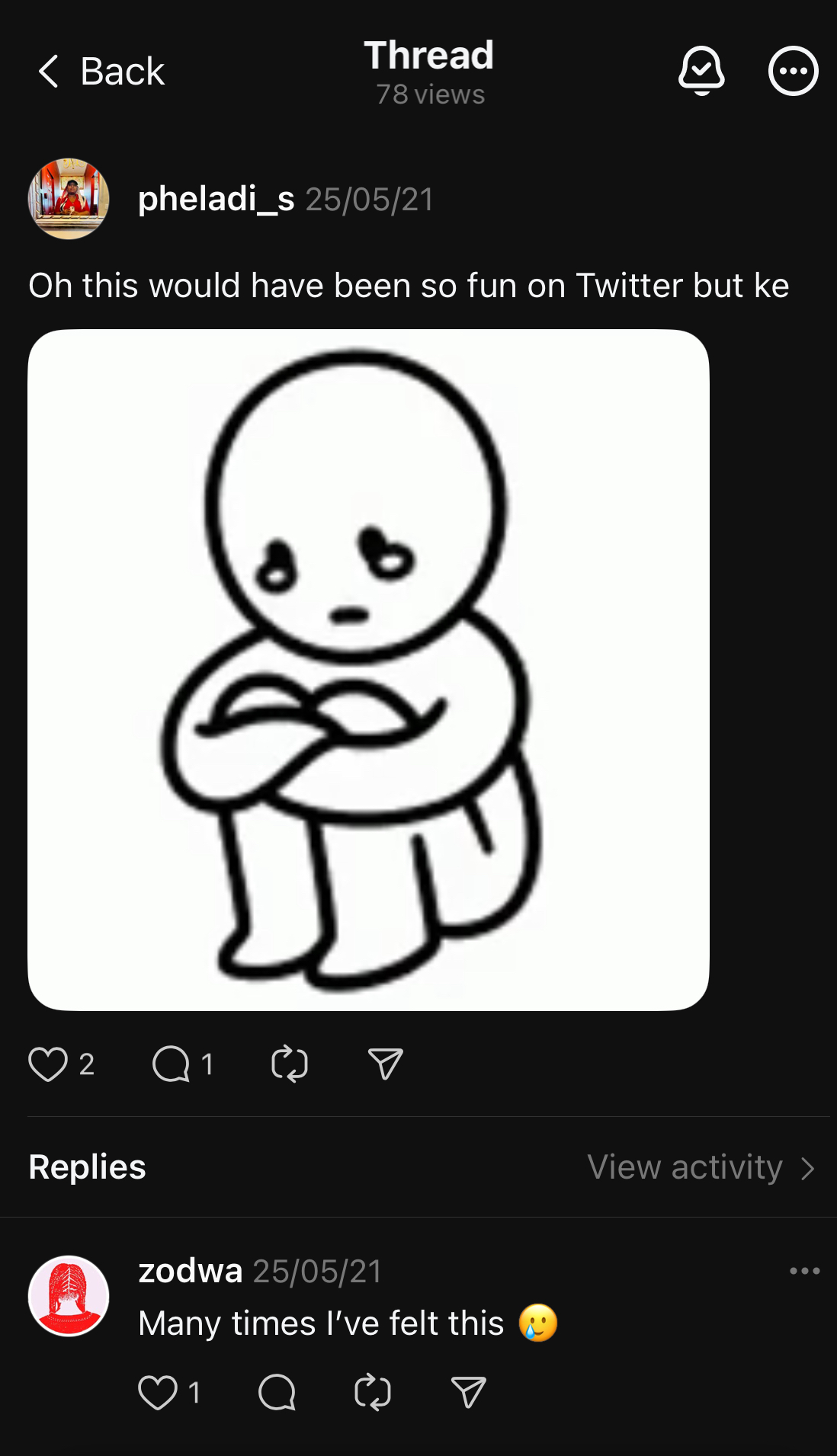
After some research, watching most of the films he had recommended and quite a bit of procrastination, I decided I could give it a go. The competition deadline helped in lighting a fire under my ass and I managed to make and submit, i miss everything. I was hesitant to share it publically when I was done, because it was my first try and I was sure it sucked and and and. Then I saw the tweet on the left by a photog I follow and admire, which gave me the confidence I needed to just share it for the heck of it.

i miss everything – a short desktop doc by yours truly

I am going to keep making stuff, writing stuff, shooting stuff, producing stuff, for the heck of it. Sometimes I will need the fire of a deadline, which is why I have started entering paid writing competitions for instance, because if I don’t I just won’t grow. A lot of it will be bad but not all of it will and I guess that’s the point for me right now.

Alone, Together

A short by your shorty *slaps thigh*, sorry just had to get that one out of my system. But it is, this is the very first short documentary I have conceptualised, filmed, edited and produced. Yes, it wasn’t my initial vision; yes, I didn’t get to use professional equipment; yes, it views like a long self-involved vlog – but all that aside, I still did it. The pandemic forced us to change our plans and adjust/pivot to the new normal and we did. So if you have 12 minutes to spare, I would appreciate the pleasure of your time to watch Alone, Together.