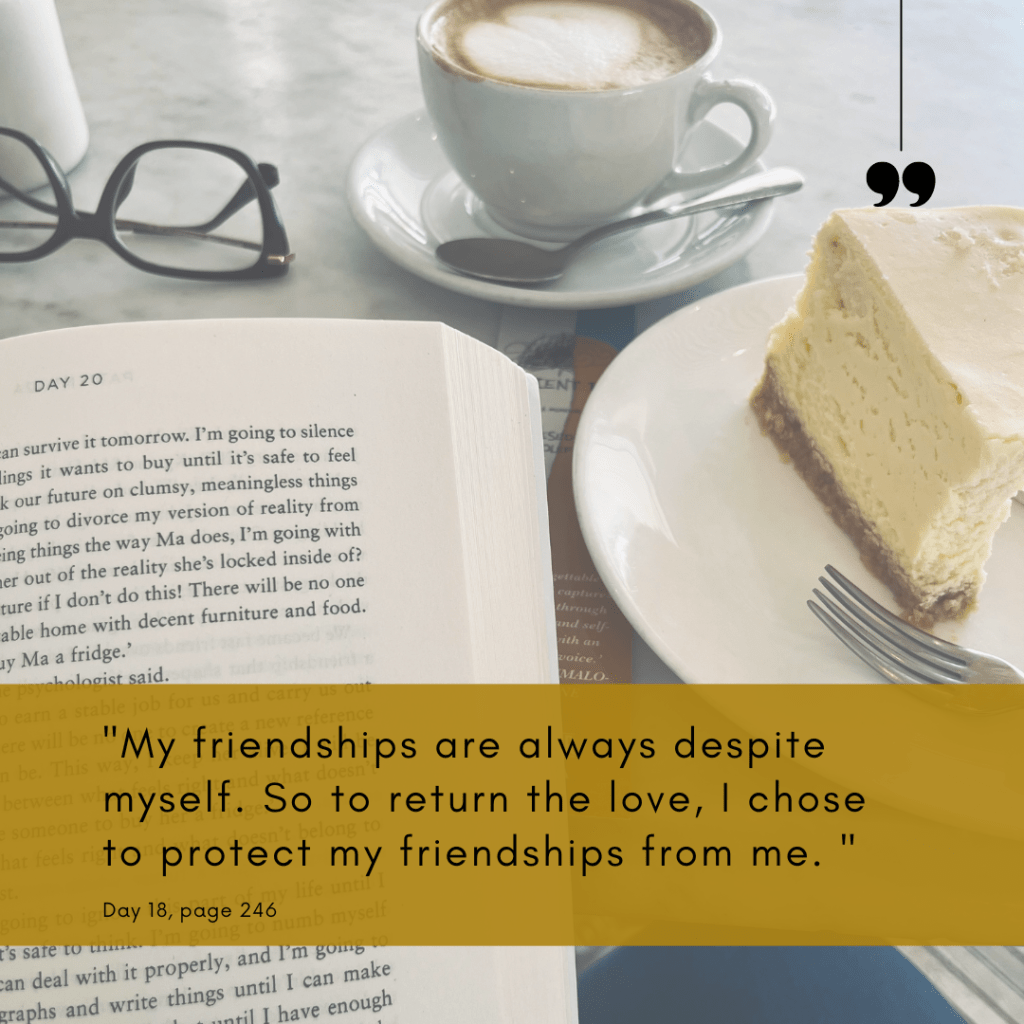
Trying to make the ‘best bits’ a permanent feature of my literary postmortems, mostly because there are so many passages, sentences, phrases that stay with us beyond the initial reading.
In this read, technically speaking, the whole book is a ‘best bit’ but copyright laws are a thing so I have highlighted just ten moments that gave me pause.
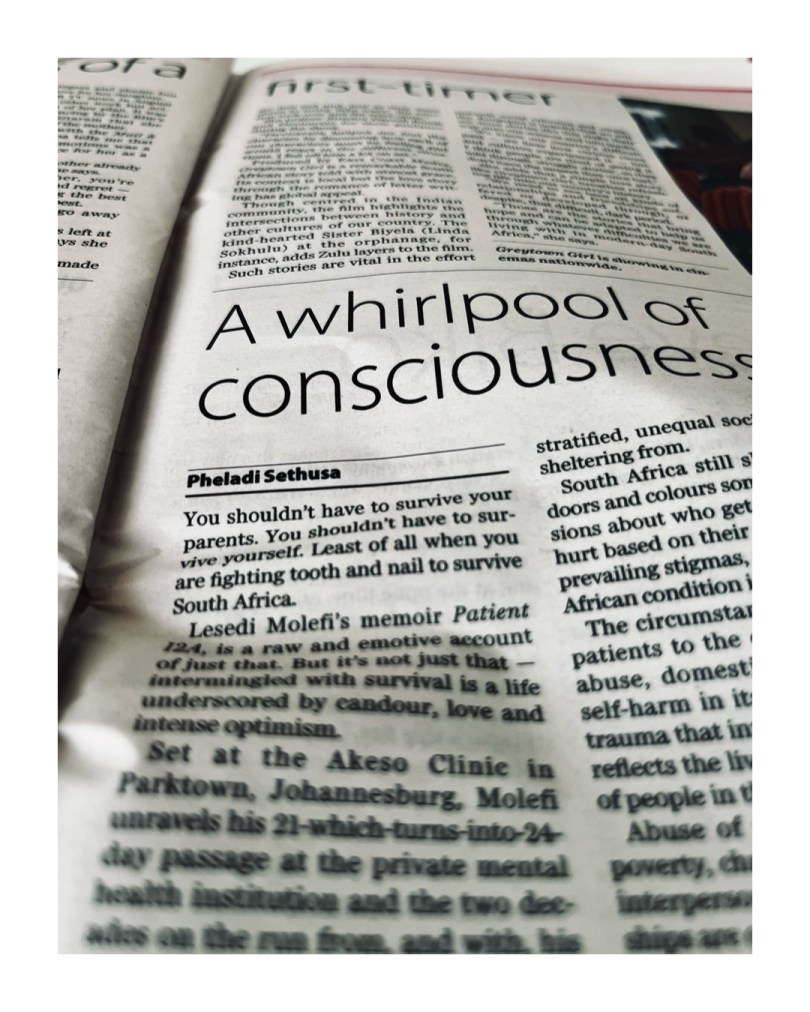
You shouldn’t have to survive your parents. You shouldn’t have to survive yourself. Least of all when you are fighting tooth and nail to survive South Africa.
Lesedi Molefi’s memoir Patient 12A, is a raw and emotive account of just that. But it’s not just that — intermingled with survival is a life underscored by candour, love and intense optimism.
Set at the Akeso Clinic in Parktown, Johannesburg, Molefi unravels his 21-which-turns-into-24-day passage at the private mental health institution and the two decades on the run from, and with, his family that necessitated him checking in in the first place.
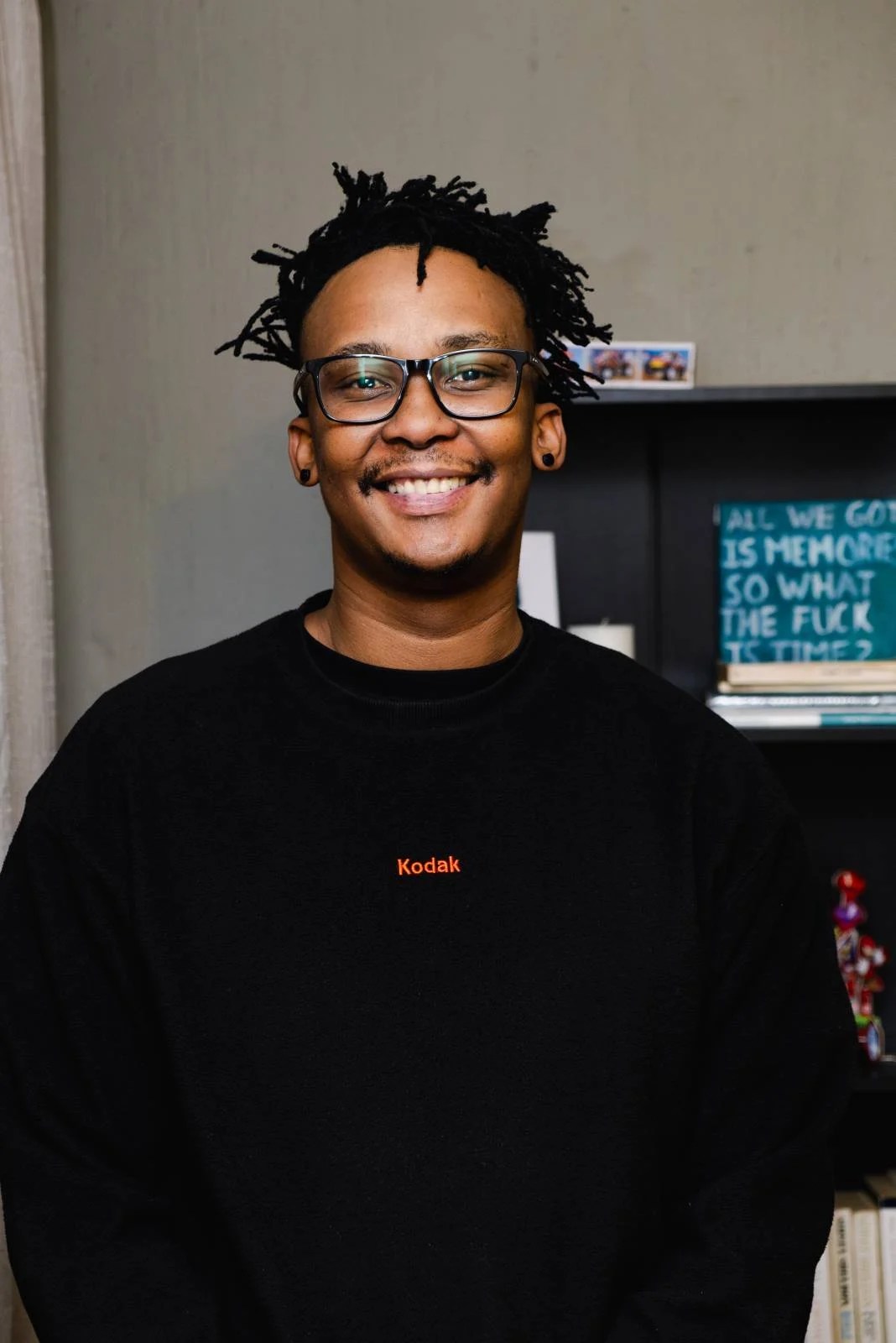
Passages of mind: Lesedi Molefi’s memoir Patient 12A explores his battle with mental illness. Photo: Thabiso Molatlhwa/Richart Productions
Some of the factors include parental abandonment; managing the symptoms and consequences of undiagnosed mental health issues and constant uprootedness and hunger.
Tipping the scales ever so slightly, and perched on the other side of these circumstances, is loyalty, creativity and unbridled self-belief.
With my previous insights into stays at mental health facilities limited to the accounts in Sylvia Plath’s The Bell Jar and Ken Kesey’s One Flew Over the Cuckoo’s Nest, I had braced myself for coldness and rigidity, but was pleasantly surprised and relieved when, instead, the walls that house this clinic were safe and warm. This is because of something unique — the people Molefi finds there, a “cross-section of ordinary South Africans”, as he calls them.
Together they parse their traumas, relate and commune authentically.
Running alongside formal treatment sessions and various forms of therapy, this community of patients provides another lifeline to, and through, one another.
But it isn’t all kumbaya — the clinic and its patients still mirror the stratified, unequal society they are sheltering from.
South Africa still slips under the doors and colours some tough discussions about who gets to hurt and be hurt based on their race, gender and prevailing stigmas, proving the South African condition is inescapable.
The circumstances that led other patients to the clinic include drug abuse, domestic abuse, grief and self-harm in its various forms. The trauma that informs their inner lives reflects the lived realities of millions of people in this country.
Abuse of power, the violence of poverty, chronic neglect and broken interpersonal and familial relationships are common threads.
This external backdrop of extreme inequality, and the violence thereof, must be surmounted daily, an impossible task for anyone, much less someone without the socioeconomic resources that afford one relative safety, space and access to process with grace and dignity.
The most ubiquitous and immersive device in the memoir is “the noise”, the literary and internal universe Molefi steeps us in.
The noise emanates both from him and through him. It is a whirlpool of his consciousness and internal struggles, used to transport us fluidly from the past to the present with careful clarity.
While he describes the noise as chaotic and disruptive, for those reading this work, the noise is an expert and intimate guide through the passage of his mind.
The complicated thoughts and feelings that colour and blur his cognition help readers to identify where and how they intersect, overlap and relate to the vast array of pain points chronicled.
At the launch of Patient 12A a few weeks ago, and in subsequent interviews, the author has been at pains to emphasise that this isn’t a self-help book. He goes out of his way to avoid listicles and passages filled with advice and definitions from medical and psychology journals.
But through the careful reconstruction of tobacco-stained conversations in an inner-city courtyard, he does the work of inviting people to see themselves through his personal anguish and through the highly relatable experiences of the other patients “doing time”.
Without spoiling it for anyone yet to read it, the memoir’s true heartbeat and nerve centre — and by extension Molefi’s — are his mother and sisters. From a very young age he is driven and compelled to protect them, but he can’t, and that inability taints every attempt at a semblance of normality — something he yearns for from their first uprooting through to their last.
Initially, one can be taken by the adventure that swirls around the first few “trips” their mother takes Molefi and his siblings on, the promise of greener pastures. But it soon turns into concern and quiet rage when you realise that the four of them are in fact being dragged from one terrible situation to the next.
Homelessness and hunger are always assured but not much else. The children try to grapple with their mother’s simmering mental illness and keep one another fed, educated and away from the monsters that lurk in the shadows as they move from one precarious place to the next.
The scars of their experiences play out in different ways and at different stages for each of them but Molefi articulates his payoff as “a strange education”.
By the time he is in his twenties, he is a master of survival — not quite the education he wanted but the one that has carried him thus far.
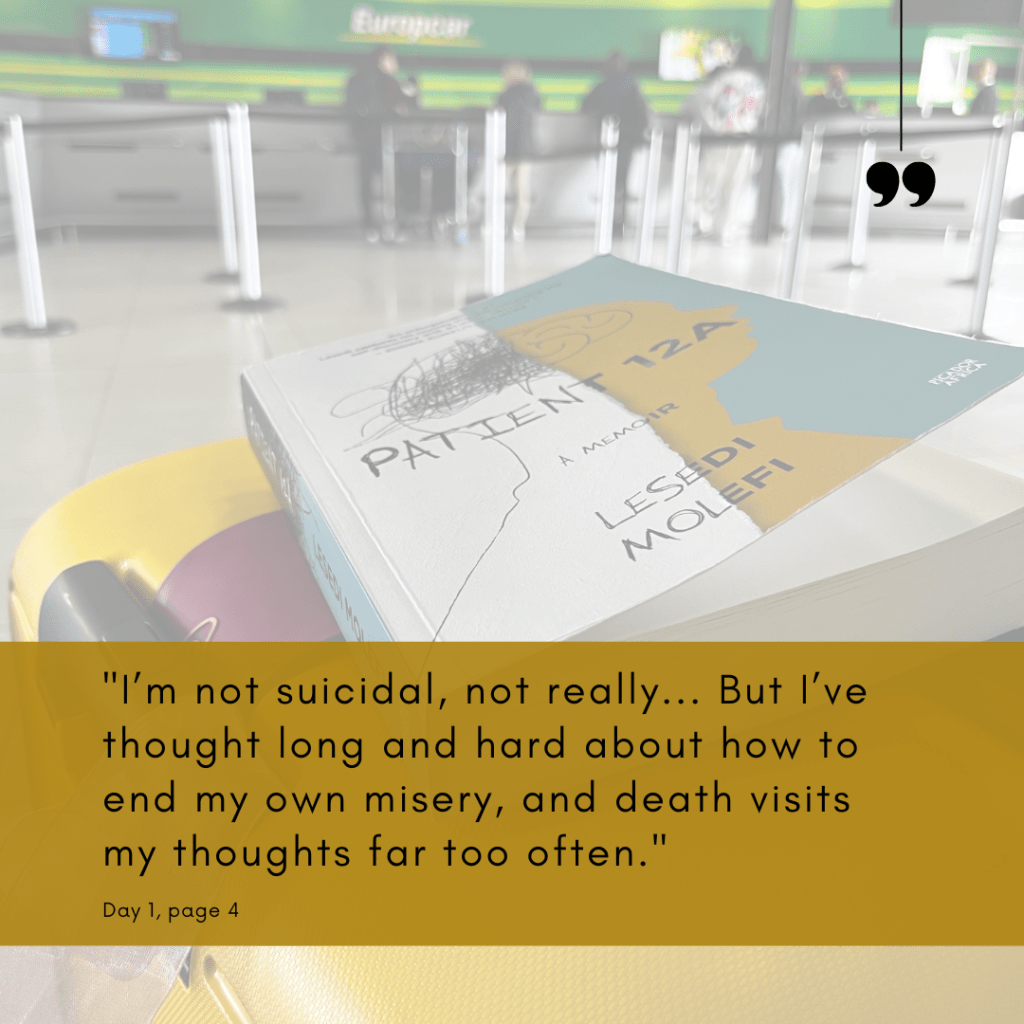
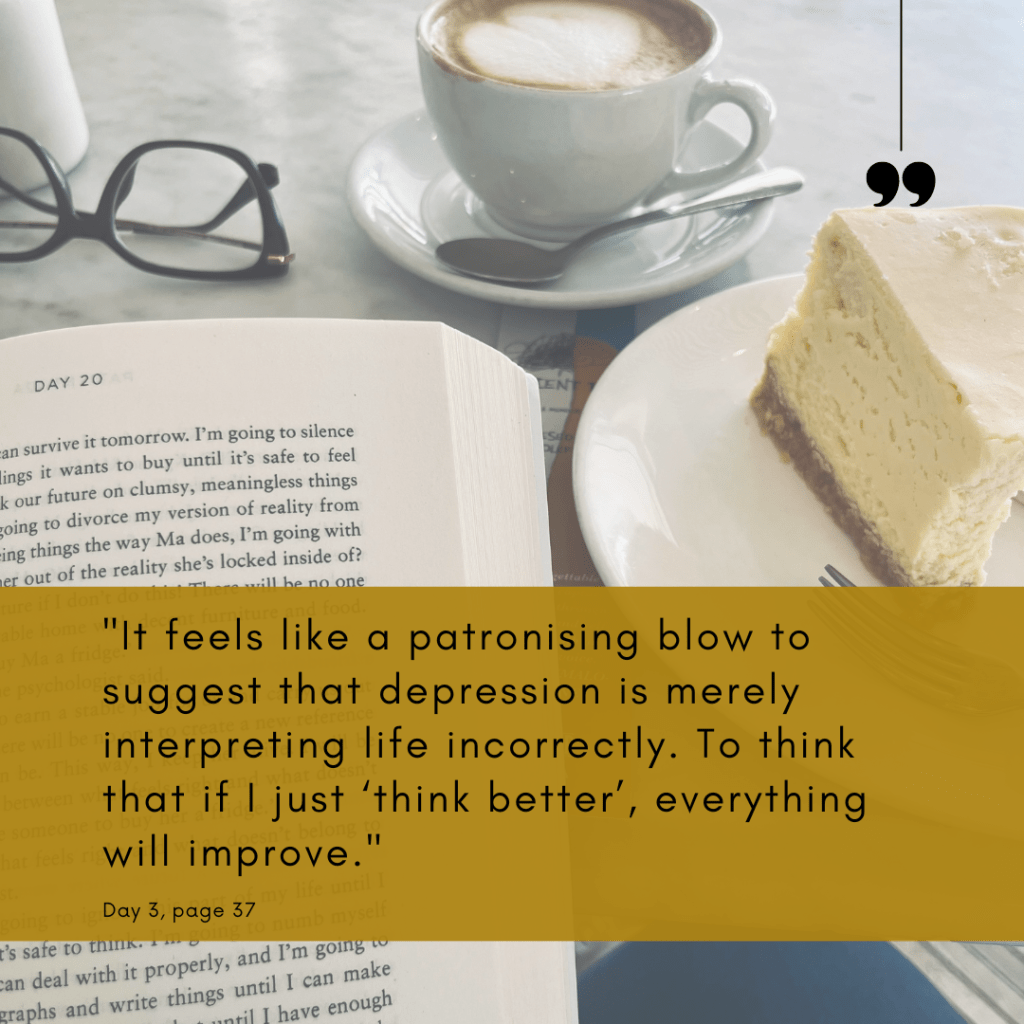
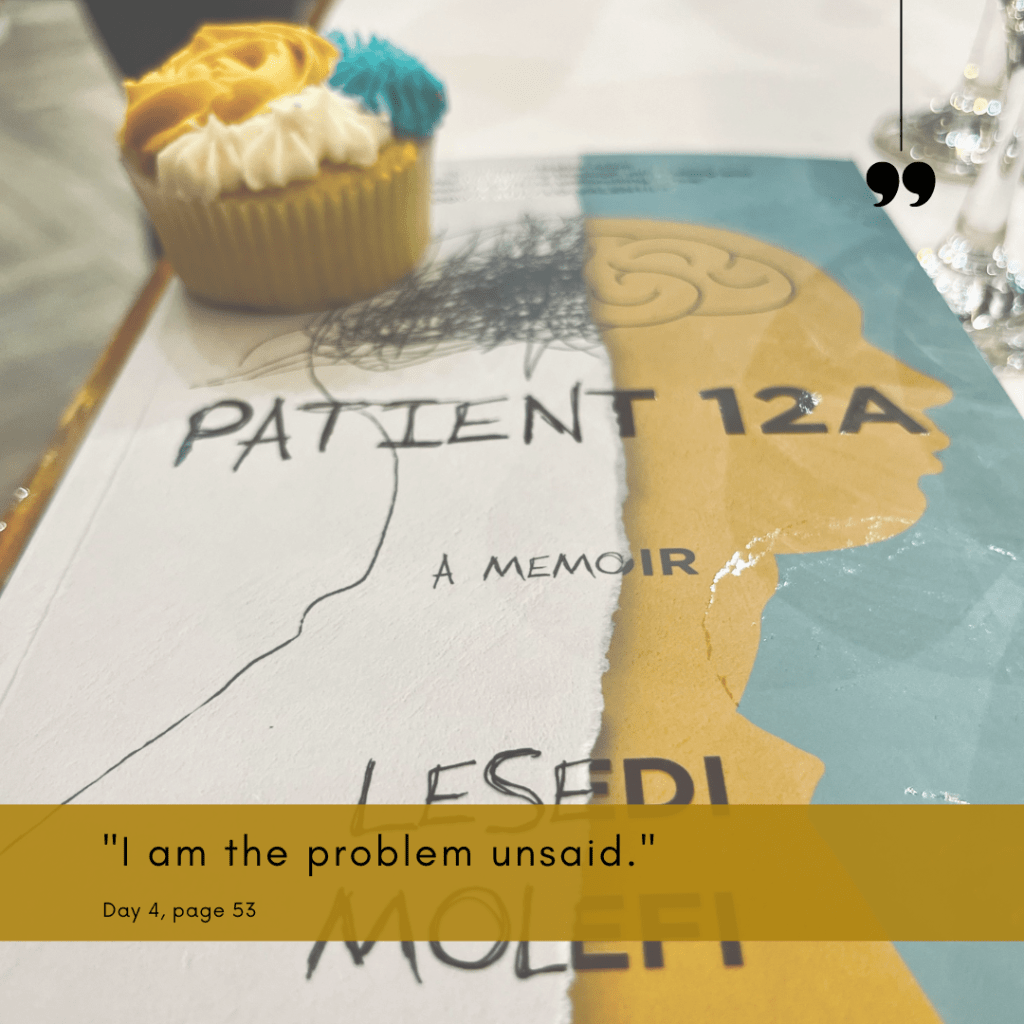
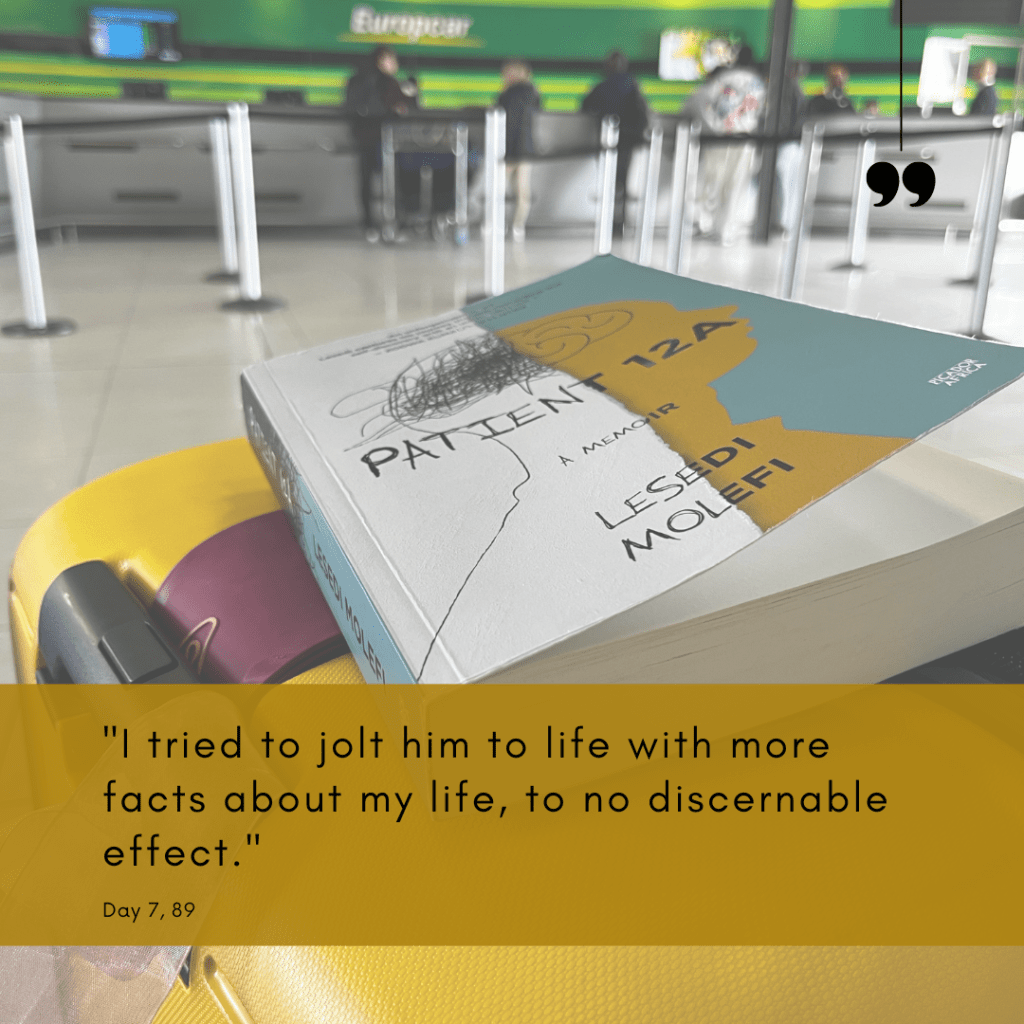
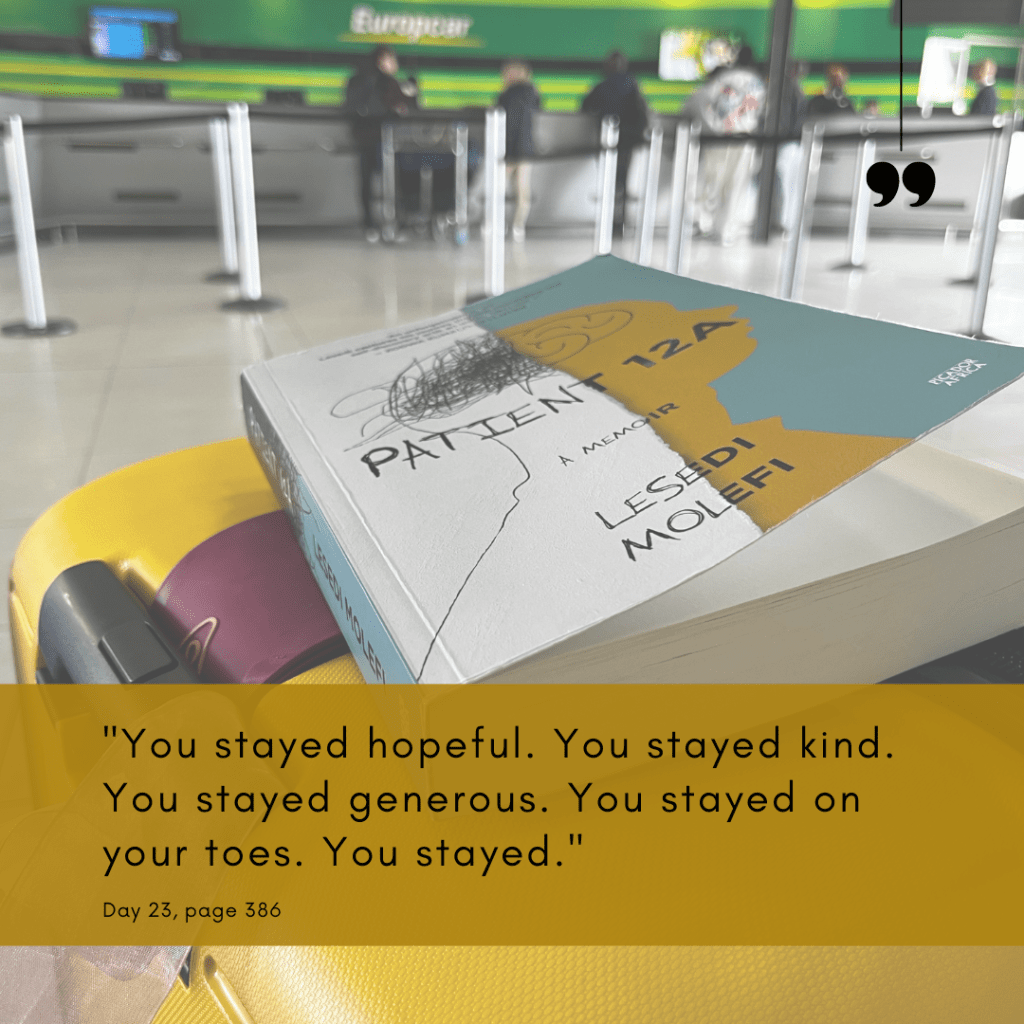
My copy of the book is dog-eared, tatted up in orange highlighter, has travelled on planes and trains, and watched me drink copious amounts of coffee as I struggled to put it down.
What really carries one through the 408 pages is Molefi’s ability to write about pain and trauma with a level of honesty and vulnerability that invites one in and that, quietly, asks one to look at him in the context of “the facts of his life”, directly in the eyes — and not look away when he shows you who he is.
Through the whispers and shouts of the noise, Molefi speaks himself back to life.
It is prose, it is poetry, it is beautiful.
——————————————
Patient 12A is published by Pan Macmillan South Africa.
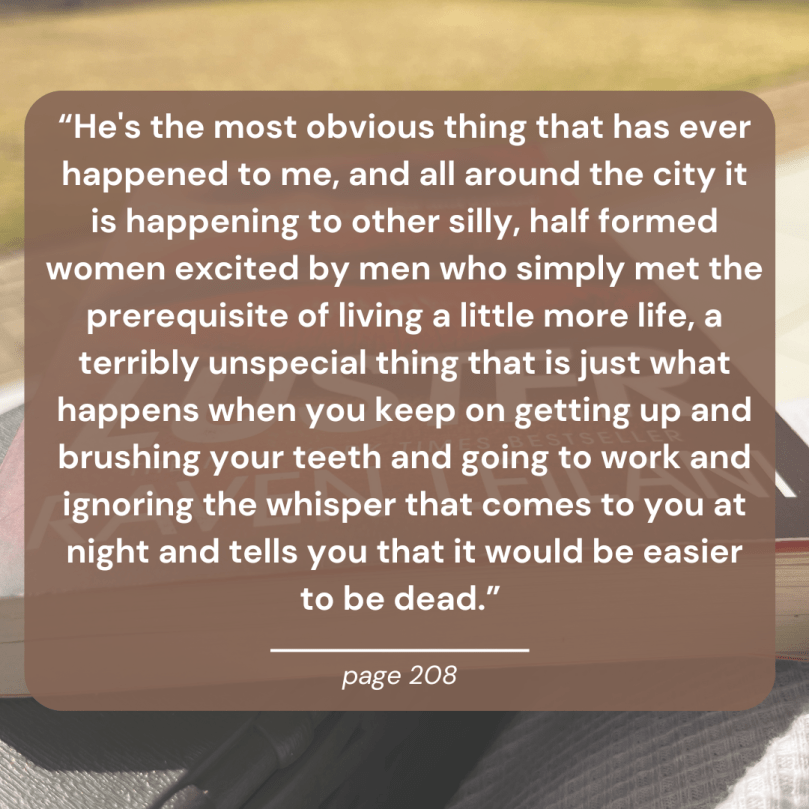
“What the actual?!” I have never said and thought this phrase more than I have in the last month reading Raven Leilani’s Luster.
I recently described it as ‘very fucked up and difficult to read, but the beautiful sentences have made me stay the course’ – I probably phrased it less eloquently at the time but that’s what I thought when taking in the 227 pages that often felt like an exaggerated pitch for an HBO show (you know, dimly lit with all of the fucked up sex and drugs).
In short: Edie is a traumatized, touch-starved, poverty-stricken artist, who starts an affair with a very boring, middle-aged married man (I think his name was Tom, no James, no Michael, no no Eric – see, unmemorable at best). In the middle of their punch-me-fuck-me shenanigans, Eric’s wife, Rebecca (who we are told knows about the affair) moves Edie into the marital home on the day she has quite literally hit rock bottom, with no job, no money and nowhere to live.
The move isn’t benevolent, Rebecca wants someone, someone Black, to act as some kind of hand-holding older sister to her adopted Black daughter. The whole thing is insane. Edie has nowhere else to go, so she stays. Carries on with that man, befriends the daughter (Akila – who is arguably the only person I even liked and rooted for on this whole thing), and lives off random monetary offerings Rebecca leaves her – until she falls pregnant.
As I said, story-wise – hated it, Edie was living through the wound from onset and throughout. I suppose her upbringing was the catalyst for some of the chaos that was her lived experience, to be fair she couldn’t make better choices because she often didn’t have the liberty to truly choose. But Raven is such a good writer that I stayed the course despite myself to find more of her tragic, curt and heart-wrenching sentences and passages. Some of my “best bits” below:
This is the message that reverberated in my being when I came home from watching TheCry of Winnie Mandela at the Market Theatre last month (May 2024).
The set of The Cry of Winnie Mandela at the Market Theatre in Johannesburg. A quote from Winnie Nomzamo Mandela adorns the wall. Photo: Pheladi Sethusa
Adapted from the novel of the same name written by Njabulo S. Ndebele, the play felt like an apparition straight from the book cracked open at the spine. The novel had been sitting on my bookshelf since a random trip to Clarkes in Cape Town with my brother in 2019, leaving the shop that day with the gifted copy I had imagined I would be giving myself over to its contents soon, but life and living happened – until I had just two weeks before curtains up to get stuck in. Luckily for me once I started, I could barely put it down! It is a form bending, intimate and harrowing account of womanhood, loneliness and the alienation of strength (a strength required, not innate).
“I’m fine, but insane.”
– Mamello Molete, page 44
I initially bought tickets based off of who was directing the play alone. Momo Motsunyane. A fire. A force. I have never seen Momo on stage and been left unmoved, close to tears and deliriously joyful all at once, which is how I knew this would be a production that would leave me altered after experiencing it. Walking into the intimate theatre, with the pensive writer pacing and muttering to himself, I knew immediatley that we were about to be transported into another realm.
If I had to describe this book in one word it would be: personal, no intimate. From the very first sentence in the introduction – which is inward looking – to the last – which throws forward to a hopeful future – one is thrust into the inner lives of the writer (Njabulo S. Ndebele) and his characters with their noses pressed up against their insecurities, humiliation, longing, hurt and unwavering affections.
Instead of attempting to write a clear-cut biography of a woman almost “too big” to capture fully, the writer chooses to tell the stories of ‘ordinary’ women and through their telling, begin to peel back the layers of a figure steeped in mystery, shrouded in controversy and shielded by personality. Ndebele also writes the stories of four woman in Apartheid South Africa with a tenderness and rawness that was unexpected but most welcome.
While the stories cover themes from adultery, to sacrifice and even sexual liberation, at their core is one constant theme – abandonment. The women chronicled are alone. Some are alone in their marriages, others alone as extras in the lives of others and one alone in her revolutionary persona. Through no decision-making of their own, their circumstances leave them forever altered by their chronic aloneness and their lives turned into waiting rooms.
“When you are waiting, you know the meaning of desire: the desire to be the only woman (even in a illicit relationship); the desire for secrecy and pleasure of remaining unacught; the desire to prolong intimate moments beyond time and circumstances…”
– Delisiwe S’kosana, page 64
The novel felt like it was written to be performed and this became apparent as it unfolded before me in the Barney Simon theatre. Perhaps this was my own bias having just read the novel before watching, no experiencing it on stage, but it felt less like an adaptation and more of a rendering. The cast made up by Lesley “Les” Nkosi (Professor Ndebele), Rami Chuene (Mmannete Mofolo) Mofolo, Pulane Rampoana (Mamello Molete), Siyasanga Papu (Delisiwe Dulcie S’kosana), and Nambitha Mpumlwana (Winnie Nomzamo Mandela) brought Ndebele’s words and Motsunyane’s vision to life perfectly. Using song, wit and conversation to soften the ‘mbhokoto’s’ on stage.
I appreciate how the novel and the play alike aim to move beyond the historic accounts of stoicism and duty where black women are concerned, and instead asks the audience to consider and contemplate their vulnerabilities and extend them grace. They do the same for one another in their otherworldly conversations between Madikizela-Mandela and Cleopatra. I wish I could have seen it on stage one more time before the run was over, but I guess I will always have the novel to return to.
I remember being insanely jealous when I saw this book being advertised when it was first published in 2014. Watching Malaika wa Azania doing interviews about the book, thinking “that’s what I wanted to do, surely that should be me”. I’m so glad the universe gave her the gig because this is honestly one of the best books I have read about the state of South Africa – now more than ever really.
This nation’s students stood up last year to say enough is enough and more importantly stood up for themselves when nobody else would. This book reads like a brilliantly timed prologue to what we have seen happen in the past few months at universities across the country.
I was part of the generation that has witnessed the end of our people being oppressed and trapped by the false belief that they owed their eternal gratitude to you (the ANC), and that there would be none brave enough to take you on. (page 167)
For the longest time, until recently, people have expected and have thought about “born free’s” as one homogeneous group that is “non-racial”, not oppressed and has countless opportunities to drag themselves out of poverty and joblessness. This has never been true in this country and remains untrue today. This book made me acknowledge the nuances of inequality in this country, I’ll explain by way of example.
Malaika and I are exactly the same age. The schools we went to were relatively similar. We both fell in love with books an words in ways that changed our lives. Our experiences of whiteness in high school were quite similar. Our thoughts about this continent and it’s people on par. But even though we share some experiences there are a lot, too many that we don’t. And that is our reality. My heart almost broke when she shared a story about taking a friend home from school one afternoon. They ate and did what they did very other afternoon when they went to one another’s “houses” (I say houses like that because a shack isn’t isn’t a house). It started raining. Heavily. The topmost form of zinc protection between them and the heavens caved in from the rain. The shack flooded. Pots and pans floated around the girls. We see similar images on news bulletins every now and again but being inside the head of that little girl who was embarrassed that she had a friend over as they and everything her family owned took an involuntary swim. Some people routinely experience such things as drainage systems and plumping systems are non existent in the places that house tin enclosures.
Merely by being born black in this country you had problems. I didn’t think I’d need therapy to cope with my own circumstances. (page 104)
Her life was rough, she dealt with and took on so much just to survive. There are some who would look at her story and begin telling the “magic negro/against all odds” narrative, that instead of speaking to and addressing the conditions that make people have to trudge through hell just to eat or have a place to sleep or gain entrance into an institution of further education, praises this magical black person who “overcame” those challenges and puts them on a pedestal with a placard reading “HARD WORK PAYS” as inspiration for the other lazy blacks – who are obviously poor because they don’t work hard enough, lol.
She has an amazing mind and can so easily put forth her observations in ways that had me screaming out yes on the train while I was reading this. It was like having one of those heated debates in a politics lecture that I miss so much, affirming and teaching me things at the same time. She speaks to the reality of now, the discord between the state and us, the animosity between black and white and the poverty keeping the majority of our people scrapping at the bottom of the barrel.
There are times when the only weapon a black child can use to fight against a system that dehumanises her is to be so angry that she is left with no choice but to dare to be alive.
While I bemoan the resilience narrative, I also found her political resilience inspiring. Fighting “the system” is an uphill battle with assured losses along the way, choosing to keep on fighting is necessary to achieving any kind of change. It’s not about winning or reaching a point where you get something that you want, like the vote, thinking that you have attained freedom once you have it. It is a journey, a continuous one that will not end any time soon if we rest at historical pit stops for a feast.
But comrade Malema was the closest thing to ourselves than anyone else at that point. (page 114)
I was particularly saddened by her account of what transpired while she was part of the EFF, the way they treated her really hurt and frightened me considering their trajectory and my allegiance. Either way this woman is a fighter and I can only hope that one day I can follow in her footsteps in using words to paint truth bombs for pictures.
Immediately after finishing this read last night, I almost felt like I had never really read a novel before, that’s how incredibly remarkable it was.
It was my first Ayi Kwei Armah reading and it definitely won’t be my last. What a man. To call this a book would be reductive it’s a piece of brilliant literary work – something that should be at the very top of all those narrow “50 books to read before you die” listicles.
“Beyond that he taught us not to fear the power of the destroyers’ weapons but to learn quickly the use of that power against the destroyers themselves.” – pg 147
So what happens? Basically the book is a narrative account of slavery thrust upon this continent, first by the Arabs and then later by the “white destroyers from the sea”. There is nothing vague in this work, people are called what they are and the terrible acts performed by these destroyers described in all their grotesque wickedness are laid bare. Of people being forced to fornicate with horses as punishment, of people being branded, of the raping of young boys by old men, of being shot at and dumped overboard and much more. It felt all the more real because Armah had made you (the reader) a part of this world, on this journey with these people’s in the grips of a terrible destruction.
But beyond this is also offers an insight into “the way”, our way before we were so rudely interrupted, and interestingly he doesn’t paint it as some utopia either but there was much more respect for one another and the spaces we occupied.
It’s a difficult read, with a lot happening on every single page, so I took my time reading it. Every word counts and if you miss a line you will be the lesser for it. It was a truly devastating read but in the best way possible, I will never be the same and I am the better for it.
“A mind attacked and conquered is guided easily away from the paths of its own soul,” – pg 28
What I loved most was that he didn’t just outline and highlight what the problem was/is but he proffered practical solutions. I think that is what kept me from complete ruin by the works close. Yes, I cried in many, many places, but towards the end when one of the most important characters meets his end, I was sad but I knew it was coming and I also knew that his death would not render those like him immobile, incapable of carrying out their planned action without him at helm to lead the charge.
I was left with a real sense of hope, a real sense of knowing that I will not be the answer to today’s destruction but I can in whatever way I can, CREATE something that will help to bring the end of our destruction closer. And that is all I need, all I want really.
“No illusions brought us here, none support our work. We offer none of the comfort destroyed mind finds in lies.” – pg 183
Of this reading experience I would say this: As a student of history I know things and stuff about slavery in its many forms, when it happened, to whom etc. I’ve read the books, watched the movies and written the essays. But all in a semi-detached way because those accounts are rarely ever personalised, Armah made the facts breathe.
I’ll use a short analogy to elaborate: I was unplugged from the Matrix like Neo, I had already puked from the knowledge being forced down my throat and into my ears. Eventually as he began to accept the truth about the world and who he was, that was all flipped upside down when he met the architect. This book was my architect. Laid everything bare, didn’t hold back on anything, showed its disdain and even gave me a way forward.
Nothing and no one have done that for me before, I will forever be thankful for this piece of work. It gave me real and more importantly, practical advice on how to press on. I will have to read and reread it many more times, it’s too dense a work for me not to have missed things.
I will start by saying “long live Chimamanda Ngozi Adichie, long live”. What a woman, what a storyteller.
There is nothing I didn’t love about this novel. Well at first I looked at the tiny bible-like print with a bit of a side eye but it grew on my eyes.
In the past two to three years, I have made a conscious effort to read more African authors because frankly even though I was an English Literature student, I was starved for stories told by my people, about my people for my people. This novel lived up to this preference through and through.
From the very first paragraph to the last one on page four hundred and something – she had me. Not to compare, but Americanah filled the historic/political/social gap I found in NoViolet Bulawayo’s We Need New Names.
In Americanah there is an effort made to make the reader truly see and understand Nigeria, its people and its politics. In no way forced or didactic, but rather she chose to edify us by way of conversation. The whole book felt like a collection of stories told by that very interesting person at the party who has everyone in the room enthralled. It almost felt like a very long, well-written, witty blog post – which I loved.
In a nutshell the story follows Ifemelu – a woman you will come to love and hate – from her childhood and teenage years in Nigeria, to her years spent in “exile” in America-land. I say exile like that because she really only went there because life in her home country was not conducive to her growth at the time, which is what going to exile is partly about. People leave because they have to not because they want to – it’s about fleeing from restriction really (well to my mind).
The bulk of the book speaks to two of my favourite topics, love and race. It’s a great love story, one that had me falling in love with Obinze (the love of her life) chapter by chapter. He is perfect because of his imperfections and somewhat simple nature. He loves her in an all encompassing way but never smothering. Their story is weaved into every corner of the book, much like her longing for him when they are apart. Without quite knowing it until the very end, he is everything.
I found it fascinating that race only became an issue for Ifemulu when she stepped off this continent full of people who look like her without question. I like that she tackles race head-on in her personal life and goes as far as to start a blog dedicated to confronting the race problem in America. She puts excerpts of the blog in the book, which was another highlight while reading.
Her characters are complicated, irritating even frustrating and that made for a more authentic read. I liked that i didn’t like everyone all the time because that is our reality. People are disappointing, fearful, childish, racist, arrogant and and and.
If my opinion counts for anything I would say in fifty years this will be one of those books we call classic, hell I’ll call it that now. Read it. Re-read it. Make people you love read it.
No one ever thinks of war with an air of pleasantry, but I must admit I never stretch my imaginings of the true horrors far enough – a realization that came to me quite early on reading this book.
Everything I assumed would happen never did and every single climatic moment in the novel came as a shock, often accompanied by tears. It was a heart wrenching read. I suspect that it is why it took me so long to read (about five months I think).
It isn’t a long read at all and it’s beautifully written, with a flow that hooked one instantly, but I could only deal with it in small chunks at a time. A way to apportion the pain I think. It was astounding to me how inhumane people became with the power of gunfire in their hands and a band of cowards behind them, cheering their brutish behavior on.
The novel written by Geling Yan is set in China in 1937, during their occupation by the commanding island that is Japan. The novel is set a few months after the Second Sino-Japanese War started – a war that lasted almost ten years. Although the novel is a brief glimpse into a short time during the war, I loved how Yan mixed fiction and history – simultaneously educating and entertaining me.
Yan focuses on a singular location in the novel, an American church in Nanking which is housing a number of orphaned teenage school girls who had not managed to escape the country in time. Throughout the entire book I was under the false illusion that because of where they were the girls would be safe. But chapter by chapter, as the Japanese soldiers’ stomped their way through the pages, that hope waned. I soon realised that these girls couldn’t possibly evade the Nanking Massacre that was happening around them.
Things got all the more dangerous for the girls when a group of prostitutes and wounded Chinese soldiers turn to the church for refuge. What follows are scenes I have had bad dreams about for the past few nights. I recall one particularly grisly chapter set at an execution ground. Shucks, I was never ready for that chapter.
Every death was a blow, as it should be. It’s so easy these days to shrug off death at the hands of violence because “we know it happens” or it’s just all around all the time. But it shouldn’t be like that. It’s not normal to live in a perpetual state of continued violence. I think what this novel taught me was that yes war time is horrible, but it made me realise that maybe wars don’t really end. Yes soldiers leave and there are treaties signed and what not but people don’t necessarily stop living in horrible conditions without the threat of rape and murder. But I digress.
On the positive side this was the second book I have read about women in war and again I was shown what resilient beings we can be. The women in this book were very inspiring, they were “naturally” the most vulnerable people throughout the novel but somehow they survived it and not by chance either.
Anyway this is one I would definitely recommend, for both your intellectual and social edification.
bell hooks hit me with some knowledge and schooled me on black feminism – what it is, the conditions that led to its existence, outlined its challenges/objectives and so much more.
This very short read is filled with pearls of wisdom and earth shattering truths that need to be shared. In keeping with the fashion of alternative book reviews, I’m going to share some of my favourite quotes and lessons learned from the book. Initially I wanted to write an essay but there’s no insight I could give that she didn’t articulate perfectly.
But for a bit of background, Hooks traces the roots of the woman’s rights struggle all the way from American slavery to the present day America (which was the 80s). Her research unearths harrowing facts about the black female experience. I would put the whole book on here if I could because it is that necessary. For example:
“Racist, sexist socialization had conditioned us to devalue our femaleness and to regard race as the only relevant label of identification… We were afraid to acknowledge that sexism could be just as oppressive as racism. We clung to the hope that liberation from racial oppression would be all that was necessary for us to be free” (page 5).
That is the precursor to a passage on how black men were given the vote before black women and white woman in the late 1800s, a show of the utter disdain for all woman – racism was put aside for sexism to soar.
Chapter 1: Sexism and the Black Female Slave Experience
On the slave experience aboard slave ships: “After branding all slaves were stripped of any clothing. The nakedness of the African female served as a constant reminder of her sexual vulnerability. Rape was a common method of torture slavers used to subdue recalcitrant black women” (page 18).
Things didn’t get better on plantations: “Those black women who resisted sexual exploitation directly challenged the system; their refusal to submit passively to rape was a denouncement of the slave-owner’s right to their persons. They were brutally punished. The political aim of this categorical rape of black women by white males was to obtain absolute allegiance and obedience to the white imperialist order” (page 27).
“White male religious teachers taught that woman was an inherently sinful creature of the flesh whose wickedness could only be purged by the intercession of a more powerful being. Appointing themselves as the personal agents of God, they became the judges and overseers of woman’s virtue” (page 29). Damn, just damn.
Sadly: “Most black male slaves stood quietly by as white masters sexually assaulted and brutalised black women and were not compelled to act as protectors. Their first instincts were toward self-preservation” (page 35).
I’ve had fights with my brother about this one. I suppose women were all alone when they were sold to go on those ships and no one stopped it. He argues they weren’t in a position to fight back, they weren’t – but fucking try, If enough men had I like to believe things may have turned out differently.
True story: “While racism was clearly the evil that had decreed black people would be enslaved, it was sexism that determined that the lot of the black female would be harsher, more brutal than that of the black male slave” (page 43).
Chapter 2: Continued Devaluation of Black Womanhood
“Systematic devaluation of black womanhood was not simply a direct consequence of race hatred, it was a calculated method of social control” (page 59-60).
This is a referral to the structural support garnered by the myths that had been circulated around black women’s sexuality. This myth being that black women were loose, had insatiable sexual appetites and were masters of seduction. Which is why raping them was not seen as a violent offense, society had come to believe that black woman basically asked for it. Along with this black men were said to be violent rapists who wanted to harm white women, another myth to keep the races separate through fear.
“White Americans have legally relinquished the apartheid structure that once characterised race relations but they have not given up white rule. Given that power in capitalist patriarchal America is in the hands of white men, the present obvious threat to white solidarity is inter-marriage between white men and non-white women, and in particular black women” (page 64).
This is something I don’t think I can agree with. Given that “the power” is in the hands of white men, they don’t need the solidarity of their white women to keep it – they need them to make that grip tighter possibly. I don’t think that inter-marriage is a threat at all, in fact it’s an advantage, that shows just how all-encompassing that power is.
“The term matriarch implies the existence or a social order in which women exercise social and political power, a state which in no way resembles the condition of black women or all women in American society. The decisions that determine the way in which black women must live their lives are made by others, usually white men” (page 72).
Chapter 3: The Imperialism of Patriarchy
“… Emphasis on the impact of racism on black men has evoked an image of the black male as effete, emasculated, crippled. And so intensely does this image dominate American thinking that people are absolutely unwilling to admit that the damaging effects of racism on black men neither prevents them from being sexist oppressors nor excuses or justifies their sexist oppression of black women” (page 88).
“At a very young ages, black male children learn that they have a privileged status in the world based on their having being born male; they learn that this status is superior to that of a woman. A consequence of their early sexist socialisation, they mature accepting the same sexist sentiments…” (page 102).
I have seen this among my own friends – they expect women to be and act a certain way – standards they definitely hold for themselves. Or the women they have “fun” with, only the ones “worthy” of taking their names one day. Le sigh.
“While insecure feelings about their selfhood may motivate black men to commit violent acts, in a culture that condones violence in men as a positive expression of masculinity, the ability to use force against another person – i.e., oppress them – may be less an expression of self-hatred than a rewarding, fulfilling act” (page 104). Wowzer.
“Since the black woman has been stereotyped by both white and black men as the “bad” woman, she has not been able to ally herself with men from either group to get protection from the other” (page 108).
Steve Biko once said of black people that we are on our own, black women especially so, I feel.
“While I believe it is perfectly normal for people of different races to be sexually attracted to one another, I do not think that black men who confess to loving white women and hating black women or vice versa are simply expressing personal preferences free of culturally socialized biases” (page 112). Word to big bird.
Chapter 4: Racism and Feminism: The Issue of Accountability
“To black women the issue is not whether white women are more or less racist than white men, but that they are racist” (page 124).
“Animosity between black and white women’s liberationists was not due to disagreement over racism within the women’s movement; it was the end result of years of jealousy, envy, competition and anger between the two groups” (page 153).
A conflict that Hooks says was driven by white males to make sure the two would not be able to find solidarity at any point. She adds that the only way to try and achieve any kind of “sisterhood” begins with actively rejecting and all stereotypes about one another.
Chapter 5: Black Women and Feminism
On the Civil Rights Movement: “Those black women who believed in social equality of the sexes learned to suppress their opinions for fear attention might be shifted from racial issues” (page 176).
“The fear of being alone, or of being unloved, had cause women of all races to passively accept sexism and sexist oppression” (page 184).
“We, black women who advocate feminist ideology, are pioneers. We are clearing a path for ourselves and our sisters. We hope that as they see us reach our goal – no longer victimized, no longer unrecognized, no longer afraid – they will take courage and follow” (page 196).
Was uncomfortable to read the criticisms of Malcolm X and Amiri Baraka, had one eye closed and everything, but ya. It’s astounding that a book written in 1982 could resonate so well with me in 2014 – that we still face many of the same challenges.
Therefore we must take courage as she said. Aluta Continua.
I finished reading the novel (The Secret Life of Bees by Sue Monk Kidd) last week and have been having a bit on an internal debate about whether I should write about it or not. A gap in my schedule presented itself so here I am.
Recently started a book club with some friends and this was the book I got in our first swap. I chose it as soon as I saw it on the table because I vaguely remember liking the movie when it came out a few years back.
Sometimes I do enjoy reading the book after the movie because I don’t have to create characters in my own head that I will probably be disappointed in when I see the movie after the fact. But only sometimes – this time for sure. I could see the action in the book more clearly because of it this time.
It was a good read, short and engaging – one of those page turners we always yearn for. It was full of colour and emotion. There were quite a few things I had forgotten from the movie that caught me by surprise, which was fun.
The only thing I found unpalatable was the main character – Lily Owens. I understand that she was young and my impatience with her was probably unwarranted. I also understand that the book is set in a certain time and political climate in America, but I still couldn’t reconcile with some of her racism and selfish behaviours.
I enjoyed the Boatwright sisters and Rosaleen the most because I could relate to all of them in different ways. Through them I got to feel a kind of hope for change that I didn’t get from Lily – even though she “dated” a black guy. But her love story was also another highlight for me – the way she spoke about Zachary Taylor was the only times I felt a bit of connection with her.
I would recommend it but I don’t rate it as something you must read before you die.









 Write. Snap. Click.