On the eve of elections

The elections for 2014’s Wits Student Representative Council (SRC), are but hours away. With over 50 people and organisations running for elections, students need to think carefully about whose picture they will put their ‘X’ next to.

The road to the polls

People clad in dark blue, yellow and light blue t-shirts have been knocking on doors and debating furiously the past few weeks as the election dates draw ever nearer.

The campaign trail has been upped a notch this year with the arrival newcomer ProjectW. They have collected over 3000 canned food items, handed out study guides earlier in the year and delivered couches to residences. Leaving egg on the faces of those who handed out t-shirts and lollipops.

ProjectW provides?

ProjectW member, Jamie Mighti said that they were simply fulfilling students needs with the couches. “We deliver on the ground and will continue to do so beyond these elections”.

Pearl Pillay, member of opposition group PYA said that what ProjectW had done with the couches was very opportunistic and that they were simply trying to buy students’ votes. “Let them bring couches, we will bring leadership,” she added.

Mighti responded to these claims by saying that the PYA were then hypocrites because they handed out 5000 t-shirts to students, “what they didn’t consider is the fact that our couches will be around for years to provide comfort to students, while their t-shirts will be used to sleep in”. Mighti added that their opponents were merely trying to undermine them, even though they have failed to fulfil student needs for the past three years.

Whether or not these incentives are the way to student’s hearts will become evident after the polls have closed.

Promises, promises

Many a promise has been made by those running for office. The Progressive Youth Alliance (PYA) has a history behind them to support their claims. Their campaign focused on past victories like the reduction of proposed registration fees last year for students in need.

This year the Democratic Alliance’s (Daso) youth wing was not the PYA’s biggest competitor. ProjectW made a lot of noise during the circuses on campus about what they can and will do if given the opportunity to lead the SRC next year. They have been embroiled in a lot of back and forth banter with the PYA on what the latter have failed to do while in office.

Amongst some of ProjectW’s promises they listed longer library hours, more textbooks and online lectures as vital goals on their agenda.

Daso put forward their 18 point manifesto which promised a bail-out fund for students who may lack funding for school related necessities during their year of study.

Independents

Totally lost in all the campaigning are the independent candidates. There are eight independents in total, none of whom have managed to make much of an impression in the hearts and minds of the electorate at large.

Pabalelo Selema, an independent candidate said that he was excited ahead of elections and that he felt prepared. “I did one on one sessions with students to campaign”. He added that the bigger organisations were at an advantage because they had bigger budgets with which to campaign. “I only got R5oo to campaign, I could barely afford to put up posters,” he said.

As students head to the polls tomorrow, one can only hope that they vote for the people and persons who will help to make Wits better and not be blinded by the momentary blue colouring in their mouths from the blue gobstoppers they were given.

RELATED ARTICLES: 


Cool Kid on Campus: Tom Revington

LOL: Thomas Revington laughs as he tells Wits Vuvuzela more about himself. Photo: Shandukani Mulaudzi

Thomas “Tom” Revington is a long-haired indie kid, who is a student by day and a rock star by night.

The fourth year film student is the guitarist and ukulele player in indie-bele band Shortstraw. His other talents include beat boxing and playing on an electric drum kit.

He lives in a commune in Emmarentia with other musicians, which allows him to jam whenever the urge arises.

Why did you choose to study film?

‘Cause it’s cool. No I’m joking. I wanted to do architecture, but apparently my maths marks weren’t good enough so film was the next best thing. Glad I did though, I get to experience life in its entirety and love the creative process and being able to produce a product at the end.

How did you get involved with the band Shortstraw?

I used to be in a band called The Uncut, but that ended. I just posted a Facebook status saying that I was bored and wanted to jam with people looking for a guitarist.

Jason Heartman, the band’s ex-guitarist, saw it and let the guys know and, yeah, two and a half years later, I’m still the guitarist.

 You just went to Oppikoppi with the band. How was that?

It was awesome, dusty and crazy, but I managed to survive it. I particularly enjoyed the performances byManchester Orchestraand Matthew Mole. He’s a buddy of ours. Also our show was crazy cool, just an amazing experience.

How do you juggle being in a band and being a full-time student? 

Yo, it’s hard hey. I do that and I have to work to pay for rent and stuff. Last year my first day of exams coincided with the band’s first day of tour, so I had to fly back and forth a lot and did a lot of studying on planes.

But everything works out somehow.

Are girls very forthcoming with their advance because you’re in a band?

Ha ha ja, but I‘m just not that kind of guy. I have signed a boob though. There’s a lot of temptation I suppose, but I am single and I’m just really awkward anyway. My awkwardness generally just puts girls off.

What are some of your favourite spots in Braamfontein?

There’s so many, I like Great DaneKitchenersFather Coffee – actually just everything on Juta. The urban renovation is awesome, I hope it keeps growing so everyone can come party in the city.

RELATED ARTICLES: 

Diski 101: a mission to civilise

TIMELINES on twitter are clogged up by constant sports updates on Saturday and Sunday afternoons.

The most tiresome of the bunch are the football ones, random tweets with things like “foul ref!”, “4-3-3” and “what a cross”.

Maybe a little understanding of the so-called beautiful game would lead to less annoyance come kick-off time. I decided to find out what the basics are, so that I too can get angry when people are offside and tweet about it.

Along with this I am on a mission, like Will McAvoy, to civilise, to reform the poor spectator abilities of those of us who watch for ‘hunks of the week’ instead of ‘sportsmen of the week’.

Soccer versus football

Firstly there is a whole debate about whether to call it soccer or football, football or soccer.

“It’s fashionable to be angry and indignant at people who call it soccer instead of football, it’s f***ing bullshit” said one dreadlocked enthusiast.

He went on to explain that people have become obsessed with calling it football as a way to defy the Americans. They call it soccer so as not to be confused with their American football, also known as fake rugby.

“Just because European football is considered better, now all of a sudden we want to change what we’ve been calling the game for years, it’s soccer man!” said someone in the newsroom.

Good on those who choose to colour outside of the lines drawn by those in the land of the free, but let’s just stick to local lingo and go for diski.

I went around asking semi-keen people what they were unsure about or wanted clarity on when it came to diski. The responses included “what the hell is offside”, “are the soccer players single?” and “what do those numbers like 3-5-2 stand for”.

Offside rule

The offside rule is actually quite an easy one to wrap your head around and once you do, the game starts making sense.

The FIFA rule book says “It is not an offence in itself to be in an offside position. A player is in an offside position if he is nearer to his opponents’ goal line than both the ball and the second-last opponent”.

Student and avid football lover Brendan Zietsman said to imagine this scenario:

“You are at a club and you see a girl/guy you like. Another person has seen the girl/guy too and they have a drink in their hand for that person. Your friend slides you a drink across the bar to give to the girl/guy. It would be wrong of you to step in front of the other person before their drink has left their hand. That is offside”. Simple.

4-3-3: Formations in football or soccer (whatever you call it) are used to ensure flexible play but given the fluidity of the game they can become redundant. Graphic: Provided

 Hotties on the pitch

The second response points to the question on many minds when they watch 22 men running around after a patent leather ball. I will admit that I am one of those people.

When the teams line up I watch out for a hottie to keep my eyes on for the 90 minutes that will follow. Every team has that one player who captivates the imaginations of those of us who aren’t ‘fans’.

Formations

3-5-2, 4-3-3 and 4-5-1 are “those numbers” which indicate a team’s planned formation for the game. Formations are used to strategically place players across the field, to enable them to attack and defend in the best ways possible.

Now to watch a match to see if I scream “offside” at the television with confidence.

“Special” leave?

THE DEAN of students, Prem Coopoo, has been  on special leave for the past two weeks, since August 2, with little clarity on when she will return.

Wits spokesperson Shirona Patel told Wits Vuvuzela that Coopoo had been placed on special leave pending an investigation.

Elaine Milton, head of employee relations at Wits, said the reasons behind Coopoo’s absence are “personal and private” and she could not comment on them.

Wits Vuvuzela tried numerous times to get in touch with Coopoo and other members in management for more information but to no avail.

Head of Residence Life Rob Sharman has been named acting dean of students while Coopoo is on special leave.

According to the university’s website, the office of the dean of students facilitates student life and the academic life of students. It also assists with programmes and services to students.

The dean of students also provides “the strategic direction and co-ordination of all student affairs operations” and sets “clear and specific expectations for staff involvement in facilitating students’ experiences”.

EDITORIAL: The real is on the rise

Last week we took a decision to change the colour of our masthead to a bright pink. This was done to celebrate Women’s Day. Just a small token on our part.

The public holiday was spent with some people attending high teas, getting breakfast in bed or perhaps a bunch of flowers. For Team Vuvu, however, it was spent in the Limpopo heat, deciding which band to listen to.

Oppi

The only signs of Women’s Day at this year’s Oppikoppi Bewilderbeast festival were in the random shout-outs by artists and bands on stage.

Maybe the signs were all around us: women were drinking their livers dead, laden with dirt and screaming their lungs out, with no visible judgment against them. We saw a beautiful lesbian couple wrapped in each other’s arms, listening to Bongeziwe Mabandla’s set on the top of a hill.

They epitomised some of the freedom women enjoy today.

The Wits Vuvuzela team exercised their own kind of freedom. We pitched our tent where we wanted, showered when we could and got to pick and choose from some of the best performers the festival has ever seen.

The experience was soured by a minor racist incident, something we had been waiting for. What we hadn’t anticipated was that it would come from a tiny hipster-looking girl. Looks can be deceiving like that.

Oppikoppi has a reputation for being an Afrikaans rock festival, but that in no way describes the entire festival. The programme was defined by diversity.

We watched a set done entirely in isiXhosa, swayed to the “indie-bele” sounds of ShortStraw and danced like we were on Jika Majika when Mi Casa and Zakes Bantwini performed. We didn’t even get to attend half the things on offer.

We left on a high note, having experienced something new and survived the wilderness.

Back to reality

On the way back, reality sent shivers down our spines when we drove past a sign marking the entrance to Marikana. Today marks the one-year anniversary of what is now called theMarikana massacre, in which 34 families lost fathers, brothers, sons and husbands.

Under apartheid, we had a police force that we believe was put in place to drive fear into the hearts of people. Post-1994, we expected a police service that would serve and protect its people. On August 16 2012, we started to question whether we don’t perhaps have a police force instead of a police service.

Driving past the place where so much blood was split and where people are still being killed brought us back to the “real” South Africa. The one beyond the 20 000 people choosing to slum it for the experience, and pretending to get along despite the drunken slurs.

How much for a dozen?

CHEATED: Khanyi Ntsenge spoke candidly about her experience. Photo: Pheladi Sethusa

From being on the pill for a month, to injecting herself every day, twice a day for two weeks, to having one simple operation that she couldn’t even recall, one Witsie has given the gift of life to a couple.

The money

Young women can make up to R6 000 by giving their eggs to couples who cannot produce on their own, said Colleen Oates from Baby Miracles.

“Some couples pay the clinic up to R60 000 for treatments and they have a 55% success rate,” said Oates. Clinics make 90% more than the girls donating their eggs. “We have a set fee of R6 000, but I feel it needs to go up a bit,” said Oates. She said people commit themselves and make others’ dreams come true, which should count for something.

The Injections

Girls who donate have to inject hormones that make their eggs larger, which can and often does change their hormones before and after treatment. Some feel bloated, sluggish and get enlarged breasts as side effects, like Witsie Khanyi Ntsenge.

Ntsenge, a 22-year-old honours student in demography, said the money was never a motivating factor for her to donate. She just knew she had nothing to lose. “After the operation I ate and signed an indemnity form to get my R6 000. But I hardly remember that because I was so drugged up,” said Ntsenge.

Dr Trudy Smith, a gynaecologist at Charlotte Maxeke Academic Hospital, said the consequences of donating don’t really make sense to her. “You are on drugs that make you fat and moody,” said Smith.

She said donations made should not be motivated by money but rather out of genuine care for helping a childless person, preferably one you are close to. Ntsenge said she wouldn’t have donated if she hadn’t passed the psychological test that checks if you are able to deal with donating your eggs.

No satisfaction

Ntsenge did however feel “cheated” when the process ended in no more than 30 minutes. “You don’t get to see the fruits of your labour – it’s horrible,” said Ntsenge. She said she was shocked by how quickly things came to end once her eggs were harvested. She said if you wanted to be a martyr for donating, you would be left disappointed.

Ntsenge met a woman who was there to receive an egg on the day Ntsenge donated.

Hearing the woman’s story helped lessen Ntsenge’s anti-climatic feelings. But she still stressed that “logic is not the same as emotions” so it took time to accept what had happened. Oates said women who donate are not taking any eggs away from their “store”. The hormones they inject only help women to produce more eggs than they normally would.

“It wouldn’t be legal if we were making people infertile,” said Oates. Oates said that to be eligible to donate girls need to be between the ages of 21 and 32. She said 21 years of age is old enough to make such a decision and 32 is the cut-off age because “the quality of eggs deteriorate when women reach about 35 years of age”.

Big five in the posts

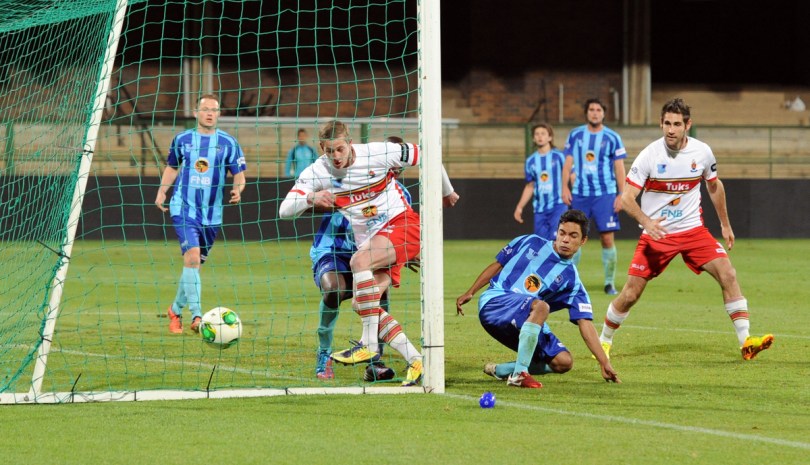
Keegan Boulle, Tuks reserve, scores the fourth goal in their game against UCT on Monday. Photo: Provided

A RESOUNDING defeat on Monday night took away any hopes the University of Cape Town (UCT) team had of moving up from the bottom of the Varsity Football log.

Goal after goal, it became obvious that the University of Pretoria (Tuks) players were not going to let the UCT team squeeze in one redeeming goal for themselves.

The team from the coast were at a slight disadvantage as Tuks played on their home ground, the Ama Tuks Stadium, with their fans cheering them on every step of the way.

UCT goalkeeper Bevan Adonis showed some promise in the fifth minute of the game with an impressive diving save. The opening goal by Tuks’s Desmond Khuzwayo was the catalyst that kept Adonis diving and sliding in the goalposts.

Man of the match Dean Wilkinson then scored a clean shot on goal, which made it obvious that Tuks were out to win.

Mbongeni Masilela put his boot in with a third goal.

Keegan Boulle, a reserve put on late in the game, added two more goals to Tuks’s tally. By the 90th minute the outwitted UCT team had watched five flashes of fire go off, signalling five goals at their goalposts.

Back home

More disappointment took place on the field closer to home at Milpark Stadium. Wits were beaten by the visiting team from the University of the Western Cape (UWC).

The 2-0 victory pushed the Wits team down to seventh spot on the log after the gains they had made last week with their 1-0 win over UCT.

Best reads

This week’s paper came out a little later than usual, hence that lead to delayed reading of all the copy.

But now that I have, here are this week’s best reads:

  • Cheers, I’ll drink to that by Liesl Frankson. This was one of the first ‘fun’ front page stories we have had all year. It was a refreshing read and I’m glad it got to go on the front page. Also love the picture that went with it.
  • Transie Missions by many (lol). This was a collaborative photo spread done by a few of us in the newsroom. I love any and all photo spreads that go in the paper because I’m down with photos like that :p
  • The power of woman by Prelene Singh. This piece spoke to the other side of the Vavi scandal. Probably an unpopular debate to have with it being women’s month but an important one I rate.
  • Supreme Failure by Emelia Mostai and Shandukani Mulaudzi. This breaking news story looks at a high school across the road from us; parents and students complained about the lack of teaching staff for grade 12 learners. The publishing of the story has led to the Department of Education promising to visit the school tomorrow to assess the situation. The efforts of great journalism.

OPPIKOPPI: Made it out alive

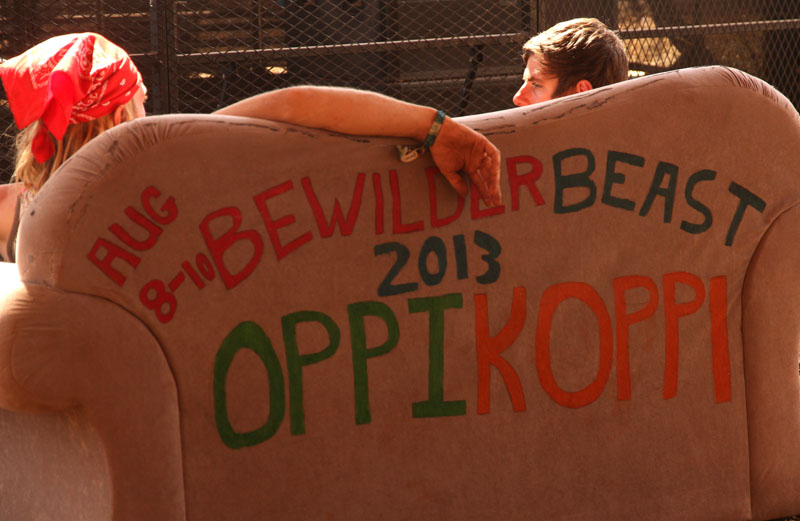
CHILL OUT: Oppi goers taking time out on a couch on the last day of the festival. Photo: Pheladi Sethua

By Pheladi Sethusa and Shandukani Mulaudzi

While one of us sits with a heaving chest and the cough of death, the other found the cure to her cold at Oppokoppi.

The last day of the festival could not have come soon enough, we were exhausted, dirty, dehydrated and hungry – but we had survived.

#InDustWeTrust

We had the time of our lives and we screamed our lungs out for our favourite acts as the dust made its way into our ill-prepared bodies.

The first thing to remember for next year is that Oppi is also known as “Dustville”. Have something to cover your nasal cavities and mouth. It will save you rocky tastes in your mouth and sandy lip gloss.

Now that we are no longer Oppi virgins, we thought it fitting to provide a few survival tips for those looking to go next year.

BAKING: Fans braving the sun to watch a show. Photo: Pheladi Sethusa

 How to make it out alive

We had bought enough food and booze to sustain our little bodies for three days in the bush. But on the last day, dry hot dogs with no margarine on the bun or sauce on the Vienna no longer seemed appealing.

The second thing to remember, the festival runs on a cashless system. Those who wish to buy food and drink on the farm have to buy pre-loaded debit cards.

We opted not to do this, knowing it would lead to frivolous spending. We had packed enough food but the smell of boerie rolls and hot chips accosted our senses by the last day, we were dying for a hot meal.

We were also so dehydrated at that point that seeing people’s water bottles had us salivating. Pack enough water, even enough is not quite enough – pack more than enough just to be safe.

In addition energy drinks would have been beneficial. We could barely keep our eyes open by the third day, this would have been cured by a kick and wings from one of those special drinks.

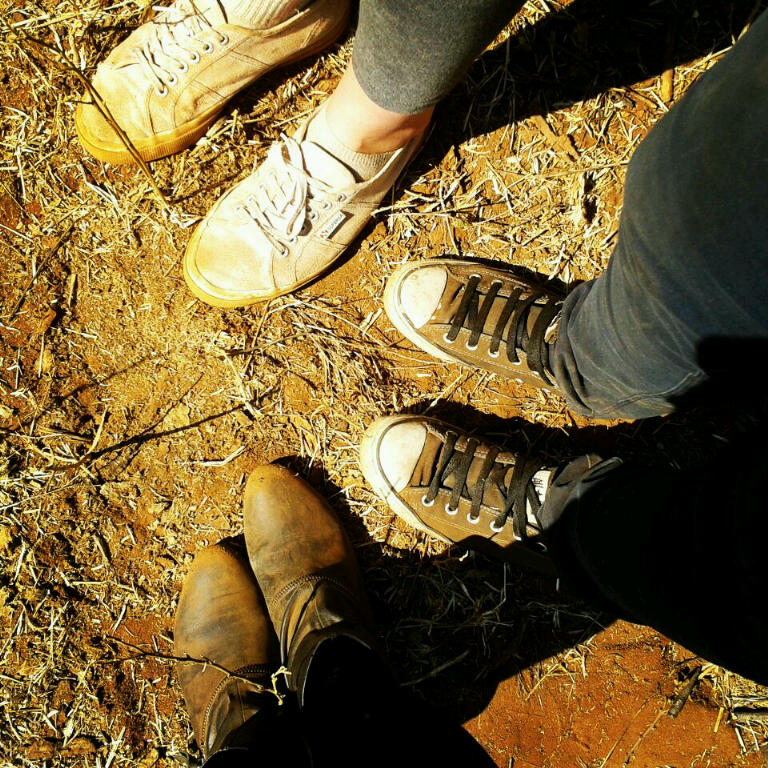
RUINED: Three pairs of shoes that will probably never be clean again. Photo: Shandukani Mulaudzi

 Clothes and shoes

We were so scared of the cold that we only packed winter clothes, big mistake. During the daytime we wanted to cry as the hot Limpopo sun scorched our fully covered bodies. It was as if the devil himself was sitting on the hill by the stages letting his heat out on everybody.

Do not bring shoes you hope to wear ever again and only bring one pair. You are going to be filthy by the end of the festival, so rather go with the general theme and take scrappy clothing.

On your way in and out

On the way to and from Oppi try to choose the route with the toll gates, it will set you back R21 but big, open, un-potholed roads await you. This way you won’t have to battle it out with trucks that are struggling to stay on the narrow, windy lanes.

Most importantly though we had a of fun, we enjoyed all that Oppi had to offer and made memories to last a lifetime.