I’m locked out

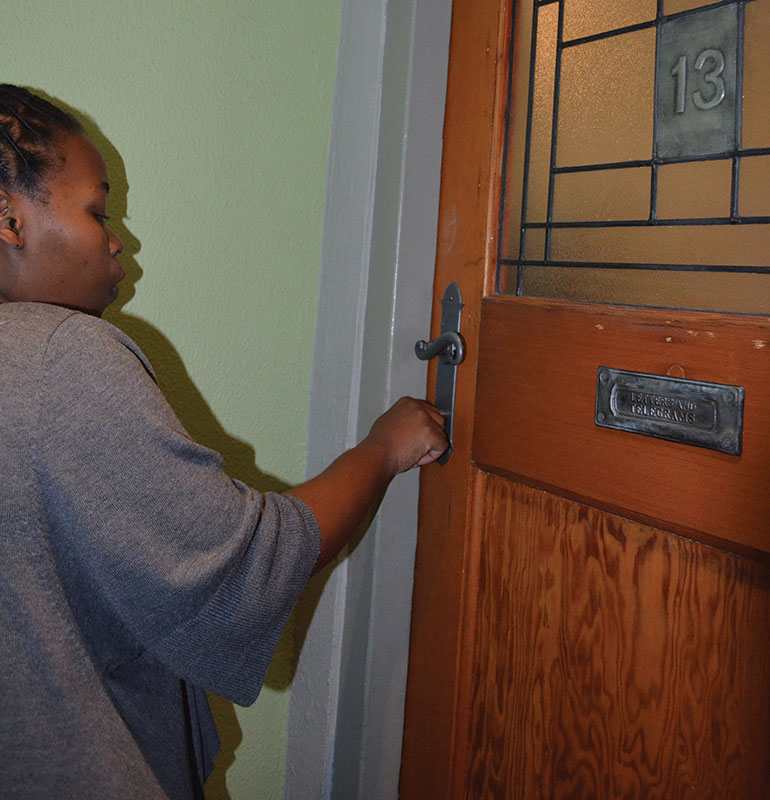
NO ENTRY: A Locked out student couldn’t even fit her key in the keyhole. Photo: Pheladi Sethusa

Thokwadi Seabela had left out mince to defrost. It was 8pm and after a long day at the UJ Law Clinic, she was looking forward to a nice hot meal.

But when she reached her South Point flat, she found herself illegally locked out – with no clothes, no food and nowhere to sleep.

The Peppermint House resident and fourth year LLB student at UJ was locked out of her flat in April – with no warning.

Although she had paid her rent, South Point administration claimed she was
R8 200 in arrears.

She is not the only one. Lebohang Motaung, 3rd year BSc Chemistry, heard his lock being changed while he was in his Norvic room.

He was lucky though. He was able to persuade admin staff to return his key – but only after an angry exchange of words.

It’s a lockout
Seabela found herself in a worse, and certainly more dangerous situation. When she reached her flat, she thought the key would work.She continued struggling with it, thinking she might have used excessive force and broken it.

She went to ask the security guard, who helped put her in touch with “the guy who deals with locks”.“The lock guy just said: ‘It’s a lockout. It means you haven’t paid your rent’. Then he just left.”

After calling around for a place she could stay for the night, she finally got a hold of her cousin, who put her up for the night in Pretoria.

Not a rare occurrence

Motaung said he had seen students forced to sleep in their building foyers, after being locked out of their flats without notice.

He was locked out because the administration claimed his roommate owed R8 000 – despite having only lived in the flat for a week, and having paid a deposit.

Motaung said it was impossible a new tenant could owe so much money. And even if he did, Motaung could not understand why he was being made to pay for his roommate’s error.

“It turned out they had made a mistake on his account and they did not even try to contact him before locking him out.”

Late payment(s)

When Seabela went to South Point central the day after being locked out, she was told she was late on her January rent payment. She had not even been living in the flat in January.

“When I signed the lease I was told my deposit includes the first month of rent payment, which was in February.”

She had received an inflated statement at the end of March, stating that she owed R8 200. She said alarm bells should have gone off, but she just thought they had included the next month’s statement as well.

“A statement doesn’t constitute a notice,” said a visibly upset Seabela.
Former Van De Stel resident, Kelebogile Mothlomedi, said at her building they used to put up a list on the notice board of students in arrears.

“Students then had a week to pay up their rent before being locked out if they failed to do so.”

Legally speaking

Alina Starosta, Head of Property and Evictions at the Wits Law Clinic, said: “A lockout constitutes an eviction.”

Lockouts like these were illegal because the landlord had not sought a court order to remove the tenants, she said. However, if tenants defaulted on payments, landlords had every right to evict them.
Starosta said students could sue or lay a complaint with the Rental Housing Tribunal in town.

“Students should not let inaccuracies in the statements lie. People often think they can get away with stuff because they’re dealing with students.”

No comment

Wits Vuvuzela approached South Point administration, but were told the responsible person was away on holiday and could not be reached for comment.

Pheladi Sethusa 

The Newsroom 5.5

This week we had no print edition of the paper, so we had to up our game online (well at least that was the plan going in).

Photo: Shandukani Mulaudzi

I was the lucky one who got to be online editor during this week. I was very excited to do so because online things tickle me. I got to run my first ever news conference which I must say I did quite well, delegating has always been a strong point of mine.

Once that was done, I typed up the diary of the week – which set out who was doing what and when they were doing it for. I wouldn’t say that my deadlines where unrealistic, but I came to learn that they actually meant nothing to a lot of people. Some things came in two hours late and others two days late. I still rate I did what I could to make sure that the most important deadlines where adhered to.

Our guest speaker for the week was Justice Malala, from 24 hour news channel eNCA. I opted to do something a little alternative this week when it came time to hand in our guest speaker report. Right after he spoke to us we learnt about content curation via Storify. So I took it upon myself to incorporate what I had learnt and went the alternative route when writing up my report/article – I am not sure how well that went down with my lecturer though.

I had so much fun with my test run on storify mission that I went ahead and put together another with a colleague later in the week. It is the ultimate stalker tool on the interwebs, I am slowly becoming a wee bit obsessed with it.

We had a public holiday right in the middle of the week, that holiday was Worker’s Day. Vuvu journalist, Dineo Bendile wrote a great article on the day – she covered the staff at Wits who work nights to keep campus safe and clean. It made me realise how hard some people have to work and how little recognition these people get.

Thursday and Friday were business as usual, which saw me running around asking people to submit their articles online. I went to a lecture/talk hosted by Eusebuis McKaiser on the importance of the intimacy required in student-staff relationships, to make them beneficial to the students. I must admit I am a fan of his and tend to agree with a lot of things he has to say, that said he made some great points.

I also had a lot of fun putting together and just watching the daily video vox’s on our site, it is always a treat to get to hear other student’s thoughts and opinions on current issues. Which is another reason I had a blast being the editor this week.

On the weekend I was part of the #vuvuweekend team, we went around various joints in Braam to check out the vibe. We managed to get some amazing shots, no “grin and grabs”. We will be using the photo’s in a photo spread next week – in our very first 12 page paper *excitement*

So all in all I had a great week, busy but quite chilled (hence the .5 numbering in my title) in comparison to what is coming our way this week.

Xoxo – Gossip Girl!

Gossip Girl” has left the lavish penthouses of New York’s Upper East Side to wreak havoc on our very own West Campus.
On April 13, a number of people noticed that they were being followed on twitter by a user with the handle @WestGG.

This is how they first got wind of Wits’ own gossip girl.She then became active the very next day, sending out tweets containing very personal information about the people she followed.

“She insinuated that I was dating one of my close friends, who was actually in another relationship at the time. It was very childish,” said Yandani Bashman, 4th year LLB.

“GG also taunted an individual about their sexual orientation which is extremely sensitive stuff, so in that regard it can get really hurtful,” said a person who did not want to be named.

Tweeters mobilised to report the account as spam so gossip girl could be suspended, to which the account replied, “you can report me as spam if you wish, but you know I’ll keep coming back.”

Twitter policy does not allow for users to carry abusive content in their tweets. Violating this rule could lead to the suspension of an account.
After being suspended once, gossip girl created a new account under the name @westcampusgg. This account didn’t last long either but was around long enough to cause a stir in the rumour mill.Tweeters again responded by marking her tweets as spam. But all the spam reports couldn’t keep her down as she started a new account for a third time on April 16.

“I felt that it was extremely juvenile but it had the potential to ruin people’s relationships and caused a deep level of distrust within circles of friends,” said one of the account’s most tweeted victims, Livhuwani Makungo, 3rd year BCom Marketing.
“She/he seemed to focus her/his (tweets) on my previous relationship claiming that I was unfaithful and slanderous as if it was a form of retribution. All allegations made against me were false,” said Makungo.

Gossip girl had a lot to say about a past relationship that Makungo had been in. In her tweets she tagged his previous girlfriend and the girls she claims he cheated with.“For the most part I laughed and brushed it off but I did worry about how it affected those who were implicated,” Makungo said.

“Her tweets were out of hand and unnecessary. Whoever is behind the account must just come forward and explain themselves,” said Bashman. He added that there was speculation about who might be behind the account but he believes that there are a number of people responsible for the tweeting.
Another person, who did not want to be named, said they believed the person behind the account must be someone they all know on a very personal level, especially because of the level of information the West Campus gossip girl had access to.


Another hit-and-run in campus parking lot

On Friday night, after a long day on campus Sechaba*, 3rd year Construction Management, walked to his car only to find it dented and surrounded by shattered glass.

A picture of Sechaba's car after the incident. Photo: Provided
A picture of Sechaba’s car after the incident. Photo: Provided

Sechaba’s car was parked next to the bus stop on Yale road, between 9pm and 12am. He had come to campus to pick up friends.On seeing the damage, Sechaba immediately contacted Campus Control to report the matter.

The officers on duty made him fill out an incident form and advised him to come back on Monday to view video footage, if any was available. The officers told Sechaba that the culprit would be easier to apprehend if he was captured by video footage.


By Monday, following discussions with his mother, Sechaba decided not to take the matter further. “I decided just to go ahead and fix it myself, luckily I have a few mechanics in my network and the cost of repair is minimal,” said Sechaba.

Sechaba felt that Campus Control did all they could to help him. However, his concerns lay elsewhere, “as students of Wits, we pay so much money to attend here but our needs are treated as second class,” lamented Sechaba.

Wits Vuvuzela spoke to a number of Witsies about whether they felt their cars were safe on campus. Candice Griev, 3rd year BA Law, said nothing major had ever happened to her car except for a minor scrape.

Griev said she had seen vandalised cars at the parking lot for third and fourth years next to the Origins Centre. She saw one incident where someone had written on a parked vehicle with glue “How dare you park here?”

“The thing is there are security guards around here. I don’t understand why this was never addressed and why the person was never caught,” said Griev.
Mitchell Leering, MA Chemical Engineering, said he did not feel that cars were safe on campus late at night. “My car has been hit five times in the last three years,” he said.

Leering said his car had only ever incurred light damage. He said he had friends who had been victims of hit-and-runs with enough damage to be sent in for panel beating over a long period of time.
Leering told Wits Vuvuzela that they had not reported the matter to Campus Control.
“It’s not really worth it, because in our building we get alarms going off for hours without Campus Control coming. What’s the chance that Campus Control will come around to talk about your car?”
Robert Kemp, head of security for Campus Control, said that some parking lots have CCTV camera’s monitoring them. Along with this he said that there are regular patrols in the parking lots during the day.

He stressed the importance of students reporting their issues, so that they could get the help they needed.

Kemp encouraged those who had accidentally damaged cars to always leave a note with their name, number and student number on it. The repercussions for not doing so could be bad if the culprit later caught.

*Name changed to protect identity.

Witsies put their bare feet forward

BAREFOOT BEAUTIES: From left to right, Nelisa Ngcobo, 2nd year BA, Mungi Llale, $th year Dramatic Arts and Ziyanda Ngcobo, 3rd year BA
BAREFOOT BEAUTIES: From left to right, Nelisa Ngcobo, 2nd year BA, Mungi Llale, 4th year Dramatic Arts and Ziyanda Ngcobo, 3rd year BA. Photo: Pheladi Sethusa

Witsies braved stale urine, glass and camel droppings on April 16 when they came to campus barefoot in support of the One Day Without Shoes initiative.

The Wits Volunteer Programme (WVP) hosted an event to raise awareness for the drive, which aims to collect shoes for underprivileged children. Witsies attended the event barefoot to show their support and donated shoes.
A “path without shoes” was created on library lawns, from sand, dried grass, rocks and bits of Lego. The barefoot students were encouraged to walk across it to make them aware of how tough it could be to walk across these kinds of surfaces.

SHOES FOR WHO?: Students take on the "Path Without Shoes" to understand what it is like to live without shoes. Photo: Pheladi Sethusa
SHOES FOR WHO?: Students take on the “Path Without Shoes” to understand what it is like to live without shoes. Photo: Pheladi Sethusa

But perhaps a normal walk across campus provided the greatest challenge. Besides camels offering rides, and depositing droppings, on Library Lawns, Wits Vuvuzela caught the scent of urine in corners and saw broken glass on pathways.
“We take shoes for granted…in some developing countries some kids are not allowed to go to school if they don’t have shoes,” said Joanne Tomlinson, 2nd year BA and co-founder of the initiative at Wits.

Some kids were denied the opportunity to get an education, simply because they did not have shoes.Children also get cuts on their feet, which turn septic over time, she said. They caught diseases which were completely preventable.

One Day Without Shoes is an initiative that was originally started by the American shoe company TOMS. “For every pair of shoes they [TOMS] sell they give one away… They have actually handed out some in Diepsloot. They take each individual pair and fit it onto a kid’s feet. They don’t just drop the shoes off,” said Tomlinson.
Asked by Wits Vuvuzela how she had survived her day without shoes, Vivien Teijlingem, 1st year Fine Arts, said: “It’s nice for us to get to experience how tough it is walking without shoes, so we can care and understand what people go through.” BSC student Khosa Solly,added: “We can feel the pain that they [children who go to school without shoes] feel today, which will raise awareness.”

Tomlinson said she was grateful for the support the initiative had received from the WVP. Karuna Singh of the WVP attended the event barefoot.

Those who missed out on Tuesday can still donate shoes at the WVP offices in Senate House, Tomlinson said the shoes collected on campus would be given to the Bryanston Bible Church, who run a number of community outreach initiatives.


A VoW to clothe the needy

The chill in the air over the past weeks signals the onset of winter – and also the start of the annual Voice of Wits Winter Collection drive.

VoW aims to collect clothing and anything else that will keep people warm in winter. These items will be donated to those in need, according to marketing manager Lucky Mdaweni.

The organisers would be grateful for anything, from scarves and hats to blankets, he said. But they were particularly looking for clothing in good condition. “We don’t want any torn and tattered clothes.”

He asked that people wash their clothing before dropping them in one of the branded boxes placed around campus. Boxes can be found in various strategic spots, including residences.

DROP HERE: Vow FM has placed these collection boxes for winter clothing all over campus. Photo: Pheladi Sethusa

“We will distribute the items we collect to people in the Braamfontein area, as it is the community that supports the radio station,” said Mdaweni.

Wits Students in need would also benefit from the drive. VoW had a partnership with the Wits Volunteer Programme, which would distribute clothing to students on an anonymous basis, said Mdaweni.

The drive will run through the months of April and May and Vow will host on-campus promotions

Harvard graduates ASSIST kids in Alex

ASSISTANTS: Pergan Naicker (left) and Victor Sithole (right) from the Wits Volunteer Programme tutoring in Alexandra. Photo: Provided by Assist
ASSISTANTS: Pergan Naicker (left) and Victor Sithole (right) from the Wits Volunteer Programme tutoring in Alexandra.
Photo: Provided by Assist

Underprivileged children in Alexandra are scoring with some assistance from a non-governmental organisation, the African Sports and Scholastic Initiative for Students in Townships (Assist).

Harvard graduates started Assist last September to aid underprivileged children in Alexandra.

The name of the initiative is a clever play on a basketball term, which means helping someone score a goal. In this case, the assistance comes in the form of a mentorship system to tutor children in their school subjects. 

Harvard graduates from the class of 2012 Dennis Zheng, Patrick Li and Ian Choe started the initiative in September 2012. This came after Zheng and Li had visited South Africa in 2011 to volunteer as basketball coaches at the Special Olympics South Africa.

On this 2011 visit they had the opportunity to work at different schools in Alexandra township with intellectually disabled children. Zheng said: “We then became connected with Harry Nakeng, a local community leader of the Alexandra Basketball Association (ABA), and began coaching basketball with township youth every afternoon.

“What Patrick and I discovered was a testament to the power of athletics; each day after school, 50 players of varying ages took to dusty courts in bare feet or their school shoes to learn the sport,” said Zheng.

The children made such an impact on Li and Zheng that they could not stop thinking about them. They decided to return to Johannesburg with their classmate Choe to found Assist. Zheng said: “The programme aims to leverage Alexandra township youth’s excitement about the emerging sport of basketball in order to catalyze students’ success in the classroom and ultimately improve their lives.”

The founders believe it is important to have a balance between sports and academics. Assist incorporates basketball to encourage physical, emotional and mental health, Zheng added. Sports also promotes a sense of camaraderie and helps to develop traits like discipline, he said.

The initiative has teamed up with the Wits Volunteer Programme (WVP) to outsource tutors. “Forty five Wits students are tutors for the ASSIST project now,” said Karuna Singh who heads the WVP.

These students tutor on Monday to Thursday afternoons and on Saturdays. Assist provides the tutors with transport to Alexandra. They help with subjects like Maths and English, Singh explained.

Zheng agreed: “Their consistent mentorship leads to not only better marks from term to term but also empowers each child to develop and reach his or her life goals.”

The initiative continues to seek funding, Zheng: “We initially funded the first year of the programme through the generosity of supportive friends and family, but we are currently exploring local options for financial support while preparing for another world-wide fundraising campaign.”

Up until now, by April 2013, close to 60 learners have benefited from the initiative. If you wish to assist, and help children, then  find out more about the initiative and go to:

theassist.org. You can also visit the WVP at Senate House, Ground Floor.