Literary Post-Mortem: A Bantu In My Bathroom

Disclaimer: I wouldn’t really call this a book review – just don’t dig the term. Also don’t feel like I’m qualified to write such yet. I’m just telling you that I read this book, how it made me feel and why or why not one should give it a read. That’s all. Let’s rather call it a ‘Literary Post-Mortem’ (I like that)

IMG00724-20130613-1623.jpg

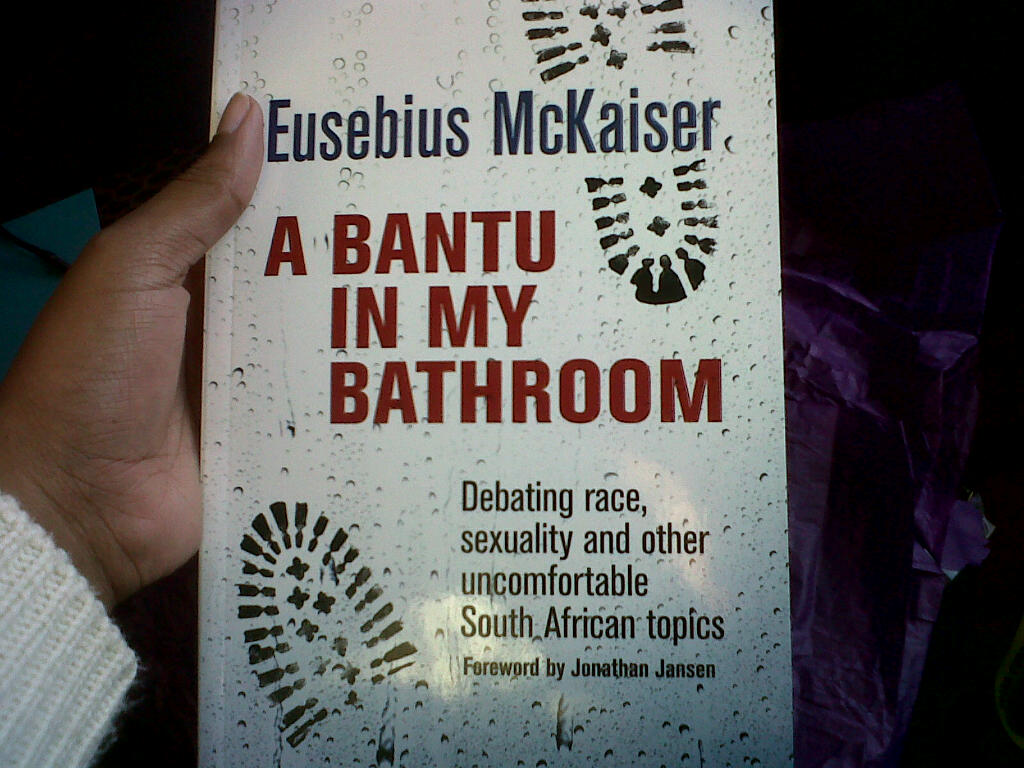
Onwards with A Bantu in My Bathroom by Eusebius McKaiser then. Been wanting to read this book for some time, but being the broke student I am it just never happened. Umtil I got this as a gift, yays.

Before I tell you how awesome a read it was, I must mention that I am a fan of the man. At some point in my second year at Wits I considered taking up Philosophy in the hopes of being lectured by him at some point. However, reason and a passion for what I was already doing steeled me. Anyway back to why I’m a fan – I love his insights and the way he chooses to deal with difficult topics that many are reluctant to. Along with this I find him quite relatable – not all the time but I mostly get him/what he’s saying.

The book is basically a collection of essays based on a variety of topics. Namely race, culture and sexuality. Under each section there are about four to five essays, which aim at tackling various aspects of the ‘big issue’ at hand. Unsurprisingly, my favourite essays were  in the race section. I think that it is still important to look at and understand why race is still an important contributing factor to the lived South African experience. He mentioned that we can’t pretend we don’t see race just to avoid being labelled ‘racist’.

McKaiser highlights some of the most important race related challenges South Africans face. He explains why Affirmative Action is necessary, discusses white privilege, tackles the issue of whether or not black people can be racist and much more. Even though one might disagree in places, I did find myself agreeing with him 80% of the time – not just in this section but throughout the rest of the book.

In the sexuality section he spoke about ‘coming out’, love and even rape. This part of the book was the most personal for me and as such riveting to read. When it came to culture he looked at ploygamy, divisions present in our society and the advantages and disadvantages of being a so-called coconut. The range of issues raised in his essays is quite big. I was not left wanting when I was done reading – I legit felt like he discussed everything one could in 209 pages.

We should instead accept that we are deeply divided – spatially, linguistically, culturally, ideologically – and reflect on how we might live in each other’s space while disagreeing deeply with each other. The alternative, fake national unity, is simply childish. (excerpt from the book)

What I enjoyed the most were the little anecdotes that coloured his essays. For me it helped to bring home his points and also offered an unique peep into his personal life. I have often seen McKaiser on tv, attended seminar’s that he spoke at and listened to his show on radio. This book felt like the literary incarnation of those experiences. Not the content but with regards to style. It was easy read and understand because he was just being himself (or so I assume). He did stress how important authenticity is to him so I imagine he wrote in a way that would reflect that.

I also liked and admired the fact that he didn’t ‘other’ people. He didn’t speak about racists, homophobes and misogynists in a distanced manner. He made it clear that we are these people, that we are our biggest problem in many cases. Also highlighting that change can only begin with us.

If I had the money I would go out of my way to buy a few people a copy. The idea’s put forward are of great import and I feel that the more people they reach the better.

PS**

’76

This slideshow requires JavaScript.

On this most auspicious day, I suppose I have to put fingertips to keyboard and thoughts on screen. Here goes:

A thousand voices,
The marching feet approaching.
Growing louder and louder.
Determination etched in the words on their placards.
Courage in their feet, bravery in their voices.

Grown men hugging rifles.
Scared witless of –
Defiance? Black faces?
Children.

Grown men scared of children.

Children they knew they had wronged.

Children they were about to kill.

Children who did what their fathers/mothers could not.

Children we can only hope to become when we grow up.

PS**

Not Yet Uhuru

There’s a popular saying that I have seen Thandiswa Mazwai tweet quite often, which says “Until we are all free, none of us are free.”

Today, April 27 is Freedom Day in South Africa.

I woke up to the sounds of the President’s voice, as he addressed people at a Freedom day event in Pretoria earlier. I heard him speak about the evil we managed to triumph over, I found myself nodding when he mentioned that this freedom we have, came at a price.

He spoke about the great strides that have been made since 1994 in housing and with the general provision of basic amenities. The ruling party has actually done a lot to try to improve the lives of the majority. Obviously a lot more could be done and hopefully will be done if we can “deal” with corruption and inequality and racism and and and.

Anyway, I suppose what made me open my laptop was the fact that we hear these things all the time. Which is why at some point I stopped listening and opted to read yesterday’s paper instead. Yes things are changing, a lot has changed. We do have a lot to be grateful and thankful for but we still have a long way to go. A very long way.

For the past two days in my Journalism class, we have had a guest speaker, Kevin Davies from the Mail & Guardian come school us on Financial Journalism. We had very interesting debates with about the state of our economy. Yesterday in particular we spoke about some of the challenges we are facing and tried to brainstorm solutions.

My answer to his question on a solution, was a Pan-African one, which seemed impossible for our speaker to comprehend. I was glad that my classmates however, agreed with me (for the most part). What struck me about the conversation that was going on, was that we too had all these ideas but no solid ways of implementing them. Much like some our leaders today.

To test our optimism about the country’s future, Mr Davies drew a ‘level-of-optimism-scale’ to see where we lay on it. Most of us were on a very high 7, saying that we do have high hopes for the future based on the amount of potential in the country. Then he went on to say that this scale is based on a ten year period, at which point our optimism waned.

Making one thing very clear (to me at least), we are nowhere near where we need or even want to be. Especially when it comes to economic equality. Something that was also mentioned in the President’s address earlier today.

I can’t help but think of Agent Smith’s words in the Matrix Reloaded every time this day rolls around. He said: “We’re not here because we are free. We’re here because we are not free.”

The Newsroom 5.0

This week has been an exceptional one.

I had semi decent pitches on the news diary (nothing to write home about but whatevs) making for a busy week. I was also the photo editor for the week. Meaning I would get to make the decisions on all the pictures in the paper for the week, yays.

On Tuesday I covered One Day Without Shoes on campus. Luckily it wasn’t particularly chilly on the day, so it was easy to leave my shoes behind as I got dressed for the day. I quite enjoyed walking around barefoot. Getting to feel all the different textures I never seem to consider when I have shoes on.

People were very concerned about ‘hygiene’ and asked how on earth I could stand being so dirty. To which I said one wash will take it all away. I really couldn’t be bothered with how dirty my feet got. It was awesome to see so many other Witsies supporting the initiative by donating shoes or just being barefoot on campus.

Production this Wednesday was particularly hectic for me, so much so that I missed an exhibition I really wanted to attend. On the plus side I managed to start working out at the gym again, was starting to feel like a right porker. Thursday morning followed the same vain, some tempers flared during production but I was too busy trying to design a front page to be on that boat.

On Thursday afternoon our photography lecturer, TJ Lemon organised us a very cool guest speaker, James Oatway from The Star. A super talented photo journalist. He showed us some of his shoots as a way of teaching – which was different and very helpful. His photographs are really worth a thousand words as the adage goes. I was left saddened by his photographs taken of what is left of a Khoi/San community and more recently some taken in the Central African Republic. It made me realise once more how powerful photo’s can be. For example his CAR photo’s told me stories I would have never even read in the paper, because sometimes seeing is believing.

Our guest speaker also highlighted the dangers of the profession. Just last week he had an encounter where a gun was waved right in front of his face by a Seleka rebel. He told us anecdotes of people who had lost limbs and lives trying to get the perfect shot. I came into the year with photo journalism as THE thing I really wanted to do. I’m not so sure now. I would like to have babies at some point. Or just be alive you know.

On Friday I spent at great deal of my day covering “R U Silent” on campus. I could not have expected how that event would move me. I am very glad I got the opportunity to be a part of it all. I got a sneak peak into the brave hearts of men and women who wanted with all their might to fight sexual violence in our country. My “debrief” came in the form of a concert later that night. All in all a very fulfilling week was had. More to come next week.

Silent Protest at Wits

Photo: Pheladi Sethusa

I offered to be the photographer for this event as soon as I saw the posters on campus a few weeks ago. I knew I wanted to be involved with this event, as I had seen a friend’s pictures from last year’s Silent Protest at Rhodes University.

By the time I arrived on the Library Lawns for the handing out of t-shirts on Friday, April 16, it was already drizzling. This didn’t make people run off, they all just whipped out their umbrella’s and continued to queue for their shirts. There were three different shirts being handed out: shirts specifically for rape survivors (those brave enough to wear them); for supporters of the protest (who had to go a step further and have tape over their mouths) and lastly shirts for supporters who for health reasons could not join in being gagged the whole day.  

Photo: Pheladi Sethusa

From what I understand the reason for taping supporters was that they had to endure the burden of being silenced, in their case for a day. Symbolic of the silent struggle that many rape survivors go through. Those who were taped could not take that tape off until later that afternoon, when they would be able to “break their silence.”

At 12.45 all the R U Silent Wits supporters met at Amic Deck for a silent march through the university. 


The march was powerful in its silence. People are too used to loud protests/marches, which makes them somewhat indifferent to them. In this case the silence of the protesters caused more of a stir for onlookers. There were audible murmurs of people asking one another what was going on, wanting to know how they could join etc. The flip side of that were nasty jeers from people who wanted to belittle the protesters. I heard a group of young men laughing as one amongst them shouted “you have sexy ambitions with this thing you are trying to do,” to which I saw a few faces scrunch up in abhorrence.

The final destination was Senate House Concourse, where a few speakers were expected. Rosie Motene spoke on behalf of POWA, a rape survivor from the crowd Tumi shared her experience and Kelly Gillespie, Wits academic, also addressed the crowd. They all managed to resonate with and inspire the gathered protesters. In between the speakers shocking rape stats were read out to the crowd. Things like 100 year old woman rape, 4 year old raped and mutilated… It made the rape statistics we hear about so much more real.

After this was what they called the “die in,” when all in attendance lay on the floor in remembrance of those who had died from rape related violence. It was at this point I began to see reddened eyes and tears streaming down people’s faces. I saw friends tightly holding one another’s hands and boyfriends mustering up courage to lend strong enough shoulders, or just wiping away tears. It was at this point that I stopped taking pictures, lay next to my friend, to hold her hand.

Photo: Pheladi Sethusa


The silence of the “die in” was broken by wails from two actresses who began their skit in the middle of the crowd. A moving piece which illustrated the torment rape victims go through and their struggle to speak out.  After the performance those whose mouths had been taped all day could finally “break their silence” by taking the masking tape off of their mouths. This came at the right time as, the debrief thereafter would be the space in which people could reflect on the day and share their experience

Photo: Pheladi Sethusa

.

No media was allowed in the debrief, so I simply went in my personal capacity. It was a very emotional experience. Brave young women and men took heed to the messages to break the silence and shared their stories. I heard stories I will never forget for as long as I live. I heard things that made the stats resonate, that made them real. The sheer numbers in that lecture venue of survivors made me shudder. One must keep in mind there were probably more who were too afraid to speak out to that large body of people.

I was thoroughly depressed when I left that venue. Drained. But I realised that I needed that experience. I needed to know the reality of the situation. I can only hope that the day helped others in the way that it helped me and that the movement continues to gain momentum.

PS**