Born free, but still in chains

Last week I gave an impassioned speech to a group of young, soon to be journalists at my alma mater. I told them that this might possibly be the best time to be a young journalist, the opportunities are endless, and other such brochure stuff.

They believed me. Hell, I believed me. And a part of me still does – there is so much we can do, yes we’ll run into and slog under organisations that are counter-revolutionary but it can be done. We can be authentic to ourselves and each other while running on this side of the tracks.

But a part of me faltered and scoffed at the hypocrisy of that talk we had when I read a report with statistics on everything “born free” and my oh my do the numbers look bleak.

The report, Born Free But Still in Chains: South Africa’s First Post-Apartheid Generation, was released by the South African Institute of Race Relations last week. Luckily their definition of a young person is different from Stats SA (which includes everyone between the ages of 15 and 34), in this report Born Free’s are defined as people under the age of 25.

There were many graphs and numbers broken down and presented in the 39 page report, some of the more jarring (personally), are in this quick infographic I made:
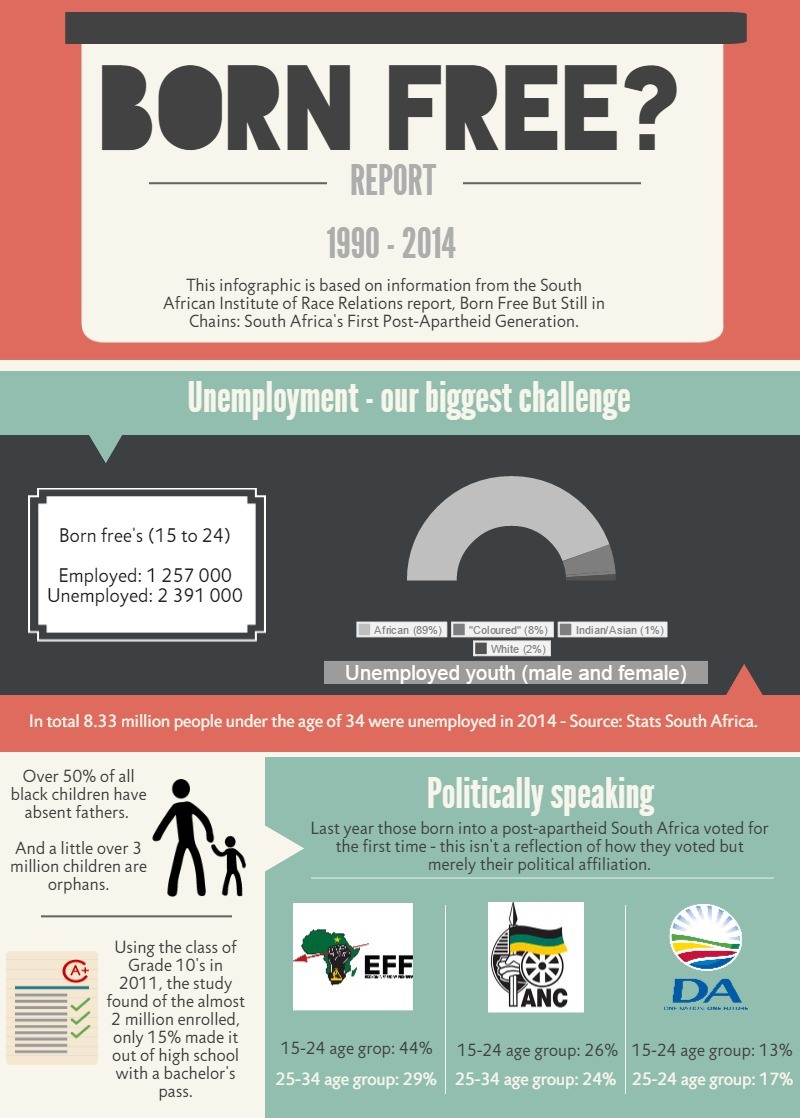
Born free graphic

The statistics aren’t new but I thought about the numbers a lot more personally this time – they are alarming, they are dire, they speak to a crisis even. They speak to the brazen young men we see and speak to at protests, the young girls who want my details so they can get a job (even if it is just carrying my camera bag). They speak to the anger on timelines and the rage that breaks into our homes and smashes windows.

The numbers mattered more now because I see the faces behind those numbers every day and that realisation makes it all so real.

In the report unemployment and education are highlighted as the two biggest concerns we have – unsurprisingly the former is often caused by the latter but not always. The bulk of those unemployed did not complete their secondary (high school) education, and on the other hand almost 400 000 varsity graduates sit without work – so who’s to say having a degree helps these days.

I have no answers at all, but I do know that the columns and warnings about us being a ‘ticking timebomb’ are true. We’re the generation that won’t let the empty promises be the hope we cling on to, we want answers and action and it makes me so happy to know that we are inching ever closer to making ourselves heard. It’s already happening, it’s already here. Like Fanon said we just have to collectively fulfil our mission, I think we have already discovered it.

These statistics cannot continue to rise. That there are people in positions of power who are blase about them (if I’m being polite) is sickening. They should know that their protection now is temporary, if we have to destroy to build they might be collateral – something to think about while they can.

There was a wealth of information in that study that also spoke to how many children are orphans, how many (overwhelmingly black) are child headed households, how HIV/Aids has affected them,  how many have never received any early childhood development, how their living conditions haven’t changed in 21 years (sleeping on the floor, washing and relieving themselves in buckets).

Read it. Gain some perspective before you run around telling people they are “lazy” – there are millions of children who have to fight every single day just to stay alive, be cognisant of that.
We definitely need new names

I have now written a few stories and filmed footage around the current spate of Xenophobic violence in South Africa. I have had debates about whether its xenophobia or afrophobia, about the good King and the reluctance from our government to shame him and about self-hate/unemployment/ignorance being catalysts for the violence.

I have thought about and consumed information on this topic for the past three weeks but I still feel like there’s nothing I can say. The shame coupled with the guilt and anger and sheer despondency have rendered me speechless.

I have nothing intelligent to add to the “stop xenophobia” calls and campaigns – particularly because I feel that a lot of the talking is happening at a level that doesn’t speak directly to the guys wielding pangas and knives on the streets. The guys who are drunk at 7a.m. with the whole day ahead of them to burn and loot and terrorise. The guys who we rarely think about outside of their sins.

A lot of the rhetoric from the top said: no matter what your frustrations are, you have no right to mete that out with violence against others. Another reminded us of the moral debt we owe to those who sheltered us in our time of need. But within those same ranks we had people in positions of power saying the amount of “foreign nationals” in South Africa was reaching a problematic level.

On the ground the guys I talked to said they don’t want “foreigners” in this country because they steal their jobs, sell drugs and steal “their” women. I didn’t know I was a thing that could be stolen. The same guys who told me that are also the same guys who felt it appropriate to try to kiss me, despite my continuous and unwavering “No’s”.

All of that aside, they were the first people I thought of when I heard this quote last night: “You lose your soul when you feel like the world has forgotten about you.”

I just don’t understand how another person from this continent can be called a foreigner. To me anyone who calls them that has no proper scope of history – they obviously know nothing about the false colonial borders, efforts by those same colonisers to have us identify and discriminate on “tribal lines” and obviously even less about the Bantu migration, we’re from Congo yo (but that is a story for another day).

I don’t understand how we let everyone and their mother walk all over us for hundreds of years then have the audacity to touch another African just because we know we can hit them and nothing will happen. It’s like men who beat their wives when they get home after biting their tongues for several hours saying “yes baas”. He bottles is anger and frustration, knowing that saying or doing something to “baas” will have real consequences, consequences a coward like him couldn’t possibly deal with. So he waits, stores that anger, until he can reach a target he can attack with the conviction that no one will be there to back his victim.

For me the reasons of anger and frustration at broken promises decades after democracy are secondary – this is about our level(s) of self hate. It runs deeps and cuts wide.

I say we need new names because we can no longer claim to be true sons and daughters of the soil, when we treat our own like this – I don’t know which words they might be but any that speak to a deep betrayal and self-hate will suffice.

PS

**Photo: Tracy Lee Stark/The Citizen

Literary Postmortem: Americanah

I will start by saying “long live Chimamanda Ngozi Adichie, long live”. What a woman, what a storyteller.

There is nothing I didn’t love about this novel. Well at first I looked at the tiny bible-like print with a bit of a side eye but it grew on my eyes.

In the past two to three years, I have made a conscious effort to read more African authors because frankly even though I was an English Literature student, I was starved for stories told by my people, about my people for my people. This novel lived up to this preference through and through.

From the very first paragraph to the last one on page four hundred and something – she had me. Not to compare, but Americanah filled the historic/political/social gap I found in NoViolet Bulawayo’s We Need New Names.

In Americanah there is an effort made to make the reader truly see and understand Nigeria, its people and its politics. In no way forced or didactic, but rather she chose to edify us by way of conversation. The whole book felt like a collection of stories told by that very interesting person at the party who has everyone in the room enthralled. It almost felt like a very long, well-written, witty blog post – which I loved.

In a nutshell the story follows Ifemelu – a woman you will come to love and hate – from her childhood and teenage years in Nigeria, to her years spent in “exile” in America-land. I say exile like that because she really only went there because life in her home country was not conducive to her growth at the time, which is what going to exile is partly about. People leave because they have to not because they want to – it’s about fleeing from restriction really (well to my mind).

The bulk of the book speaks to two of my favourite topics, love and race. It’s a great love story, one that had me falling in love with Obinze (the love of her life) chapter by chapter. He is perfect because of his imperfections and somewhat simple nature. He loves her in an all encompassing way but never smothering. Their story is weaved into every corner of the book, much like her longing for him when they are apart. Without quite knowing it until the very end, he is everything.

I found it fascinating that race only became an issue for Ifemulu when she stepped off this continent full of people who look like her without question. I like that she tackles race head-on in her personal life and goes as far as to start a blog dedicated to confronting the race problem in America. She puts excerpts of the blog in the book, which was another highlight while reading.

Her characters are complicated, irritating even frustrating and that made for a more authentic read. I liked that i didn’t like everyone all the time because that is our reality. People are disappointing, fearful, childish, racist, arrogant and and and.

If my opinion counts for anything I would say in fifty years this will be one of those books we call classic, hell I’ll call it that now. Read it. Re-read it. Make people you love read it.

Literary Postmortem: The Reactive

My excitement and expectations going into this book were quite high and I must say I was not disappointed at all. This debut novel by Masande Ntshanga, is one of the best things I have read in a long time. He is a young, black writer from the Eastern Cape aka everything I want to be one day (save for being from the Eastern Cape).

Anyway so late last year I attended an event where he read an extract from the book and I knew then that I had to read the book. He writes in a way that demands you to carry on reading. If you plan on reading the book and want to be surprised don’t read this – there will be spoilers.

Right.

So I mentioned the high expectations – shattered not long after I had settled into this read. I expected to read about his younger brother, Luthando dying at an initiation school and the guilt his older brother, Lindanathi felt over his compliancy in that. That’s actually why I was so interested in the story to begin with. It’s a horrible thing that happens to young boys out in rural areas in our winter. Luthando’s death is always lingering throughout the book but I still felt I needed to know more about his death.

Initially I thought the immense guilt the protagonist (Lindanathi) feels throughout the book irrational because you know things happen, right? But then the more I read about his drug induced hazy days in Cape Town with his two friends Ruan and Cecelia, the less empathy I felt.

They did drugs. Often. A lot of drugs. Often. It scared me. Scared me because it just happens so easily, they are at the point where it’s routine, they need the drugs to peel themselves off Cecelia’s apartment floor. It also scared me because Ntshanga writes about the drug use/dependency with far too much accuracy to not be drawing from personal experience (or so I think). There’s also quite a bit of kinky bordering on messed up sex, group sex with masculine porn endings *purses lips*.

But anyway in a nutshell, these three are drugged up all the time and sell pharmaceutical drugs (ARVs) on the side – they lead a life that looked like absolute chaos to me. But there are reasons for why they are the way they are, some which we don’t really get to learn about. Personally, Lindanathi making himself reactive was the most chilling for me. There’s a lot of ambiguity in the book, shielded by absolutely beautiful imagery and sentences. I can’t recall how many times I had to stop reading to re-read and mull over the perfect sentences.

To me, Lindanathi redeems himself towards the end of the book when he decides to stop running from his problems and avoiding his family. He goes back to do the thing he promised his brother he would do with him. He decides for a change to look his life in the face and show up. Then we meet Esona, ah I would have loved to have one more chapter for their story – she sounds like the thing he has needed for a long time.

The way the book ends is comforting, still sad (yes, I cried) but it feels like things happen as they should. It really was a brilliant read, it felt extremely honest, therefore heartbreaking but also so necessary.

I am just a girl with a blog who read a book but I would definitely recommend The Reactive.

Literary Postmortem: The Flowers of War

No one ever thinks of war with an air of pleasantry, but I must admit I never stretch my imaginings of the true horrors far enough – a realization that came to me quite early on reading this book.

Everything I assumed would happen never did and every single climatic moment in the novel came as a shock, often accompanied by tears. It was a heart wrenching read. I suspect that it is why it took me so long to read (about five months I think).

It isn’t a long read at all and it’s beautifully written, with a flow that hooked one instantly, but I could only deal with it in small chunks at a time. A way to apportion the pain I think. It was astounding to me how inhumane people became with the power of gunfire in their hands and a band of cowards behind them, cheering their brutish behavior on.

The novel written by Geling Yan is set in China in 1937, during their occupation by the commanding island that is Japan. The novel is set a few months after the Second Sino-Japanese War started – a war that lasted almost ten years. Although the novel is a brief glimpse into a short time during the war, I loved how Yan mixed fiction and history – simultaneously educating and entertaining me.

Yan focuses on a singular location in the novel, an American church in Nanking which is housing a number of orphaned teenage school girls who had not managed to escape the country in time. Throughout the entire book I was under the false illusion that because of where they were the girls would be safe. But chapter by chapter, as the Japanese soldiers’ stomped their way through the pages, that hope waned. I soon realised that these girls couldn’t possibly evade the Nanking Massacre that was happening around them.

Things got all the more dangerous for the girls when a group of prostitutes and wounded Chinese soldiers turn to the church for refuge. What follows are scenes I have had bad dreams about for the past few nights. I recall one particularly grisly chapter set at an execution ground. Shucks, I was never ready for that chapter.

Every death was a blow, as it should be. It’s so easy these days to shrug off death at the hands of violence because “we know it happens” or it’s just all around all the time. But it shouldn’t be like that. It’s not normal to live in a perpetual state of continued violence. I think what this novel taught me was that yes war time is horrible, but it made me realise that maybe wars don’t really end. Yes soldiers leave and there are treaties signed and what not but people don’t necessarily stop living in horrible conditions without the threat of rape and murder. But I digress.

On the positive side this was the second book I have read about women in war and again I was shown what resilient beings we can be. The women in this book were very inspiring, they were “naturally” the most vulnerable people throughout the novel but somehow they survived it and not by chance either.

Anyway this is one I would definitely recommend, for both your intellectual and social edification.

Imbawula: Modern storytelling

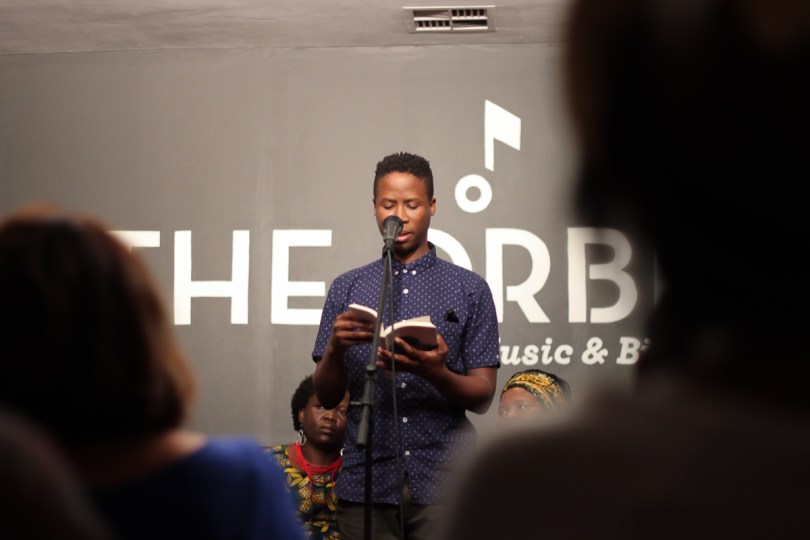
We laughed, we cried, we were enlightened and we were simply enthralled when four vastly different people told us stories in a basement  at Bean Republic, over wine last week Thursday.

It was the first Imbawula event jointly hosted by Random Window and Quarphix Foundation, under the stewardship of Siphiwe Mpye. He got the ball rolling by telling us a tale of how the idea for what will now become a monthly event came about. He remembered always being curious about the time shift that happened as the sun set and he had to run home to when the dark settled leading to older boys taking over street corners to talk sex and politics next to informal fireplaces.

I imagined that people would read something short that they had written – but it was really just four people telling us stories about themselves, which was really something. First we had Lee Molefi, who told a very moving story about being a kid on the cusps of teenage drama, who had to navigate  not black enough, too smart and and an untimely death. He has the kind of voice you can listen to for hours and so it was nice to hear him speaking in such a personal way as opposed to the very serious MC’ing I’ve only ever heard. His story had us gasping, laughing  in one moment  and then suddenly crying.

The second storyteller was, the sultry voiced, Vutomi Mushwana. She spoke about love and used the example of what was one of her most important relationships to illustrate how love can smother, hurt, heal and ultimately make you grow. As a lover of love, her story was my favourite. Not because of the topic but because of the reality of what  a toxic relationship can do to you without you realizing. She definitely hit us with some wisdom. I have read some stuff on her blog and I have become a fast fan.

The third speaker was one of my favourite commentators slash bloggers, Milisuthando Bongela (better known as Miss Milli B). First of all her outfit was fierce and fittingly so because her tale was about where her journey with fashion began. But the bigger story she told was how she met her intuition while on the job, when it seemed that the world was coming crashing down around her. We so often second guess our intuition and if she had that day things would not have worked out as intended.

The night ended of an a light note when Anele Mdoda’s storytelling time turned into a bit of a comedy set. She regaled us with a tale from her early childhood, one I had read before in her book, It Feels Wrong to Laugh, But (part of The Youngsters series) but because of how animated she is in person I loved seeing that story come alive. I cried but not because there was any sad part in the story but because I was laughing so hard.

I loved the intimacy of the evening because it let those who told stories do it so freely and made those of us who listened privy to some the four storyteller’s most telling tales. I am keen for the next event, to hear more stories over wine in a basement.

PS – In between the storytelling, Melo B. Jones serenaded us, here’s a little taste of that:

On Ferguson – The System Isn’t Broken, It Was Built This Way

All of this.

Anne Thériault's avatarThe Belle Jar

I have an uncle who was a cop.

His kids, my cousins, were around my age and when we visited our family in Québec every summer I practically lived at their house. As soon as we got to my grandmother’s house, all rumpled and grumpy from our eight hour drive, I would start dialling my cousins’ number on her beige rotary phone. I spent the whole damn school year waiting for summer, and my time with my cousins, to come; we wrote each other letters all through the dreary winter, hatching plans for new summer exploits. Life with my cousins – swimming in their pool, family barbecues, playing hide-and-seek in my grandmother’s mammoth hedge at twilight – was lightyears better than my boring life in Ontario.

Pretty much every summer my uncle would, at some point, take us to visit the police station. He would pretend that we were criminals and…

View original post 1,109 more words