Operation fiela. Fiela in Sepedi means “sweep away”. This is the name my government chose as a response to the recent spate of xenophobic attacks in the country.
This year it started in Soweto, when “foreigners” were looted out of the shipping containers that are their livelihoods. Some kicked, slapped, knifed and burnt. Our leaders said it was all down to criminality, not xenophobia but added that perhaps sharing business secrets with unemployed, discouraged South Africans would help- because it wasn’t xenophobia.
“Foreigners need to understand that they are here as a courtesy and our priority is to the people of this country first and foremost. They cannot barricade themselves in and not share their practices with local business owners,” Lindiwe Zulu, Minister for Small Business Development (January 28, 2015)
Then last month “afrophobic” attacks (the chosen instigator this time) broke out in Durban and copycat attacks spread to other parts of the country. We were told lies about how many had died as a result, reminded that South Africans had also died. This time were even treated to the “third force” delicacy – nice. But back to operation sweep away.
In May 2008, South Africa witnessed its worst wave of xenophobic violence. An estimated 20 000 people were displaced, 62 died during clashes, 600 more injured, over 500 arrested but only 132 convicted for crimes committed during that time.
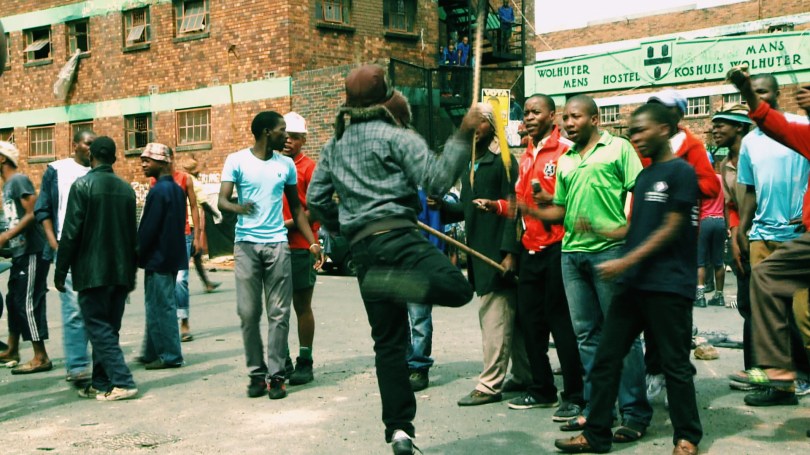
Screenshot from a short clip I took in Jeppestown, Johannesburg last month.
Often the names given to police or government operations have more bark than the implementations bite. Normally bad things happen, they say nothing for what seems an inordinate window between the occurrence and their reaction. And then (normally) things that make it look like things are happening happen – photos are taken, interviews conducted, live crossings on the scene – some people feel like something has happened because their voices are heard or a heavy police presence alters their daily reality somewhat. Then we all run towards the smoke of another fire in the distance and leave before a pile of ashes can form before us, at the current crisis.
Normally.
Sometimes the (re)action comes in the form of a temporary structure or a wrongful arrest – something, anything that will appease even the skeptics for a few beats.
This time they chose force, brute force and swift broom strokes to deal with the problem.
Every police man or government official I have spoken to has said that Operation Fiela is in no way linked to xenophobia, it’s just a standard joint operation to deal with criminal activity in certain areas (read hostels, informal settlements and other such places where they can stamp their boots with unadulterated impunity). Even though they’re collaborating with the same army that was deployed a few weeks ago and conducted humiliating night time raids.
“Large sections of police were unleashed on people, their doors kicked down and people were asked to show their papers. It was a military operation in the middle of the night,” Stephen Faulkner, Cosatu nine unions representative (May 12, 2015)
This week, Stephen Faulkner said it perfectly, to paraphrase: this entire operation needs a rethink, we can’t go around unleashing the military on people and sweep them away (deport them) like rubbish.
Wayne Ncube, human rights lawyer, explained that deportation is a lengthy process with many steps, which is why they are concerned with the high number of arrests and possible deportations that have already happened. This week they are working towards consulting with about 400 of the latest victims of such a raid which took place at the Central Methodist Church last Friday.
I have not spoken to a single person who isn’t in government who has stood behind the operation. The raids never made sense to begin with, nor do the arrests. It would be easier to believe that these are “standard joint operations” if they were in actual fact standard. If we knew about weekly or monthly raids to seize illegal firearms, bust prostitution rings and arrest undocumented people it would have been easier.
But the timing – first the limp condemnations a week after the first attacks, then the army deployment and raids two weeks after that – the boasting and plenty photo opps say otherwise.
I have now written a few stories and filmed footage around the current spate of Xenophobic violence in South Africa. I have had debates about whether its xenophobia or afrophobia, about the good King and the reluctance from our government to shame him and about self-hate/unemployment/ignorance being catalysts for the violence.
I have thought about and consumed information on this topic for the past three weeks but I still feel like there’s nothing I can say. The shame coupled with the guilt and anger and sheer despondency have rendered me speechless.
I have nothing intelligent to add to the “stop xenophobia” calls and campaigns – particularly because I feel that a lot of the talking is happening at a level that doesn’t speak directly to the guys wielding pangas and knives on the streets. The guys who are drunk at 7a.m. with the whole day ahead of them to burn and loot and terrorise. The guys who we rarely think about outside of their sins.
A lot of the rhetoric from the top said: no matter what your frustrations are, you have no right to mete that out with violence against others. Another reminded us of the moral debt we owe to those who sheltered us in our time of need. But within those same ranks we had people in positions of power saying the amount of “foreign nationals” in South Africa was reaching a problematic level.
On the ground the guys I talked to said they don’t want “foreigners” in this country because they steal their jobs, sell drugs and steal “their” women. I didn’t know I was a thing that could be stolen. The same guys who told me that are also the same guys who felt it appropriate to try to kiss me, despite my continuous and unwavering “No’s”.
All of that aside, they were the first people I thought of when I heard this quote last night: “You lose your soul when you feel like the world has forgotten about you.”
I just don’t understand how another person from this continent can be called a foreigner. To me anyone who calls them that has no proper scope of history – they obviously know nothing about the false colonial borders, efforts by those same colonisers to have us identify and discriminate on “tribal lines” and obviously even less about the Bantu migration, we’re from Congo yo (but that is a story for another day).
I don’t understand how we let everyone and their mother walk all over us for hundreds of years then have the audacity to touch another African just because we know we can hit them and nothing will happen. It’s like men who beat their wives when they get home after biting their tongues for several hours saying “yes baas”. He bottles is anger and frustration, knowing that saying or doing something to “baas” will have real consequences, consequences a coward like him couldn’t possibly deal with. So he waits, stores that anger, until he can reach a target he can attack with the conviction that no one will be there to back his victim.
For me the reasons of anger and frustration at broken promises decades after democracy are secondary – this is about our level(s) of self hate. It runs deeps and cuts wide.
I say we need new names because we can no longer claim to be true sons and daughters of the soil, when we treat our own like this – I don’t know which words they might be but any that speak to a deep betrayal and self-hate will suffice.



 Write. Snap. Click.