Sunday Scribble #11: It’s the art of loving fr fr

When weeks of having Olivia Dean on repeat, collided with immersion in the words of bell hooks and Kennedy Ryan.

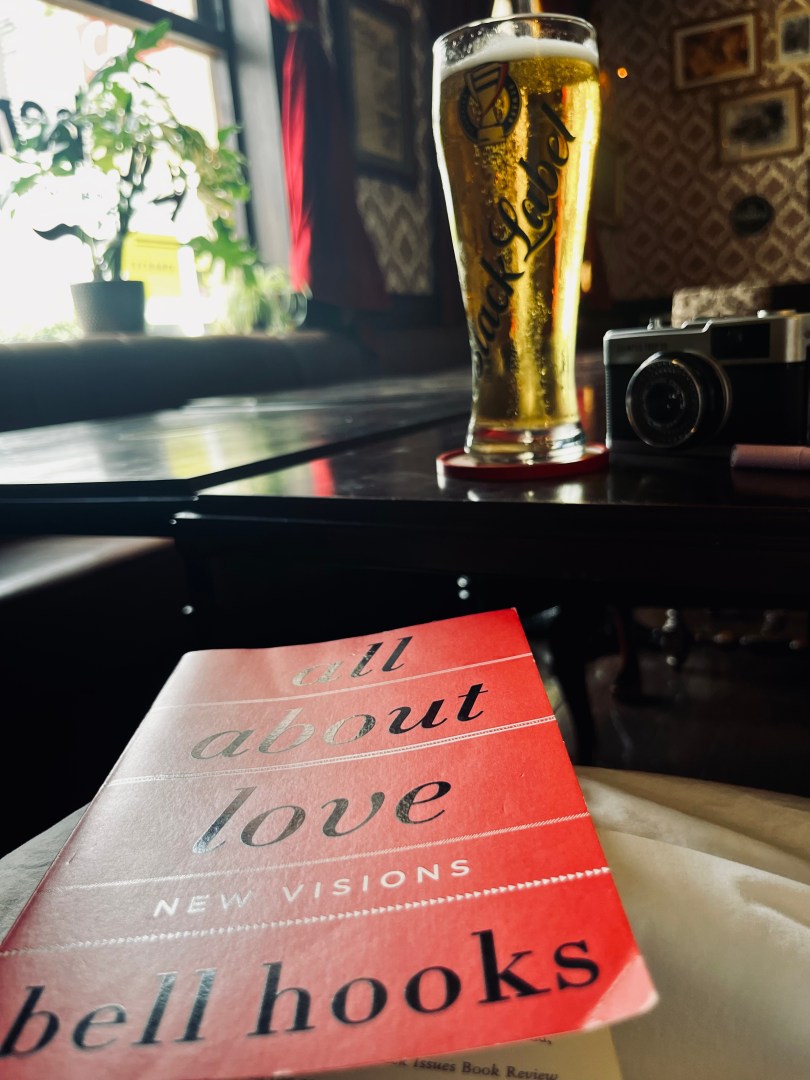
Working towards a ‘love ethic’ in a reality riddled with genocide, seemingly unchecked evil of all shades and material and spiritual poverty, can seem almost impossible. But rereading bell hooks’ all about loveprovided the grounding I needed after being swept up in Kennedy Ryan’s steamy romance,This Could Be Us and all the while being serenaded daily by Olivia Dean’s affirming album, The Art of Loving since October 2025. They texts were connected and timely in a way that went beyond coincidence for me. I will attempt to synthesise some of the overlaps across the three projects that have left an indelible mark in my spirit.

Love yourself

To me, self-love is at the root of all three works, not the magical thinking kind that instructs: ‘love yourself before anyone else can’, but the kind that posits that an awareness of self and directly addressing patterns and behaviours that have informed past relationships. An exercise which then allows us to communicate more honestly and choose partners based not on our traumatic inferences and wounds, but our shared commitment to mutual growth.

When we understand love as the will to nurture our own and another’s spiritual growth, it becomes clear that we cannot claim to love if we are hurtful and abusive.

bell hooks, all about love, pg. 6

Of all the illuminating things hooks writes about love and loving, the thing that continues to stay with me is the idea that love is essentially rooted in care, choice, justice and nurturing one another’s growth, that the feelings it brings, the act of ‘falling’ in it, and any abusive betrayals simply stand in contradiction to living a life founded on a true love ethic. As intimate relationships often mirror or are informed by their immediate environment, a love ethic needs to underpin the broader society’s workings – a society moved by love rather than greed, violence and other injustices. But that is not the society and culture we live in.

Knowing how to be solitary is central to the art of loving. When we can be alone, we can be with others without using them as a means of escape.

bell hooks, all about love, pg. 140

In Ryan’s novel, the protagonist, Soledad, is forced into a journey of self-discovery by tumultuous circumstances, but quickly realises that her self-love or ‘self-partnering’ journey may require growing in love with another rather than practicing strict solitude rooted in denial of desire and care. It helps that Judah Cross (oh Judah Cross) is similarly trying to engage in a practice of prioritising self, through increased accountability, patience and intentional communication. And, the cherry on top, they both use all about love as a guide to work through this season and towards the other. Ryan is undoubtedly an incredible author, who manages to deftly marry romantic escapism with serious issues.

https://tenor.com/embed.js

I’ll be my own pair of safe hands, it’s not the end it’s the making of.

Olivia Dean, So Easy (To Fall in Love), track 5 on The Art of Loving

The Art of Loving as a whole, feels like a warm hug, reassurance that you are more than enough and worthy of effort (internally and externally). That the mistakes and missteps of your past aren’t defining, they are lessons that will help you communicate your wants and hurts with clarity. Dean’s self-love is rooted in radical honesty and staying true to oneself; a kind of reflexivity that allows one to honour whichever version of ‘love’ they are after. The yearning and care she speaks of are not rooted in melancholy, ownership but consideration.

Platonic love as vital anchorage

There aren’t enough sonnets for friendships. Note enough songs for the kind of love not born of blood or body but of time and care. They are the one we choose to laugh and cry and live with. When lovers come and go, friends are the ones who remain. We are each others constants.

Kennedy Ryan, This Could Be Us, pg. 95

We all know, or maybe have been, the friend who drops everyone and everything the minute they find themselves in a new relationship. Spending less and less time with their core support system, to maintain the newer, shinier connection that has entered their lives. There’s nothing wrong with making time to genuinely get to know someone and nurture what may be a more fragile connection. In our context, maintaining any relationship, romantic or otherwise, is made all the more difficult by demanding jobs, staying sane, fed and fit. But friendship isn’t an optional extra, a nice to have, it’s essential to living and loving well. Studies suggest that women’s friendships help us live longer, make us healthier and are most cases the only place we receive reciprocity and considered care. Obviously this isn’t a blanket fact or experience, some friendships (like relationships) are toxic or operate in misalignment, which would then bear very different results. So let’s healthy friendships are lifesaving for clarity’s sake. In This Could Be Us, this is evidenced by the way Soledad’s friends jump in to help her without question in moments of distress, in how they encourage her professionally and personally, and in how they hold her accountable. This accountability should, but doesn’t always translate in romantic relationships. hooks points out that for most women the stringent, unforgiving standards we have for friends, falls away when we encounter romantic partners because we are socialised to idealise the codependency of ‘other halves’ and put romantic love on a pedestal.

When we see love as the will to nurture one’s own or another’s spiritual growth, revealed through acts of care, respect, knowing, and assuming responsibility, the foundation of all love in our life is the same. There is no special love exclusively reserved for romantic partners. Genuine love is the foundation of our engagement with ourselves, with family, with partners, with everyone we choose to love.

bell hooks, all about love, pg. 136

Which is why the line, “who would do that to a friend, let alone the one you love” in Dean’s Let Alone The One You Love, is the one of the saddest for me on the album, it gives into that acceptance of elevated difference. In its solemn lament, it’s an illustration of the devaluation of friendship.

Love is in the doing

The desire to love is not love itself love. Love is as love does. Love is an act oof will—namely, both an intention and action. Will also implies choice. We do not have to love. We choose to love.

bell hooks, all about love, pg. 172

Something I have had to remind myself of, quite sternly at that, int the last few months, is that love is a verb, it’s a doing word. To say it is easy, to mean it requires more than the eight letters it takes to type it out. It’s the people who keep their promises, who show up, who consider you and who take any opportunity to demonstrate it in whatever way they can. I have also worked on being a better friend myself, it was one of my goals for the year, to prioritise my friendships and be intentional about their maintenance.

When conversing with the heart, expect it to talk back, to revisit the pains and disappointments that left the deepest dents and scratches.

Kennedy Ryan, This Could Be Us, pg. 216

The doing also extends to self responsibility and accountability – keeping the promises you make to yourself, committing to the routines you know you need, and truthfully engaging in introspection. The vulnerability on The Art of Loving acted as quiet confirmation that I was in the ‘right’ path insofar as my personal ‘doing’ was going. It more closely spoke to who I was becoming than who I was. It was a also a good reminded that you don’t ever really lose the love you have shared, especially if you shared it freely, and that helped me process a lingering hurt.

Love is never wasted when it’s shared.

Olivia Dean, A Couple of Minutes, track 11 on The Art of Loving

Literary Postmortem: Ain’t I a Woman by bell hooks

bell hooks hit me with some knowledge and schooled me on black feminism – what it is, the conditions that led to its existence, outlined its challenges/objectives and so much more.

This very short read is filled with pearls of wisdom and earth shattering truths that need to be shared. In keeping with the fashion of alternative book reviews, I’m going to share some of my favourite quotes and lessons learned from the book. Initially I wanted to write an essay but there’s no insight I could give that she didn’t articulate perfectly.

But for a bit of background, Hooks traces the roots of the woman’s rights struggle all the way from American slavery to the present day America (which was the 80s). Her research unearths harrowing facts about the black female experience. I would put the whole book on here if I could because it is that necessary. For example:

“Racist, sexist socialization had conditioned us to devalue our femaleness and to regard race as the only relevant label of identification… We were afraid to acknowledge that sexism could be just as oppressive as racism. We clung to the hope that liberation from racial oppression would be all that was necessary for us to be free” (page 5).

That is the precursor to a passage on how black men were given the vote before black women and white woman in the late 1800s, a show of the utter disdain for all woman – racism was put aside for sexism to soar.

Chapter 1: Sexism and the Black Female Slave Experience

  • On the slave experience aboard slave ships: “After branding all slaves were stripped of any clothing. The nakedness of the African female served as a constant reminder of her sexual vulnerability. Rape was a common method of torture slavers used to subdue recalcitrant black women” (page 18).
  • Things didn’t get better on plantations: “Those black women who resisted sexual exploitation directly challenged the system; their refusal to submit passively to rape was a denouncement of the slave-owner’s right to their persons. They were brutally punished. The political aim of this categorical rape of black women by white males was to obtain absolute allegiance and obedience to the white imperialist order” (page 27).
  • “White male religious teachers taught that woman was an inherently sinful creature of the flesh whose wickedness could only be purged by the intercession of a more powerful being. Appointing themselves as the personal agents of God, they became the judges and overseers of woman’s virtue” (page 29). Damn, just damn.
  • Sadly: “Most black male slaves stood quietly by as white masters sexually assaulted and brutalised black women and were not compelled to act as protectors. Their first instincts were toward self-preservation” (page 35).

I’ve had fights with my brother about this one. I suppose women were all alone when they were sold to go on those ships and no one stopped it. He argues they weren’t in a position to fight back, they weren’t – but fucking try, If enough men had I like to believe things may have turned out differently.

  • True story: “While racism was clearly the evil that had decreed black people would be enslaved, it was sexism that determined that the lot of the black female would be harsher, more brutal than that of the black male slave” (page 43).

Chapter 2: Continued Devaluation of Black Womanhood

  • Systematic devaluation of black womanhood was not simply a direct consequence of race hatred, it was a calculated method of social control” (page 59-60).

This is a referral to the structural support garnered by the myths that had been circulated around black women’s sexuality. This myth being that black women were loose, had insatiable sexual appetites and were masters of seduction. Which is why raping them was not seen as a violent offense, society had come to believe that black woman basically asked for it. Along with this black men were said to be violent rapists who wanted to harm white women, another myth to keep the races separate through fear.

  • “White Americans have legally relinquished the apartheid structure that once characterised race relations but they have not given up white rule. Given that power in capitalist patriarchal America is in the hands of white men, the present obvious threat to white solidarity is inter-marriage between white men and non-white women, and in particular black women” (page 64).

This is something I don’t think I can agree with. Given that “the power” is in the hands of white men, they don’t need the solidarity of their white women to keep it – they need them to make that grip tighter possibly. I don’t think that inter-marriage is a threat at all, in fact it’s an advantage, that shows just how all-encompassing that power is.

  • The term matriarch implies the existence or a social order in which women exercise social and political power, a state which in no way resembles the condition of black women or all women in American society. The decisions that determine the way in which black women must live their lives are made by others, usually white men” (page 72).

Chapter 3: The Imperialism of Patriarchy

  • “… Emphasis on the impact of racism on black men has evoked an image of the black male as effete, emasculated, crippled. And so intensely does this image dominate American thinking that people are absolutely unwilling to admit that the damaging effects of racism on black men neither prevents them from being sexist oppressors nor excuses or justifies their sexist oppression of black women” (page 88).
  • “At a very young ages, black male children learn that they have a privileged status in the world based on their having being born male; they learn that this status is superior to that of a woman. A consequence of their early sexist socialisation, they mature accepting the same sexist sentiments…” (page 102).

I have seen this among my own friends – they expect women to be and act a certain way – standards they definitely hold for themselves. Or the women they have “fun” with, only the ones “worthy” of taking their names one day. Le sigh.

  • “While insecure feelings about their selfhood may motivate black men to commit violent acts, in a culture that condones violence in men as a positive expression of masculinity, the ability to use force against another person – i.e., oppress them – may be less an expression of self-hatred than a rewarding, fulfilling act” (page 104). Wowzer.
  • “Since the black woman has been stereotyped by both white and black men as the “bad” woman, she has not been able to ally herself with men from either group to get protection from the other” (page 108).

Steve Biko once said of black people that we are on our own, black women especially so, I feel.

  • “While I believe it is perfectly normal for people of different races to be sexually attracted to one another, I do not think that black men who confess to loving white women and hating black women or vice versa are simply expressing personal preferences free of culturally socialized biases” (page 112). Word to big bird.

Chapter 4: Racism and Feminism: The Issue of Accountability

  • “To black women the issue is not whether white women are more or less racist than white men, but that they are racist” (page 124).
  •  “Animosity between black and white women’s liberationists was not due to disagreement over racism within the women’s movement; it was the end result of years of jealousy, envy, competition and anger between the two groups” (page 153).

A conflict that Hooks says was driven by white males to make sure the two would not be able to find solidarity at any point. She adds that the only way to try and achieve any kind of “sisterhood” begins with actively rejecting and all stereotypes about one another.

Chapter 5: Black Women and Feminism

  • On the Civil Rights Movement: “Those black women who believed in social equality of the sexes learned to suppress their opinions for fear attention might be shifted from racial issues” (page 176).
  • “The fear of being alone, or of being unloved, had cause women of all races to passively accept sexism and sexist oppression” (page 184).
  • “We, black women who advocate feminist ideology, are pioneers. We are clearing a path for ourselves and our sisters. We hope that as they see us reach our goal – no longer victimized, no longer unrecognized, no longer afraid – they will take courage and follow” (page 196).

Was uncomfortable to read the criticisms of Malcolm X and Amiri Baraka, had one eye closed and everything, but ya. It’s astounding that a book written in 1982 could resonate so well with me in 2014 – that we still face many of the same challenges.

Therefore we must take courage as she said. Aluta Continua.