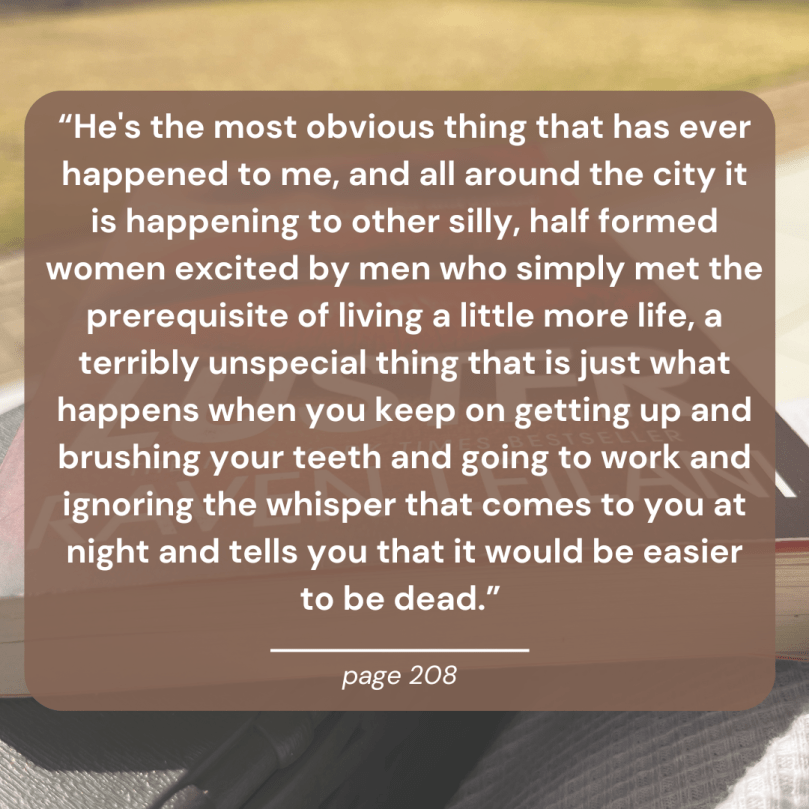
“What the actual?!” I have never said and thought this phrase more than I have in the last month reading Raven Leilani’s Luster.
I recently described it as ‘very fucked up and difficult to read, but the beautiful sentences have made me stay the course’ – I probably phrased it less eloquently at the time but that’s what I thought when taking in the 227 pages that often felt like an exaggerated pitch for an HBO show (you know, dimly lit with all of the fucked up sex and drugs).
In short: Edie is a traumatized, touch-starved, poverty-stricken artist, who starts an affair with a very boring, middle-aged married man (I think his name was Tom, no James, no Michael, no no Eric – see, unmemorable at best). In the middle of their punch-me-fuck-me shenanigans, Eric’s wife, Rebecca (who we are told knows about the affair) moves Edie into the marital home on the day she has quite literally hit rock bottom, with no job, no money and nowhere to live.
The move isn’t benevolent, Rebecca wants someone, someone Black, to act as some kind of hand-holding older sister to her adopted Black daughter. The whole thing is insane. Edie has nowhere else to go, so she stays. Carries on with that man, befriends the daughter (Akila – who is arguably the only person I even liked and rooted for on this whole thing), and lives off random monetary offerings Rebecca leaves her – until she falls pregnant.
As I said, story-wise – hated it, Edie was living through the wound from onset and throughout. I suppose her upbringing was the catalyst for some of the chaos that was her lived experience, to be fair she couldn’t make better choices because she often didn’t have the liberty to truly choose. But Raven is such a good writer that I stayed the course despite myself to find more of her tragic, curt and heart-wrenching sentences and passages. Some of my “best bits” below:
This is the message that reverberated in my being when I came home from watching TheCry of Winnie Mandela at the Market Theatre last month (May 2024).
The set of The Cry of Winnie Mandela at the Market Theatre in Johannesburg. A quote from Winnie Nomzamo Mandela adorns the wall. Photo: Pheladi Sethusa
Adapted from the novel of the same name written by Njabulo S. Ndebele, the play felt like an apparition straight from the book cracked open at the spine. The novel had been sitting on my bookshelf since a random trip to Clarkes in Cape Town with my brother in 2019, leaving the shop that day with the gifted copy I had imagined I would be giving myself over to its contents soon, but life and living happened – until I had just two weeks before curtains up to get stuck in. Luckily for me once I started, I could barely put it down! It is a form bending, intimate and harrowing account of womanhood, loneliness and the alienation of strength (a strength required, not innate).
“I’m fine, but insane.”
– Mamello Molete, page 44
I initially bought tickets based off of who was directing the play alone. Momo Motsunyane. A fire. A force. I have never seen Momo on stage and been left unmoved, close to tears and deliriously joyful all at once, which is how I knew this would be a production that would leave me altered after experiencing it. Walking into the intimate theatre, with the pensive writer pacing and muttering to himself, I knew immediatley that we were about to be transported into another realm.
If I had to describe this book in one word it would be: personal, no intimate. From the very first sentence in the introduction – which is inward looking – to the last – which throws forward to a hopeful future – one is thrust into the inner lives of the writer (Njabulo S. Ndebele) and his characters with their noses pressed up against their insecurities, humiliation, longing, hurt and unwavering affections.
Instead of attempting to write a clear-cut biography of a woman almost “too big” to capture fully, the writer chooses to tell the stories of ‘ordinary’ women and through their telling, begin to peel back the layers of a figure steeped in mystery, shrouded in controversy and shielded by personality. Ndebele also writes the stories of four woman in Apartheid South Africa with a tenderness and rawness that was unexpected but most welcome.
While the stories cover themes from adultery, to sacrifice and even sexual liberation, at their core is one constant theme – abandonment. The women chronicled are alone. Some are alone in their marriages, others alone as extras in the lives of others and one alone in her revolutionary persona. Through no decision-making of their own, their circumstances leave them forever altered by their chronic aloneness and their lives turned into waiting rooms.
“When you are waiting, you know the meaning of desire: the desire to be the only woman (even in a illicit relationship); the desire for secrecy and pleasure of remaining unacught; the desire to prolong intimate moments beyond time and circumstances…”
– Delisiwe S’kosana, page 64
The novel felt like it was written to be performed and this became apparent as it unfolded before me in the Barney Simon theatre. Perhaps this was my own bias having just read the novel before watching, no experiencing it on stage, but it felt less like an adaptation and more of a rendering. The cast made up by Lesley “Les” Nkosi (Professor Ndebele), Rami Chuene (Mmannete Mofolo) Mofolo, Pulane Rampoana (Mamello Molete), Siyasanga Papu (Delisiwe Dulcie S’kosana), and Nambitha Mpumlwana (Winnie Nomzamo Mandela) brought Ndebele’s words and Motsunyane’s vision to life perfectly. Using song, wit and conversation to soften the ‘mbhokoto’s’ on stage.
I appreciate how the novel and the play alike aim to move beyond the historic accounts of stoicism and duty where black women are concerned, and instead asks the audience to consider and contemplate their vulnerabilities and extend them grace. They do the same for one another in their otherworldly conversations between Madikizela-Mandela and Cleopatra. I wish I could have seen it on stage one more time before the run was over, but I guess I will always have the novel to return to.
I remember being insanely jealous when I saw this book being advertised when it was first published in 2014. Watching Malaika wa Azania doing interviews about the book, thinking “that’s what I wanted to do, surely that should be me”. I’m so glad the universe gave her the gig because this is honestly one of the best books I have read about the state of South Africa – now more than ever really.
This nation’s students stood up last year to say enough is enough and more importantly stood up for themselves when nobody else would. This book reads like a brilliantly timed prologue to what we have seen happen in the past few months at universities across the country.
I was part of the generation that has witnessed the end of our people being oppressed and trapped by the false belief that they owed their eternal gratitude to you (the ANC), and that there would be none brave enough to take you on. (page 167)
For the longest time, until recently, people have expected and have thought about “born free’s” as one homogeneous group that is “non-racial”, not oppressed and has countless opportunities to drag themselves out of poverty and joblessness. This has never been true in this country and remains untrue today. This book made me acknowledge the nuances of inequality in this country, I’ll explain by way of example.
Malaika and I are exactly the same age. The schools we went to were relatively similar. We both fell in love with books an words in ways that changed our lives. Our experiences of whiteness in high school were quite similar. Our thoughts about this continent and it’s people on par. But even though we share some experiences there are a lot, too many that we don’t. And that is our reality. My heart almost broke when she shared a story about taking a friend home from school one afternoon. They ate and did what they did very other afternoon when they went to one another’s “houses” (I say houses like that because a shack isn’t isn’t a house). It started raining. Heavily. The topmost form of zinc protection between them and the heavens caved in from the rain. The shack flooded. Pots and pans floated around the girls. We see similar images on news bulletins every now and again but being inside the head of that little girl who was embarrassed that she had a friend over as they and everything her family owned took an involuntary swim. Some people routinely experience such things as drainage systems and plumping systems are non existent in the places that house tin enclosures.
Merely by being born black in this country you had problems. I didn’t think I’d need therapy to cope with my own circumstances. (page 104)
Her life was rough, she dealt with and took on so much just to survive. There are some who would look at her story and begin telling the “magic negro/against all odds” narrative, that instead of speaking to and addressing the conditions that make people have to trudge through hell just to eat or have a place to sleep or gain entrance into an institution of further education, praises this magical black person who “overcame” those challenges and puts them on a pedestal with a placard reading “HARD WORK PAYS” as inspiration for the other lazy blacks – who are obviously poor because they don’t work hard enough, lol.
She has an amazing mind and can so easily put forth her observations in ways that had me screaming out yes on the train while I was reading this. It was like having one of those heated debates in a politics lecture that I miss so much, affirming and teaching me things at the same time. She speaks to the reality of now, the discord between the state and us, the animosity between black and white and the poverty keeping the majority of our people scrapping at the bottom of the barrel.
There are times when the only weapon a black child can use to fight against a system that dehumanises her is to be so angry that she is left with no choice but to dare to be alive.
While I bemoan the resilience narrative, I also found her political resilience inspiring. Fighting “the system” is an uphill battle with assured losses along the way, choosing to keep on fighting is necessary to achieving any kind of change. It’s not about winning or reaching a point where you get something that you want, like the vote, thinking that you have attained freedom once you have it. It is a journey, a continuous one that will not end any time soon if we rest at historical pit stops for a feast.
But comrade Malema was the closest thing to ourselves than anyone else at that point. (page 114)
I was particularly saddened by her account of what transpired while she was part of the EFF, the way they treated her really hurt and frightened me considering their trajectory and my allegiance. Either way this woman is a fighter and I can only hope that one day I can follow in her footsteps in using words to paint truth bombs for pictures.
I will start by saying “long live Chimamanda Ngozi Adichie, long live”. What a woman, what a storyteller.
There is nothing I didn’t love about this novel. Well at first I looked at the tiny bible-like print with a bit of a side eye but it grew on my eyes.
In the past two to three years, I have made a conscious effort to read more African authors because frankly even though I was an English Literature student, I was starved for stories told by my people, about my people for my people. This novel lived up to this preference through and through.
From the very first paragraph to the last one on page four hundred and something – she had me. Not to compare, but Americanah filled the historic/political/social gap I found in NoViolet Bulawayo’s We Need New Names.
In Americanah there is an effort made to make the reader truly see and understand Nigeria, its people and its politics. In no way forced or didactic, but rather she chose to edify us by way of conversation. The whole book felt like a collection of stories told by that very interesting person at the party who has everyone in the room enthralled. It almost felt like a very long, well-written, witty blog post – which I loved.
In a nutshell the story follows Ifemelu – a woman you will come to love and hate – from her childhood and teenage years in Nigeria, to her years spent in “exile” in America-land. I say exile like that because she really only went there because life in her home country was not conducive to her growth at the time, which is what going to exile is partly about. People leave because they have to not because they want to – it’s about fleeing from restriction really (well to my mind).
The bulk of the book speaks to two of my favourite topics, love and race. It’s a great love story, one that had me falling in love with Obinze (the love of her life) chapter by chapter. He is perfect because of his imperfections and somewhat simple nature. He loves her in an all encompassing way but never smothering. Their story is weaved into every corner of the book, much like her longing for him when they are apart. Without quite knowing it until the very end, he is everything.
I found it fascinating that race only became an issue for Ifemulu when she stepped off this continent full of people who look like her without question. I like that she tackles race head-on in her personal life and goes as far as to start a blog dedicated to confronting the race problem in America. She puts excerpts of the blog in the book, which was another highlight while reading.
Her characters are complicated, irritating even frustrating and that made for a more authentic read. I liked that i didn’t like everyone all the time because that is our reality. People are disappointing, fearful, childish, racist, arrogant and and and.
If my opinion counts for anything I would say in fifty years this will be one of those books we call classic, hell I’ll call it that now. Read it. Re-read it. Make people you love read it.