Book Review: For Matrimonial Purposes

I bought this book for a shocking (yet pleasing) R3 at a book sale at the Wits Hospice Shop – another steal. I liked the hennaed hand on the cover and was intrigued by the thought of learning more about Indian weddings.

Book cover. Photo: Pheladi Sethusa

When I was younger I used to be obsessed with Bollywood movies. Even though they were three to four hours long and in subtitles – I loved them. Between the hunks with the sleek black hair, family feuds, lavish weddings and scandals I just could not get enough.

The weddings were of particular interest to me – it was the first time I witnessed grandeur in a setting that wasn’t associated with ‘white weddings’. I guess I admired that in the Indian culture no compromise was made between culture and a fairy-tale wedding; that their culture was not up for discussion or optional.

Onwards with the literary post-mortem (relax, this phrase will catch on). This book was written by Kavita Daswani– whom I know nothing about (sorry). The book kicks off with a lavish wedding which sets the tone for the rest of the book. It seems that marriage in the Indian community is a matter of extreme import and something that is considered necessary to bringing dignity to families. From the onset it is clear that Anju has been left behind, unmarried at 33.

Her mother has been trying tirelessly for about ten years to arrange a marriage for her, but Anju has not yet met a man she likes enough to marry. Mind you dating is not on the cards – she meets these guys and after that meeting a proposal should follow. The marriage is about getting to know your spouse, about falling in love with them. Something which was foreign to my imagination, as I am used to things happening the other way around.

In this all important quest to find a husband – one learns the difficulty of being an Indian girl in a traditional setting and also of one forced to grapple with her tradition in a Western world. After a few years of fruitless or rather marriage-less efforts Anju’s parents reluctantly let her go to America to further her studies and find a husband there. She is faced with all this freedom, which one imagines she would be seduced by – but she isn’t. She remains as conservative as her parents for the most part. Doing nothing that would be deemed sinful by them – consulting with them when making decisions many would make in their sleep.

Anju’s pursuit made me a little sad. Every time her mother called the first thing she would ask is: ‘Have you found a boy?’, not an enquiry about her daughters health and well-being. All Anju wanted was to stop being a disappointment and be truly loved by her parents. She imagined that getting married was the only way to do that and sadly it was. None of her academic achievements or career achievements inspired any sort of approval from them.

Daswari put little quotes at the beginning of each chapter, oft very helpful in better understanding the perpetual quest for a mate. I got the idea from the quotes and the book in general that women and independence seemed most incongruent; especially in Anju’s case. For instance her parents freaked out when she had to travel to Paris for business – they could not stand that she would be travelling alone and feared the scandal and shame it would bring to the family’s reputation if she was spotted by someone they know.

“They say that you find the love you seek when you stop looking. They say that the second you get busy with work, friends, other interests outside romance, that the man or woman of your dreams comes sauntering into your life. I say they’re wrong. The fact is when you’re looking for love, you can’t ever really stop”

A-fucking-men. I have been saying this to my friends for a while.

I have never found any kind of solace with the ‘if you stop looking it will come to you’ adage, it just doesn’t make sense. Why doesn’t the same principle apply to the pursuit of career goals and dreams. It’s a load of hogwash. Sure I shouldn’t be out on the hunt every hour of every day but pretending I am not looking for someone doesn’t erase the desire. I am busy with ‘other’ things but that hasn’t induced some mild amnesia either. Anywho…

By the close of the book she has a happy ending. Not the most conventional one and not one on her own terms. She nearly forces the poor man to marry her instead of dating as he suggests. But despite herself and her parents it all worked out. I was relieved – my spirit may have been shattered had she not.

PS**

Literary Post-Mortem: A Bantu In My Bathroom

Disclaimer: I wouldn’t really call this a book review – just don’t dig the term. Also don’t feel like I’m qualified to write such yet. I’m just telling you that I read this book, how it made me feel and why or why not one should give it a read. That’s all. Let’s rather call it a ‘Literary Post-Mortem’ (I like that)

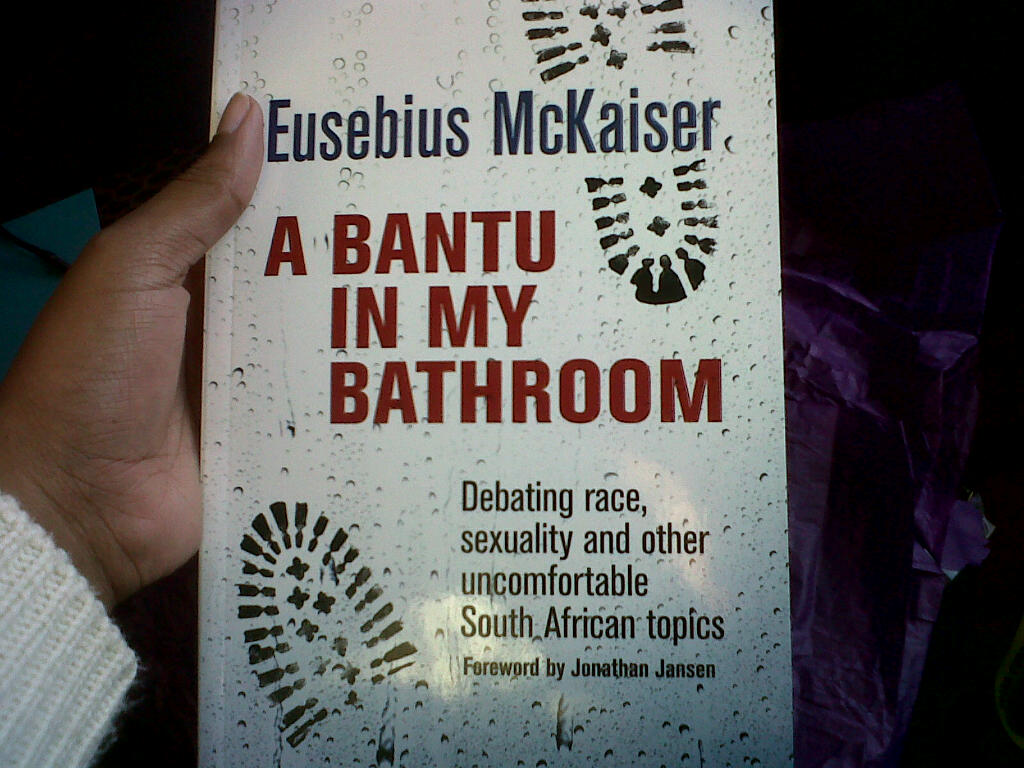
IMG00724-20130613-1623.jpg

Onwards with A Bantu in My Bathroom by Eusebius McKaiser then. Been wanting to read this book for some time, but being the broke student I am it just never happened. Umtil I got this as a gift, yays.

Before I tell you how awesome a read it was, I must mention that I am a fan of the man. At some point in my second year at Wits I considered taking up Philosophy in the hopes of being lectured by him at some point. However, reason and a passion for what I was already doing steeled me. Anyway back to why I’m a fan – I love his insights and the way he chooses to deal with difficult topics that many are reluctant to. Along with this I find him quite relatable – not all the time but I mostly get him/what he’s saying.

The book is basically a collection of essays based on a variety of topics. Namely race, culture and sexuality. Under each section there are about four to five essays, which aim at tackling various aspects of the ‘big issue’ at hand. Unsurprisingly, my favourite essays were  in the race section. I think that it is still important to look at and understand why race is still an important contributing factor to the lived South African experience. He mentioned that we can’t pretend we don’t see race just to avoid being labelled ‘racist’.

McKaiser highlights some of the most important race related challenges South Africans face. He explains why Affirmative Action is necessary, discusses white privilege, tackles the issue of whether or not black people can be racist and much more. Even though one might disagree in places, I did find myself agreeing with him 80% of the time – not just in this section but throughout the rest of the book.

In the sexuality section he spoke about ‘coming out’, love and even rape. This part of the book was the most personal for me and as such riveting to read. When it came to culture he looked at ploygamy, divisions present in our society and the advantages and disadvantages of being a so-called coconut. The range of issues raised in his essays is quite big. I was not left wanting when I was done reading – I legit felt like he discussed everything one could in 209 pages.

We should instead accept that we are deeply divided – spatially, linguistically, culturally, ideologically – and reflect on how we might live in each other’s space while disagreeing deeply with each other. The alternative, fake national unity, is simply childish. (excerpt from the book)

What I enjoyed the most were the little anecdotes that coloured his essays. For me it helped to bring home his points and also offered an unique peep into his personal life. I have often seen McKaiser on tv, attended seminar’s that he spoke at and listened to his show on radio. This book felt like the literary incarnation of those experiences. Not the content but with regards to style. It was easy read and understand because he was just being himself (or so I assume). He did stress how important authenticity is to him so I imagine he wrote in a way that would reflect that.

I also liked and admired the fact that he didn’t ‘other’ people. He didn’t speak about racists, homophobes and misogynists in a distanced manner. He made it clear that we are these people, that we are our biggest problem in many cases. Also highlighting that change can only begin with us.

If I had the money I would go out of my way to buy a few people a copy. The idea’s put forward are of great import and I feel that the more people they reach the better.

PS**