Literary Postmortem: You Made a Fool of Death with Your Beauty by Akwaeke Emezi

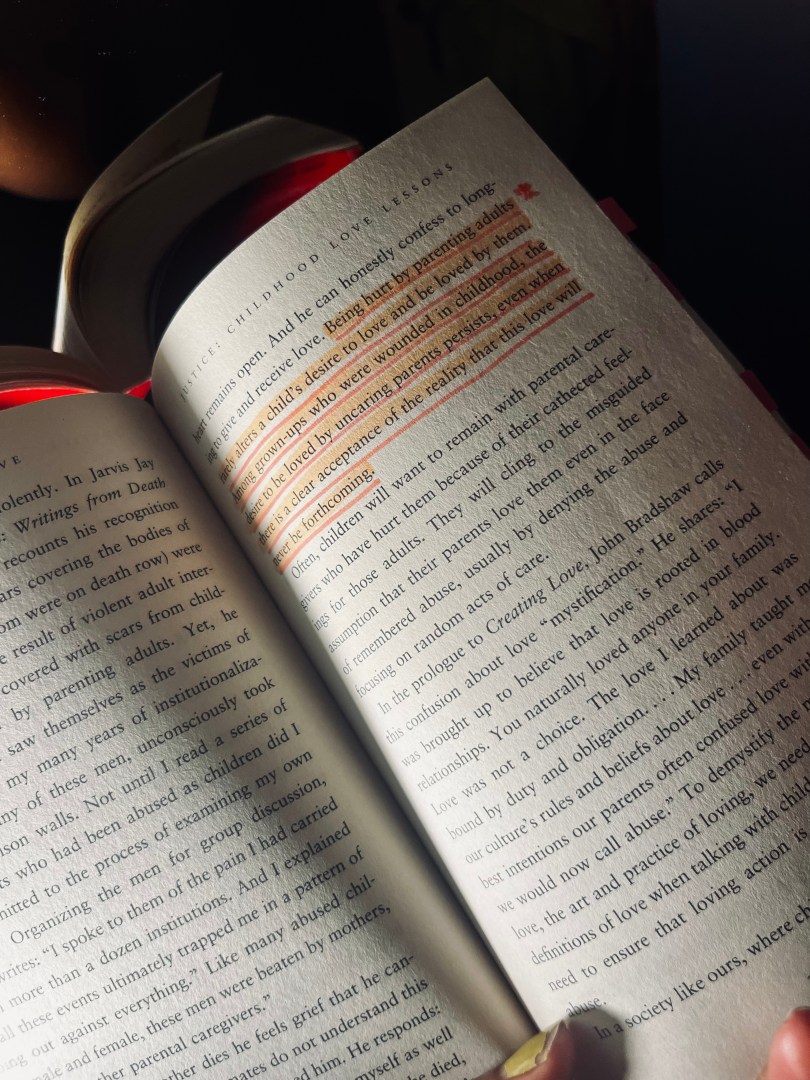
What a frustratingly delicious and maddening rollercoaster ride this novel was. Feyi when I catch you?! This was a page turner for sure, but because it was a library book, I couldn’t mark it up as I went along so instead, I am going to go through some of the questions in the book club reading guide, as a means to reflect on my experience of it.

Q: Feyi’s interior monologue (and actions) In response to Nasir’s pursuit rapidly oscillates between interest and disgust, as we see in chapter 2: “he was hunting her”; “she wanted him closer. She wanted him far, far away.” What does Feyi want on the roof? Do we know? Does she?

I think she carries enormous guilt about the fact that she not only survived the accident with Jonah, but is now at a place where she is physically and emotionally trying to explore new connections. Feyi is on the roof because she is really curious about Nasir, but also knows she can’t make eyes at him ‘during the people’ (South African turn of phrase, look it up, or don’t). So she knows they can have a private moment up there.

Q: In chapter 3, Joyce says, “Maybe Nasir is it—not the serious thing itself, but just the chance. Don’t run away from it,” in response to Feyi’s insecurities about accepting a date with Nasir. Later, Joy’s voice in Feyi’s head tells her to take a chance. What does this chance refer to and what could it mean will Feyi?

A chance at a real romantic relationship, what she has with Milan is purely physical but she can already sense that things would be a lot more serious with Nasir.

Q: When thinking about her developing emotional intimacy with Nasir, Feyi considers the fact that their physical intimacy is moving glacially. In chapter 4, Feyi asks Nasir whether he was sleeping with anyone, and his response allows for a shared moment of trust and humour between them. Nasir uses that space as an opportunity to inquire about Feyi’s studio. How does this reflect their respective outlets of intimacy and their inevitable relationships to it?

There’s a quiet acknowledgement that Feyi isn’t quite ready for physical intimacy because Nasir is ‘more’ than just a guy, knowing that he is being ‘serviced’ elsewhere brings her some relief that she can push that task even further out (emphasis on task). I remember taking issue with how this conversation moved on so casually, flippantly almost. But I recognise that is because I hold a candle for Nasir and I was upset that he was stepping out on us 🥲😅 The pivot to the studio conversation is his effort to get to know her more deeply, he is at this moment operating under the premise that she wants to be known fully before taking their relationship to the next level. Oh, if only he knew 😦 Shame I’m being unfair she also was giving their relationship a genuine chance at this point, but definitely holding back A LOT under the guise of taking things slow.

Q: “So much of her time was spent in uncertainty” Feyi reflects on her imposter syndrome; meanwhile “It was hard to imagine Alim ever doubting if he fit into whatever he was.” What were Feyi’s doubts around her work? How does this doubt pervade other aspects of her life and how does she view Alim’s sureness in comparison?

Because her art is so personal, it puts her life up for scrutiny and judgment from others and herself. It operates as a mechanism to memorialise and process, which requires enormous amounts of vulnerability from her, which she isn’t entirely comfortable with. Alim is able to practice his art more freely because he is more open and quick to vulnerability, it colours his world as opposed to dimming it in hers.

Q: “It was something she wanted to hear—what it was like to fall in love again after your heart had been shattered. She could feel Jonah’s presence on the mountain peak, gentle and curious,” writes Emezi in chapter 10. How does this differ from past moments of intimacy up until this point, when Feyi felt Jonah’s presence?

In other moments, she was overcome by guilt, and Jonah’s presence was her internal warning signal that what she was doing was not ‘right’. When she is on the mountain top with gramps (sorry, not sorry #justiceforNasir) because she feels strongly for and about Alim, she doesn’t feel that guilt and/or shame; instead she feels the warmth of a familiar safety and calm by being with someone who makes sense to her.

Q: “’ There are so many different types of love, so many ways someone can stay committed to you, stay in your life even if y’all aren’t together, you know? And none of those ways are more important than the other,” Feyi says in Chapter 11. Why is this perspective liberating for Feyi?

I think she realises that moving on isn’t about forgetting Jonah, that being devoted to his memory doesn’t have to mean staying stuck in her hurt or even in who she was when they were together.

Q: In Chapter 11, Nazir tells Feyi, “Lorraine and I don’t have a lot of memories of our mum. The house helps us remember.” What does this house represent to the Black family? And to Feyi? How do these meanings influence the space she occupies in it?

I think it is a living monument to the memory of what they lost and the effort to keep things together through physical reminders of what once was. It also signals an inability to move on in some ways, less nostalgia, more shrine if you know what I mean. Crazy to me that Feyi feels a pang of jealousy seeing family photos – like yes doll, where do you think you are?!

Q: Feyi fondly recalls Jonah’s words in chapter 15: “He said [being messy is] one of the best things about being human, how we could make such disasters and recover from them enough to make them into stories later.” How has this informed Feyi’s decisions in life since Jonah’s passing?

Well she’s made quite a big mess of things at the Black’s, so that’s one. This recollection allows her to remember that she can prioritise herself and her desires (not that anything had been stopping her to be fair).

Q: What is the difference between Alim calling Faye his friend and Faye calling Nasir her friend?

He meant it, she didn’t 💀

Q: “You know you can always just come home right?” Joy reassures Feyi in chapter 16. What or who is Feyi’s home here?

Joy is Feyi’s home now.

Q: In chapter 17 we witnessed the confrontation between Nasir, Feyi, and Alim. Discuss whether you expected it to go down this way or not. When Nasir’s anger and subsequent actions justified? Were Alims? How is this possibly triggering forfeit?

I actually did because I was BIG MAD myself, but I was also scared of him and what he might do in that moment, I understand why she was terrified too.

Q: Alim tells Feyi in chapter 18, “I can’t bring myself to not try to give you the best every year I have left,” to which she requests he make “no plans.” Why is Feyi resistant to making plans?

Because people can die tomorrow and none of those plans would matter, she has conditioned herself to live moment by moment because of the fear of loss that constantly walks beside her.

Q: “You can see [my painting] in any stage it’s in. I don’t care, I like showing myself to you,” Feyi tells Alim in chapter 21. How does this stark difference from her objection to showing Nasir her artwork parallel the differences in their respective relationships?

This really hurt me, because Nasir was so eager, on board, down-for-whatever, desperate for her to show herself to him. But she just couldn’t and I guess that’s only fair, we don’t have to match people’s attraction/energy/care, but I do think he was owed more honest communication about the improbability of her feelings for him growing beyond a homie level.

Q: “You’re worth it, Feyi. You can be yourself, as messy and contradictory as you like,” Joy affirms in chapter 5. “He’s lucky to even be near you.” Feyi’s feelings seemed to be at odds with each other throughout the novel. Speak to the inherent beauty in the contradiction and comfort and transients that come as a result of Feyi’s growth, both within our protagonist as well as from the perspective of the reader.

I struggled with her choices, not gonna lie, but I get them. She gave herself the chance to figure out what she truly wants and needs. She was ten toes about what she did and didn’t want for herself. I suppose the intensity of my disappointment helped me realise that people fiercely choosing exactly who and what they want for themselves might always look crazy or wrong or ill-timed to others, but that those things can’t and shouldn’t inform whether or not they make those decisions. That sometimes your body knows before you do what is meant for you and what isn’t. As much as I was batting for Nasir, choosing him would have been a betrayal of self that actually may have set Feyi back even further in her journey of healing. Alim, whether I like him or not, was the person she needed to help in coming back to herself fully and simultaneously shed the survival version that had been in the driver’s seat for the last few years (unfortunate pun, forgive me).

That said, #justiceforNasir, tell him he can find me @pheladi_s on all socials.

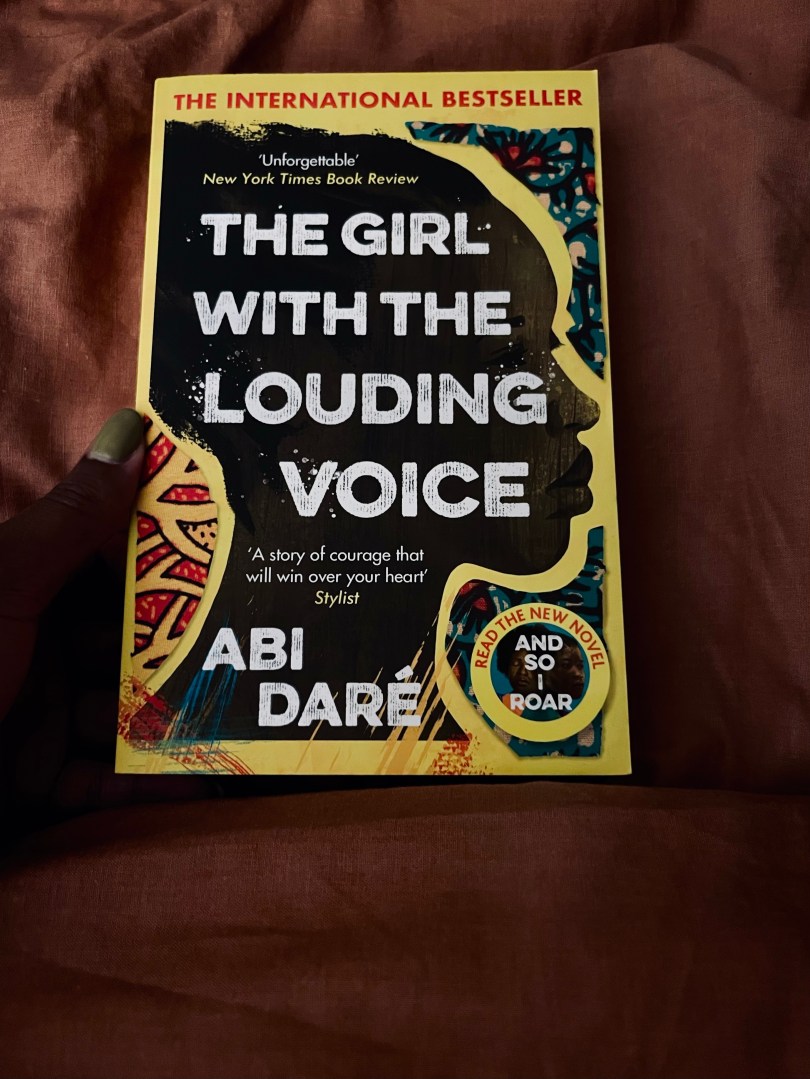
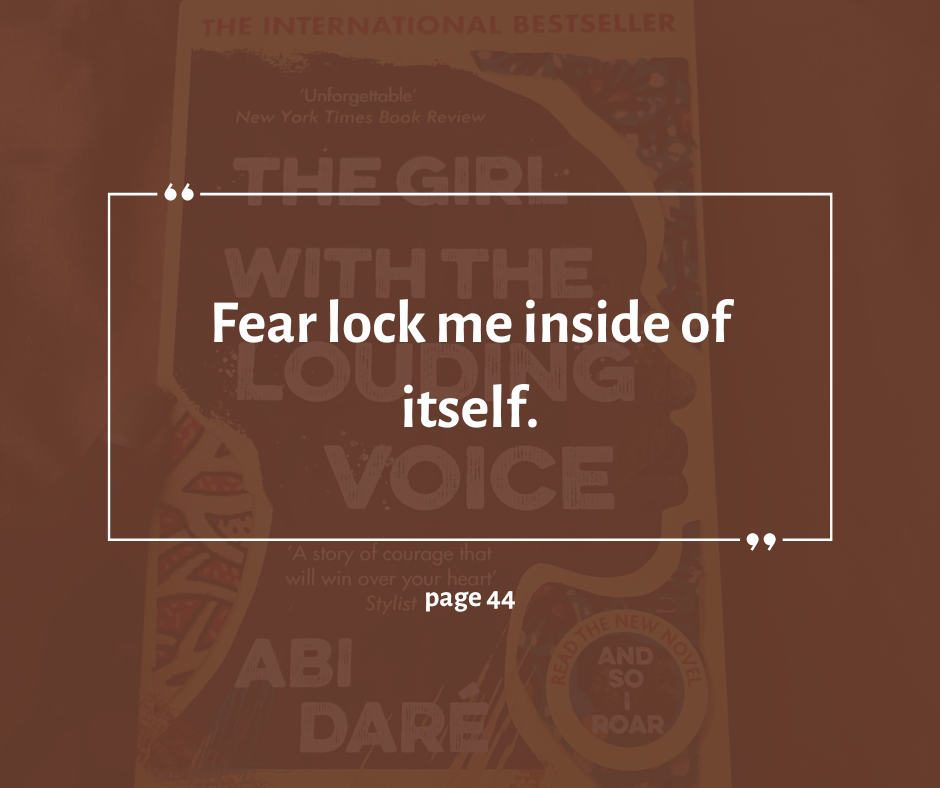
Literary Postmortem: The Girl With the Louding Voice by Abi Daré

Things just kept getting worser and worser with each page I turned in this read, the sheer volume of violence and injustice both overwhelming and infuriating. Which is why I could barely put it down and sometimes spent an extra two or three hours reading before bed, I was captivated by Adunni and Daré’s literary presentation of life in rural and urban Nigeria in the early 2010s. 

I had heard much about the protagonist, Adunni before even opening this book from friends and people I go to the same internet with, mostly because of how she speaks. Daré makes the deliberate decision to write Adunni’s thoughts, fears and hopes in the broken English of a 14-year-old who didn’t quite finish school, which is true to the character and adds so much honesty to her story. The “nonstandard English” spoken by Adunni was less confusing than expected and often times more descriptive to me of the situations she found herself in, phrases like “the sky have eat up the morning sun” to describe an overcast sky, and “cold is spreading rashes all over my body” to describe goosebumps, provide such clear imagery. I think for me, the language alone was the thing that allowed me to be steeped in Adunni’s innocence and fostered an intimacy that kept me ‘on side’ no matter how bad things got for her.

Adunni’s tale is coloured by various indignities, violations and brazen injustice. The thing that keeps readers afloat is her determination to somehow overcome those odds. I usually hate an ‘against all odds’ narratives, in which wave after wave of evil is meant to simply be thwarted by sheer resilience, but Adunni’s character implores you to stay with her through all of it. She is fuelled by the prospect of different outcomes, which keeps your hope alive as well, despite the deep poverty, child marriage, domestic violence and slavery of it all. 

The chapters are short but jam-packed, which makes for a fast-paced, page-turning adventure. Daré has written some of the most endearing and repulsive characters, people like Big Madam and Morufu filled me with unspeakable rage. While their context and complex backgrounds are unpacked and do shed light on why they are the way they are, it’s a cold comfort when the object of their frustration and abuse of power is a little girl.

From about halfway through, I appreciated and even looked forward to the foreshadowing at the start of chapters, provided by whatever fact was quoted from ‘The Book of Nigerian Facts’. I like my fictional reads injected with some historical tidbits that feed my insatiable need to know things. The facts about Nigeria were fascinating and sobering, for example: 

“Fact: Child marriage was made illegal in 2003 by the Nigerian government. Yet, an estimated 17% of girls in the country, particularly in the northern region of Nigeria, are married before the age of 15.” – page 194/Chapter 35

I was looking forward to finding out some more of these revelatory facts in the book once I purchased a copy, only to find it was a fictional book used for the purposes of the narrative in the pages of this novel 😦 There is, however, a Nigerian Facts Book published in 2022, which I imagine aims to do the job of the book Adunni uses to learn about her country and her life really. 

In short, it’s a harrowing but highly entertaining read, filled with twists and turns that will still your sensibilities. I will probably never read it again because of how much trauma lives in it’s pages but I would recommend it. Best bits below.

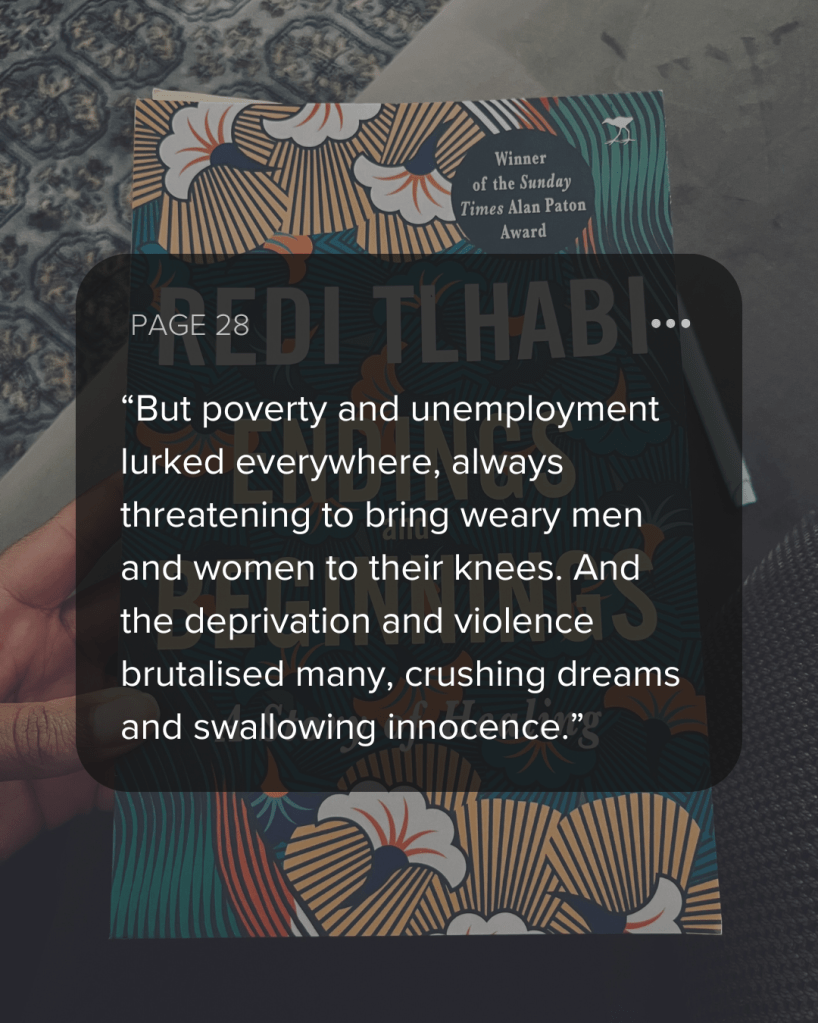
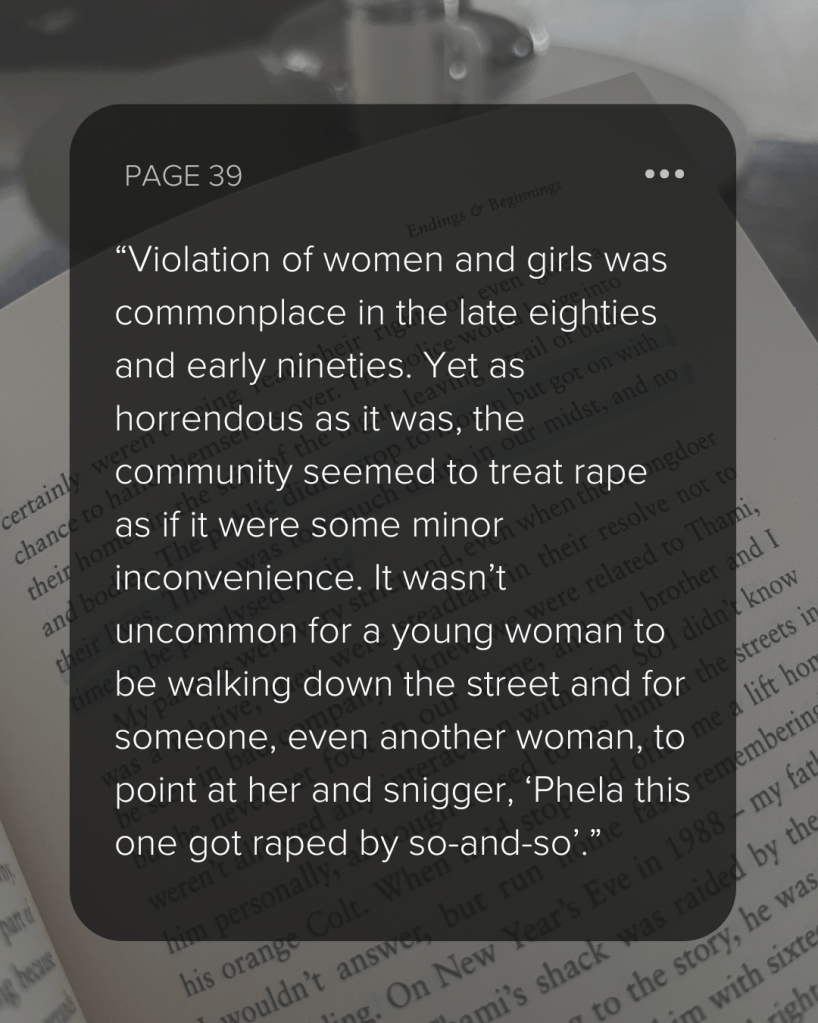
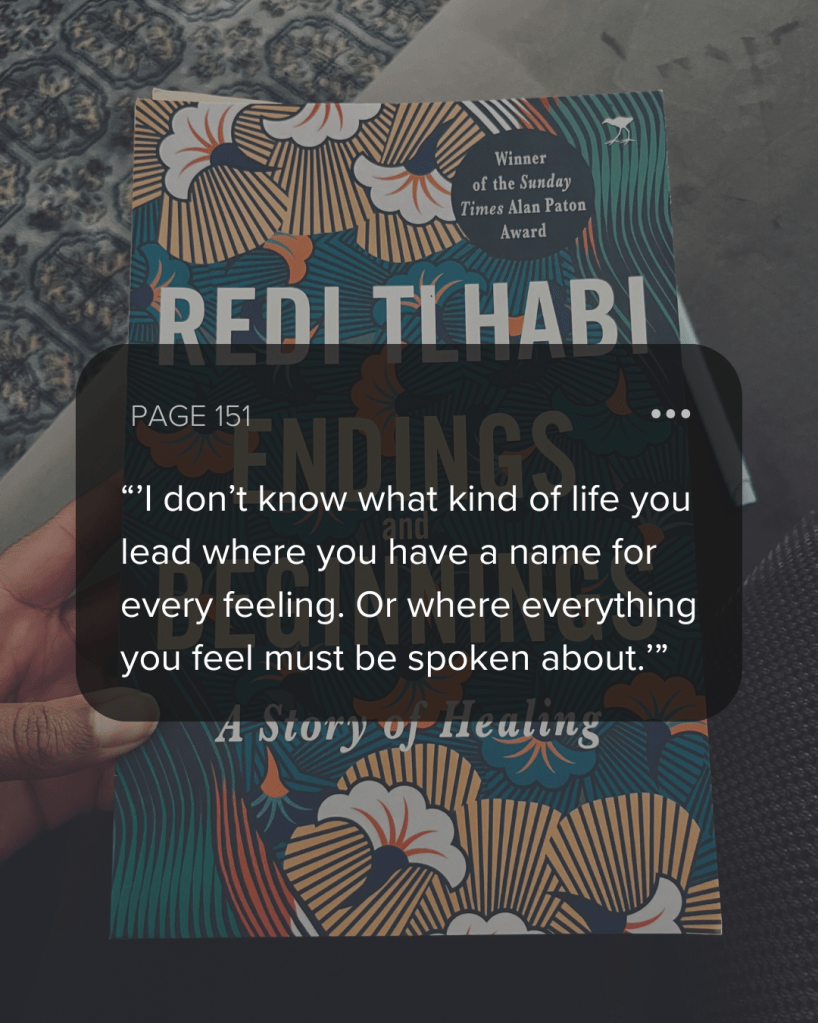
Literary Postmortem: Endings and beginnings

The fragility of life and the devaluation of individual lives in South African society swung on a pendulum throughout the 288-page stage that this memoir played out on.

For transparency’s sake, I must declare that I am a certified Redi Thlabi stan, she’s an incredible journalist and thinker I have always looked up to, and that no doubt coloured my reading somewhat. I picked my copy up at a recent book sale by publisher, Jacana, for a steal (one of those pay-per-kilogram sales – best!) Knowing Thlabi’s public persona quite well, I went in with quite specific assumptions about what her memoir might be like, and boy was I wrong on every count. Nothing could have prepared me for the twisted tale of a great first love marred by violence, manipulation and neglect. Sjoe, I was never ready shem.

Without giving away much more of the plot, I will say that the story that unfolds won’t be difficult to summon into ones imagination, Thlabi writes with a careful balance of honesty, warmth and clarity that transports you to the same street corners, the end of longing stares and swirls of despair that she experienced. It’s a reminder of how complex human beings and human relationships can be. Thlabi illustrates just how thin the line is between our precious inner lives and the relived realities that threaten it day and night. Grief stalks the pages from start to finish, the intensity of it varied from part to part and chapter to chapter, but ever present nonetheless.

Without being glaringly obvious about it, a geographic and historical profile of Soweto is sketched and helps root readers in place. The passage of time can also be seen through the lens of the location itself, ensuring that the past and present are delineated well. The lives of ordinary South Africans (and Southern Africans) during Apartheid always fascinate me, because they help us fill in the gaps that pure political and historical accounts can not. One of my favourite parts of the memoir was an account of how a central character risked life and limb to do his bit to assist in the anti-Apartheid movement. I appreciate accounts like this because the collective memory of our history can be narrow and solely focused on the people with bridges and buildings named after them, which is a distortion of how many truly played their part to fight off an oppressive regime.

Would I read it again? Nah uh. While intensely personal and revealing, I think it’s the kind of work that doesn’t necessitate revisiting when you are done reading it. Much like Khwezi, Thabi’s second book, it winds you so much that the very idea of bracing for impact again just doesn’t seem possible. But like Khwezi, it is a masterclass in using deep listening and authentic connection to navigate through one’s curiosity and sense of justice.

Some of my best bits below:

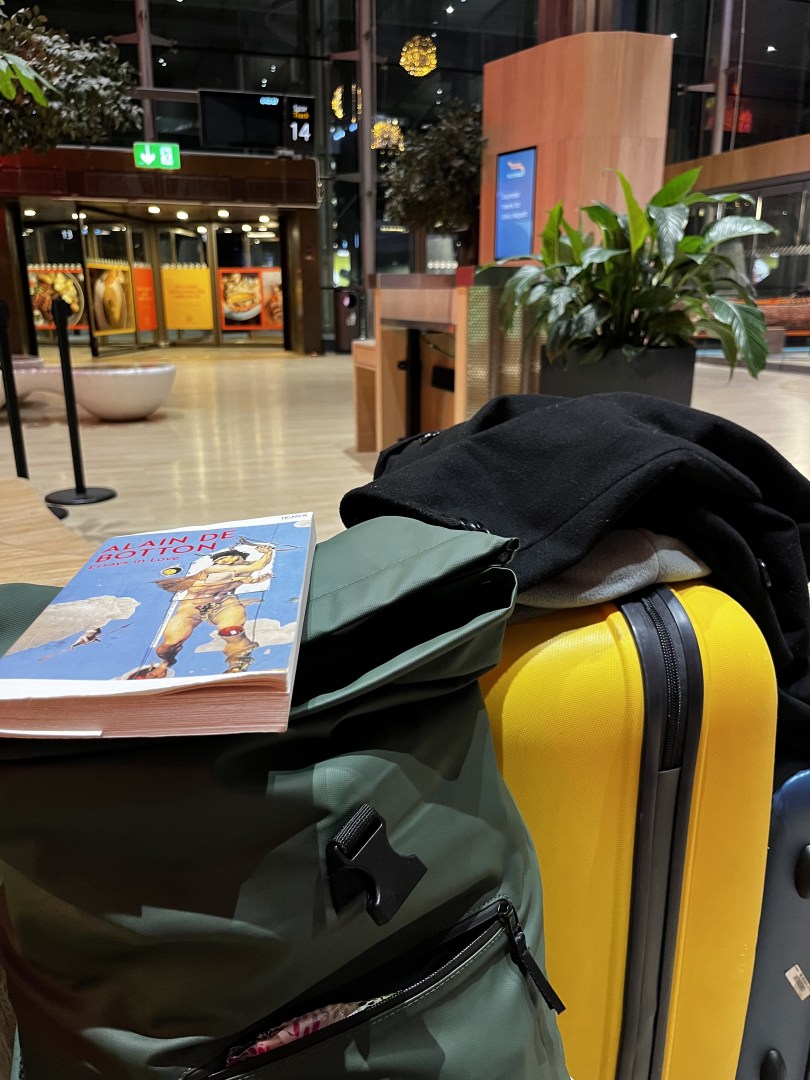
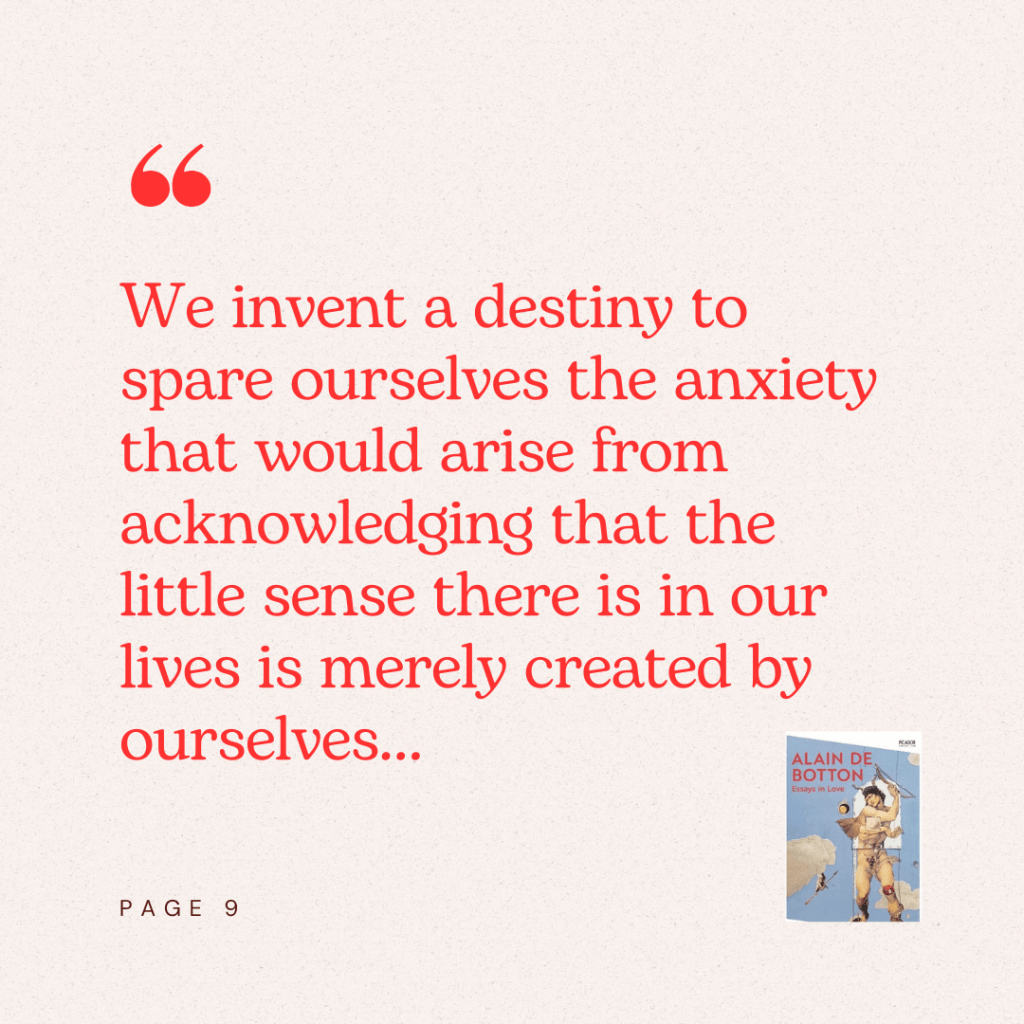
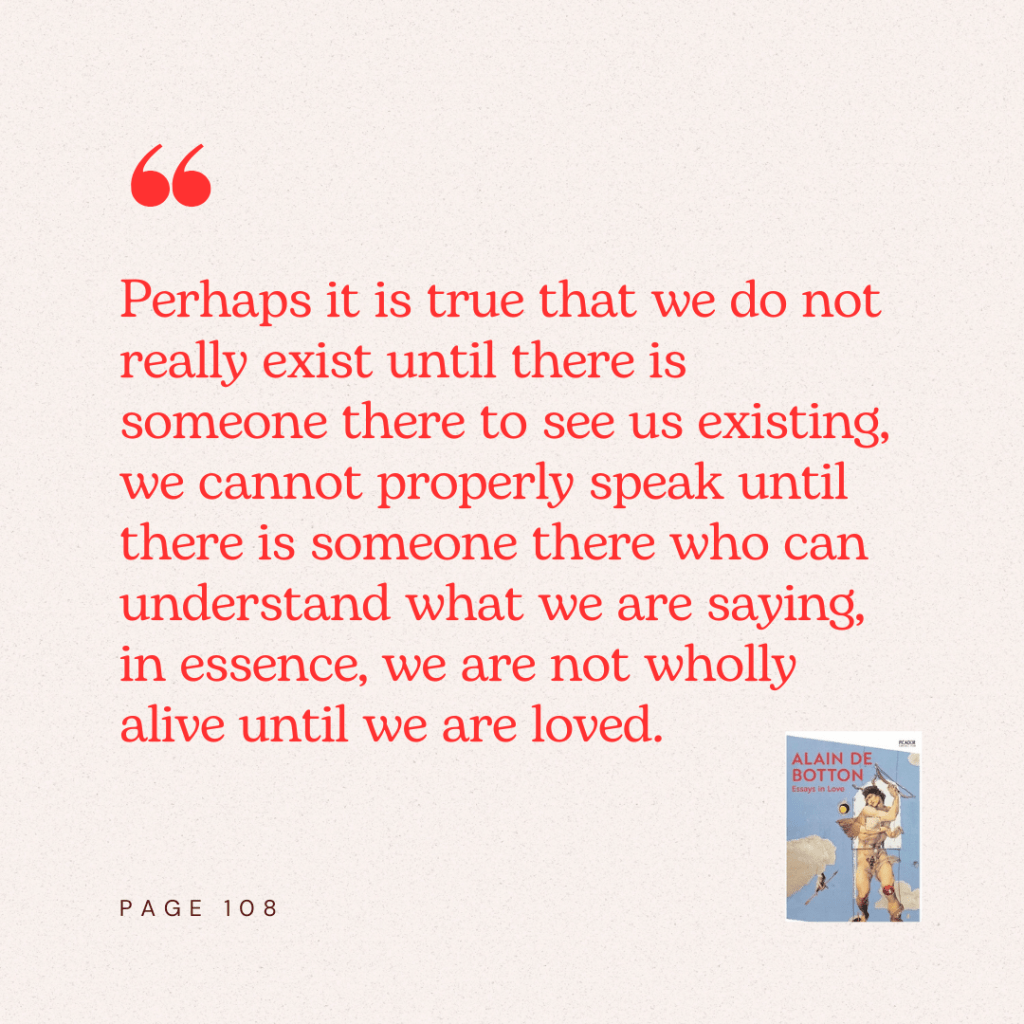
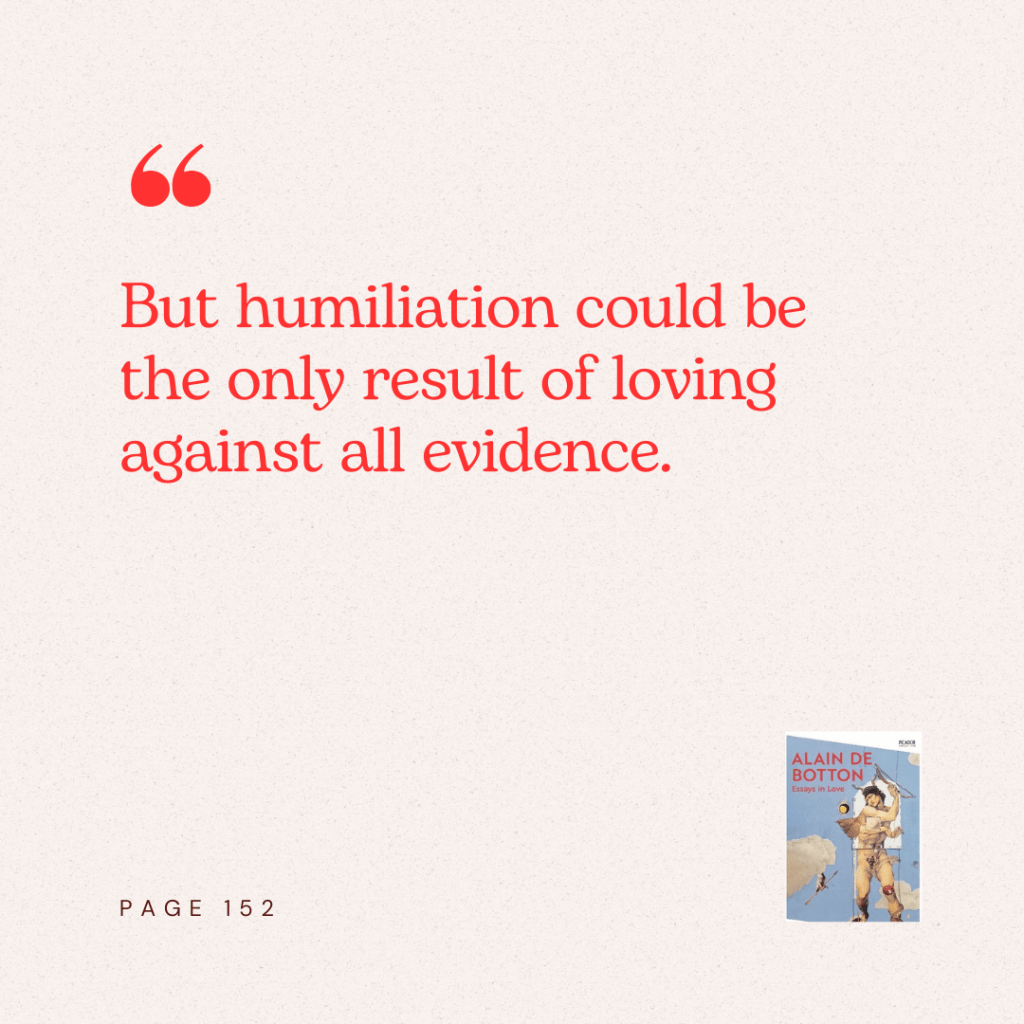
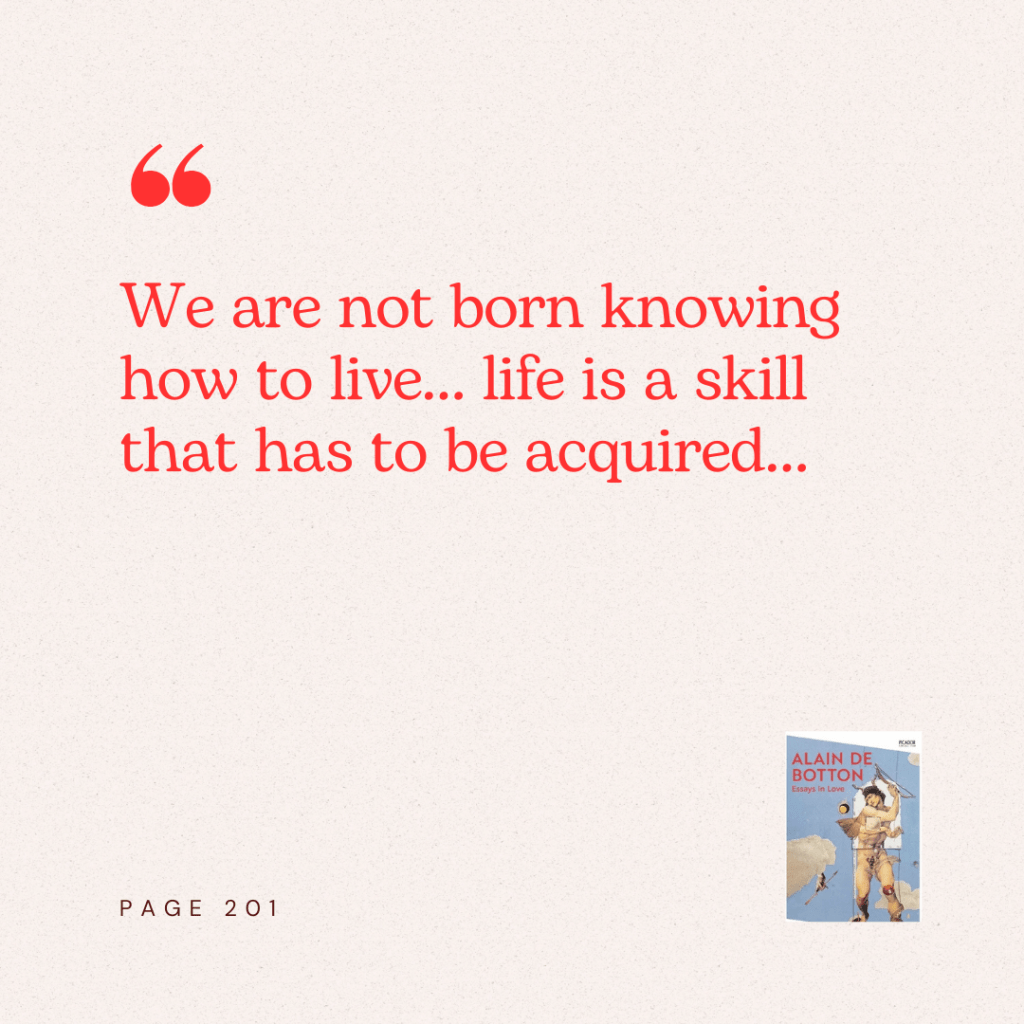
Literary Postmortem: Essays in Love

I know the internet girlies tell us we should never spin the block, but let me tell you that doesn’t count for books and the second or third or fourth time is often better than the first.

I first read Alain de Botton’s Essays in Love some eight or so years ago when I joined a new book club shortly after moving to Cape Town to start a new gig and life. I remembered laughing and nodding along a lot, so I decided to pick it up again when I needed a pick me up a while back. My slim recollection was correct, I laughed and nodded along more upon my second read. Time and one too many relatable experiences also made sure that I cried a bit too this time around.

As someone who often has to imbibe whatever can be learned about relationships through external media and anecdotes, the writing style in this book invited an intimacy which placed me in the middle of the room when they were fighting, alongside him on taxi rides and embedded in the neural networks that carried his stream of consciousness. De Botton allows us to be flies on the wall, inviting us into this relationship and its journey from start to end. With chapter titles like ‘The Fear of Happiness’, ‘Romantic Terrorism’ and ‘Psyco-Fatalism’ one is never too far from learning some cool historical and philosophical insights while relating to the more personal linkages. The numbered paragraphs in said chapters initially look like an odd choice but it actually helped move the narrative along quite neatly.

The critique of modern love and our strange passage through it remains my most memorable takeaway from this book; it is reflective and honest about what it takes to be with another person and highlights the inner conflicts that ultimately make/break such unions. Upon a second read, I probably like it more now than I did as the hopeful romantic I was when I read it some eight years ago.

As always, the best bits below:

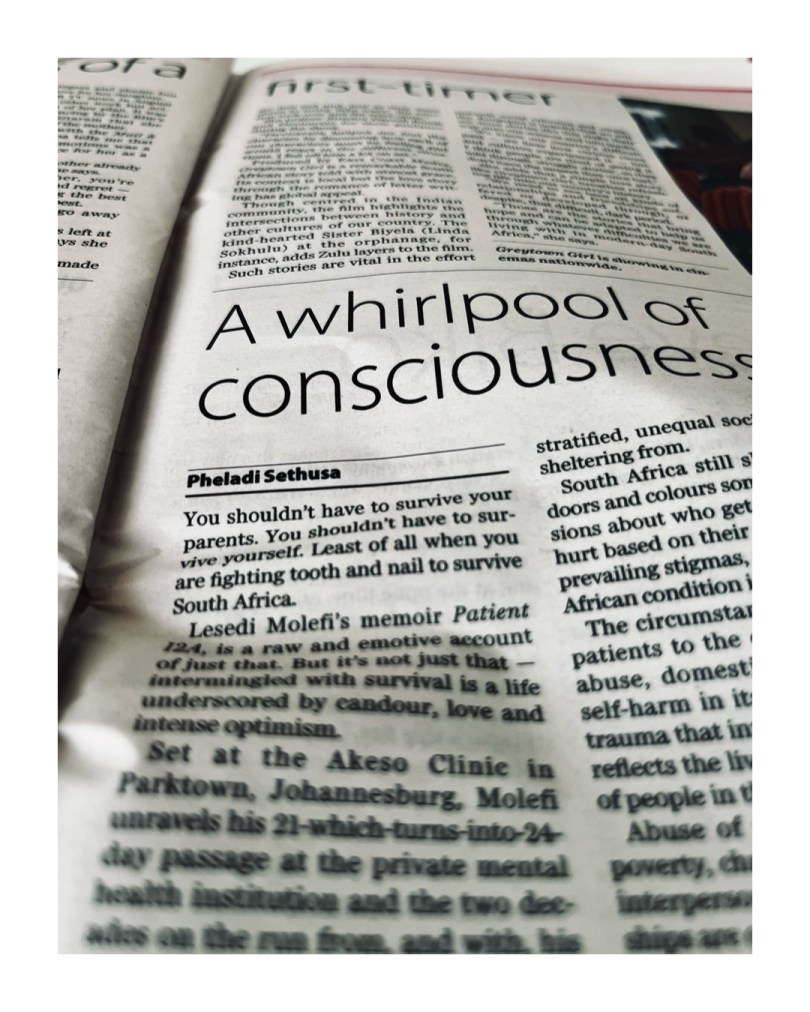
Lesedi Molefi’s Patient 12A is a whirlpool of consciousness

**First appeared in the Mail & Guardian on Friday, September 27 2024.

You shouldn’t have to survive your parents. You shouldn’t have to survive yourself. Least of all when you are fighting tooth and nail to survive South Africa.

Lesedi Molefi’s memoir Patient 12A, is a raw and emotive account of just that. But it’s not just that — intermingled with survival is a life underscored by candour, love and intense optimism.

Set at the Akeso Clinic in Parktown, Johannesburg, Molefi unravels his 21-which-turns-into-24-day passage at the private mental health institution and the two decades on the run from, and with, his family that necessitated him checking in in the first place.

Passages of mind: Lesedi Molefi’s memoir Patient 12A explores his battle with mental illness. Photo: Thabiso Molatlhwa/Richart Productions

Some of the factors include parental abandonment; managing the symptoms and consequences of undiagnosed mental health issues and constant uprootedness and hunger. 

Tipping the scales ever so slightly, and perched on the other side of these circumstances, is loyalty, creativity and unbridled self-belief.

With my previous insights into stays at mental health facilities limited to the accounts in Sylvia Plath’s The Bell Jar and Ken Kesey’s One Flew Over the Cuckoo’s Nest, I had braced myself for coldness and rigidity, but was pleasantly surprised and relieved when, instead, the walls that house this clinic were safe and warm. This is because of something unique — the people Molefi finds there, a “cross-section of ordinary South Africans”, as he calls them.

Together they parse their traumas, relate and commune authentically. 

Running alongside formal treatment sessions and various forms of therapy, this community of patients provides another lifeline to, and through, one another. 

But it isn’t all kumbaya — the clinic and its patients still mirror the stratified, unequal society they are sheltering from.

South Africa still slips under the doors and colours some tough discussions about who gets to hurt and be hurt based on their race, gender and prevailing stigmas, proving the South African condition is inescapable.

The circumstances that led other patients to the clinic include drug abuse, domestic abuse, grief and self-harm in its various forms. The trauma that informs their inner lives reflects the lived realities of millions of people in this country.

Abuse of power, the violence of poverty, chronic neglect and broken interpersonal and familial relationships are common threads. 

This external backdrop of extreme inequality, and the violence thereof, must be surmounted daily, an impossible task for anyone, much less someone without the socioeconomic resources that afford one relative safety, space and access to process with grace and dignity.

The most ubiquitous and immersive device in the memoir is “the noise”, the literary and internal universe Molefi steeps us in. 

The noise emanates both from him and through him. It is a whirlpool of his consciousness and internal struggles, used to transport us fluidly from the past to the present with careful clarity.

While he describes the noise as chaotic and disruptive, for those reading this work, the noise is an expert and intimate guide through the passage of his mind. 

The complicated thoughts and feelings that colour and blur his cognition help readers  to identify where and how they intersect, overlap and relate to the vast array of pain points chronicled.

At the launch of Patient 12A a few weeks ago, and in subsequent interviews, the author has been at pains to emphasise that this isn’t a self-help book. He goes out of his way to avoid listicles and passages filled with advice and definitions from medical and psychology journals.

But through the careful reconstruction of tobacco-stained conversations in an inner-city courtyard, he does the work of inviting people to see themselves through his personal anguish and through the highly relatable experiences of the other patients “doing time”.

Without spoiling it for anyone yet to read it, the memoir’s true heartbeat and nerve centre — and by extension Molefi’s — are his mother and sisters. From a very young age he is driven and compelled to protect them, but he can’t, and that inability taints every attempt at a semblance of normality — something he yearns for from their first uprooting through to their last.

Initially, one can be taken by the adventure that swirls around the first few “trips” their mother takes Molefi and his siblings on, the promise of greener pastures. But it soon turns into concern and quiet rage when you realise that the four of them are in fact being dragged from one terrible situation to the next.

Homelessness and hunger are always assured but not much else. The children try to grapple with their mother’s simmering mental illness and keep one another fed, educated and away from the monsters that lurk in the shadows as they move from one precarious place to the next.

The scars of their experiences play out in different ways and at different stages for each of them but Molefi articulates his payoff as “a strange education”. 

By the time he is in his twenties, he is a master of survival — not quite the education he wanted but the one that  has carried him thus far.   

My copy of the book is dog-eared, tatted up in orange highlighter, has travelled on planes and trains, and watched me drink copious amounts of coffee as I struggled to put it down.

What really carries one through the 408 pages is Molefi’s ability to write about pain and trauma with a level of honesty and vulnerability that invites one in and that, quietly, asks one to look at him in the context of “the facts of his life”, directly in the eyes — and not look away when he shows you who he is.

Through the whispers and shouts of the noise, Molefi speaks himself back to life. 

It is prose, it is poetry, it is beautiful.

——————————————

Patient 12A is published by Pan Macmillan South Africa.

REVIEW: We are Winnie, Winnie is us.

This is the message that reverberated in my being when I came home from watching The Cry of Winnie Mandela at the Market Theatre last month (May 2024).

The set of The Cry of Winnie Mandela at the Market Theatre in Johannesburg. A quote from Winnie Nomzamo Mandela adorns the wall. Photo: Pheladi Sethusa

Adapted from the novel of the same name written by Njabulo S. Ndebele, the play felt like an apparition straight from the book cracked open at the spine. The novel had been sitting on my bookshelf since a random trip to Clarkes in Cape Town with my brother in 2019, leaving the shop that day with the gifted copy I had imagined I would be giving myself over to its contents soon, but life and living happened – until I had just two weeks before curtains up to get stuck in. Luckily for me once I started, I could barely put it down! It is a form bending, intimate and harrowing account of womanhood, loneliness and the alienation of strength (a strength required, not innate).

I initially bought tickets based off of who was directing the play alone. Momo Motsunyane. A fire. A force. I have never seen Momo on stage and been left unmoved, close to tears and deliriously joyful all at once, which is how I knew this would be a production that would leave me altered after experiencing it. Walking into the intimate theatre, with the pensive writer pacing and muttering to himself, I knew immediatley that we were about to be transported into another realm.

If I had to describe this book in one word it would be: personal, no intimate. From the very first sentence in the introduction – which is inward looking – to the last – which throws forward to a hopeful future – one is thrust into the inner lives of the writer (Njabulo S. Ndebele) and his characters with their noses pressed up against their insecurities, humiliation, longing, hurt and unwavering affections.

Instead of attempting to write a clear-cut biography of a woman almost “too big” to capture fully, the writer chooses to tell the stories of ‘ordinary’ women and through their telling, begin to peel back the layers of a figure steeped in mystery, shrouded in controversy and shielded by personality. Ndebele also writes the stories of four woman in Apartheid South Africa with a tenderness and rawness that was unexpected but most welcome.

While the stories cover themes from adultery, to sacrifice and even sexual liberation, at their core is one constant theme – abandonment. The women chronicled are alone. Some are alone in their marriages, others alone as extras in the lives of others and one alone in her revolutionary persona. Through no decision-making of their own, their circumstances leave them forever altered by their chronic aloneness and their lives turned into waiting rooms.

“When you are waiting, you know the meaning of desire: the desire to be the only woman (even in a illicit relationship); the desire for secrecy and pleasure of remaining unacught; the desire to prolong intimate moments beyond time and circumstances…”

– Delisiwe S’kosana, page 64

The novel felt like it was written to be performed and this became apparent as it unfolded before me in the Barney Simon theatre. Perhaps this was my own bias having just read the novel before watching, no experiencing it on stage, but it felt less like an adaptation and more of a rendering. The cast made up by Lesley “Les” Nkosi (Professor Ndebele), Rami Chuene (Mmannete Mofolo) Mofolo, Pulane Rampoana (Mamello Molete), Siyasanga Papu (Delisiwe Dulcie S’kosana), and Nambitha Mpumlwana (Winnie Nomzamo Mandela) brought Ndebele’s words and Motsunyane’s vision to life perfectly. Using song, wit and conversation to soften the ‘mbhokoto’s’ on stage.

I appreciate how the novel and the play alike aim to move beyond the historic accounts of stoicism and duty where black women are concerned, and instead asks the audience to consider and contemplate their vulnerabilities and extend them grace. They do the same for one another in their otherworldly conversations between Madikizela-Mandela and Cleopatra. I wish I could have seen it on stage one more time before the run was over, but I guess I will always have the novel to return to.

Fairy tales for little girls whose identities are all too often marginalised

“CAPE TOWN 25 June 2016 – Twenty five year old actress and now author, Buhle Ngaba has written a children’s book aimed at empowering young black girls. Copies of “The Girl Without a Sound” will be available in bookstores next month.”

I really enjoyed my interview with Buhle, she is the personification of #blackgirlmagic and I will enjoy watching her star burn even brighter in months and years to come.

Source: eNCA

Books For No Bucks

FREE BOOKS: Charmaine Pule, Media and Marketing Officer for the SRC shows Wits Vuvuzela some of the books they have collected for their book drive. Photo: Pheladi Sethusa

WITS students now have the opportunity to loan textbooks for free. Paul Maluleka is the brains behind the SRCs latest campaign that collects textbooks and books for students who cannot afford to buy books.

Earlier this year the SRC was involved in helping excluded students with their problems. They frequently complained that buying books and textbooks was a problem. They cannot all afford to buy new textbooks each semester.

The book drive is one way of fixing that problem said Pule, 4th year Education and Media and Marketing Officer for the SRC. She is running the book drive in conjunction with Maluleka in a bid to help alleviate some of the stress that students face when it comes to lack of access to resources.

They are looking for students to donate their old books to the campaign. Donated books will be given out on loan to students in need.  It’s a fairly simple process whereby students need to fill in a form from the SRC office. The students loan the books for however long they are needed..

So far, the SRC have received engineering and law textbooks. While this is appreciated, they need more textbooks and books from across all faculties and disciplines to broaden the campaign’s reach.

In line with the book drive, the SRC will be launching  a campaign called ‘Each One, Teach One.’ This campaign will look at donating a variety of things to matric students. Things like stationary, school uniforms and matric dance dresses. The objective of this campaign will be to support matric students who are in need. When dropping off the donated items, SRC members will also hand out food parcels and interact with the students.

Pheladi Sethusa