Literary Postmortem: Endings and beginnings

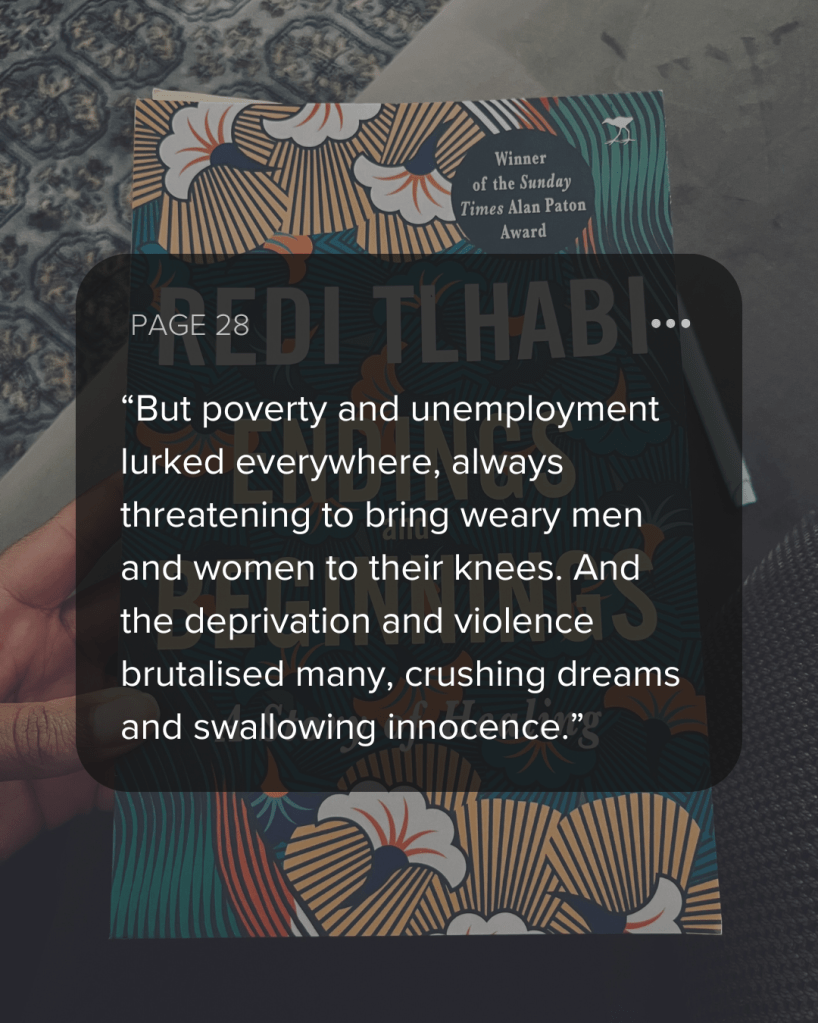
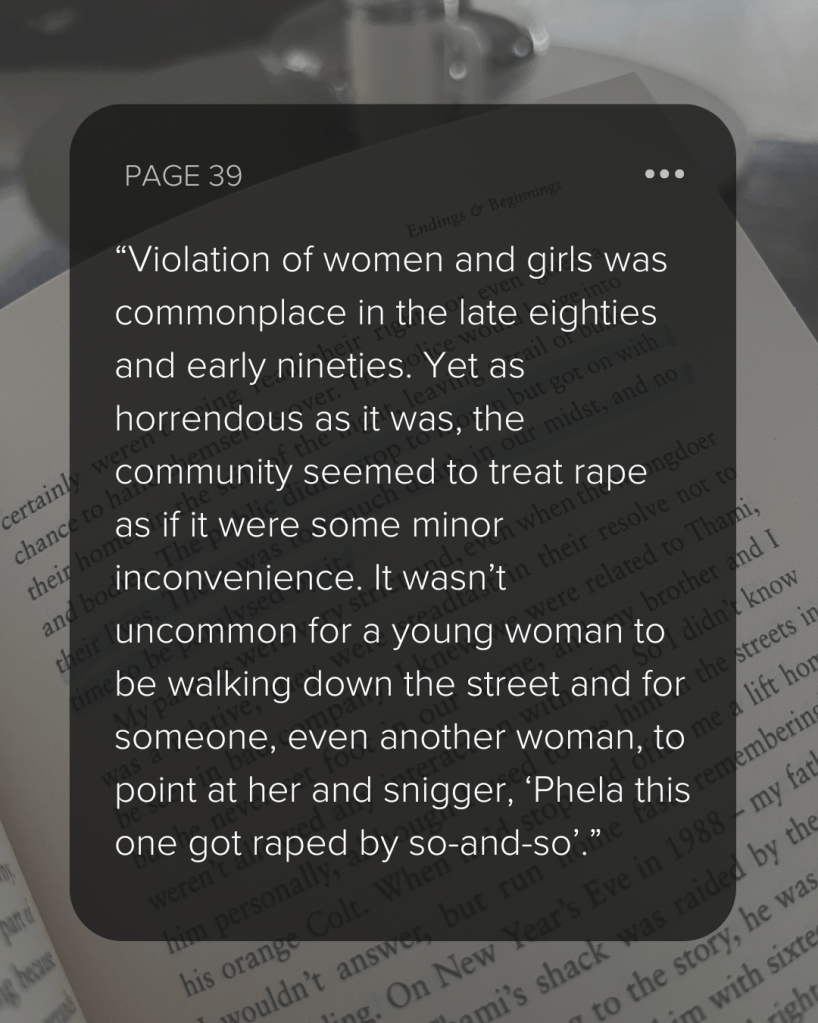
The fragility of life and the devaluation of individual lives in South African society swung on a pendulum throughout the 288-page stage that this memoir played out on.

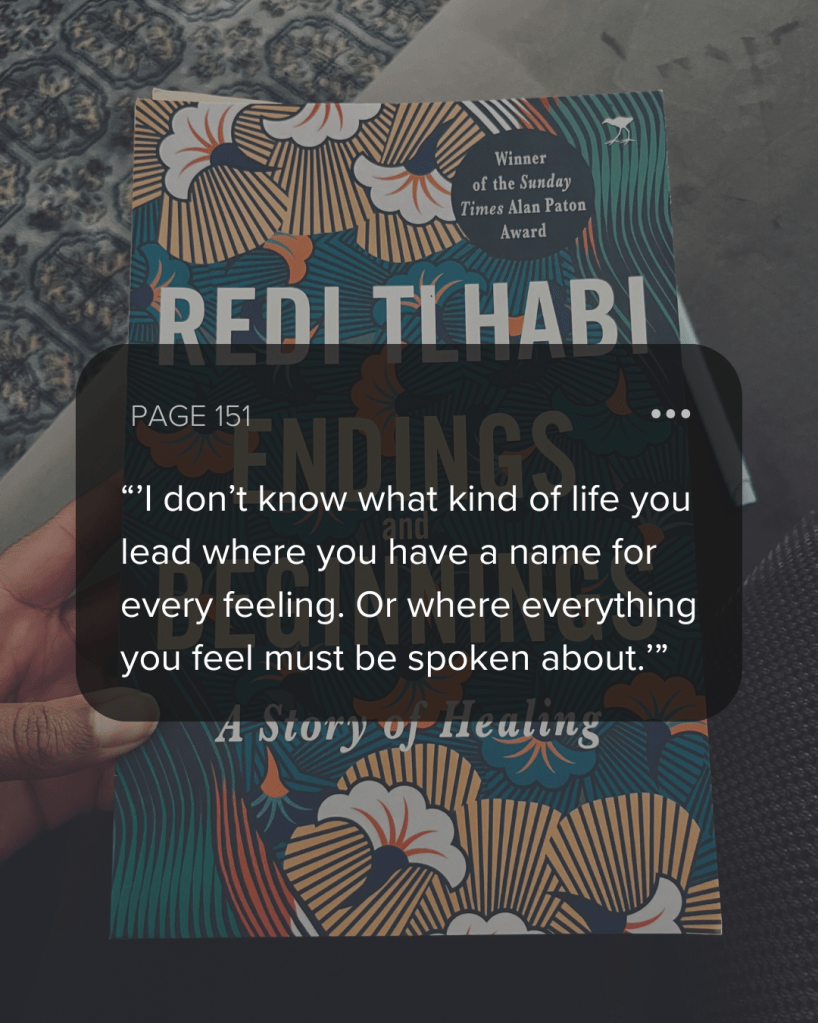
For transparency’s sake, I must declare that I am a certified Redi Thlabi stan, she’s an incredible journalist and thinker I have always looked up to, and that no doubt coloured my reading somewhat. I picked my copy up at a recent book sale by publisher, Jacana, for a steal (one of those pay-per-kilogram sales – best!) Knowing Thlabi’s public persona quite well, I went in with quite specific assumptions about what her memoir might be like, and boy was I wrong on every count. Nothing could have prepared me for the twisted tale of a great first love marred by violence, manipulation and neglect. Sjoe, I was never ready shem.

Without giving away much more of the plot, I will say that the story that unfolds won’t be difficult to summon into ones imagination, Thlabi writes with a careful balance of honesty, warmth and clarity that transports you to the same street corners, the end of longing stares and swirls of despair that she experienced. It’s a reminder of how complex human beings and human relationships can be. Thlabi illustrates just how thin the line is between our precious inner lives and the relived realities that threaten it day and night. Grief stalks the pages from start to finish, the intensity of it varied from part to part and chapter to chapter, but ever present nonetheless.

Without being glaringly obvious about it, a geographic and historical profile of Soweto is sketched and helps root readers in place. The passage of time can also be seen through the lens of the location itself, ensuring that the past and present are delineated well. The lives of ordinary South Africans (and Southern Africans) during Apartheid always fascinate me, because they help us fill in the gaps that pure political and historical accounts can not. One of my favourite parts of the memoir was an account of how a central character risked life and limb to do his bit to assist in the anti-Apartheid movement. I appreciate accounts like this because the collective memory of our history can be narrow and solely focused on the people with bridges and buildings named after them, which is a distortion of how many truly played their part to fight off an oppressive regime.

Would I read it again? Nah uh. While intensely personal and revealing, I think it’s the kind of work that doesn’t necessitate revisiting when you are done reading it. Much like Khwezi, Thabi’s second book, it winds you so much that the very idea of bracing for impact again just doesn’t seem possible. But like Khwezi, it is a masterclass in using deep listening and authentic connection to navigate through one’s curiosity and sense of justice.

Some of my best bits below:

Grain meet blur

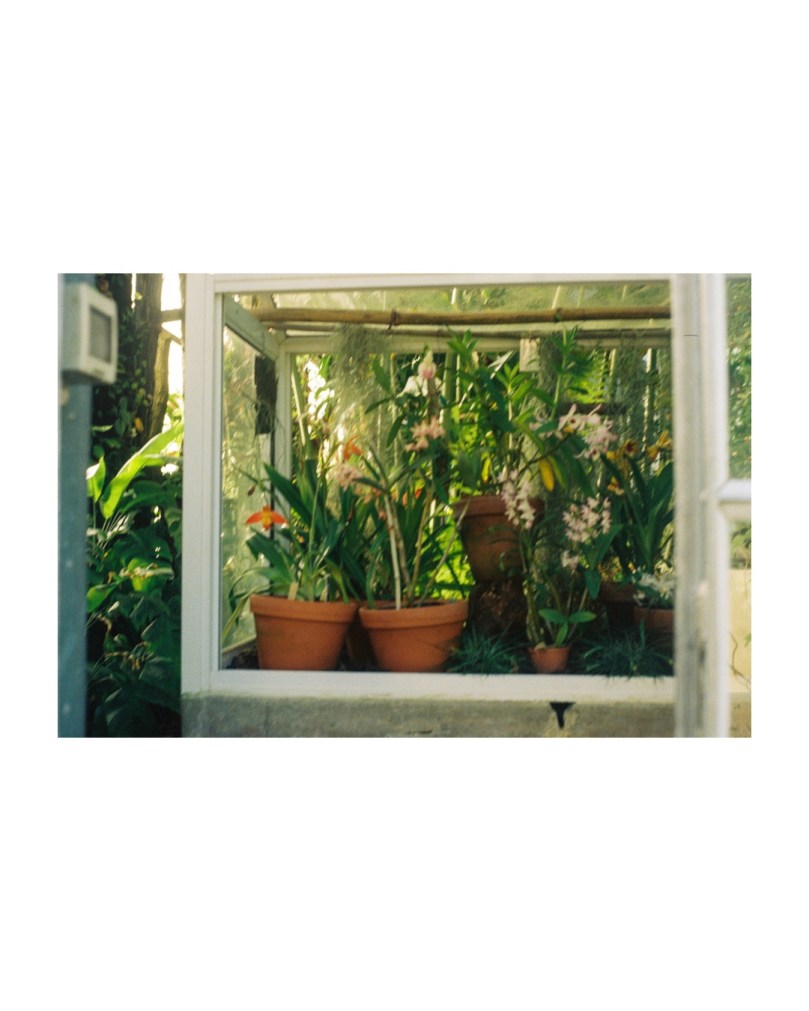
Finally developed another roll of film – averaging about a year a roll – lol. Have just bought some more film so hoping to change this habit quite quickly and take my camera along on every adventure, big or small, I embark on in the next few months.

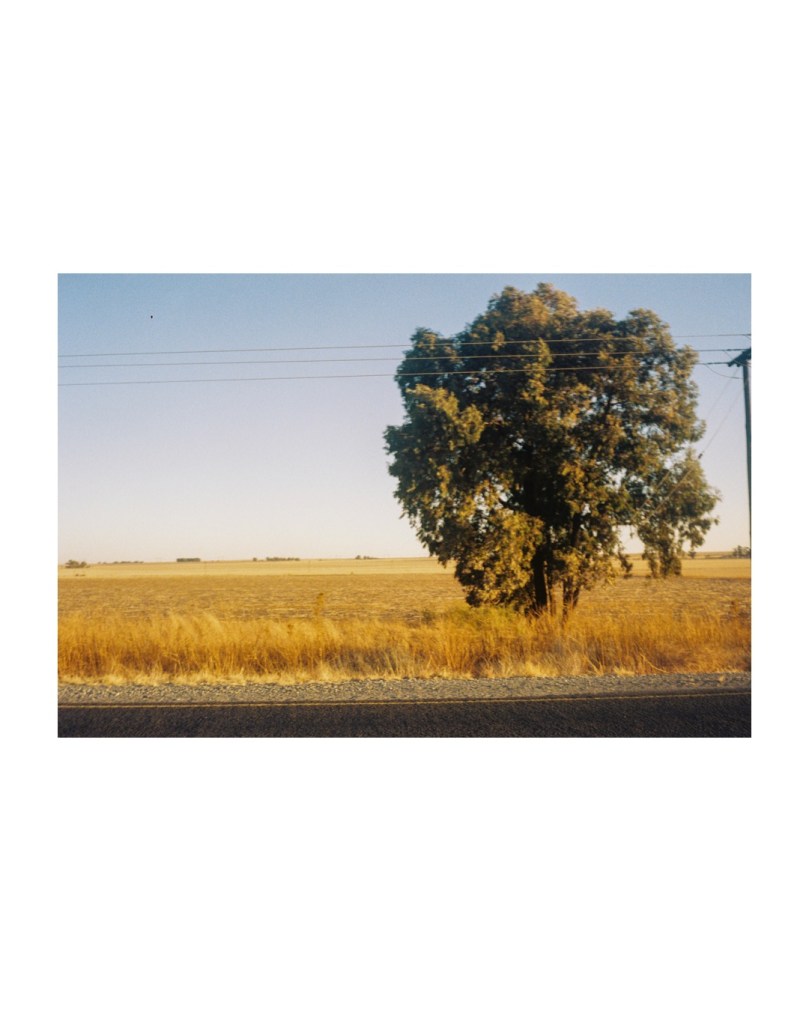
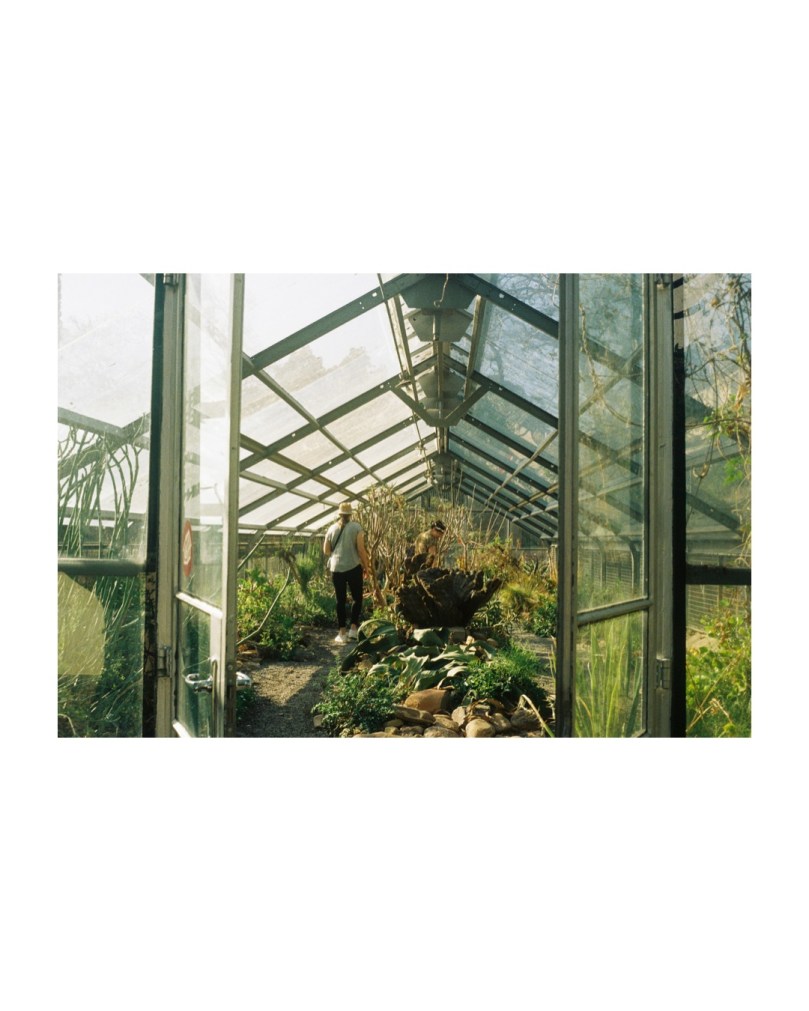
This roll covered quite a bit of ground, it travelled with me to a speed dating event, a road trip and girls’ weekend away in the Vaal, an especially magical few days in Cape Town, a side quest to a botanical garden at a conference in Stellenbosch and a final trip with my class of postgraduate students at Constitutional Hill. Very different but very special memories.

I love how much more selective I am when shooting on film, and which moments feel special enough to etch onto film, I’ve missed the intimacy with memory this brings. Additionally, the imperfection in some of my frames feels almost signature and unshackles me for a moment from the obsessive need to have the right f stop, focus and ISO with each shot – something I am trying to unlearn as I shift between shooting on an SLR and my film camera.

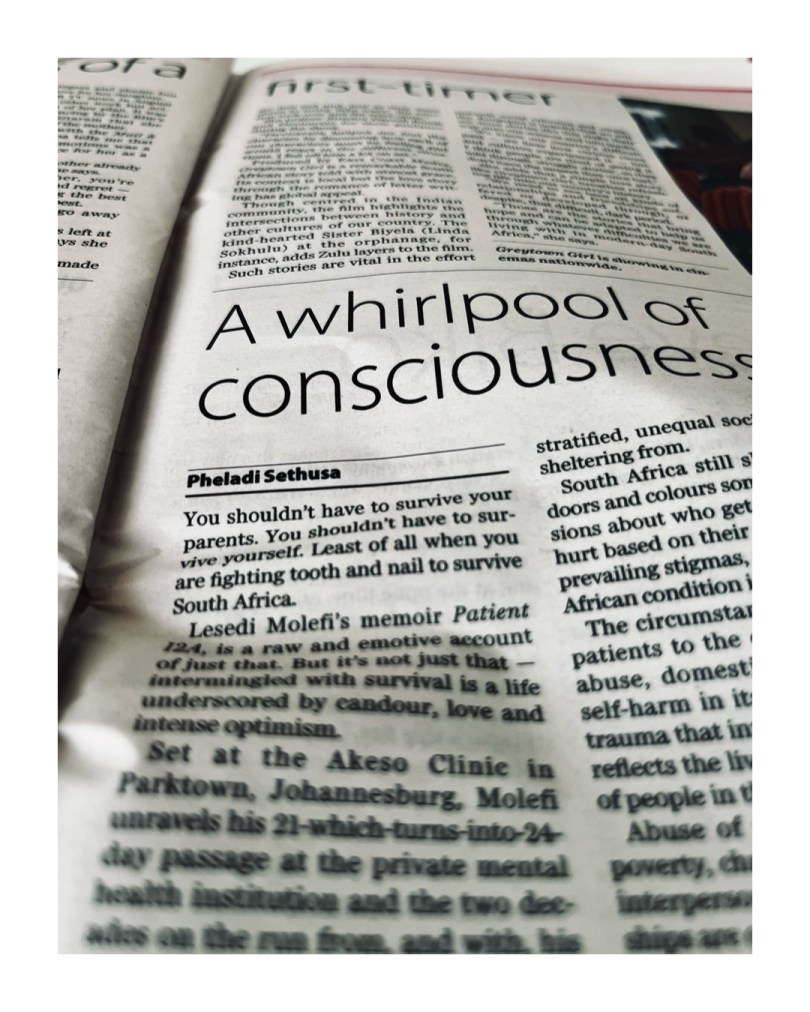
Lesedi Molefi’s Patient 12A is a whirlpool of consciousness

**First appeared in the Mail & Guardian on Friday, September 27 2024.

You shouldn’t have to survive your parents. You shouldn’t have to survive yourself. Least of all when you are fighting tooth and nail to survive South Africa.

Lesedi Molefi’s memoir Patient 12A, is a raw and emotive account of just that. But it’s not just that — intermingled with survival is a life underscored by candour, love and intense optimism.

Set at the Akeso Clinic in Parktown, Johannesburg, Molefi unravels his 21-which-turns-into-24-day passage at the private mental health institution and the two decades on the run from, and with, his family that necessitated him checking in in the first place.

Passages of mind: Lesedi Molefi’s memoir Patient 12A explores his battle with mental illness. Photo: Thabiso Molatlhwa/Richart Productions

Some of the factors include parental abandonment; managing the symptoms and consequences of undiagnosed mental health issues and constant uprootedness and hunger. 

Tipping the scales ever so slightly, and perched on the other side of these circumstances, is loyalty, creativity and unbridled self-belief.

With my previous insights into stays at mental health facilities limited to the accounts in Sylvia Plath’s The Bell Jar and Ken Kesey’s One Flew Over the Cuckoo’s Nest, I had braced myself for coldness and rigidity, but was pleasantly surprised and relieved when, instead, the walls that house this clinic were safe and warm. This is because of something unique — the people Molefi finds there, a “cross-section of ordinary South Africans”, as he calls them.

Together they parse their traumas, relate and commune authentically. 

Running alongside formal treatment sessions and various forms of therapy, this community of patients provides another lifeline to, and through, one another. 

But it isn’t all kumbaya — the clinic and its patients still mirror the stratified, unequal society they are sheltering from.

South Africa still slips under the doors and colours some tough discussions about who gets to hurt and be hurt based on their race, gender and prevailing stigmas, proving the South African condition is inescapable.

The circumstances that led other patients to the clinic include drug abuse, domestic abuse, grief and self-harm in its various forms. The trauma that informs their inner lives reflects the lived realities of millions of people in this country.

Abuse of power, the violence of poverty, chronic neglect and broken interpersonal and familial relationships are common threads. 

This external backdrop of extreme inequality, and the violence thereof, must be surmounted daily, an impossible task for anyone, much less someone without the socioeconomic resources that afford one relative safety, space and access to process with grace and dignity.

The most ubiquitous and immersive device in the memoir is “the noise”, the literary and internal universe Molefi steeps us in. 

The noise emanates both from him and through him. It is a whirlpool of his consciousness and internal struggles, used to transport us fluidly from the past to the present with careful clarity.

While he describes the noise as chaotic and disruptive, for those reading this work, the noise is an expert and intimate guide through the passage of his mind. 

The complicated thoughts and feelings that colour and blur his cognition help readers  to identify where and how they intersect, overlap and relate to the vast array of pain points chronicled.

At the launch of Patient 12A a few weeks ago, and in subsequent interviews, the author has been at pains to emphasise that this isn’t a self-help book. He goes out of his way to avoid listicles and passages filled with advice and definitions from medical and psychology journals.

But through the careful reconstruction of tobacco-stained conversations in an inner-city courtyard, he does the work of inviting people to see themselves through his personal anguish and through the highly relatable experiences of the other patients “doing time”.

Without spoiling it for anyone yet to read it, the memoir’s true heartbeat and nerve centre — and by extension Molefi’s — are his mother and sisters. From a very young age he is driven and compelled to protect them, but he can’t, and that inability taints every attempt at a semblance of normality — something he yearns for from their first uprooting through to their last.

Initially, one can be taken by the adventure that swirls around the first few “trips” their mother takes Molefi and his siblings on, the promise of greener pastures. But it soon turns into concern and quiet rage when you realise that the four of them are in fact being dragged from one terrible situation to the next.

Homelessness and hunger are always assured but not much else. The children try to grapple with their mother’s simmering mental illness and keep one another fed, educated and away from the monsters that lurk in the shadows as they move from one precarious place to the next.

The scars of their experiences play out in different ways and at different stages for each of them but Molefi articulates his payoff as “a strange education”. 

By the time he is in his twenties, he is a master of survival — not quite the education he wanted but the one that  has carried him thus far.   

My copy of the book is dog-eared, tatted up in orange highlighter, has travelled on planes and trains, and watched me drink copious amounts of coffee as I struggled to put it down.

What really carries one through the 408 pages is Molefi’s ability to write about pain and trauma with a level of honesty and vulnerability that invites one in and that, quietly, asks one to look at him in the context of “the facts of his life”, directly in the eyes — and not look away when he shows you who he is.

Through the whispers and shouts of the noise, Molefi speaks himself back to life. 

It is prose, it is poetry, it is beautiful.

——————————————

Patient 12A is published by Pan Macmillan South Africa.

Cite me or whatever

Sethusa (2024) or (Sethusa, 2024) or (Sethusa 2024) – any style will do really.

If you haven’t guessed by now, this is my not-so-subtle way of saying I have just published my first academic article in a peer-reviewed journal. Reimagining Through Crisis: How the Covid-19 Pandemic Changed the Fortunes and Futures of Journalism Schools and Graduates, is now available in African Journalism Studies. The open access article is free to read and download.

In this exploratory study, I look into the way the pandemic affected our graduating studies entry and introduction into the working world. In the last few years students had to add a global pandemic to the list which includes shrinking budgets, trust deficits, tanking circulation figures and more. The shifts in journalism make it a challenging industry to actively pursue, but students who eke out postgraduate degrees at journalism schools hoping to buck the trends and pursure their passions regardless. By looking squarely at honours students in the programme I teach in at the Wits Centre for Journalism, I track some emerging trends and discuss what they indicate, with journalism students, educators and practitioners in mind.

We are in the midst of an equally frustrating and interesting time, which means we can either spearhead change or fall victim to it. Give my article a read and let me know what you think.

Farm evictions persist amid land reform talks

Cape Town, 2 August 2018 – According to research by the University of the Western Cape, 2-point-3 million people have been displaced from South African farms since 1994. Just under half of them forcibly removed from land they worked and lived on for decades. As Parliament’s land hearings reach the Western Cape this week, we focus on one such eviction, in Stellenbosch. Farm workers say they’re not protected, and need better security of tenure, especially now that new legislation is being considered. eNCA’s Pheladi Sethusa has the story.