Same music, different people

By Pheladi Sethusa and Shandukani Mulaudzi

Pulling the short straw is something that happens a few times in your life. Sometimes you may be lucky and you won’t, this is life.
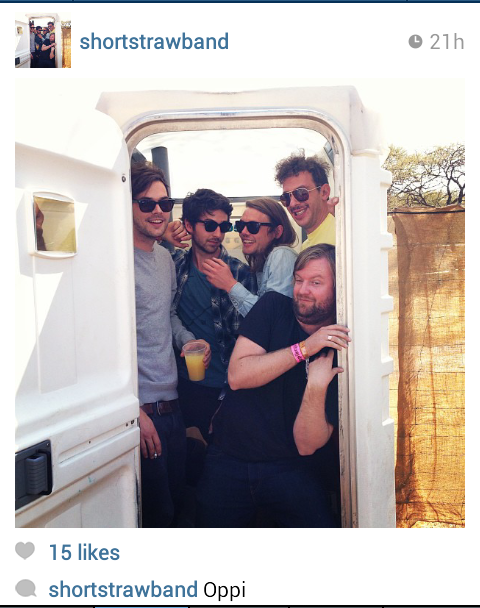
Screenshot_2013-08-10-12-10-21-1 ShortStraw

For the five man band ShortStraw, it was about the beginning of their career. They started out playing for no one then moved on to crowds of about 40 and now, they have two shows on the best Oppikoppi stages.

In an interview with the band, we told them ofour sad racist encounter the night before.

“That’s fucking bullshit. It’s fucking 2013 you can only laugh at people who still think that way,” said Russel, bass player for ShortStraw.

Russel told Wits Vuvuzela that one of the first black bands to play at Oppi was Kwani Experience and that was what sparked a cultural change at Oppi.

“Black bands used to be apprehensive. But once they played and were received well they changed their minds about the fest.”

Tom added that music is an experience for everyone and something that should bring all people together.

After pulling the short straw on day one, we were on a mission to find some diversity at Oppikoppi.

Traditional music moves

FIRST OPPI: Bongeziwe Mabandla plays his first set at the festival. Photo: Pheladi Sethusa

The Ray-Ban stage, where the incident happened the night before was where we found a new enlightening Oppi experience.

The act was, Bongeziwe Mabandla, who enchanted the crowd with his sweet traditional melodies in isiXhosa. His sound was one we cannot put our finger on but it made us feel like we were watching a male Thandiswa Mazwai.

The crowd, representative of South Africa’s overrated rainbow nation, more than half of whom did not understand the lyrics, stood and danced along with him.

People lost their minds when he jumped off the stage into the crowd and beckoned him to jump onto the table, which he did without protest.

AO JIKA: Mi Casa’s frontman, J Something setting the stage alight. Photo: Pheladi Sethusa

 Oppi’s cultural shift

Bittereinder, who are veterans to Oppi said the festival has gotten bigger and better with more variety in music than ever before.

Jaco van der Merwe, rapper in three man band used the Vusi Mahlasela tribute last year as an example of Oppi’s diversity.

Mi Casa is a great example of diversity, it’s just beautiful. They also have random black people at our show, who have no idea what we are saying, but they jam anyway,” Jaco chuckled.

Later that evening we jammed to crowd favourites Zakes Bantwiniand MiCasa. At these performances, the crowds were just as diverse and responsive. As J’Something asked us to jika, we turned and saw different people jika along with him.

Not Yet Uhuru

There’s a popular saying that I have seen Thandiswa Mazwai tweet quite often, which says “Until we are all free, none of us are free.”

Today, April 27 is Freedom Day in South Africa.

I woke up to the sounds of the President’s voice, as he addressed people at a Freedom day event in Pretoria earlier. I heard him speak about the evil we managed to triumph over, I found myself nodding when he mentioned that this freedom we have, came at a price.

He spoke about the great strides that have been made since 1994 in housing and with the general provision of basic amenities. The ruling party has actually done a lot to try to improve the lives of the majority. Obviously a lot more could be done and hopefully will be done if we can “deal” with corruption and inequality and racism and and and.

Anyway, I suppose what made me open my laptop was the fact that we hear these things all the time. Which is why at some point I stopped listening and opted to read yesterday’s paper instead. Yes things are changing, a lot has changed. We do have a lot to be grateful and thankful for but we still have a long way to go. A very long way.

For the past two days in my Journalism class, we have had a guest speaker, Kevin Davies from the Mail & Guardian come school us on Financial Journalism. We had very interesting debates with about the state of our economy. Yesterday in particular we spoke about some of the challenges we are facing and tried to brainstorm solutions.

My answer to his question on a solution, was a Pan-African one, which seemed impossible for our speaker to comprehend. I was glad that my classmates however, agreed with me (for the most part). What struck me about the conversation that was going on, was that we too had all these ideas but no solid ways of implementing them. Much like some our leaders today.

To test our optimism about the country’s future, Mr Davies drew a ‘level-of-optimism-scale’ to see where we lay on it. Most of us were on a very high 7, saying that we do have high hopes for the future based on the amount of potential in the country. Then he went on to say that this scale is based on a ten year period, at which point our optimism waned.

Making one thing very clear (to me at least), we are nowhere near where we need or even want to be. Especially when it comes to economic equality. Something that was also mentioned in the President’s address earlier today.

I can’t help but think of Agent Smith’s words in the Matrix Reloaded every time this day rolls around. He said: “We’re not here because we are free. We’re here because we are not free.”