New contender in the arena

Third year law student, Zareef Minty, is the national youth president for businessmen Kenny Kunene and Gayton McKenzie’s new political party, the Patriotic Alliance (PA).

The slight looking 20-year-old Minty, who is also a fashion designer said the PA was youth-centred and had a strong focus on giving second chances to the reformed, like two of its own founders.

Second chances and new alliances

“If Nelson Mandela could have that chance to be reformed (sic) coming out of jail and having an opportunity, then we should allow Kunene and Gayton to have the same thing.

UGGLING: National youth president for the Patriotic Alliance, Zareef Minty, explains how he manages between being a law student, political figure, fashion designer and author.                                                                         Photo: Pheladi Sethusa
JUGGLING: National youth president for the Patriotic Alliance, Zareef Minty, explains how he manages between being a law student, political figure, fashion designer and author. Photo: Pheladi Sethusa

“In the same way a student has been charged with something should be allowed to have a future as well,”  said Minty.

“Ex-cons” Gayton McKenzie, president of the PA and general secretary Kenny Kunene, met each other in jail and following their release in 2003, became business partners.

Minty met the two through his clothing line partnership, after Kunene was asked to be an ambassador for Minty’s own fashion label, Self Made Billionaire (SMB). “Kunene liked the idea of an up and coming clothing brand worn by celebrities,” said Minty.

Youth-centric

He said the party also included more young people in its decision-making. He said four of the party’s 12-member national executive committee were under the age of 25.

“We are the only party out there who allows youth to have a platform in the NEC. The ANC and the Democratic Alliance has a separate Youth League so you don’t get young people in parliament,” he said.

Minty is sixth on the PA’s parlimentary list, which means if they manage to get six seats after the national elections this year, he could be sitting in parliament and not in stuffy lecture rooms.

The party’s focus on the youth and a “practical approach” to politics are what Minty believes will make the PA “a better alternative to the ANC”, which he said was policy heavy with little to no implementation thereof.

He believes that PA would be able to relate mostly to the born-frees because it was a party that did not  have any “baggage”.

Campaign trail

The PA’s campaign trail on campus has come with its own set of issues, “Until we have permission to be a club or society on campus we can’t really go out in a group and recruit people. We have been working by going person to person, trying to get them to join,” he said.

The PA, often referred to as the “coloured” or “gangster party”, was founded in Paarl in the Western Cape three months ago and plans to contest in the upcoming elections.

Minty said they have a good chance of having up to six seats in parliament after this year’s elections.

Minty is treasurer of the Wits Law Students’ Counsel and the chairperson of the Student Discipline Committee, which influenced his alignment with the PA and their belief in reforming and empowering the previously charged.

Before the PA, he was part of the ANC Youth League on campus where he took up position as treasurer but the PA presented him with an opportunity for national leadership

Along with the multitude of things Minty has on his plate this year, he plans to publish a motivational book, Empireby March.  Let’s watch this space.

RELATED ARTICLES:

The Newsroom 2.2

The past week in the newsroom has been so hectic that I didn’t manage to get around to this post until now. We had a lot on our plates, resulting in the production of a great edition of the Wits Vuvuzela.

Did some very interesting stuff, some ruffling a few feathers even:

We were also busy over the weekend with a workshop with some students working with One World Media. They are in the country trying to produce feature pieces on various topics. We helped where we could by answering questions they had about how and where to start with their stories. They were a lovely bunch, with interesting projects – I look forward to seeing their work in a few months.

The Newsroom 2.1

The past week was a hectic one, but a very fun one in the Newsroom. I was steering the ship, so that always comes with it’s own personal pressures.

Luckily this week we were “fully” staffed with all six interns on board. This made for a paper filled with much more copy than the week before, copy that was interesting and fun to read.

I did some fun things last week, the videos being somewhat of highlight. Here’s the list of things I managed to do:

  • #Teamvuvu #NekNominated. We got a Nek Nomination from Wapad, another student newspaper. Instead of downing a drink as most people do with this new social media game, we decided to do a philanthropic nomination with a journalisty twist. Watch here.
  • STORIFY: “Real jobs” march turns into real fight. On Tuesday the DA decided to march on Luthuli House and that did not sit well with the ANC. Watched the whole mess unfold on twitter and curated this story.
  • Artists collabo for LGBTI awareness. Went to an exhibition at the Wits Arts Museum and wrote a short review. Exceptional work by visual artists Zanele Muholi and Gabrielle Le Roux are on display.
  • How to back your boytjies. Wrote another one of my sports columns, in an effort to teach myself and others a thing or two about rugby.
  • EDITORIAL: Twisted love affair. Scribbled some thoughts on the upcoming elections and called it an editorial.
  • WITH VIDEO: Cape to Rio Witsies talk sailing. Had a very cool interview with two crew members who just finished the Cape to Rio race 2014. Their achievement is truly amazing.

We also handed over one of the first paper realated duties to the “new kids” by letting deliver the paper on Friday. In a few short weeks we will be leaving everything in their capable hands.

WITH VIDEO: Cape to Rio Witsies talk sailing

Earlier this month seven brave sailors from the Wits Yacht Club embarked on an epic sail to Rio, Brazil from Cape Town. Exactly 23 days and 53 minutes later they had reached their destination and managed to be the sixth boat to arrive at their intended destination.

Now that they’re back…

Two weeks after their victory, the crew that was on board the Amtec Wits Aladdin are getting back to their daily routine – which means lectures at Wits for most. Wits Vuvuzela talked to skipper, Bradley Robinson and crew member Alexa Brown, both only 22 years old.

One would imagine that being the only woman on board might have been a daunting experience for meteorologist, Brown but she took  it in her stride. “I’ve known all the guys for a really long time and have three brothers at home, so it’s not unfamiliar for me to be surrounded by testosterone,” she joked. Brown said that she got used to the guys “behaviour” and ignored what she needed to and only participated in conversations she felt comfortable with.

Getting to the finish line required much more time, effort and money than making it safely across. Months of planning and fundraising were needed beforehand to get the campaign going.

The money

Initially the idea to take part in Cape to Rio originated from the four “pioneers” of the team, who later recruited three more members, Brown being one of them. The four were Robinson, coach and manager, Brennan Robinson, trimmer Ricardo de Carvalho and watch captain, Alistair Moodie. The three “newbies” were navigator, Staurt Purchase, bowman, Patrick Chappel and Brown.

“It’s not a cheap campaign, we needed a large budget,” said Brown. The pioneers each contributed a substantial R30 000 each for the campaign and the other crew members R20 000.

Along with this the team had three main sponsors namely, Wits, Amtec Engineering and PPS Insurance. Additionally the crew started a something called “R50 a mile”, whereby they secured donations from ordinary people. “We wanted to give people a reason to donate, that’s why we came up with the R50 a mile concept,” said Brown. She explained that people could donate R50 for one of the estimated 4000 miles they would travel. “We printed all the names of our donators in the Wits emblem on the side of the boat, so in essence they came all the way with us,” said Brown.

Training beforehand

“They (the recruited members) knew nothing about sailing when came to Wits. It’s incredible that after just four years later they travelled across the sea,” said skipper Robinson. The training for the race started almost a year ago and happened in an incremental manner, but luckily all members had been sailors for a while and more than half had been sailors or years.

By November of last year most of the crew travelled down to Cape Town and lived on the boat for five weeks in preparation of their journey.  In those five weeks the crew was preparing the boat, cleaning it, checking its safety, fixing it up and so on. The Aladdin was a yacht generously lent to the crew, it is now at sea once again being delivered to its owner.

Along with being placed in sixth place, the crew won the Youth Ocean Sailors Award, which commended them for being the only student boat in the race and recognition for doing so well in the race.

While the crew was at sea they had a “stig” who was taking care of all their social media, to update people who were following their progress, see the journey on their website: witscapetorio2014.

RELATED ARTICLES:

EDITORIAL: Twisted love affair

It starts  with some subtle courting, then a proposal for a dinner date. You plan the outfit carefully a week before, pick the right shoes and accessories? The day before you get a call to confirm your date, along with it an sms that night saying: “I’m really looking forward to our date tomorrow, sleep tight.”

You arrive on time –15 minutes before, in fact, just to be safe. You ask for a table right in the middle of the restaurant so your date can spot you immediately and so that  the two of you can be seen. After an hour you start to worry, your call is met by voicemail, you text incessantly but in vain. You start to notice patrons whispering about you.

The waiter is optimistic, says he’ll arrive any minute now. The manager has seen this happen before. She is sure you’ve been stood up and should probably just head home. She comes over and says: “These things never work out, don’t do it again.” After waiting 2 and 1/2 hours you admit defeat and head home, maybe it will work out next time, you think.

Voting in our beloved country has become much like the above scenario for many discouraged South Africans. We continue to show up, allow ourselves to trust, to hope and make our mark. Only the other side doesn’t show up. They leave us all dressed up with nowhere to go.

The upcoming elections present an opportunity to make our voices heard, or so they say. There are millions of voices trying to have their say, our government can only do so much, right? They may listen but it’s hard to believe they actually hear us. My generation has only just entered the arena as citizens with a voice, but already so many of us are weighed down by an overwhelming apathy because of the disconnect we can see in the promises made and the promises kept.

We fill our heads with countless readings, hours of roundtable discussions and engage with one another on theinterwebs trying to find a way. Just trying to find someone and something to believe in, someone and something bigger than the various constraints of our supposed privilege and contrasting poverty. There’s not much consensus between our leaders and us, the youth and the future. We don’t believe their lies, but we know it’s all  part of a bigger  game – if they don’t do it someone else will. We don’t believe there’s any point in choosing the lesser evil either, picking a side just to pick a side. The whole thing smells like a convoluted fishy mess to me.

But what choice do we have? If we keep quiet, we’ll have to watch it all burn. If we make a spoiled mark we may be accused of dishonouring those who shed blood to give us this right. If we agree to just pick a side as an act of “democracy”, we would willingly be hopping aboard  “The Assimilation”, a ship destined for failure.

We don’t have the answers, we may never have them. They don’t have them either but they think they do. We have a choice to make, an important one.

It’s up to us to make the one that says the plan isn’t working, one that says let’s revise the plan, let’s turn the plan on its head if need be.

Our inked thumbnails do mean something and will mean something either good or bad for those to come. As the architect in the Matrix said: “Hope, it is the quintessential human delusion, simultaneously the source of your greatest strength, and your greatest weakness.”

Artists collabo for LGBTI awareness

CRAFTY SYMBOLISM: Onlookers were drawn to the Faces and Faces wall, full of black and white photographs taken by visual artist Zanele Muholi. Photo: Pheladi Sethusa

Walking onto the eerily silent ramp that leads to the new exhibition at the Wits Art Museum, one is met by death. Small mounds of sand stand,holding up colourful wooden crosses that have dates of birth and death written on them.These graves that lie in glass containers are in the Zanele Muholi’s Mo(u)rning section of the exhibition.

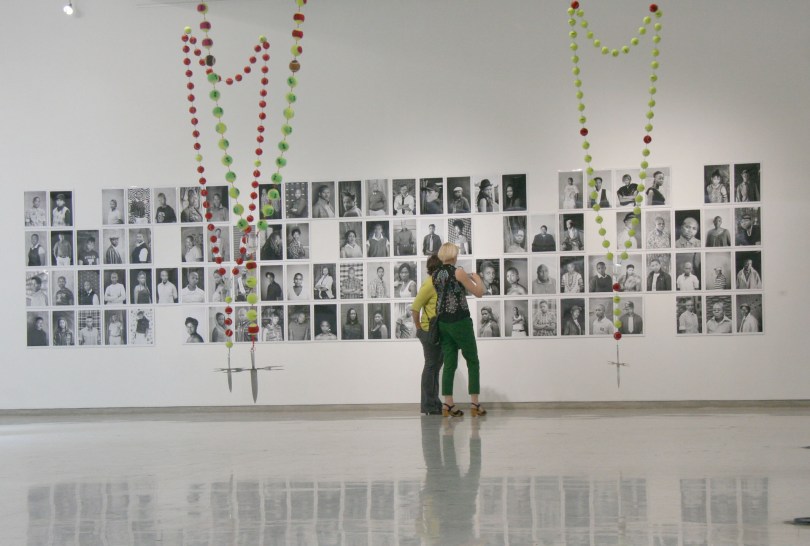
The next piece of the collection, Faces and Faces catches the eye immediately as a wall of black and white portraits look one in the eye. There are some gaps between some of the photographs by Muholi which speak to the nameless but dated graves.

“The spaces were left there to show that they could have been a part of this section of the exhibition if they weren’t killed for being gay and lesbian,” explained facilitator Ace Kekana, whose face appears in one of Muholi’s portraits. Queer and Trans Art-iculations: Collaborative Art for Social Change is a collaborative exhibition by visual artists, Muholi and Gabrielle le Roux. 

“…men who gang rape women, who murder lesbians, who beat their wives – they walk the streets as free men.”

Muholi’s work is on the ground floor of the museum with a focus on the LGBTI community in South Africa – their beauty, their struggle, their murders and more. Muholi is not only a photographer, so her work varies and in this exhibit includes some of her bead work and a documentary film.

The most elaborate display in Muholi’s section are rosaries that hang from the ceiling. The beads in the rosaries are tennis balls and kitchen utensils. The vertical end of the cross at the end of the rosary is made from a knife which represents the violent killings of members of the LGBTI community experience, and the horizontal end from braai forks to represent the supposed hell killers think they’ve sent their victims to, or perhaps the lived hell victims endure.

“When people kill based on gender they like to say it’s for religious reasons, these crosses represent how dangerous that kind of thinking can be,” said Kekana.

The most moving part of Muholi’s exhibited work is a wall with a number of written messages from victims and their family members about their experiences. One of the messages read: “Here in South Africa you have judges sending women to jail for stealing a loaf of bread to feed her baby, but men who gang rape women, who murder  lesbians, who beat their wives – they walk the streets as free men.” 

This is one of the rosaries that hang from the ceiling. Photo: Pheladi Sethusa

In contrast to the quiet reception on entering Muholi’s floor of the exhibition, walking down the ramp into the basement area, sounds from the television screens set up with short documentaries by Le Roux lure attendees with their mixed up buzz.

Le Roux’s collection, Proudly African & Transgender and Proudly Trans in Turkey looks at the experiences “trans and intersex people in Turkey and Africa,” said Kekana. Another facilitator, Thekwane Mpisholo is in one of the portraits put on display by Le Roux.

The painted portraits are inclusive of their “subjects” and this can be seen in the quotes the artist let them scribble on their actual portraits.

The newly launched Wits Centre for Diversity Studies, helped to find the funding for this project. “They’re the ones who helped us with the planning and funding because they (Diversity Studies) study things that aren’t ordinarily studied by other faculties – that’s how they came on board,” said Mpisholo.

There is a lot to read, watch and see at this exhibition and people can do so until March 30 2014 at the Wits Art Museum.

RELATED ARTICLES:

#Teamvuvu #Neknominated

#NekNomination, a social media challenge, has flooded profile pages and time lines of young people around the world. Formerly a drinking game, #NekNominations are now used to encourage people to do good.

A person or organisation challenged does an activity that helps someone else out, then passes along the challenge. It’s sort of like a electronic chain letter for charity.

The Wits Vuvuzela team (#teamvuvu), was challenged in a #NekNomination from Wapad, the student publication of the North West University. We had 24 hours to take on the challenge of making a difference and recording it.

Wits Vuvuzela reporters hit the streets of Braamfontein to hand out cupcakes to the homeless. But we also wanted to  ask the homeless what they needed because sometimes a simple gesture is not enough.


The Newsroom 2.0: I’m back!

Happy New Year and all that jazz, I do realise that I’m like a month too late, but better late than never goes the adage. Started working as an intern at Wits Journalism last week. Going to be here for a few weeks, “mentoring” the new bunch of Journalism Honours students.

Last week was mad hectic because there were only four of us in the newsroom but somehow we managed to produce an entire paper. Here are links to all the things I did last week:

I’m the editor this week, so there will be lot’s more coming,in my round up of the week over the weekend.

ps – unlike last year I won’t be uploading all my work on this blog, but will put up my favourite pieces for that week on here 🙂

Literary Post-mortem: Q & A

My first encounter with this novel was in my second year at University when I was buying my textbooks for the year. Q & A had just become one of the required readings in the first year set work. I was gutted that I wouldn’t get to study it and by the fact that I couldn’t afford to buy it at the time.  1388439205768

I had watched Slumdog Millionaire when it came out as well, but had a very poor recollection of it by the time I began reading this (which I was thankful for).

From the very first word in the prologue to the very last word in the epilogue, I was with, for and enthralled by Ram Mohammed Thomas, the protagonist in this brilliant read. One of the first things that stuck out to me was the structure of each chapter in the book. Each chapter revealed more about some of the harsh circumstances in which Ram grew up but on the flipside also revealed how going through those very specific circumstances helped him answer the game show questions posed at the end of each chapter.

Perhaps I should explain a little here – Ram was a contestant on game show modelled on Who Wants to be a Millionaire, but in his case one billion rupees were up for grabs. He miraculously answers all the questions right and wins the one billion. Each chapter of the book serves as an explanation of sorts as to how his street smarts enabled him to answer the questions asked on the show.

This quote from the first chapter in the book speaks to his University of Life degree:

“A quiz is not so much a test of knowledge as a test of memory.”

The world being as it is, the powers that be behind the show try to frame Ram as being a cheat because they cannot afford to pay him the money owed to him for winning. He is arrested shortly after the show is recorded and that is how this novel began. A genius start I rate, I don’t know if it would have worked if it had started there.

Structure aside, each chapter tackled very tough themes – everything from disability, to rape, murder, poverty, and even love. There was a twist in every chapter that had me gasping and exclaiming in sheer shock or in some cases just setting the book down for the day because what I had read was just too much. There were some truly terrible moments littered throughout the book, moments that made me realise how universal injustice and suffering are. Even though I knew the stories to be fictional, I know that pain like that isn’t only imagined, it is some peoples, too many peoples lived realities.

Ram speaks about heroes throughout the novel but never seems to think of himself as one. His chequered past seems to be in the way of that. But he is one, through and through. Even when he makes mistakes, they are often done trying to protect others. He is one of the nicest characters I have ever encountered, despite all the things he goes through. That was really inspirational to me, that someone who had been abandoned, cheated and treated less than human over and over again, could strive to get through it all and never give up even in the face of the most trying situations.

It was masterfully written and I applaud Vikas Swarup for this magnificent piece of literature. As depressing a read as it was, it also left me with so much hope and taught me a thing or two about perseverance and fearlessness. Another important thing I learnt was to never let ‘The Man’ win –  to challenge him and perhaps beat him at his own game.