Literary Post-mortem: The Art of Seeing

I’ve decided to do this review a little differently than the others. At the end of this book I found a reading group guide with a number of questions for discussion. Instead of telling you all what the book was about, how it affected me etc – I’ll simply answer some of the questions.

(Note: Most of the questions are very lengthy so in some places I have only concerned myself with parts of the question)

image

Q: Why does art play such an important role in the novel? In what way does art define life for Jemma and Rozzie?
A: As a photographer, Jemma uses her way of seeing the world to inform the direction of her art. Her art is one of the most important things in her life and pushes and pulls her in various directions throughout the novel. As an actress, Rozzie was propelled into an artistic industry at a very early age. Her acting ability is her art and it too has a lasting and often overwhelming effect in her life.

Q: Jemma says: “Anecdotes about the rich and famous make people cough into their fist or refold a napkin, staring into their lap…” What is it that makes people uncomfortable? How does society respond to fame in the novel?
A: I think people feel uneasy because of the excessive lifestyles, of the narcissism anf just of the impossible and unimaginable lifestyles the rich and famous lead. In the novel people close to it are mostly uneasy about it and try to keep their distance where possible. Those who don’t have personal proximity with fame are enamoured by it because it doesn’t affect their lives in a real way.

Q: How does Rozzie’s fame affect the way Jemma sees herself and others? How does fame diminish those who are famous and the people around them? How does it build them up?
A: Jemma lives in her sister’s shadow, at some point she stops actively being her sister and becomes one of the many people watching her in awe. She has an inability to connect with other people because of it – she doesn’t seem to think much of herself, she shrinks behind her sister’s brilliance. Rozzie pushed her family away in pursuit of fame, she allowed herself to be influenced by people who didn’t even care about her. I think that’s how it diminished them both. It built Rozzie up in that she was widely adored and admired. For Jemma her sister’s fame helped to build up het career.

Q: Discuss the different paossible meanings of the novel’s title. What is the relationship between art and seeing?
A: It’s a play on Jemma’s photography and Rozzie’s blindness. Both have adapted to alternative ways of seeing the world they live in. I think the relationship between art and seeing is that the way we see is in itself an art. Along with this that art extends beyond physically being able to see, that it’s about making people feel something as much as it is about making them feel something.

Q: Why is Jemma’s story told in first person and Rozzie’s in third person? How does this narrative structure shape our ability to understand each character?
A: I don’t know why but I imagined that it might have to do with the author identifying more with Jemma. The narrative structure made me immediately take Jemma’s side, feel her pain and loneliness more than her sister’s. I felt like the entire story was more about her because of it.

Q: Why does putting on Rozzie’s clothes give Jemma a feeling of protection when she removes her pictures from the gallery? Who is Jemma trying to be?
A: Jemma is a very insecure, meek character who rarely does what she really wants to. By putting on her sister’s clothes she takes on her brave and daring persona. She used the clothes as a mask to allow herself the freedom to do as she wished. She ultimately tried to be het fearless sister for a while.

Q: Why does Rozzie’s relationship with Daniel remain so important to her over the years? What does he give her that no one else can?
A: He was a first – her first lover, first mentor and the first person to truly believe in her and her talents. As this person he provides her with a genuine reassurance in her abilities and when she’s with him she can be her old self. He is her comfort zone.

Q: Jemma says of Rozzie: “My whole life has been shaped by the stretch of her light”, and that, “in my head, she’s always been a celebrity.” How do these statements reflect all sibling relationships?
A: I suppose there’s always one sibling who is the leader and one who follows. In this case Jemma’s whole life was shaped by the way Rozzie’s unfolded.

Q: At the end of the book, Jemma says, “Maybe [Rozzie is] an actress because I made her be one.” What does Jemma mean? How might she be correct?
A: Linked to the previous answer, she always let Rozzie take the lead, forcing her to always be the strong one, the brave one etc. Rozzie had to step up to her baby sister’s expectation, always had to make a show of things.

Q: In what ways does Rozzie’s blindness help both sisters gain more control over their lives? And how does it change their relationship?
A: Rozzie’s blindness forces her to become self dependent and this allows her sister to start building her own life. Even though at first her work is centered around Rozzie, she embarks on a journey of self discovery.  Because they both go their separate ways for a while, they allow themselves to slowly repair their relationship.

Literary Post-mortem: Intimate Enemy

Intimate Enemy: Images and Voices  of the Rwandan Genocide

It has taken me a few weeks to get through this book. Not becaause I was bored or at all disinterested but because it was difficult to read what had actually happened.

image

The Rwandan Genocide is something I learnt about from Hollywood and a worksheet or two back in high school. I’ve known for a while now that I needed to school myself further on the subject.  To broaden the narratives I’m privy to on this tragic moment in African history.

Before I started this I had read To See You Again: The Betty Schimmel Story, a remarkable and heartbreaking account of living through the Holocaust. I imagined that reading that had readied me for another tragic and positively horrifying read, I was sorely mistaken.

An Intimate Enemy is a joined effort by Scott Straus and photographer Robert Lyons.

Combined then testimony and images offer a largely unmitigated and intimate view of the Rwandan genocide.” ~ Scott Sraus

Straus explains his mission and objectives in an emotive and rather educational introduction.  In short, he wanted to start to figure out who and what had led to the genocide. His interviews in the book are with men who were both perpetrators and victims during that time. He stressed that his aim was not to other anyone but to begin to understand ordinary human beings were turned into killers literally overnight.

The images and testimony present in the book are from prisoners in a number of prisons in Rwanda, mostly male because women only made up 3% of the prison population at the time.

image

Before the advent of colonialism in Rwanda, Hutus and Tutsis lived side by side in relative harmony. Colonialists exploited the slight differences between the two groups to sow divisions of which they would reap the benefits. The usual thuggery of making one group feel superior and another inferior, affording opportunities, jobs et cetera to the superior group of people.

Straus does a good job of making the historical context of the genocide very clear. As a South African the genocide in Rwanda is particularly harrowing because of the stark change that was happening at home, while others were being hacked to death.

The interviews he conducts with the prisoners and the testimonies they give are worse than any movie or any one thing I’ve ever read. About three interviews in I had been shocked to the core, heartbroken and utterly defeated.  In most cases people literally became killers overnight, some killing their own family members for their own survival. The speed at which things happened is what struck me the most, it always has even where the Holocaust is concerned.  People can turn on one another in a heartbeat and that more than anything scares me about my species.

As I said I went through the testimonies very slowly, as a way of reading them as historical documents and committing them to my meomory.

Robert Lyons work starts to come up more often towards the end of the interviews.  All black and white photographs, mostly portraits. His aim was to capture a side of the genocide that wasn’t sensationalised and didn’t frame a particular narrative.  The exclusion of captions is an extention of that aim.

“I felt that somehow there must be a way to show the horror of genocide without making sensationalistic imagery.  I wanted to explore the space between the victims and perpetrators.” ~ Robert Lyons

Looking through his photographs brought home Straus’ point. I tried but there wasn’t a person I could point out as a killer, I saw mothers, fathers, brothers and sisters. Old and young, male and female. Having the knowledge of those testimonies made it all the more trying.

Hands down the toughest thing I’ve read this year.

Literary Post-mortem: Mockingjay

Finished reading the third and final book in the Hunger Games series in the wee hours of yesterday morning and was in tears.

Had to re-read the last paragraph because it was so perfect. I bow down at the greatness that is Suzanne Collins.

I never imagined that I’d ever read an action novel, but I kind of did with this third installment. There’s always been a fair amount of adrenaline and action in the previous books but it all reached a whole new level in Mockingjay.

To say what happened without saying what happened,  I’ll say this:

I was not prepared for all the things that happened. This book picks up right where Catching Fire left off. So I still had the same indignant feels where Peeta was concerned.

For a long while Katniss goes on living a semi – normal life while preparing for what’s to come. For me she became someone I couldn’t look up to anymore. I don’t know if this has to do with her now being a flawed person, a real person. Who’s irrational, unforgiving and selfish. Which in retrospect was actually endearing and made everything all the more believable.

Even though she may have ‘shrunk’ somewhat for me because of the above she also grew a little. She finally found the words to describe what she felt for the men in her life and the words she used to describe her feelings were nothing short of beautiful. Because she knows what she feels she can find it in her to finally make a decision on who she loves and who she wants.

While the drama was a little extra, it was necessary and like I said very plausible for the most part. The narrative about war and freedom required it actually. Reading all the prep that went into training soldiers, the sacrifices that people had to make made me realise that I am nowhere ready for such fundamental change in my life. I do feel that change is needed in the world, but the magnitude of sacrifice required just never clicked. Perhaps it’s not even sacrifice as such but giving up small comforts for total and unequivocal freedom.

By the end of Mockingjay a lot has been lost but tremendous gains have also been won, both in the personal and political realm. Even though things have gone tits up, it does bring Katniss closer to the man she loves loves (<—-not an error). The epilogue reminded me of Harry Potter – both how it ended and how reading those books made me feel.

The Hunger Games trilogy felt like going back in time, to being that girl I was in high school who stopped living in this world for a few days and being right there at Hogwarts, or rather Panem.

In short, it was brilliant.

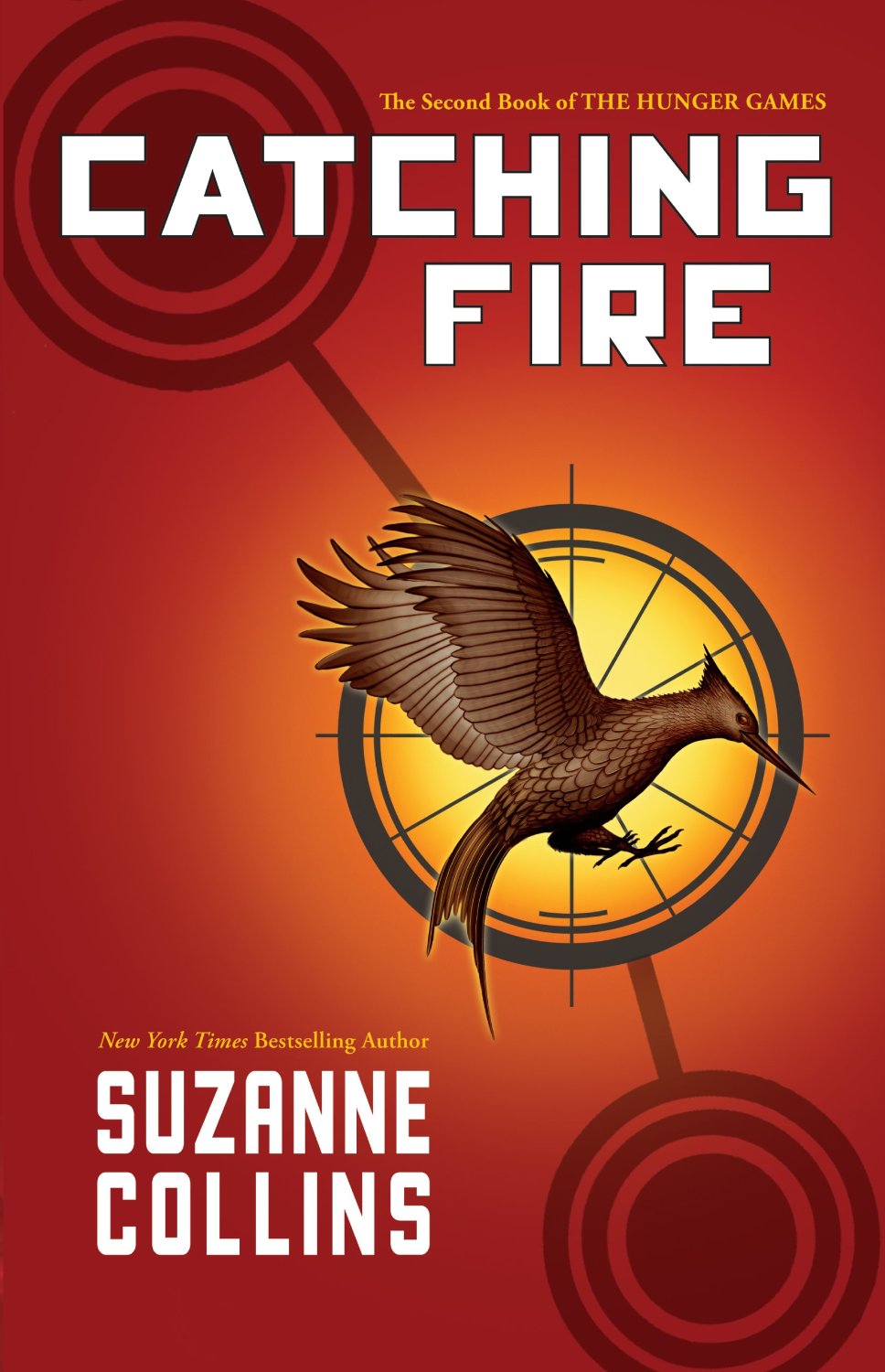
BOOK REVIEW: Catching Fire

Catching Fire by Suzanne Collins. Photo: Provided
Catching Fire by Suzanne Collins.

This is the second book in the Hunger Games series and boy does it deliver.

I imagined that The Hunger Games was some sick, fantasy story – which it is, but it is also a whole lot more. My general attitude led to me opting to watch the movie instead of reading the book I thought was some dodge teenage craze.

I loved the movie and have watched it several times over. I have loved Josh Huctherson since his movie Little Manhattan and have been hoping to see more of him ever since. And now here he is all grown up, playing the role of Peeta Mellark, the young man who is besotted with Katniss Everdeen (played by Jennifer Lawrence). Katniss is the heroine, the alpha female of the novels and movies.

Sometimes it can be good to watch the movie before reading the book, because in this case I believe the characters were perfectly cast. I might have cast the ‘wrong’ people in my mind’s eye and would have been left disappointed when I saw the people cast in the movie.

For a bit of background:

In the first Hunger Games book/movie Katniss and Peeta’s names are drawn during the reaping, which means that they have to represent their district at that years Hunger Games. A little like soldiers being drafted for war. In the games one girl and one boy from each district are picked to enter an illusory arena in which they fight to the death – the last one left alive being the victor of the games.

Things get a little complicated when Peeta declares his undying love for Katniss (which to me was super romantic) just before they enter the arena. Halfway through the games it is decided that to win a pair from a district need to be alive. Katniss then finds Peeta and as they are the only way of keeping one another alive they team up. Katniss pretends to be in love with him for the cameras. Long story short, they win and have to carry on with their charade of being lovers.

Cut to the second book, Catching Fire. It begins with showing us how life has progressed in the past few weeks after the games. They are both well to do and can afford to give their families everything they need and want.

It is evident that some of the love we saw between Katniss and Peeta in the games has since dissipated. They kiss and hold hands when the cameras are on, and this disgusts Katniss. Because she is actually in love with her best friend Gale, who she now has to pretend is her cousin.

Katniss and Peeta have to lead very particular lives because the Capitol is watching them. The president of the Capitol pays Katniss a visit to force her to make her relationship with Peeta more believable, especially when they go on their Victor’s tour through all the districts. Peeta can feel her coldness all the time and pleads for them just to be friends, at least.

On the tour it becomes evident that they have become symbols of defiance throughout the districts. This brings the two together and leads to an actual bond being formed. Things take a turn for the worse when both are forced to go back to the Hunger Games for the 75th anniversary of the games.  A twist that no one could have expected. In the arena a number of daunting and shocking things happen – but amidst all of the life threatening dangers, the two fall in love. Peeta becomes her rock, not Gale.

I’ve given way too much away but I couldn’t help myself. I could hardly stop myself from reading the book at all hours of the day and night. I was truly captivated from the first word in the first paragraph, to the last word in the last paragraph.

I love the metaphors about how cruel and calculated the powers that be can be and in fact are. I also love the powerful way in which in the people in the districts choose to risk their lives to try and rid themselves of the shackles of their oppression. But most of all, I love that Katniss finally gives Peeta a chance. That she finally sees the man he is and can be with her by his side. In other words, it was an amazing read and I cannot wait to start the third book.

Book Review: For Matrimonial Purposes

I bought this book for a shocking (yet pleasing) R3 at a book sale at the Wits Hospice Shop – another steal. I liked the hennaed hand on the cover and was intrigued by the thought of learning more about Indian weddings.

Book cover. Photo: Pheladi Sethusa

When I was younger I used to be obsessed with Bollywood movies. Even though they were three to four hours long and in subtitles – I loved them. Between the hunks with the sleek black hair, family feuds, lavish weddings and scandals I just could not get enough.

The weddings were of particular interest to me – it was the first time I witnessed grandeur in a setting that wasn’t associated with ‘white weddings’. I guess I admired that in the Indian culture no compromise was made between culture and a fairy-tale wedding; that their culture was not up for discussion or optional.

Onwards with the literary post-mortem (relax, this phrase will catch on). This book was written by Kavita Daswani– whom I know nothing about (sorry). The book kicks off with a lavish wedding which sets the tone for the rest of the book. It seems that marriage in the Indian community is a matter of extreme import and something that is considered necessary to bringing dignity to families. From the onset it is clear that Anju has been left behind, unmarried at 33.

Her mother has been trying tirelessly for about ten years to arrange a marriage for her, but Anju has not yet met a man she likes enough to marry. Mind you dating is not on the cards – she meets these guys and after that meeting a proposal should follow. The marriage is about getting to know your spouse, about falling in love with them. Something which was foreign to my imagination, as I am used to things happening the other way around.

In this all important quest to find a husband – one learns the difficulty of being an Indian girl in a traditional setting and also of one forced to grapple with her tradition in a Western world. After a few years of fruitless or rather marriage-less efforts Anju’s parents reluctantly let her go to America to further her studies and find a husband there. She is faced with all this freedom, which one imagines she would be seduced by – but she isn’t. She remains as conservative as her parents for the most part. Doing nothing that would be deemed sinful by them – consulting with them when making decisions many would make in their sleep.

Anju’s pursuit made me a little sad. Every time her mother called the first thing she would ask is: ‘Have you found a boy?’, not an enquiry about her daughters health and well-being. All Anju wanted was to stop being a disappointment and be truly loved by her parents. She imagined that getting married was the only way to do that and sadly it was. None of her academic achievements or career achievements inspired any sort of approval from them.

Daswari put little quotes at the beginning of each chapter, oft very helpful in better understanding the perpetual quest for a mate. I got the idea from the quotes and the book in general that women and independence seemed most incongruent; especially in Anju’s case. For instance her parents freaked out when she had to travel to Paris for business – they could not stand that she would be travelling alone and feared the scandal and shame it would bring to the family’s reputation if she was spotted by someone they know.

“They say that you find the love you seek when you stop looking. They say that the second you get busy with work, friends, other interests outside romance, that the man or woman of your dreams comes sauntering into your life. I say they’re wrong. The fact is when you’re looking for love, you can’t ever really stop”

A-fucking-men. I have been saying this to my friends for a while.

I have never found any kind of solace with the ‘if you stop looking it will come to you’ adage, it just doesn’t make sense. Why doesn’t the same principle apply to the pursuit of career goals and dreams. It’s a load of hogwash. Sure I shouldn’t be out on the hunt every hour of every day but pretending I am not looking for someone doesn’t erase the desire. I am busy with ‘other’ things but that hasn’t induced some mild amnesia either. Anywho…

By the close of the book she has a happy ending. Not the most conventional one and not one on her own terms. She nearly forces the poor man to marry her instead of dating as he suggests. But despite herself and her parents it all worked out. I was relieved – my spirit may have been shattered had she not.

PS**

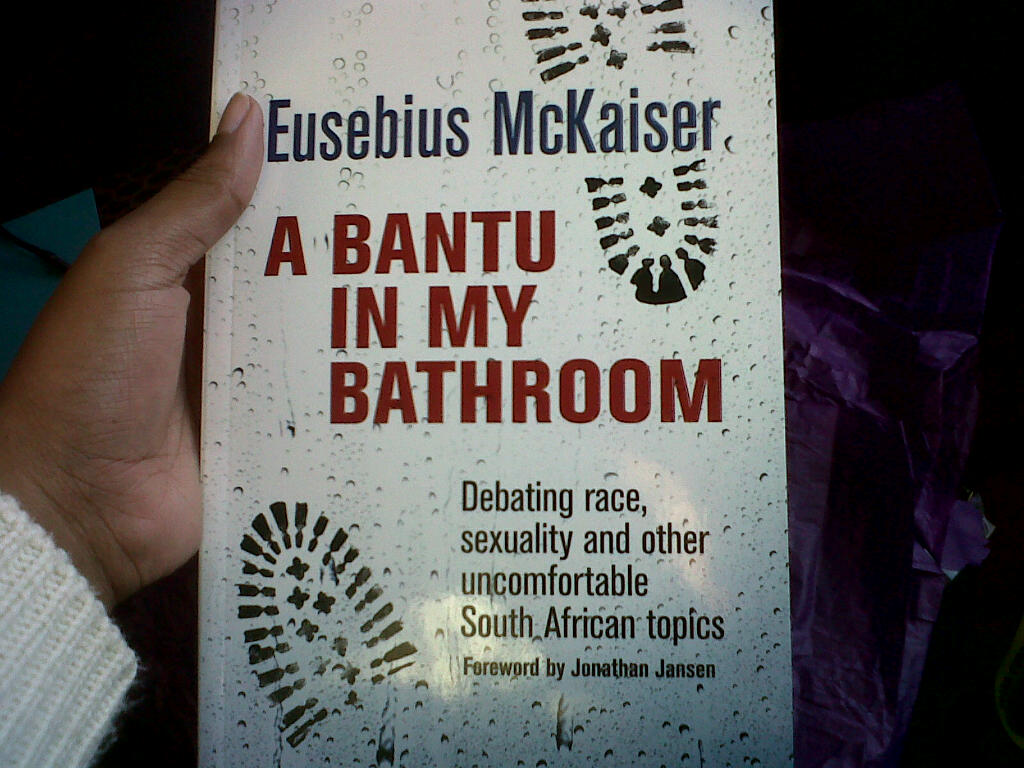
Literary Post-Mortem: A Bantu In My Bathroom

Disclaimer: I wouldn’t really call this a book review – just don’t dig the term. Also don’t feel like I’m qualified to write such yet. I’m just telling you that I read this book, how it made me feel and why or why not one should give it a read. That’s all. Let’s rather call it a ‘Literary Post-Mortem’ (I like that)

IMG00724-20130613-1623.jpg

Onwards with A Bantu in My Bathroom by Eusebius McKaiser then. Been wanting to read this book for some time, but being the broke student I am it just never happened. Umtil I got this as a gift, yays.

Before I tell you how awesome a read it was, I must mention that I am a fan of the man. At some point in my second year at Wits I considered taking up Philosophy in the hopes of being lectured by him at some point. However, reason and a passion for what I was already doing steeled me. Anyway back to why I’m a fan – I love his insights and the way he chooses to deal with difficult topics that many are reluctant to. Along with this I find him quite relatable – not all the time but I mostly get him/what he’s saying.

The book is basically a collection of essays based on a variety of topics. Namely race, culture and sexuality. Under each section there are about four to five essays, which aim at tackling various aspects of the ‘big issue’ at hand. Unsurprisingly, my favourite essays were  in the race section. I think that it is still important to look at and understand why race is still an important contributing factor to the lived South African experience. He mentioned that we can’t pretend we don’t see race just to avoid being labelled ‘racist’.

McKaiser highlights some of the most important race related challenges South Africans face. He explains why Affirmative Action is necessary, discusses white privilege, tackles the issue of whether or not black people can be racist and much more. Even though one might disagree in places, I did find myself agreeing with him 80% of the time – not just in this section but throughout the rest of the book.

In the sexuality section he spoke about ‘coming out’, love and even rape. This part of the book was the most personal for me and as such riveting to read. When it came to culture he looked at ploygamy, divisions present in our society and the advantages and disadvantages of being a so-called coconut. The range of issues raised in his essays is quite big. I was not left wanting when I was done reading – I legit felt like he discussed everything one could in 209 pages.

We should instead accept that we are deeply divided – spatially, linguistically, culturally, ideologically – and reflect on how we might live in each other’s space while disagreeing deeply with each other. The alternative, fake national unity, is simply childish. (excerpt from the book)

What I enjoyed the most were the little anecdotes that coloured his essays. For me it helped to bring home his points and also offered an unique peep into his personal life. I have often seen McKaiser on tv, attended seminar’s that he spoke at and listened to his show on radio. This book felt like the literary incarnation of those experiences. Not the content but with regards to style. It was easy read and understand because he was just being himself (or so I assume). He did stress how important authenticity is to him so I imagine he wrote in a way that would reflect that.

I also liked and admired the fact that he didn’t ‘other’ people. He didn’t speak about racists, homophobes and misogynists in a distanced manner. He made it clear that we are these people, that we are our biggest problem in many cases. Also highlighting that change can only begin with us.

If I had the money I would go out of my way to buy a few people a copy. The idea’s put forward are of great import and I feel that the more people they reach the better.

PS**

Flowers in the Attic by Virginia Andrews

[*disclaimer: my book reviews are not really book reviews, just my thoughts after I have read something particularly moving]

This novel has been one of the most interesting and riveting I have ever read. I know I have said the same about other novels – excuse me for having great taste 😛 I even feel bad that I bought it for a mere R3. Well that’s what hospice bookshops are for right?

Shucks I don’t even know were to start. I finished reading about an hour ago and I’m still reeling. The novel did come full circle but I still can’t get over the things that happened to us (the characters and I). I really did feel like I went through the things they did, goodness knows I cried just as much as they did.

From page one I was hooked. Andrews wrote a  prologue that told me that her and I were on the same wavelength. It’s one of the most honest and earnest one I’ve read. My favourite part reads “…in this work of ‘fiction’ I will hide myself away behind a false name, and live in fake places, and I will pray to God that those who should will hurt when they read what I have to say.” She said fiction like that because this book is based on a true story, which made me all the more sad.

I don’t know how to talk about what lay between the covers of this novel without giving the story away. It really is what the front cover said it would be: “the compelling story of a family’s betrayal and heartbreak, love and revenge.” That is quite literally what happens from chapter to chapter.

What I can say that isn’t a spoiler is that the novel is magnificently written. It transported me to the attic, made me feel every blow that these children were dealt, made me fall in love with yet another man and made me see the lengths that we as a species will go to to ‘survive’.

To touch on the latter – there is a theme in the story that focuses on avarice and the love of money. It is disgusting to see how money and the pursuit thereof can change a person, even a loving mother. I don’t think it’s fair to pin all the blame on her, but it is a huge catalyst that leads to the unraveling of a family.

I suppose I can’t ignore the ‘big’, overarching theme in the novel – incest.  I don’t want to dwell on it because then people form their opinion on the matter immediately and it could affect how you receive the rest of the novel. I didn’t let my so called morals colour my thinking – I gave myself to the love story that was presented to me.?

I was actually left traumatised by this read, to think that this actually did happen will make me shudder for some time to come.