As the clock struck 11 last week Thursday, we were frantically proofing and designing our way towards another deadline.
#teamvuvu did a steller job producing one of the last editions of the year. We only have two unofficial papers left to produce but we won’t have to worry about that right now.
Dreams of spending the long weekend with friends and family were quickly put at bay by our final exam staring us right in the face. We wrote for a whopping 5 and a half hours, some wrote for even longer than that. Exhaustion aside, it might be the most fun exam I have ever written (just hope the marks are ‘fun’ as well).
In keeping with the spirit of no rest for the wicked, tomorrow we start prepping for our in-depth project. All we know about the project is that it’s a long, research type project that will have us working like we’re part of amaBhungane.
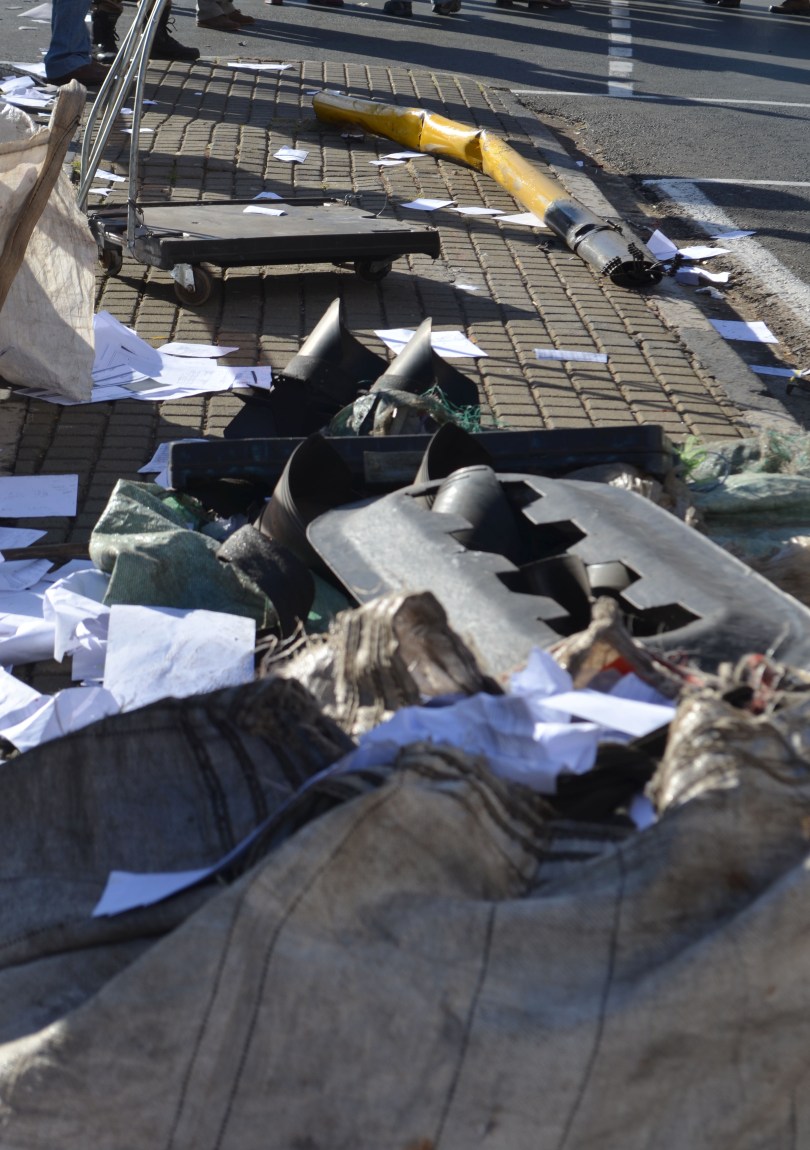
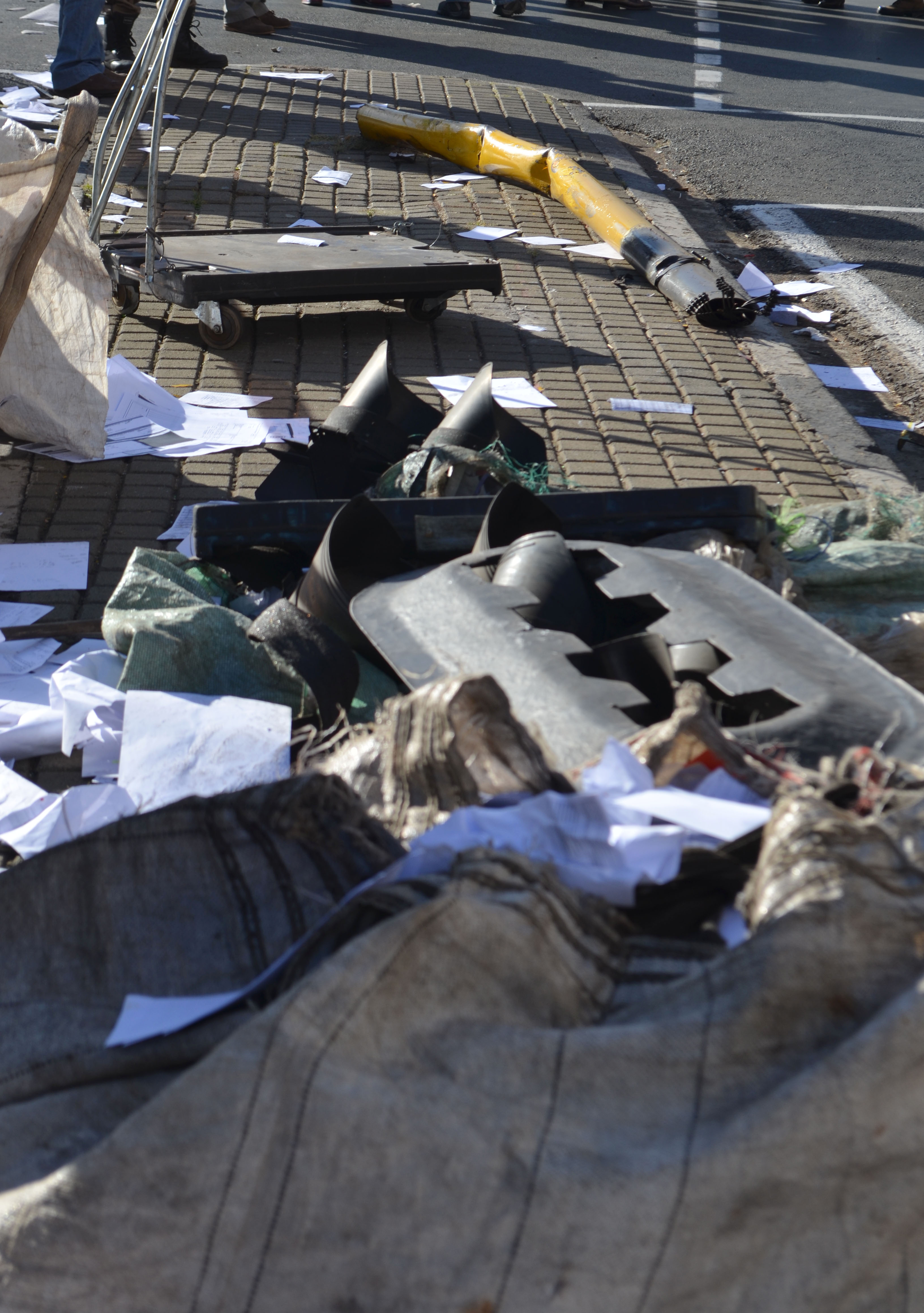
Blue light wreakage – my semi-winning photo.
I’m pretty keen because its a chance to so something a bit more substantial and less rushed than we’re accustomed to. I’m particularly looking forward to being afforded the time and resources to have a bash at a proper photo essay. An exciting few weeks lay ahead.
Oh in other exciting news, one of our lecturers is going to use some of my photo’s in a new book she’s publishing. Along with this I got an honourable mention at the prize giving for the fifth Wits Photographic Competition. Winning.
The week that was is somewhat of a blur. Feels like it took a short Usain Bolt like sprint and before I knew it, here I am on a Sunday afternoon trying to string together something semi interesting to write.
Monday morning is a haze of people typing frantically, in 11th hour attempts to get features done. I wished I could have joined in on the madness but I had already accepted that it was late for me, very late.
Later that morning we had to take a crack at writing travel features with Fred de Vries. He made us go to a mall, preferably one we had never visited before and take notes that would bring that mall to life. I went to the newly opened Oliven Plaza and man did I see some interesting things, hope it came out in the feature I managed to write.
That afternoon I dashed off to a Right2Know protest outside Luthuli House. Protesters were appealing to president Jacob Zuma, to ask for the Protection of State Information Bill to be taken back to parliament for some revision. I cause I would expect any media practitioner to support, this expectation was quickly dashed upon arrival.
We stood with some journalists and photographers from The Times and SAPA, they were obviously disappointed by the dismal turn out at the protest – granted. What I didn’t understand was their attitude towards the protest itself. There were scoffs, sighs and comments about what a waste of time the whole thing was. One photographer condescendingly said, “How many of these people (the protesters) have even read or really know what the Secrecy Bill is about?” he quickly went on to answer is own question “Only the journalists do,” he said with a chuckle.
I was like whaaaaat?! These people are gathered here to defend your right to do your job mister (all in my head of course, and in a tweet later that night). I suppose it was just disappointing to find out that some of the people we look up to are so jaded. Anyway I managed to get some great pictures and that’s all that mattered that day.
On Tuesday we had guest speaker Phillip Altbeker come in to discuss movie reviews with us. We wrote reviews on a movie the whole class went to watch a few weeks prior, Of Good Report. There were no comments on our work but he did say, “These will probably be the first and the last reviews you write.” I suppose that says it all doesn’t it?
From then on, the chase was one. One story after another had me going to and from the department. Another 12 pager was on the cards so we all had to do best. We were much more efficient than we have ever been come production time. I suppose being shouted at will do that to you. Needless to say we only missed deadline by a smidge and for the first time in a long time, I got home before the sun went down J
Friday was the best day of the whole week. It started off with a trip to Engineers Breakfast to get some good photographs, which we managed to do. Fomo hit us hard when we had to leave, we also wanted to sit under a gazebo, with meat on the coals and not a care in the world.
But we couldn’t, we had to rush off of to a guest photography lecture. I was very grateful for once it had ended, it might be one of the best lectures we have ever had. We got to see some of the meaningful work people are doing out there, as clichéd as it is pictures really are worth a thousand words.
Later that evening we had a braai and piss up of our own (that’s not very pc is it) oh well, we did and it was great. I’ve said it before and I’ll say it again, man I love my team *Drizzy voice*
Tomorrow will mark the beginning of the end. It is our last academic block, the last block I will spend in the Vuvu newsroom.
I can imagine that my sleep deprived body is celebrating at the thought, but the rest of me, is quite sad. Sad that there are only three editions of the Wits Vuvuzela left to produce, sad that I will no longer see the same 16 faces (well 18 if I include K-dawg and Mama D) and sad that I will no longer have people join in when I randomly burst into song.
The past week and a half were a taste of the emptiness that awaits me. I had my mid-year photography course with just one other classmate. It was eerily quiet in the newsroom, making it that much more obvious that our whole family was gone.
On the few days that people did come in to work, I felt whole again – suddenly the days weren’t as long and my mouth seemed to curl into smiles more often. I wish someone had warned me against getting too close to these people, it’s going to be tough without them next year.
We went on a little field trip for a lesson in photography at the Times Live Media group. The newsroom was very quiet, very orderly, very cold even. Everyone seemed to be glued to their own cubicle, trying to meet their deadlines. Got the sense that it’s an every man for himself situation. Which I am definitely not used to after this year. All my efforts, all our efforts have been to make the Wits Vuvuzela the best newspaper it can be. No single gain made has been one that we all haven’t contributed to or are proud of.
And in testimony to that every so often I think back to all that we have achieved this year and all I can think is, “Man I love my team”.
The potential team vuvu for 2014 are already in the process of being chosen, the first round of tests started last Friday. That scared me shitless. It was not so long ago that I was where they are, hoping with everything inside of me that I would get picked.
It has been a grueling and trying year, but one I would do all over again if given the chance. We’ve had our ups and downs, more ups than downs and I will cherish them forever.
So as we head into the final weeks of being student journalists, I plan to make each day memorable – not they haven’t been but just because I realise how little time I have left to do so. Onwards and upwards 🙂
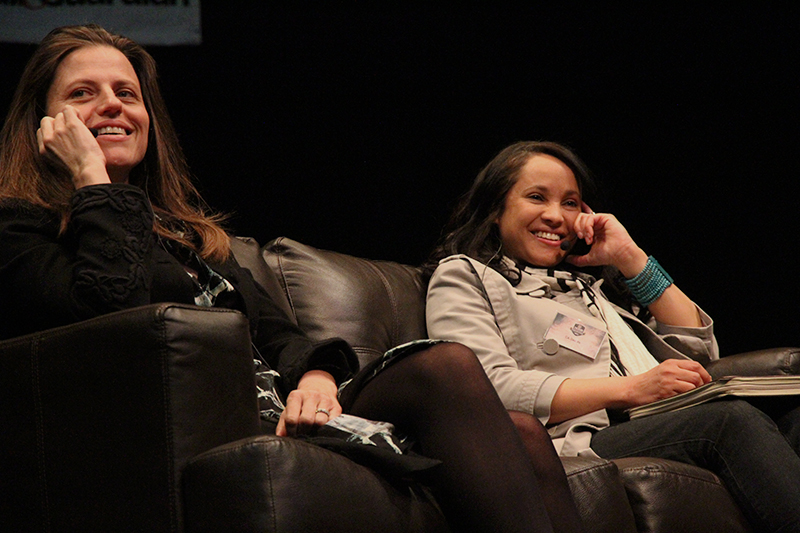
Writers Dominique Botha (left) and Carol-Ann Davids (right) were two of the ‘new’ authors on the panel. Photo: Pheladi Sethusa
“I know I’m going to be a writer one day. I don’t think it in my brain but I know it in my heart,” I have not been able to look back since I read this Chris Van Wyk quote three years ago. It provided me with the resolve to do exactly what I’m doing in my life right now.
This past weekend a colleague and I went to the 2013 Mail & Guardian Literary Festival, to bask in the presence of some of South Africa’s literary giants.
The Market Theatre was the historically apt venue picked to host the festival. Couches in the middle of a black stage in the main theatre providing the speakers with their literal platform.
We sat in one session after another, furiously typing out tweets, scribbling notes and snapping photos. Between all of this we had to process what was being discussed on the various panels. All of which were interesting and engaging in their own ways.
One recurring statement made by writers like Nadine Gordimer and Craig Higginson, was that writing is a calling of sorts. One doesn’t write because they want to but because they have to. Craig went on to say that it simply isn’t worth the pain and effort otherwise.
I want to be like them
I was lucky to sit in on a panel discussion with a theme of ‘fact and fiction’ luckier still to listen to the first panel of women only, all of whom are first time published authors.
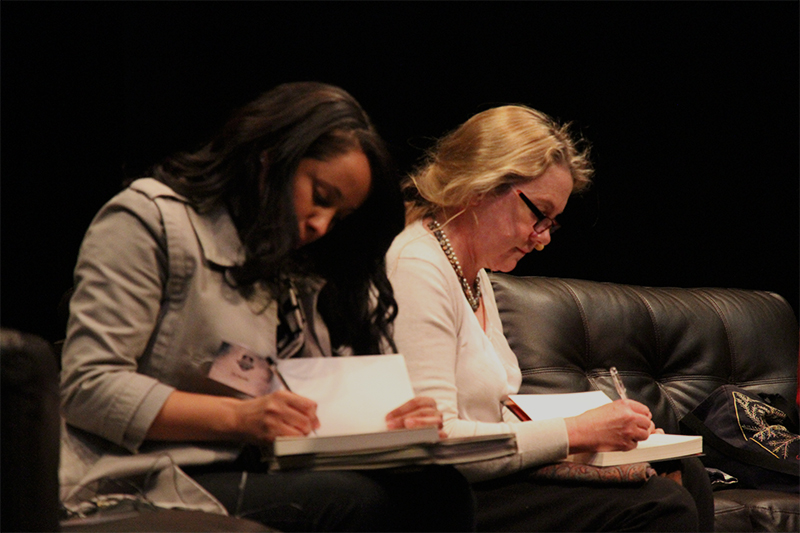
Carol-Ann Davids (left) and Claire Robertson (right) sign copies of their books for fans. Photo: Pheladi Sethusa
I have ambitions of being in their shoes one day. I’m doing journalism in a mission to be on the right side of history and because I really do enjoy writing. I want to be a journalist because I imagined at some point when I am too old or too tired of being on the field, I would magically turn into a writer. Well not magically but all that training will come in handy.
Anyway long story short, becoming a writer is the end goal.
So this panel discussion provided enough information for me to be inspired to keep on keeping on where this dream is concerned.
Journalism and writing
Claire Robertson provided some insight on how she managed to use her experience as a journalist to help her write her book, The Spiral House.
She said that she tried to avoid writing about her personal life, because in journalism reporting on oneself just isn’t done. “I’m not brave enough to write too intimately about my life,” confessed Claire. Clearly I have no such inhibitions, one browse on my tumblr blog is evidence of this.
However, she did insert herself in the places were she deemed it necessary because it was unavoidable. Her background helped her to write much faster than some of the other women on the panel, in this moment she was thankful for the demanding deadlines.
Fact versus fiction
A little fact, mixed with some fiction or do you have to one or the other. Author, Dominique Botha said the truth is incredibly hard and can never really be 100% in that regard. This makes for a problematic relationship between memoir and fiction she added.
“To retrieve memory is the first act of fiction,” she said. Botha added that memory relies on the act of imagination, in an effort to illustrate that memory is compromised and can’t be considered as 100% accurate.
Carol-Ann Davids, author of The Blacks of Cape Town said that one needs a little bit of both (fact and fiction) to tell a story.
Storytelling
The women on the panel emphasised that what they were doing was telling stories. Claire went as far as to say being a good writer is not enough, one has to be a good storyteller to write something of substance.
Maren Bodenstein , said that by way of storytelling and using details you can get a little closer to the ‘truth’ Dominique said was illusory. She said that this was the magic of, “dealing with the theory of literature”.
When asked by chair, Craig how they all managed to write such mature and deep books on their first try, the women unanimously agreed that they got to that point through enduring a lot of rejection and humiliation. “After chipping away at yourself you have no option but to write from your gut,” added Dominique.
The discussion then opened up to the floor in which time questions about getting published and being mothers were asked. Basically it difficult, it’s difficult to get published – to get someone to believe in your story. On being a mother while writing her first book, Carol-Ann said it was challenging but not impossible.
I learnt a thing or two about the journey I am yet to travel and was encouraged to press on.
(My random numbering now coincides with the month we are in so hey, so why not stay with the 8 point something’s?)
I woke up five minutes before my alarm was due to ring last week Monday. I couldn’t keep in the excitement any longer I guess. I swung my wee legs out of the warm cocoon that was my bed and braved the cold all smiles to get ready for my week ahead as editor.
I welcomed everyone on the 19th voyage upon the Vuvuzela express at news conference later that morning and just like that the week was in full swing.
We had our first feature workshop on that same day, an hour or two dedicated to criting our feature writing work. I loved this process because gaps I might have never even seen where pointed out and will make for a better feature when I re-write it.
In an odd turn of events we had to distribute the newspaper on Monday because of the public holiday the Friday before. 1pm came, 3pm strolled in and by 5pm we still had no Vuvuzela’s to hand out. Distribution then turned into a two day mission but it got done in the end.
We had two other guest speakers on Tuesday morning, meaning our Vuvu day only started at about lunch time. There we were typing and chatting away in the newsroom, when someone ran in telling us that there was a fire on the 15th floor.
SMOKEY: Elevator technician trying to extinguish the flames in Lift B on 14 floor, University Corner. Photo: Pheladi Sethusa
Being the people we are, two of us grabbed our cameras, the other a notebook and off we ran to try and get the story. By the 14th floor we were inhaling the smoke fumes but still trying to get closer for that perfect shot. We were chased away but came back about 5 minutes later. Found out that there had been a fire in one of the lifts. You know, the one we take every day. The evacuation made for an unproductive afternoon.
Wednesday morning saw 7 team vuvu members heading to Orange Farm to help out with something the Wits Justice Project was doing in the area. That plus two people off sick, made for a very empty newsroom. Copy came in very slowly, causing a few tempers to flare.
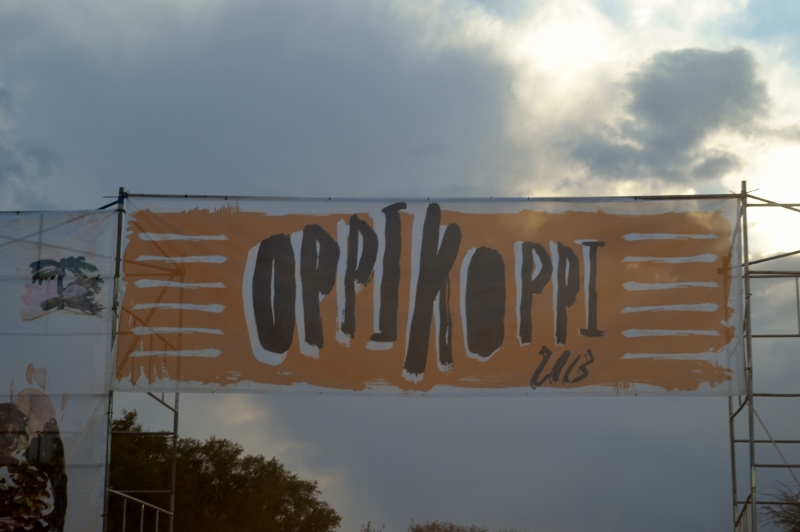
As usual I dibsed the photo spread page, the lack of fast copy got us the Oppi page we wanted *boogies*
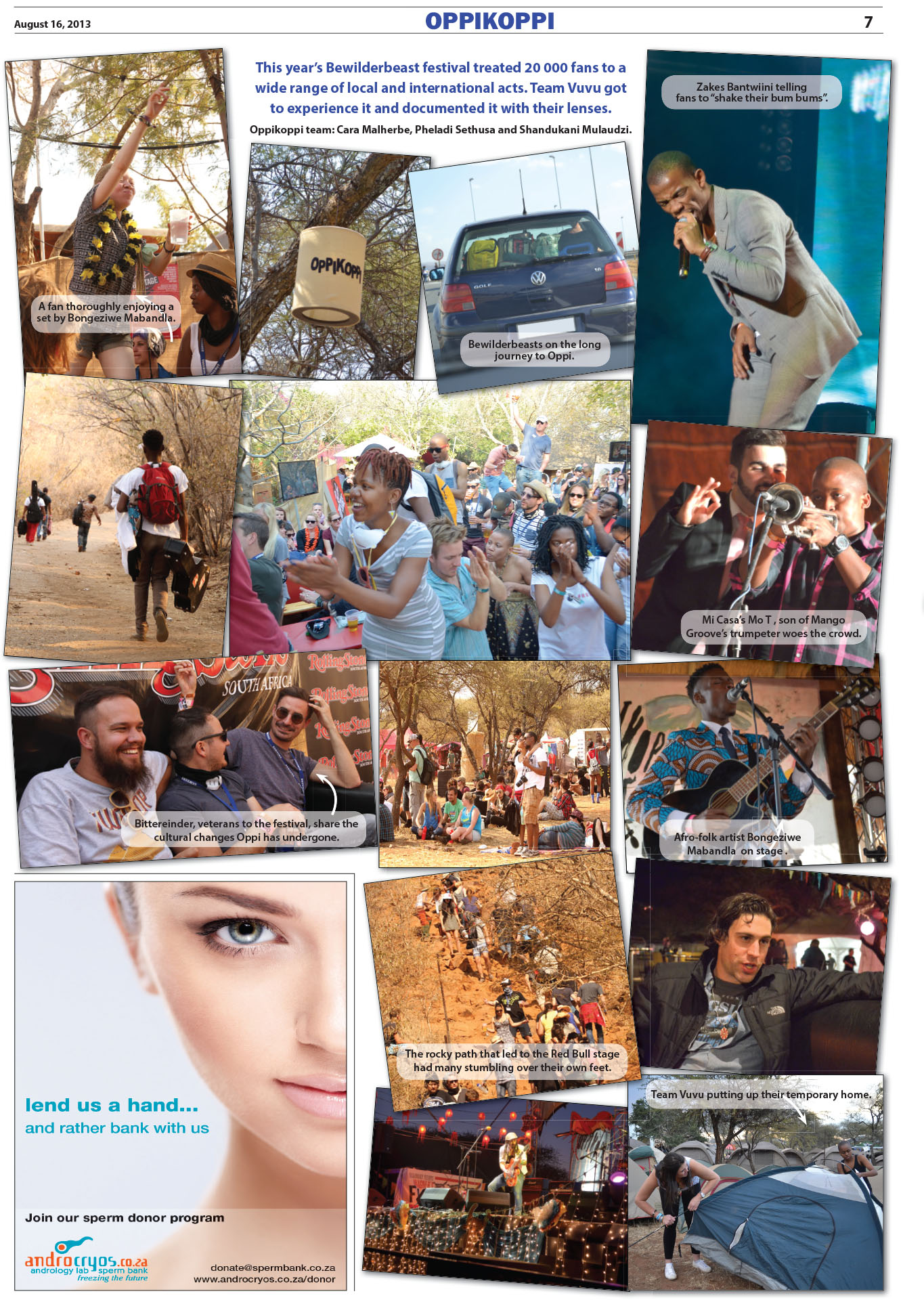
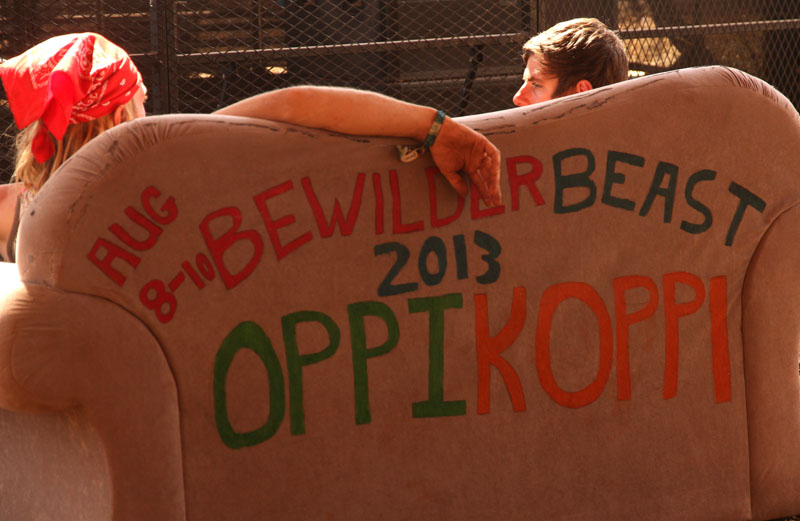
Oppikoppi photo spread
Production did not run smoothly at all but as usual it all came together in the end. The following morning we had a bit of a design workshop with Irwin Manoim, I found it quite helpful.
Later that night I went off to the “We are going to kill each other today: The Marikana Story” – a collection of photographs and stories by a group of journalists and photographers. The event was held at the Old Fort at Constitutional Hill, on the exact date that marked a year since the massacre happened. It was quite overwhelming seeing the photographs taken at Marikana while standing in what used to be an apartheid jail. Death was all around us.
On Saturday a bunch of us headed off to Soccer City for the Nelson Mandela sports day. We got complimentary tickets to watch Bafana Bafana take on Burkina Faso and later the Springboks take on the Argentinians. Both of our teams won leading to much merriment in the stands.
I wanted to leave early to see my parents off but decided to stay on to watch some of the concert. I did for a while but the cold got to me and managed to catch a ride back to campus. I was really excited to go home to a hot meal and my warm bed.
Those thoughts all came to an abrupt halt when a black figure decided to break my car window and steal my backpack. The backpack with my DSLR camera and wallet in it. In the moment I froze and couldn’t accelerate like my mind was telling me to.
Long story short, I picked up new bank cards and got a new window fitted today. What a way to end what was an amazing week.
The past seven days have been jam packed and felt more like two weeks than one.
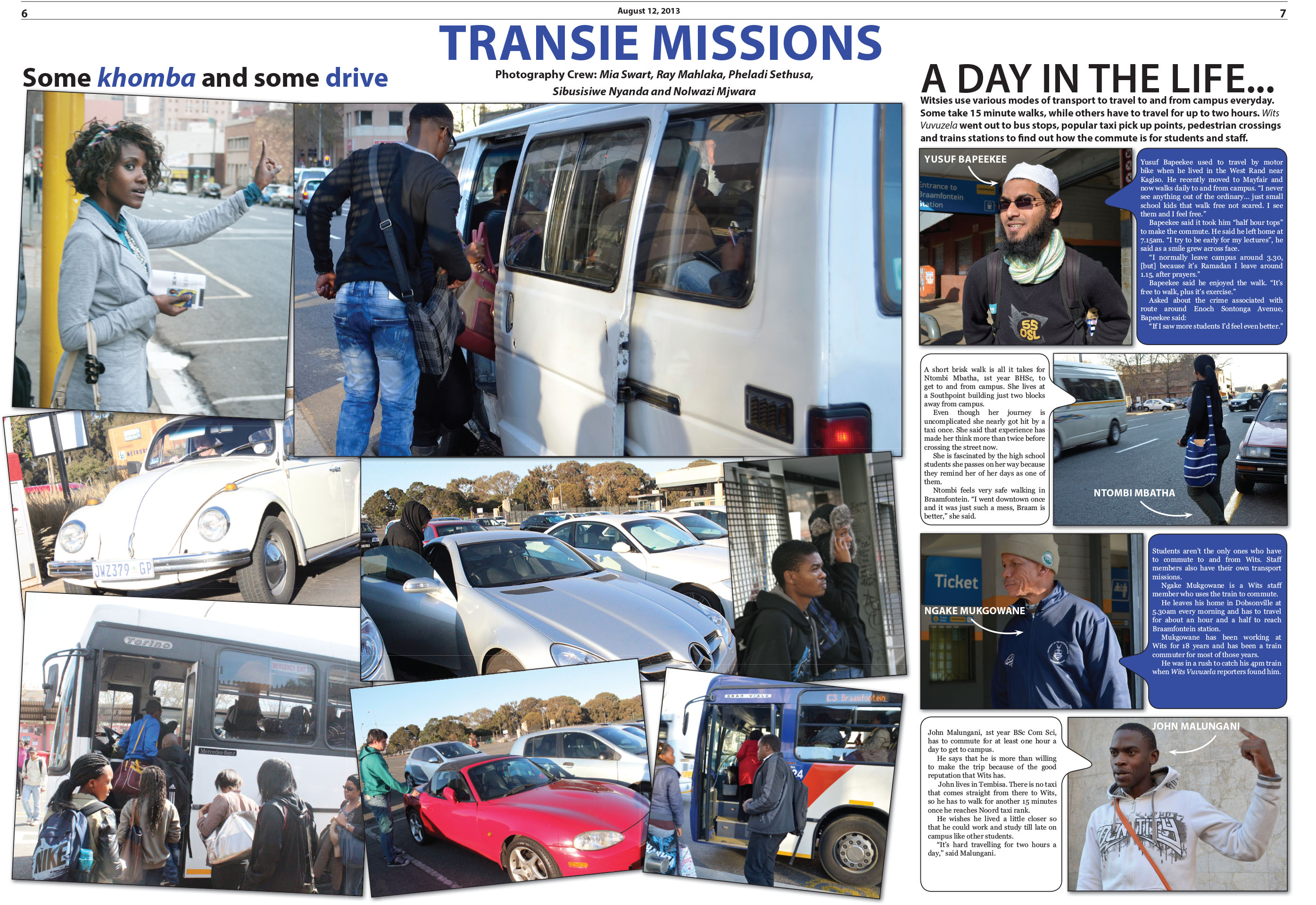
Our lives got much busier when we were told that we had to put another 12 page paper together. Personally I was excited, a 12 pager gives us more room to ‘play’ and deliver more copy. Were it not for the 12 pager we would not have been able to do this photo spread:
Doing a spread this time was a little more difficult because most people just didn’t want to be photographed. But eventually the rejections started bouncing off of us and we managed to get the above shots, and tie in little stories on the side.
Somewhere in between chasing down people for these photo’s and preparing myself for Oppikoppi, I wrote my first football story. Well to call it a story would be a stretch, it was more of a score update than anything else, but alas a football piece nonetheless. Read it here: Scoring boots lift Wits
We also handed in our first submissions for feature writing. We were tasked with writing news features, I would put it up but it was terrible so maybe I’ll put up the next one.
I am enjoying feature writing a whole lot, especially because it really gives one the opportunity to ‘play’ wit their words a bit. Our guest speaker for the week was Toby Shapshak, editor of Stuff magazine, He was a riot.
Every guest lecture we have makes me want to delve deeper into the deep, murky waters of features. Just this morning we had Mia Malan from the Mail & Guardian come in to talk about health features – her stories alone left us all in awe of the power of feature writing.
If you give my blog half a glance you’ll know that I went to my first Oppikoppi festival as well this past week, the posts are all over my blogs and there is still more to come. I have loads of pictures to edit and notes to go through, but this is definitely one of my faves that I have managed to edit so far and as such is winner of “Snap of the week”
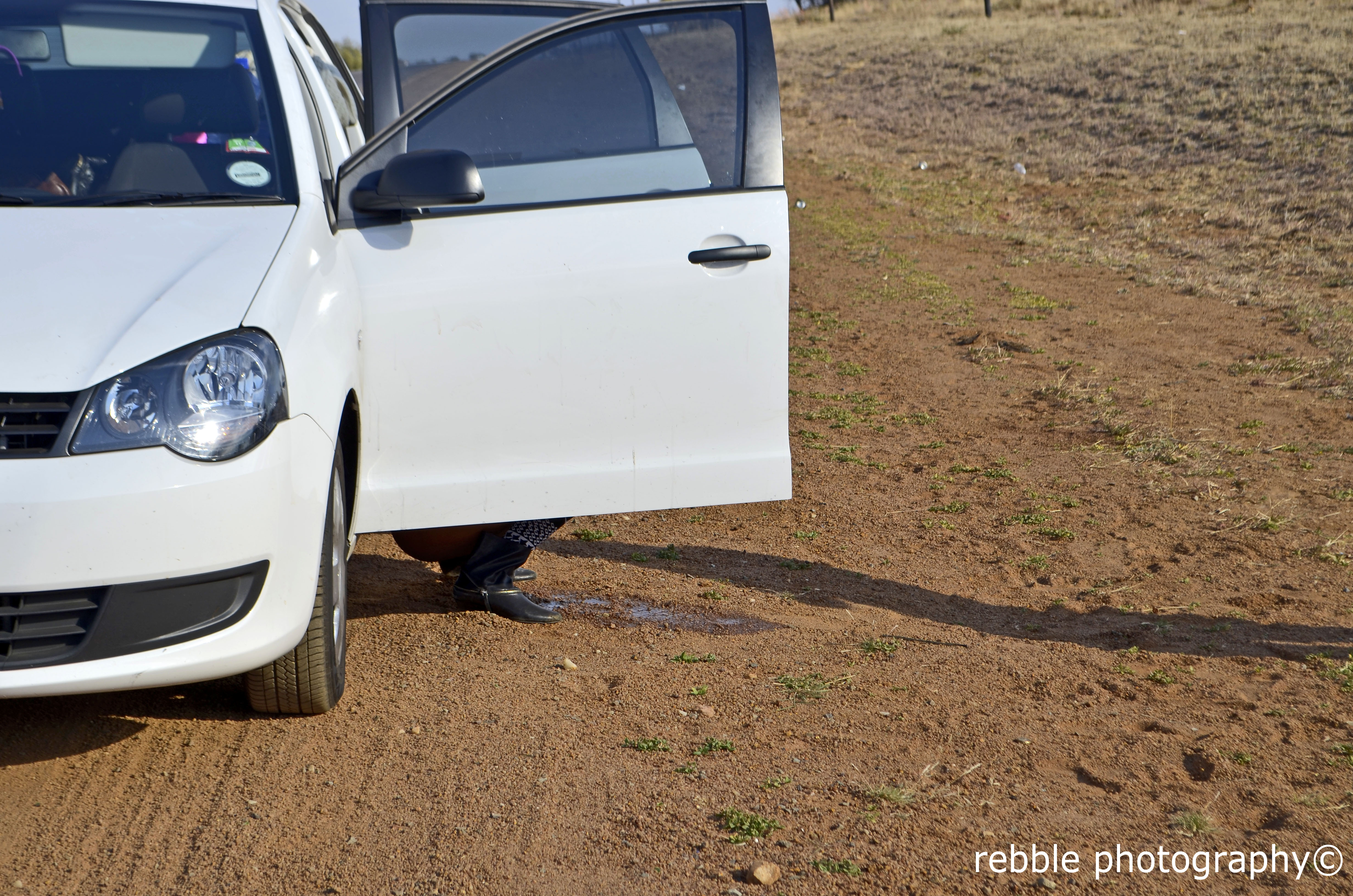
PORTABLE LOO: With no garages in sight, my car doors were turned into a restroom. Photo: Pheladi Sethusa
In much more exciting news I get to be the editor this week, yays! Hope to deliver an absolutely awesome newspaper this week, wish me (us) luck 🙂
We had the time of our lives and we screamed our lungs out for our favourite acts as the dust made its way into our ill-prepared bodies.
The first thing to remember for next year is that Oppi is also known as “Dustville”. Have something to cover your nasal cavities and mouth. It will save you rocky tastes in your mouth and sandy lip gloss.
Now that we are no longer Oppi virgins, we thought it fitting to provide a few survival tips for those looking to go next year.
BAKING: Fans braving the sun to watch a show. Photo: Pheladi Sethusa
How to make it out alive
We had bought enough food and booze to sustain our little bodies for three days in the bush. But on the last day, dry hot dogs with no margarine on the bun or sauce on the Vienna no longer seemed appealing.
The second thing to remember, the festival runs on a cashless system. Those who wish to buy food and drink on the farm have to buy pre-loaded debit cards.
We opted not to do this, knowing it would lead to frivolous spending. We had packed enough food but the smell of boerie rolls and hot chips accosted our senses by the last day, we were dying for a hot meal.
We were also so dehydrated at that point that seeing people’s water bottles had us salivating. Pack enough water, even enough is not quite enough – pack more than enough just to be safe.
In addition energy drinks would have been beneficial. We could barely keep our eyes open by the third day, this would have been cured by a kick and wings from one of those special drinks.
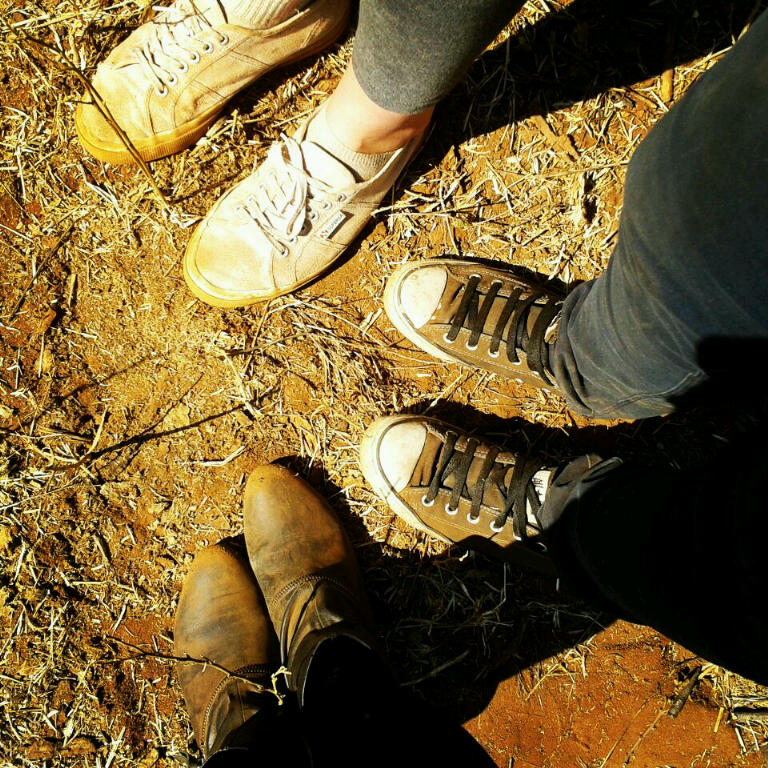
RUINED: Three pairs of shoes that will probably never be clean again. Photo: Shandukani Mulaudzi
Clothes and shoes
We were so scared of the cold that we only packed winter clothes, big mistake. During the daytime we wanted to cry as the hot Limpopo sun scorched our fully covered bodies. It was as if the devil himself was sitting on the hill by the stages letting his heat out on everybody.
Do not bring shoes you hope to wear ever again and only bring one pair. You are going to be filthy by the end of the festival, so rather go with the general theme and take scrappy clothing.
On your way in and out
On the way to and from Oppi try to choose the route with the toll gates, it will set you back R21 but big, open, un-potholed roads await you. This way you won’t have to battle it out with trucks that are struggling to stay on the narrow, windy lanes.
Most importantly though we had a of fun, we enjoyed all that Oppi had to offer and made memories to last a lifetime.
I knew Toby Shapshak was awesome when he said he might not make it to our guest lecture because he would be “fucking dead” after having to walk up ten flights of stairs to our department.
He was our guest speaker last week, tasked with teaching us a thing or two about technology feature writing. As the editor of Stuff magazine, he was the perfect man for the job.
Toby mostly weaved in-between technology talk and general journalism talk. A lot of what he had to say has been replaying in my mind over the week. So I figured it would be a good idea to jot some of his most memorable quotes down.
Toby’s pearls of wisdom
On agenda’s and agenda setting: “Everyone’s got bullshit filters”
On dodge politicians: “If you lie, cheat or steal – you will get caught. It’s just a matter of when”
On life: “You get to a point in life where you deserve aircon, power steering and electric windows” :’D
On readers/audience: “Never underestimate the stupidity of your reader”
On being a journalist: “It’s like a calling, you don’t do it for the money,” he went on to stress that we do what we do because we are compelled to; “The great thing about being a journalist is that you don’t have to be an expert, you can just call one”.
On practicing writing: “You must practice, practice, practice. In the East repetition leads to enlightenment”.
On people as “brands”:“I hate that so much. Just be good at your job”
On magazine covers:“I would drop that [white] woman in a heartbeat if I could”
Pulling the short straw is something that happens a few times in your life. Sometimes you may be lucky and you won’t, this is life.
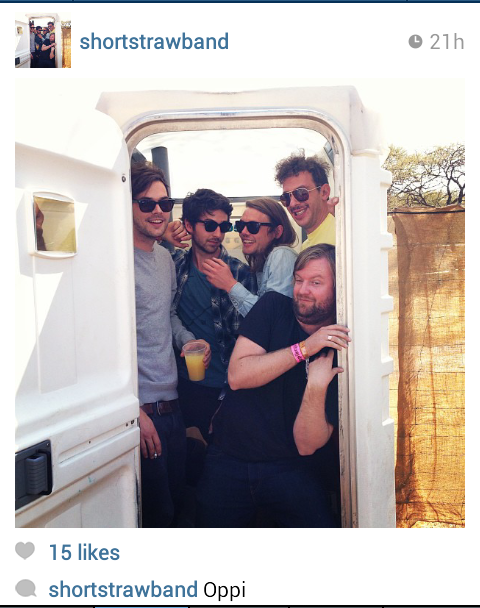
ShortStraw
For the five man band ShortStraw, it was about the beginning of their career. They started out playing for no one then moved on to crowds of about 40 and now, they have two shows on the best Oppikoppi stages.
“That’s fucking bullshit. It’s fucking 2013 you can only laugh at people who still think that way,” said Russel, bass player for ShortStraw.
Russel told Wits Vuvuzela that one of the first black bands to play at Oppi was Kwani Experience and that was what sparked a cultural change at Oppi.
“Black bands used to be apprehensive. But once they played and were received well they changed their minds about the fest.”
Tom added that music is an experience for everyone and something that should bring all people together.
After pulling the short straw on day one, we were on a mission to find some diversity at Oppikoppi.
Traditional music moves
FIRST OPPI: Bongeziwe Mabandla plays his first set at the festival. Photo: Pheladi Sethusa
The Ray-Ban stage, where the incident happened the night before was where we found a new enlightening Oppi experience.
The act was, Bongeziwe Mabandla, who enchanted the crowd with his sweet traditional melodies in isiXhosa. His sound was one we cannot put our finger on but it made us feel like we were watching a male Thandiswa Mazwai.
The crowd, representative of South Africa’s overrated rainbow nation, more than half of whom did not understand the lyrics, stood and danced along with him.
People lost their minds when he jumped off the stage into the crowd and beckoned him to jump onto the table, which he did without protest.
AO JIKA: Mi Casa’s frontman, J Something setting the stage alight. Photo: Pheladi Sethusa
Oppi’s cultural shift
Bittereinder, who are veterans to Oppi said the festival has gotten bigger and better with more variety in music than ever before.
Jaco van der Merwe, rapper in three man band used the Vusi Mahlasela tribute last year as an example of Oppi’s diversity.
“Mi Casa is a great example of diversity, it’s just beautiful. They also have random black people at our show, who have no idea what we are saying, but they jam anyway,” Jaco chuckled.
Later that evening we jammed to crowd favourites Zakes Bantwiniand MiCasa. At these performances, the crowds were just as diverse and responsive. As J’Something asked us to jika, we turned and saw different people jika along with him.
OPPI PAD: The long and windy road. Photo: Shandukani Mulaudzi
By Pheladi Sethusa and Shandukani Mulaudzi
Three camera bags, two spare batteries for each camera, sleeping bags, tent, camp chairs, bags and booze all squeezed into the back of a Polo hatchback.
Even though the day had been coming for a month, two Oppikoppi virgins were scrambling to get their things together at the last minute.
Rosebank Mall was full of people getting last minute supplies, mostly of the liquid variety.
The journey begins
Within the first 30 minutes of the drive, a wrong turn made it clear that it would be a long journey to Northam Farm, Thabazimbi.
The scenic route made up for the potholes and narrow roads which made for a bumpy ride and also provided plenty of photo opportunities.
After two hours of driving a toilet break was needed but no Engen, Shell or Totall garages were in sight – only kilometre after kilometre of dusty road and the odd bush. The only solution to this problem was found inbetween the two car doors of the little Polo.
We’re here!
A wrong turn gone right led directly to the Oppikoppi gates.
ENTER HERE: Oppikoppi 2013. Photo: Shandukani Mulaudzi
Thorn bushes and dust in the air welcomed the first-timers to what would be their home for the next three days. Setting up a tent and easing into the campsite took no longer than 30 minutes.
After settling in, it was time to explore the festival they didn’t know but had heard so much about. Having heard rumours about poor to non-existent sanitation, drunken mosh pits and rampant racism – only first-hand experiences could tell.
Rumours turned true-mours
A performance by band, CrashCarBurn proved the mosh pits true, leaving a rocky taste in our mouths.
A bird’s eye view of the ShortStraw performance from the shoulders of a strong man proved the racism claims.
While many sat on shoulders and waved their hands to the music, it was not a fun experience for one.
As soon as she was lifted to the gracious man’s shoulders, pushing and shoving came from the girls in the front. It could have been a matter of jealousy however, we learned differently.
The guy let our reporter down, and apologised for the failed experience.
His friend, known only to us as Francois, told Wits Vuvuzela journo Caro Malherbe: “I’m sorry. I really would like to talk to them (the black colleagues) but the girls won’t like it. They are of a different race classification.”
With shock and disappointment, the short straw was indeed pulled: by us. We went back to our tents feeling disheartened, but still hopeful.
That hope was quickly snuffed out by comments that came from a neighbouring tent. To our left was a tent with two black men who were very chatty, to our right were two white, Afrikaans men who were also very vocal.
We overheard the white campers saying “Ag, ek gaan nou iemand klap as hulle nie stil bly. Ons sal sommer die nuwe Waterkloof 2 wees”, this was followed by the two men laughing.
That was within a few hours of being on the farm, two more days to go.







 Write. Snap. Click.