Stuff is less exciting without Twitter

“Turn the lights off!” Before May 21, 2025 that phrase had much sexier connotations in my head, now, unfortunately, it is a reminder of the very strange ‘meeting’ between President Cyril Ramaphosa and that guy in the Oval Office. While I have appreciated and gobbled up all the analysis that followed that strange encounter in the last few weeks, something was still amiss. Memes, gags and retweets about the encounter, to be specific. This event was the first time I sincerely missed the bird app since deleting it from my phone last year.

Have I known peace, absolutely. It has been freeing to be rid of the watered-down, oft-triggering and anti-intellectual ‘discourse’ that had come to dominate my Twitter feed. Since the Musk takeover, the algorithm on that app has become most unhelpful and uninformative, making an occasionally toxic and divisive environment, perpetually so by boosting the accounts and thoughts of the most harmful actors in the swamp (himself included).

Anyway, that wasn’t the point of this little scribble. The point was, on that chilly Wednesday evening, I sat listening, enthralled by the shenanigans with no public place to live tweet and banter about the increasingly bizarre events coming through my speakers all the way from Washington DC. I was glued to the radio live feed in my car and couldn’t risk running out of the car, into the house to catch the visual feed in fear of missing even one second of the special episode of WWE. Itching to say something, anything, I turned to my almost inactive Threads account to cash in on the adrenaline that was coursing through me. I made a handful of posts, forgetting in my glee-come-horror at what I was hearing, to actually thread my posts together. But minutes passed with not a like, a retweet, a reply or GIF-only response. That’s when it hit me, that damn, Twitter is really gone and the live back and forths I had become accoustomed to during particulaarly important socio-political events and moments, could not simply be replicated on a different app. Sure, my following and level of activity on Threads probably plays a role, but that used to be the beauty of Twitter, you didn’t have to be ‘somebody’ to hop in on a trending conversation and simply by being vocal be seen by others interested in that conversation.

As someone who had been on Twitter for 14 years, using it professionally as a journalist and socially as a loudmouth, the relative silence during a live news event left me a little sad. Selfishly, for entertainment’s sake. But there was also magic in the way we collectively processed the world around us. As South Africans, primarily through laughter and making light of what is often too heavy. Threads did eventually ‘catch up’ the next day, filling my timeline with more post-meeting reactions, but the moment was gone, and my thumbs were at ease.

Mother City: Still separate and still unequal in Cape Town

*First appeared on Documentary Weekly on December 10, 2024.

Mother City by Miki Redelinghuys and Pearlie Joubert received its World Premiere at Sheffield DocFest 2024 and our writer Pheladi Sethusa had the chance to see it in Johannesburg during a screening hosted by the Ahmed Kathrada Foundation.

The more things change, the more they stay the same – Jean-Baptiste Alphonse Karr 

It has been thirty years since the end of Apartheid in South Africa, yet the freedoms of democracy remain distant for most. The wonderful, world-renowned rights enshrined in the constitution remain fable-like to the poorest, who still have to fight for even the smallest bit of justice and dignity in their daily lives. 

The fight over and for land in South Africa spans hundreds of years. Key dates for the conquest and theft thereof include but are not limited to 1652 when the first Dutch settlers arrived on our shores, 1913 when the Land Act formally restricted land ownership of ‘non-white’ peoples (yes, on the tip of Africa, bizarre I know) or 1948 when the ultimate formalisation of exclusion came in the form of Apartheid.

However, the date most people are familiar with when it comes to this country’s history, is 1994, which marked the transition from white minority rule to a fully-fledged democracy. One which was meant to undo the injustices of the past and guarantee basic human rights for all its people.

Sitting in a packed cinema in Johannesburg, at a private screening of Mother City hosted by the Ahmed Kathrada Foundation, one could be forgiven for thinking that for some (read most), despite living in a country governed by ‘their own’, very little had been done to change their fortunes three decades on. The film co-directed by impact filmmaker Miki Redelinghuys and investigative journalist Pearlie Joubert, has been screened to sold-out audiences since it first premiered at the opening night of the Encounters South African International Documentary Festival in June 2024.

Through the life of Reclaim the City campaigner, Nkosikhona “Face” Swartbooi, the story of what dispossession means to those who live and work in the City of Cape Town unfolds over an hour and forty minutes. He narrates his experiences and those of his fellow activists and reclaimers at Ahmed Kathrada House in Green Point and Cissie Gool House in Woodstock. The social movement operates under the slogan: “Land for people not for profit”, and has sustained two of the longest-standing occupations of vacant buildings in the city centre since 2017. 

It is not a first-person documentary, but the filmmakers’ intimacy and proximity to the activists makes one experience it as such. The time spent in internal strategy meetings, inside reclaimed buildings, and in public confrontations with politicians helps put viewers in the heart of the fight for affordable social housing in Cape Town. Shot freehand and off the shoulder for the most part, authenticity is quickly established and maintained as the film ebbs and flows through dense legal challenges and heartbreaking personal narratives.

The film confronts the legacy of Apartheid spatial planning, town planning which deliberately and forcefully removed Black, Coloured, Indian and Asian people from city centres and suburbs to the outskirts. Close enough to provide reliable, cheap labour but far enough that when the work was over, they remained out of sight. The areas people were relocated to were often derelict and devoid of access to services – a fact that remains true today.

The people who live in these two buildings are ordinary South Africans who had until the occupation remained financially and physically locked out of formal housing ‘opportunities’ (as the government calls them) by being held on stagnant housing lists. South Africa is one of the most unequal countries in the world, and that still largely manifests itself across racial lines. The monthly minimum wage in the country is about R 5 400 ($315), while the average rental for a one-bedroom apartment in the city of Cape Town is R 9 370 ($547). For anyone who lives outside of the City Bowl, transport ranges between R2 000 ($116) and R4 000 (233) a month. It’s clear that the math ain’t mathing and that this financial exclusion is segregation by another name. 

From start to finish, people desperate for change and dignity are met with “be patient” from deflecting politicians, “this is not how it’d done” from irritated locals, and “move, now” followed by undue violence from angry property owners. The housing problem highlighted by activists builds in intensity through their sustained action (occupations and protests) and the city’s inaction as the film comes to a devastating and ultimately fatal climax at the hands of chronic neglect. 

One of the most affecting cinematic devices in the documentary is the original score by Edward George King and Charl-Johan Lingenfelder. It swells and quiets in all the right places, making incredibly difficult and traumatic subject matter easier to wade through on the back of its accompaniment. Coupled with the six years of careful and intimate documentation of the movement, this film serves as a witness to the violence of poverty, inequality and systematic racism. It asks those watching to move beyond passivity and indifference about an issue that seemingly doesn’t affect them, to consider human dignity as an unequivocal right they can play an active role in securing for themselves and others. 


Screenings of the film are updated regularly:
https://www.mothercitydocumentary.com/

untitled

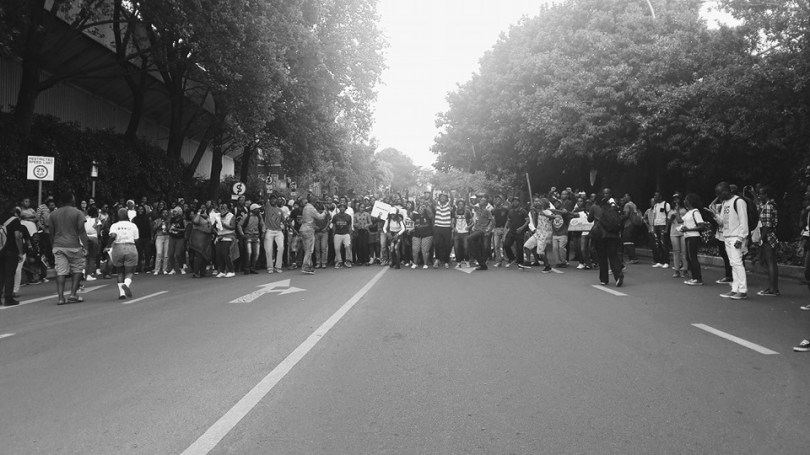
Some people are not allowed to dream. Some people are not granted the space to think beyond their circumstance and no amount of “hard work” in too many people’s cases can fix that. Some people are only given enough space to think to 6pm that evening when they have to pull off another miracle  to feed all five mouths waiting for  them at home. This thing of living just to survive another day is not okay, that’s what I hear the young lions saying and I don’t see how anyone else can hear anything but that obvious truth.

The country has been burning, things have been falling, people have been arrested, charged with treason, many assaulted but thankfully no longer ignored. Placated in some places with some concessions made, abhorred by others, attacked still, but no longer ignored.

#RhodesMustFall #FeesMustFall #OutsourcingMustFall #AccessMustRise #AfrikaansMustFall

Fallists will probably be my people of the decade. They did what those before them dared not to, in fear of shaking things up too much and as a result possibly losing their promised place in relative comfort. They stood up for not only themselves but everyone else too. Which is why it’s so difficult to hear voices of dissent from their peers, their teachers, their parents and (most disappointingly) the people who are tasked with telling their stories to people on the continent and around the world. 

I don’t deserve to write about the fallists, but I think I am allowed to say I am so proud and continue to support them in their efforts. Yes, there have been very unfortunate instances of waywardness, reports about sexual assault and the like along the way – a reflection of the society we live in because academic spaces are mere microcosms of the larger world, not separate special entities where having a degree exempts one from being sexist, homophobic, racist etc –  This doesn’t excuse the messiness at all, rather contextualizes it and mirrors who we all are. 

**Quote: Andile Mthombeni, student at Wits

ON: Gentrification

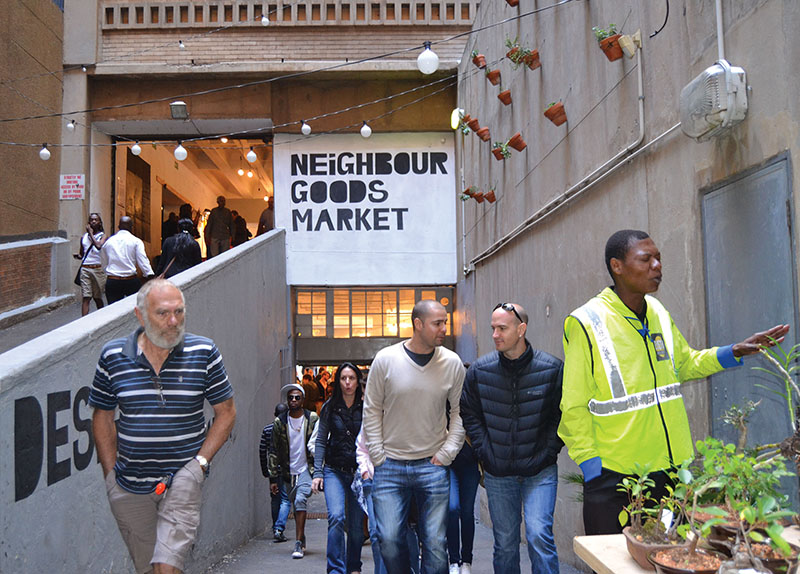
“If you drive over the bridge, you’ve gone too far. Then you’re in the CBD CBD” – this was the warning I would add when giving directions to my friends when I used to live in Braamfontein, Johannesburg. As a student it was public knowledge that crossing the Nelson Mandela bridge, meant leaving the relative “safety” of the patrolled, student filled streets of Braam and entering, “real” downtown Johannesburg.

Patrons at the Motherland coffee shop. Photo: Me
Patrons at the Motherland coffee shop. Photo: Pheladi Sethusa

When I lived in Braam four years ago, the prettification of the place had only just begun. The trendy, art decor-ish apartment block I had moved into still had builders coming in and out, paint fumes choking us and an irregular electricity supply. But it was by far the safest and cleanest place around me. Standing on the balcony of my brand new apartment, with supplied furniture and 24-hour security and fingerprint access, were the rows and rows of rusty, bird-shit-stained, peeling walls that housed the bane of property developers and the state’s existence. The blaring gospel music and the sight of panties on balconies became mine.

The run down apartments – housing entire extended families – around me reminded me of Lucky Kunene, a fictional character in a local movie, Jerusalema. Basically this ex “baddie” buys rundown buildings in the inner city, promises reduced rent to inhabitants, collects it then forces the landlords to take the reduced rent. When they fight him on it, he makes running the place and evictions impossible; then buys the buildings when landlords inevitably give up. And when he gets control, the twisted Robin Hood of Hillbrow rids the buildings of drugs, prostitutes and general squalor. The apartments around me are the places we see red ants descend upon where people are evicted after not paying rent because of the lack of services, which are a result of unpaid rent and so on and so forth.

Dictionary definition of Gentrification: the process of renewal and rebuilding accompanying the influx of middle-class or affluent people into deteriorating areas that often displaces poorer residents.

By the time I was in third year, our prettified part of the inner city had really come alive. Jolling in Braam was now a viable option. You could hop from Puma Social Club, to Great Dane to Kitcheners. None of which had entrance at the time, Great Dane just had a password some nights and if you didn’t have it R20 was your fine. In the daytime there was Post and Double Shot and Father – all of which my student budget could never quite afford but made an effort to save for come allowance day.

“Once you start to notice bike lanes in your neighbourhood – especially if you’re from the hood – that’s an indication that  the neighbourhood is about to be gentrified.” – Negus Korby in Not in my Neighbourhood (2013)

Thrift stalls at Kitcheners Cravery Bar. Photo: Me
Thrift stalls at Kitcheners Cravery Bar. Photo: Pheladi Sethusa

Then there was that whole “take the streets back” thing Nike had going on, I asked myself “back from who?” but those thoughts were quickly sanitised by the cute banana loaves and frozen lemonades at Motherland. At the time all the change happening on the streets I walked on daily was exciting. I spoke about the “rejuvenation of the inner city” with that hipster smugness we all hate. Without thinking about the people that lived on the periphery of these changes, on the other side of the bridge or even in the middle of these changes but not being able to enjoy the changes because of financial barriers.

I love Braam with all of my heart. As a girl from Pretoria it helped me begin to navigate the city in a way I never would have if I lived in res or at home. Of late, I have had to reevaluate this love. Gentrification and spatial violence in these rejuvenated spaces has come under some scrutiny. I’ve read the articles with an open mind, making me question myself and ultimately feeling guilty for my entire social life being based in one of these questionable spaces.

In 2013 evictions of informal traders in the inner city, saw over 2000 people displaced. Operation Clean Sweep (uncanny coincidence huh) was apparently an initiative aimed at ridding the city of “illegal hawkers”.

One of the things that has contributed to my mixed feelings is Not In My Neighbourhood, a unfinished documentary by Kurt Orderson. I saw the full version  this past week for the first time, screenings haven’t come up to the city of gold yet but I have spoken to him and he assured me it will happen at some point. Watching this actually made me think about spatial violence in our current context. The evictions we see in buildings too close to our little bubbles are akin to the forced removals of apartheid, are they not? But perhaps instead of bulldozers arriving suddenly, we now force people out with the exorbitant rental fees imposed after renovations.

“For inner city street traders, who are increasingly pushed into smaller and smaller spaces… Gentrification is also about – in Johannesburg – urban redevelopment is also about not just a particular aesthetic effect, it’s also a mode of governance.” – Mpho Matsipa in Not in my Neighbourhood (2013)

It had never occurred to me until I wrote this, but there are no street vendors in Braam, there are many little spaza shops and cellphone shops and salons – but no one has a little table set up on the street. Now I’m wondering if this is by design or perhaps there was just never a need for “informal traders” because everyone has a shop? Hmmm.

I don’t have an opinion on “gentrification”, I think I see both sides on this one. I get people who argue against it and I find their arguments valid but I also get people who are in favour of it and think that it brings positive change but for who is the question? I don’t have the answers, I’m just a girl with a blog, thinking out aloud.


ON: Sweeping #OperationFiela

Operation fiela. Fiela in Sepedi means “sweep away”. This is the name my government chose as a response to the recent spate of xenophobic attacks in the country.

This year it started in Soweto, when “foreigners” were looted out  of the shipping containers that are their livelihoods. Some kicked, slapped, knifed and burnt. Our leaders said it was all down to criminality, not xenophobia but added that perhaps sharing business secrets with unemployed, discouraged South Africans would help- because it wasn’t xenophobia.

“Foreigners need to understand that they are here as a courtesy and our priority is to the people of this country first and foremost. They cannot barricade themselves in and not share their practices with local business owners,” Lindiwe Zulu, Minister for Small Business Development (January 28, 2015)

Then last month “afrophobic” attacks (the chosen instigator this time) broke out in Durban and copycat attacks spread to other parts of the country. We were told lies about how many had died as a result, reminded that South Africans had also died. This time were even treated to the “third force” delicacy – nice. But back to operation sweep away.

In May 2008, South Africa witnessed its worst wave of xenophobic violence. An estimated 20 000 people were displaced, 62 died during clashes, 600 more injured, over 500 arrested but only 132 convicted for crimes committed during that time.

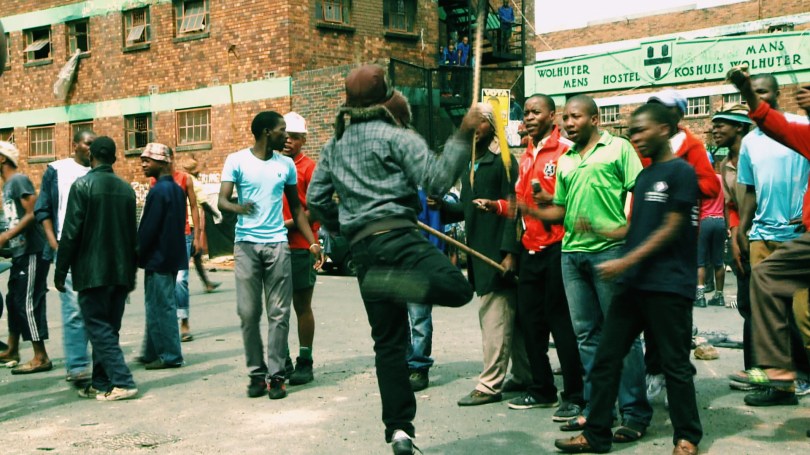
Screenshot from a short clip I took in Jeppestown, Johannesburg last month.

Often the names given to police or government operations have more bark than the implementations bite. Normally bad things happen, they say nothing for what seems an inordinate window between the occurrence and their reaction. And then (normally) things that make it look like things are happening happen – photos are taken, interviews conducted, live crossings on the scene – some people feel like something has happened because their voices are heard or a heavy police presence alters their daily reality somewhat. Then we all run towards the smoke of another fire in the distance and leave before a pile of ashes can form before us, at the current crisis.

Normally.

Sometimes the (re)action comes in the form of a temporary structure or a wrongful arrest – something, anything that will appease even the skeptics for a few beats.

This time they chose force, brute force and swift broom strokes to deal with the problem.

Every police man or government official I have spoken to has said that Operation Fiela is in no way linked to xenophobia, it’s just a standard joint operation to deal with criminal activity in certain areas (read hostels, informal settlements and other such places where they can stamp their boots with unadulterated impunity). Even though they’re collaborating with the same army that was deployed a few weeks ago and conducted humiliating night time raids.

“Large sections of police were unleashed on people, their doors kicked down and people were asked to show their papers. It was a military operation in the middle of the night,” Stephen Faulkner, Cosatu nine unions representative (May 12, 2015)

This week, Stephen Faulkner said it perfectly, to paraphrase: this entire operation needs  a rethink, we can’t go around unleashing the military on people and sweep them away (deport them) like rubbish.

Wayne Ncube, human rights lawyer, explained that deportation is a lengthy process with many steps, which is why they are concerned with the high number of arrests and possible deportations that have already happened. This week they are working towards consulting with about 400 of the latest victims of such a raid which took place at the Central Methodist Church last Friday.

I have not spoken to a single person who isn’t in government who has stood behind the operation. The raids never made sense to begin with, nor do the arrests. It would be easier to believe that these are “standard joint operations” if they were in actual fact standard. If we knew about weekly or monthly raids to seize illegal firearms, bust prostitution rings and arrest undocumented people it would have been easier.

But the timing – first the limp condemnations a week after the first attacks, then the army deployment and raids two weeks after that – the boasting and plenty photo opps say otherwise.

PS

Born free, but still in chains

Last week I gave an impassioned speech to a group of young, soon to be journalists at my alma mater. I told them that this might possibly be the best time to be a young journalist, the opportunities are endless, and other such brochure stuff.

They believed me. Hell, I believed me. And a part of me still does – there is so much we can do, yes we’ll run into and slog under organisations that are counter-revolutionary but it can be done. We can be authentic to ourselves and each other while running on this side of the tracks.

But a part of me faltered and scoffed at the hypocrisy of that talk we had when I read a report with statistics on everything “born free” and my oh my do the numbers look bleak.

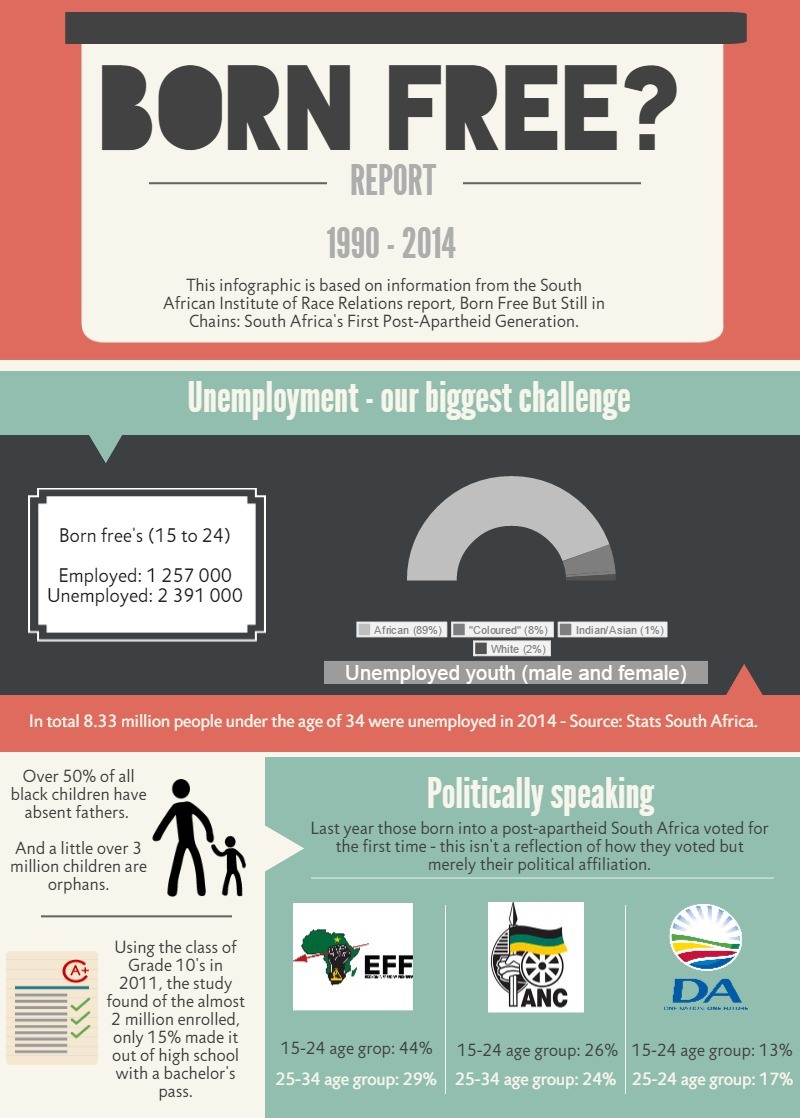
The report, Born Free But Still in Chains: South Africa’s First Post-Apartheid Generation, was released by the South African Institute of Race Relations last week. Luckily their definition of a young person is different from Stats SA (which includes everyone between the ages of 15 and 34), in this report Born Free’s are defined as people under the age of 25.

There were many graphs and numbers broken down and presented in the 39 page report, some of the more jarring (personally), are in this quick infographic I made:

Born free graphic

The statistics aren’t new but I thought about the numbers a lot more personally this time – they are alarming, they are dire, they speak to a crisis even. They speak to the brazen young men we see and speak to at protests, the young girls who want my details so they can get a job (even if it is just carrying my camera bag). They speak to the anger on timelines and the rage that breaks into our homes and smashes windows.

The numbers mattered more now because I see the faces behind those numbers every day and that realisation makes it all so real.

In the report unemployment and education are highlighted as the two biggest concerns we have – unsurprisingly the former is often caused by the latter but not always. The bulk of those unemployed did not complete their secondary (high school) education, and on the other hand almost 400 000 varsity graduates sit without work – so who’s to say having a degree helps these days.

I have no answers at all, but I do know that the columns and warnings about us being a ‘ticking timebomb’ are true. We’re the generation that won’t let the empty promises be the hope we cling on to, we want answers and action and it makes me so happy to know that we are inching ever closer to making ourselves heard. It’s already happening, it’s already here. Like Fanon said we just have to collectively fulfil our mission, I think we have already discovered it.

These statistics cannot continue to rise. That there are people in positions of power who are blase about them (if I’m being polite) is sickening. They should know that their protection now is temporary, if we have to destroy to build they might be collateral – something to think about while they can.

There was a wealth of information in that study that also spoke to how many children are orphans, how many (overwhelmingly black) are child headed households, how HIV/Aids has affected them,  how many have never received any early childhood development, how their living conditions haven’t changed in 21 years (sleeping on the floor, washing and relieving themselves in buckets).

Read it. Gain some perspective before you run around telling people they are “lazy” – there are millions of children who have to fight every single day just to stay alive, be cognisant of that.

We definitely need new names

I have now written a few stories and filmed footage around the current spate of Xenophobic violence in South Africa. I have had debates about whether its xenophobia or afrophobia, about the good King and the reluctance from our government to shame him and about self-hate/unemployment/ignorance being catalysts for the violence.

I have thought about and consumed information on this topic for the past three weeks but I still feel like there’s nothing I can say. The shame coupled with the guilt and anger and sheer despondency have rendered me speechless.

I have nothing intelligent to add to the “stop xenophobia” calls and campaigns – particularly because I feel that a lot of the talking is happening at a level that doesn’t speak directly to the guys wielding pangas and knives on the streets. The guys who are drunk at 7a.m. with the whole day ahead of them to burn and loot and terrorise. The guys who we rarely think about outside of their sins.

A lot of the rhetoric from the top said: no matter what your frustrations are, you have no right to mete that out with violence against others. Another reminded us of the moral debt we owe to those who sheltered us in our time of need. But within those same ranks we had people in positions of power saying the amount of “foreign nationals” in South Africa was reaching a problematic level.

On the ground the guys I talked to said they don’t want “foreigners” in this country because they steal their jobs, sell drugs and steal “their” women. I didn’t know I was a thing that could be stolen. The same guys who told me that are also the same guys who felt it appropriate to try to kiss me, despite my continuous and unwavering “No’s”.

All of that aside, they were the first people I thought of when I heard this quote last night: “You lose your soul when you feel like the world has forgotten about you.”

I just don’t understand how another person from this continent can be called a foreigner. To me anyone who calls them that has no proper scope of history – they obviously know nothing about the false colonial borders, efforts by those same colonisers to have us identify and discriminate on “tribal lines” and obviously even less about the Bantu migration, we’re from Congo yo (but that is a story for another day).

I don’t understand how we let everyone and their mother walk all over us for hundreds of years then have the audacity to touch another African just because we know we can hit them and nothing will happen. It’s like men who beat their wives when they get home after biting their tongues for several hours saying “yes baas”. He bottles is anger and frustration, knowing that saying or doing something to “baas” will have real consequences, consequences a coward like him couldn’t possibly deal with. So he waits, stores that anger, until he can reach a target he can attack with the conviction that no one will be there to back his victim.

For me the reasons of anger and frustration at broken promises decades after democracy are secondary – this is about our level(s) of self hate. It runs deeps and cuts wide.

I say we need new names because we can no longer claim to be true sons and daughters of the soil, when we treat our own like this – I don’t know which words they might be but any that speak to a deep betrayal and self-hate will suffice.

PS

**Photo: Tracy Lee Stark/The Citizen

Debate Club: Gender agenda

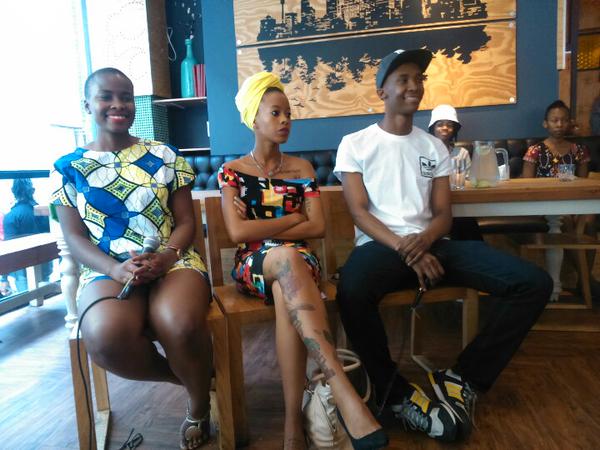
Gender not sex. Womanism not feminism. Patriarchy not masculinity.  These were some of the things brought up at the last debate club meeting of the year on November 25, 2014. The panel steering the direction of the conversation was made up by Panashe Chigumadzi, Lee Molefi and Lebohang Nova Masango.

Feminism, what it is and who it speaks to made up a substantial part of the debate on the night. Some described it as movement that seeks justice and equality. As women wanting to live in a world where they don’t have constantly “check” themselves to stay out of harms way. As vaginas and boobs not being the things that dictate where we belong and what we get to do. The most poignant description for me was:

The way patriarchy shapes what men should and can expect from women was another hot topic. I recall one guy in the audience saying he is all for woman empowerment and equality for “other women” just not his woman. He admitted that he had learnt to expect subservience and as a result that is what he now yearned for.

If I recall correctly he said he’s all for his sister becoming and engineer but his wife should have a more “humble job” as to not bruise his ego and mess with his role as the head of the house. The room, filled predominantly with women, was up in arms at that. This is the kind of thinking that reminds women that they are alone in this struggle, black men aren’t really here for us. Agreed with these comments on gender roles made on the night:

My biggest take away from the night was the fact that so few men were willing to understand what feminism is, some suggested that they can never identify because they aren’t women, that they need to be schooled and feel included to get on the train. In response, the panel said acknowledging patriarchy and how as a man you benefit from it, is similar to white people having to acknowledge white privilege. Something that was necessary to start trying to make things better.

https://twitter.com/ShanduMul/status/537288762934714369

There is a lot more that could have been discussed but time rules us all. This is a very short video of the night made by the good people at LiveMag:


Black Wednesday: Remembering the pain

About a week ago, I went to a film screening of a short doccie on Black Wednesday, hosted by the Steve Biko Foundation at the Bioscope in Maboneng.

I imagined that it would be enlightening and robust debate would be had. I didn’t imagine that I would cry throughout the entire thing.

I “know” our history, I’ve studied it extensively in school, varsity and in my private time to make sure that I never forget, I never become complacent, complicit and and and. Some say I am obsessed and I think we need to be if we truly want to “fight” the system – but that’s a discussion for another day.

Black Wednesday: On October 19 1977 three newspapers and a number of anit-apartheid journalists were banned. The movie we saw was about that, linking that day to the broader effort by the apartheid government to weaken the Black Consiousness Movement as a whole.

Seeing a grown man cry about how Steve Biko’s death was more than just a loss but something that left an indelible mark – at which point he cried, I cried. Personally I will never ever be able to forgive that. Killing Biko on September 12, a month prior, was more than an act of extreme hate but a convoluted plan to break a people – and it may have worked.

Anyway there was a cool opportunity for a Q&A session with the journalists who were banned that time, Joe Thloloe and Juby Mayet. Some highlights from that discussion:

Q: There’s a dirth intellectual leadership amongst emerging generations. They engage with Pan-African ideas at a very superficial level because it’s the “in” thing. The black rage they feel is fabricated. Thoughts on that?

Joe Thloloe: When you say fabricated anger, I disagree with that. It’s still the same anger. But we tried to sanitize it and in the process we find it erupting in ways we didn’t imagine… Since 1994 we have started to believe we are a rainbow nation, we are a miracle nation – when in fact the issues of the time still haven’t been solved. That’s the tragedy of our history.

Q: If that’s the case, can we be saved?

Juby Mayet: The black rage that exists today is directed at the current leadership, because there is such a vast gap between the haves and the have-nots. The haves are not necessarily white anymore…There is such a simple solution, don’t do it  for the t-shirt and the free food hamper – think. You’ve got the vote now, use it.

Q – asked by my friend, Shandukani Mulaudzi: What would you have liked to see happen in ’94?

JT: The first disaster was at Kempton Park, where a whole nation was hoodwinked into believing that a miracle is happening. The first thing that should have been negotiated was – how do we make up for all these years of suffering? That question wasn’t answered. And it still hasn’t been answered. We just went right to ululating and saying we are free – when in fact the basic issue was not resolved. Today a few of us have been co-opted into the old apartheid structures – we just have a few black faces there. I wanted us to answer the question of what do we do about 300 years of painful oppression.

Q: The term Black is now being used as a divider, rather than a term to unite. In the era of BCM, it was used to identify all people who were oppressed. The term Black is being abused by the current holders of power. How do you identify yourselves?

JM: When I had to fill in forms in those days and I still do this – where it asked for race I used to say human. If all of us do that they’ll soon chuck away all of the forms.

Q: Recently Minister Lindiwe Sisulu that people under 40 were not affected by apartheid, therefore should not benefit from redress measures like receiving RDP houses. Thoughts?

JT: That’s absolute nonsense. The child who is unable to read and write in Soweto today – is a product of the apartheid system. Is a product of Jan van Riebeeck landing in the Cape. So it’s 300 years that you are talking about and that will not be removed by the wave of a magic wand. When we talk about redress we must be talking about how we fix the systems, the hurt and damage that was done – mental, physical and spiritual.

Q: How do we address correcting the wrongs of the past if we don’t identify who is Black, White, Coloured etc, if we go by the human race definition?

JT: Saying we are part of “the human race” is a nice little intellectual trap we have set for ourselves. We have to be Black or Coloured or Indian to redress the past. Ultimately we are looking at all people who were oppressed, people who couldn’t vote, couldn’t get work, live where they wanted to etc.

JM: Millions are spent on nonsense things like Nkandla, expensive clothes, flying here and there. That money could be spent on other simple things like education. They did away with Teacher Training Colleges – where must our teachers learn to do what they do? There also needs to be more emphasis on reading from a very young age. Open more libraries, have mobile libraries in rural areas. My informal education largely came from reading when I was young – I just read everything that was in the house.

Q – asked by me: I’m a new journalist and obviously a black female. I find myself in a space where I am expected to write about Nkandla being so bad and that minister being so corrupt – when I know that that is not the real issue – white supremacy is. I suppose my question is, how today, as a journalist can I move beyond the anger I feel towards Jacob Zuma and focus on the real issue we have had and will probably have for I don’t know how long? It’s so very depressing to me to think that my children and their children and their children will have to live through this. It’s an all-encompassing frustration and depression that emanates from me not knowing what to do.

JM: You used the term “white supremacy” – there’s no such thing. It doesn’t exist in my world. In ’94 when we blacks went to vote for the first time were so blindsided by this rosey image of what was happening. We need to lay blame at Nelson Mandela’s feet. Yes, he was a terrific person and a great inspiration but we blindly voted for his party because of who he was – we didn’t see beyond him. We need to conscentise one another, to change mindsets.

JT: The media is a reflection of society in general. We have come to glorify the sensational. The media are businesses, they provide society with what society wants. As journalists we need to reflect who we are in our writing, not what the powers that be want. We are guerillas operating in enemy territory – the newspapers and radio stations are not ours but we must use them.

Q (asked audience member from Bolivia): I would like to see South Africa become a clour blind society. Because with this rainbow of this rainbow nation thing, there are just too many tribes – like in South America. It’s another form of apartheid to say black or white or coloured. People use “black” to play victim.

In response I said: It’s useful to label ourselves because there is a bigger system that supports those lables. It is not a coincidence that the people who liv e in dire poverty are people of colour. Until that is no longer the situation, the labeling of ourselves is necessary.

It was a lovely evening and much more was discussed in the hour long conversation. Keep learning, keep growing.