“CAPE TOWN 25 June 2016 – Twenty five year old actress and now author, Buhle Ngaba has written a children’s book aimed at empowering young black girls. Copies of “The Girl Without a Sound” will be available in bookstores next month.”
I really enjoyed my interview with Buhle, she is the personification of #blackgirlmagic and I will enjoy watching her star burn even brighter in months and years to come.
“Cape Town, 16 June 2016 – A group of school girls has got their eyes on outer space. They’ve spent their Youth Day working on a space programme, and they’ve shown their determination to become the next generation of scientists.”
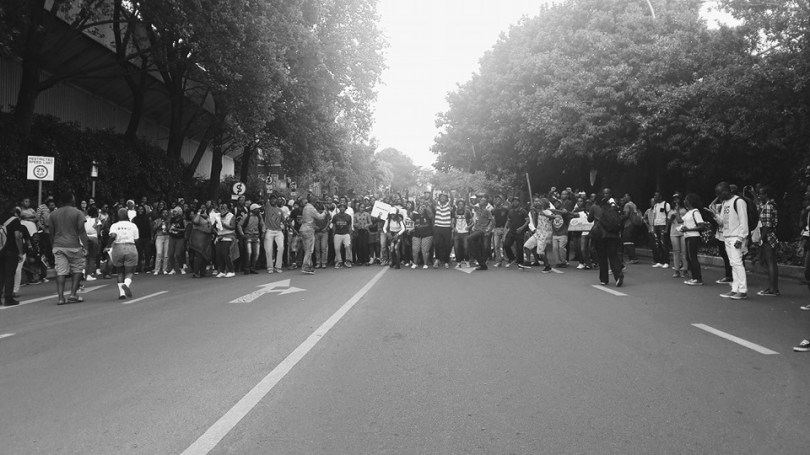
“31 May 2016 – The University of Cape Town is taking a tough stance against students who have been protesting under the Rhodes Must Fall banner. Students who violated a court interdict now face an uncertain future.”
In a surprise turn of events that happened very very quickly, I have moved to Cape Town. I somehow managed to land myself a mad cool job as a reporter at eNCA and packed up my life to do so.
It’s been a month since I started working for the news channel and living near the mountain and I can tell I am going to love it here. I’m sure it will be a tumultuous relationship with me and this place that was (is) the epicentre of the violence of 1652 onward.
But I needed the change, Joho was strengthening it’s choke-hold on me and for the first time in a long while I can breath easy. This is the part where I stop and force you to look at my work – will “press” stories I am particularly proud of working on henceforth. Kbye.
Some people are not allowed to dream. Some people are not granted the space to think beyond their circumstance and no amount of “hard work” in too many people’s cases can fix that. Some people are only given enough space to think to 6pm that evening when they have to pull off another miracle to feed all five mouths waiting for them at home. This thing of living just to survive another day is not okay, that’s what I hear the young lions saying and I don’t see how anyone else can hear anything but that obvious truth.
The country has been burning, things have been falling, people have been arrested, charged with treason, many assaulted but thankfully no longer ignored. Placated in some places with some concessions made, abhorred by others, attacked still, but no longer ignored.
Fallists will probably be my people of the decade. They did what those before them dared not to, in fear of shaking things up too much and as a result possibly losing their promised place in relative comfort. They stood up for not only themselves but everyone else too. Which is why it’s so difficult to hear voices of dissent from their peers, their teachers, their parents and (most disappointingly) the people who are tasked with telling their stories to people on the continent and around the world.
I don’t deserve to write about the fallists, but I think I am allowed to say I am so proud and continue to support them in their efforts. Yes, there have been very unfortunate instances of waywardness, reports about sexual assault and the like along the way – a reflection of the society we live in because academic spaces are mere microcosms of the larger world, not separate special entities where having a degree exempts one from being sexist, homophobic, racist etc – This doesn’t excuse the messiness at all, rather contextualizes it and mirrors who we all are.
I remember being insanely jealous when I saw this book being advertised when it was first published in 2014. Watching Malaika wa Azania doing interviews about the book, thinking “that’s what I wanted to do, surely that should be me”. I’m so glad the universe gave her the gig because this is honestly one of the best books I have read about the state of South Africa – now more than ever really.
This nation’s students stood up last year to say enough is enough and more importantly stood up for themselves when nobody else would. This book reads like a brilliantly timed prologue to what we have seen happen in the past few months at universities across the country.
I was part of the generation that has witnessed the end of our people being oppressed and trapped by the false belief that they owed their eternal gratitude to you (the ANC), and that there would be none brave enough to take you on. (page 167)
For the longest time, until recently, people have expected and have thought about “born free’s” as one homogeneous group that is “non-racial”, not oppressed and has countless opportunities to drag themselves out of poverty and joblessness. This has never been true in this country and remains untrue today. This book made me acknowledge the nuances of inequality in this country, I’ll explain by way of example.
Malaika and I are exactly the same age. The schools we went to were relatively similar. We both fell in love with books an words in ways that changed our lives. Our experiences of whiteness in high school were quite similar. Our thoughts about this continent and it’s people on par. But even though we share some experiences there are a lot, too many that we don’t. And that is our reality. My heart almost broke when she shared a story about taking a friend home from school one afternoon. They ate and did what they did very other afternoon when they went to one another’s “houses” (I say houses like that because a shack isn’t isn’t a house). It started raining. Heavily. The topmost form of zinc protection between them and the heavens caved in from the rain. The shack flooded. Pots and pans floated around the girls. We see similar images on news bulletins every now and again but being inside the head of that little girl who was embarrassed that she had a friend over as they and everything her family owned took an involuntary swim. Some people routinely experience such things as drainage systems and plumping systems are non existent in the places that house tin enclosures.
Merely by being born black in this country you had problems. I didn’t think I’d need therapy to cope with my own circumstances. (page 104)
Her life was rough, she dealt with and took on so much just to survive. There are some who would look at her story and begin telling the “magic negro/against all odds” narrative, that instead of speaking to and addressing the conditions that make people have to trudge through hell just to eat or have a place to sleep or gain entrance into an institution of further education, praises this magical black person who “overcame” those challenges and puts them on a pedestal with a placard reading “HARD WORK PAYS” as inspiration for the other lazy blacks – who are obviously poor because they don’t work hard enough, lol.
She has an amazing mind and can so easily put forth her observations in ways that had me screaming out yes on the train while I was reading this. It was like having one of those heated debates in a politics lecture that I miss so much, affirming and teaching me things at the same time. She speaks to the reality of now, the discord between the state and us, the animosity between black and white and the poverty keeping the majority of our people scrapping at the bottom of the barrel.
There are times when the only weapon a black child can use to fight against a system that dehumanises her is to be so angry that she is left with no choice but to dare to be alive.
While I bemoan the resilience narrative, I also found her political resilience inspiring. Fighting “the system” is an uphill battle with assured losses along the way, choosing to keep on fighting is necessary to achieving any kind of change. It’s not about winning or reaching a point where you get something that you want, like the vote, thinking that you have attained freedom once you have it. It is a journey, a continuous one that will not end any time soon if we rest at historical pit stops for a feast.
But comrade Malema was the closest thing to ourselves than anyone else at that point. (page 114)
I was particularly saddened by her account of what transpired while she was part of the EFF, the way they treated her really hurt and frightened me considering their trajectory and my allegiance. Either way this woman is a fighter and I can only hope that one day I can follow in her footsteps in using words to paint truth bombs for pictures.
I haven’t written anything on here in a few months and it has everything to do with my new job. My new job isn’t the kind of job that affords one the time or “space” to scribble one’s considered views on current affairs or even personal affairs.
I get to work with moving pictures which, I grew to love in 2015, and I suppose you could say I still get to write via scripts. However, it’s not quite the same.
I miss writing so so much. I miss being in the field everyday doing something different and speaking to different people, getting to see the “real” South Africa unfold before me. I miss talking to my people, talking about my people, talking through my people.
Don’t get me wrong, I still do the news but it’s slightly different when you do the news for an international audience and for pure profit. The space I was speaking about shrinks or maybe widens, depending on who you are and why you came into journalism.
It’s like watching things around you happen in slow motion, you are there but at a distance. Stuck in a fixed point unable to move close, probe deeper, ask more – just standing there with the best telephoto lens on the market – but far, very far from the centre of the riot.
It’s a good job, the opportunities that come with it are positively amazing, I’m getting invaluable experience, imali is good and and and – but we miss what we miss. I’ll be gone til November 😦
Immediately after finishing this read last night, I almost felt like I had never really read a novel before, that’s how incredibly remarkable it was.
It was my first Ayi Kwei Armah reading and it definitely won’t be my last. What a man. To call this a book would be reductive it’s a piece of brilliant literary work – something that should be at the very top of all those narrow “50 books to read before you die” listicles.
“Beyond that he taught us not to fear the power of the destroyers’ weapons but to learn quickly the use of that power against the destroyers themselves.” – pg 147
So what happens? Basically the book is a narrative account of slavery thrust upon this continent, first by the Arabs and then later by the “white destroyers from the sea”. There is nothing vague in this work, people are called what they are and the terrible acts performed by these destroyers described in all their grotesque wickedness are laid bare. Of people being forced to fornicate with horses as punishment, of people being branded, of the raping of young boys by old men, of being shot at and dumped overboard and much more. It felt all the more real because Armah had made you (the reader) a part of this world, on this journey with these people’s in the grips of a terrible destruction.
But beyond this is also offers an insight into “the way”, our way before we were so rudely interrupted, and interestingly he doesn’t paint it as some utopia either but there was much more respect for one another and the spaces we occupied.
It’s a difficult read, with a lot happening on every single page, so I took my time reading it. Every word counts and if you miss a line you will be the lesser for it. It was a truly devastating read but in the best way possible, I will never be the same and I am the better for it.
“A mind attacked and conquered is guided easily away from the paths of its own soul,” – pg 28
What I loved most was that he didn’t just outline and highlight what the problem was/is but he proffered practical solutions. I think that is what kept me from complete ruin by the works close. Yes, I cried in many, many places, but towards the end when one of the most important characters meets his end, I was sad but I knew it was coming and I also knew that his death would not render those like him immobile, incapable of carrying out their planned action without him at helm to lead the charge.
I was left with a real sense of hope, a real sense of knowing that I will not be the answer to today’s destruction but I can in whatever way I can, CREATE something that will help to bring the end of our destruction closer. And that is all I need, all I want really.
“No illusions brought us here, none support our work. We offer none of the comfort destroyed mind finds in lies.” – pg 183
Of this reading experience I would say this: As a student of history I know things and stuff about slavery in its many forms, when it happened, to whom etc. I’ve read the books, watched the movies and written the essays. But all in a semi-detached way because those accounts are rarely ever personalised, Armah made the facts breathe.
I’ll use a short analogy to elaborate: I was unplugged from the Matrix like Neo, I had already puked from the knowledge being forced down my throat and into my ears. Eventually as he began to accept the truth about the world and who he was, that was all flipped upside down when he met the architect. This book was my architect. Laid everything bare, didn’t hold back on anything, showed its disdain and even gave me a way forward.
Nothing and no one have done that for me before, I will forever be thankful for this piece of work. It gave me real and more importantly, practical advice on how to press on. I will have to read and reread it many more times, it’s too dense a work for me not to have missed things.
“If you drive over the bridge, you’ve gone too far. Then you’re in the CBD CBD” – this was the warning I would add when giving directions to my friends when I used to live in Braamfontein, Johannesburg. As a student it was public knowledge that crossing the Nelson Mandela bridge, meant leaving the relative “safety” of the patrolled, student filled streets of Braam and entering, “real” downtown Johannesburg.
Patrons at the Motherland coffee shop. Photo: Pheladi Sethusa
When I lived in Braam four years ago, the prettification of the place had only just begun. The trendy, art decor-ish apartment block I had moved into still had builders coming in and out, paint fumes choking us and an irregular electricity supply. But it was by far the safest and cleanest place around me. Standing on the balcony of my brand new apartment, with supplied furniture and 24-hour security and fingerprint access, were the rows and rows of rusty, bird-shit-stained, peeling walls that housed the bane of property developers and the state’s existence. The blaring gospel music and the sight of panties on balconies became mine.
The run down apartments – housing entire extended families – around me reminded me of Lucky Kunene, a fictional character in a local movie, Jerusalema. Basically this ex “baddie” buys rundown buildings in the inner city, promises reduced rent to inhabitants, collects it then forces the landlords to take the reduced rent. When they fight him on it, he makes running the place and evictions impossible; then buys the buildings when landlords inevitably give up. And when he gets control, the twisted Robin Hood of Hillbrow rids the buildings of drugs, prostitutes and general squalor. The apartments around me are the places we see red ants descend upon where people are evicted after not paying rent because of the lack of services, which are a result of unpaid rent and so on and so forth.
Dictionary definition of Gentrification: the process of renewal and rebuilding accompanying the influx of middle-class or affluent people into deteriorating areas that often displaces poorer residents.
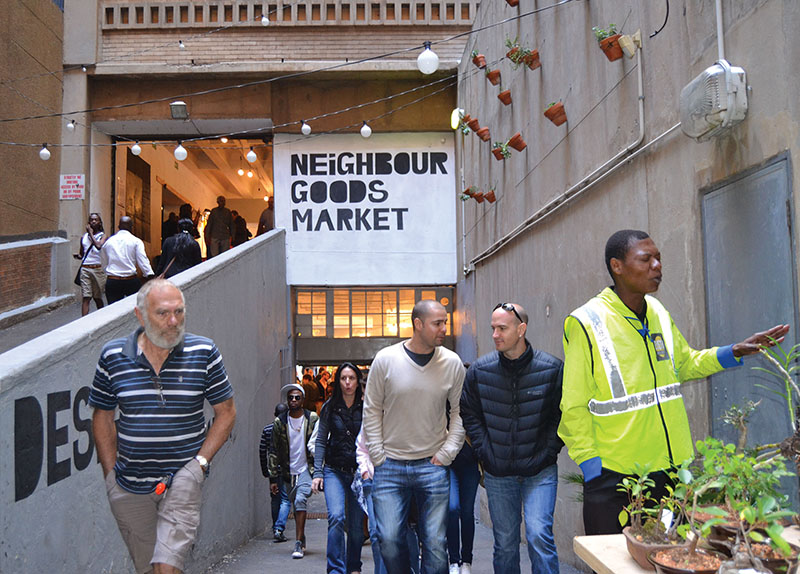
By the time I was in third year, our prettified part of the inner city had really come alive. Jolling in Braam was now a viable option. You could hop from Puma Social Club, to Great Dane to Kitcheners. None of which had entrance at the time, Great Dane just had a password some nights and if you didn’t have it R20 was your fine. In the daytime there was Post and Double Shot and Father – all of which my student budget could never quite afford but made an effort to save for come allowance day.
“Once you start to notice bike lanes in your neighbourhood – especially if you’re from the hood – that’s an indication that the neighbourhood is about to be gentrified.” – Negus Korby in Not in my Neighbourhood (2013)
Thrift stalls at Kitcheners Cravery Bar. Photo: Pheladi Sethusa
Then there was that whole “take the streets back” thing Nike had going on, I asked myself “back from who?” but those thoughts were quickly sanitised by the cute banana loaves and frozen lemonades at Motherland. At the time all the change happening on the streets I walked on daily was exciting. I spoke about the “rejuvenation of the inner city” with that hipster smugness we all hate. Without thinking about the people that lived on the periphery of these changes, on the other side of the bridge or even in the middle of these changes but not being able to enjoy the changes because of financial barriers.
I love Braam with all of my heart. As a girl from Pretoria it helped me begin to navigate the city in a way I never would have if I lived in res or at home. Of late, I have had to reevaluate this love. Gentrification and spatial violence in these rejuvenated spaces has come under some scrutiny. I’ve read the articles with an open mind, making me question myself and ultimately feeling guilty for my entire social life being based in one of these questionable spaces.
In 2013 evictions of informal traders in the inner city, saw over 2000 people displaced. Operation Clean Sweep (uncanny coincidence huh) was apparently an initiative aimed at ridding the city of “illegal hawkers”.
One of the things that has contributed to my mixed feelings is Not In My Neighbourhood, a unfinished documentary by Kurt Orderson. I saw the full version this past week for the first time, screenings haven’t come up to the city of gold yet but I have spoken to him and he assured me it will happen at some point. Watching this actually made me think about spatial violence in our current context. The evictions we see in buildings too close to our little bubbles are akin to the forced removals of apartheid, are they not? But perhaps instead of bulldozers arriving suddenly, we now force people out with the exorbitant rental fees imposed after renovations.
“For inner city street traders, who are increasingly pushed into smaller and smaller spaces… Gentrification is also about – in Johannesburg – urban redevelopment is also about not just a particular aesthetic effect, it’s also a mode of governance.” – Mpho Matsipa in Not in my Neighbourhood (2013)
It had never occurred to me until I wrote this, but there are no street vendors in Braam, there are many little spaza shops and cellphone shops and salons – but no one has a little table set up on the street. Now I’m wondering if this is by design or perhaps there was just never a need for “informal traders” because everyone has a shop? Hmmm.
I don’t have an opinion on “gentrification”, I think I see both sides on this one. I get people who argue against it and I find their arguments valid but I also get people who are in favour of it and think that it brings positive change but for who is the question? I don’t have the answers, I’m just a girl with a blog, thinking out aloud.
Operation fiela. Fiela in Sepedi means “sweep away”. This is the name my government chose as a response to the recent spate of xenophobic attacks in the country.
This year it started in Soweto, when “foreigners” were looted out of the shipping containers that are their livelihoods. Some kicked, slapped, knifed and burnt. Our leaders said it was all down to criminality, not xenophobia but added that perhaps sharing business secrets with unemployed, discouraged South Africans would help- because it wasn’t xenophobia.
“Foreigners need to understand that they are here as a courtesy and our priority is to the people of this country first and foremost. They cannot barricade themselves in and not share their practices with local business owners,” Lindiwe Zulu, Minister for Small Business Development (January 28, 2015)
Then last month “afrophobic” attacks (the chosen instigator this time) broke out in Durban and copycat attacks spread to other parts of the country. We were told lies about how many had died as a result, reminded that South Africans had also died. This time were even treated to the “third force” delicacy – nice. But back to operation sweep away.
In May 2008, South Africa witnessed its worst wave of xenophobic violence. An estimated 20 000 people were displaced, 62 died during clashes, 600 more injured, over 500 arrested but only 132 convicted for crimes committed during that time.
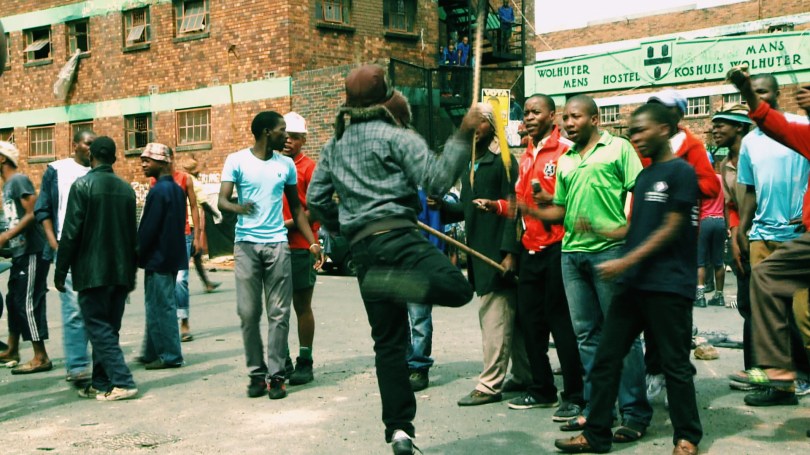
Screenshot from a short clip I took in Jeppestown, Johannesburg last month.
Often the names given to police or government operations have more bark than the implementations bite. Normally bad things happen, they say nothing for what seems an inordinate window between the occurrence and their reaction. And then (normally) things that make it look like things are happening happen – photos are taken, interviews conducted, live crossings on the scene – some people feel like something has happened because their voices are heard or a heavy police presence alters their daily reality somewhat. Then we all run towards the smoke of another fire in the distance and leave before a pile of ashes can form before us, at the current crisis.
Normally.
Sometimes the (re)action comes in the form of a temporary structure or a wrongful arrest – something, anything that will appease even the skeptics for a few beats.
This time they chose force, brute force and swift broom strokes to deal with the problem.
Every police man or government official I have spoken to has said that Operation Fiela is in no way linked to xenophobia, it’s just a standard joint operation to deal with criminal activity in certain areas (read hostels, informal settlements and other such places where they can stamp their boots with unadulterated impunity). Even though they’re collaborating with the same army that was deployed a few weeks ago and conducted humiliating night time raids.
“Large sections of police were unleashed on people, their doors kicked down and people were asked to show their papers. It was a military operation in the middle of the night,” Stephen Faulkner, Cosatu nine unions representative (May 12, 2015)
This week, Stephen Faulkner said it perfectly, to paraphrase: this entire operation needs a rethink, we can’t go around unleashing the military on people and sweep them away (deport them) like rubbish.
Wayne Ncube, human rights lawyer, explained that deportation is a lengthy process with many steps, which is why they are concerned with the high number of arrests and possible deportations that have already happened. This week they are working towards consulting with about 400 of the latest victims of such a raid which took place at the Central Methodist Church last Friday.
I have not spoken to a single person who isn’t in government who has stood behind the operation. The raids never made sense to begin with, nor do the arrests. It would be easier to believe that these are “standard joint operations” if they were in actual fact standard. If we knew about weekly or monthly raids to seize illegal firearms, bust prostitution rings and arrest undocumented people it would have been easier.
But the timing – first the limp condemnations a week after the first attacks, then the army deployment and raids two weeks after that – the boasting and plenty photo opps say otherwise.






 Write. Snap. Click.