A mall without walls

taxi-rank
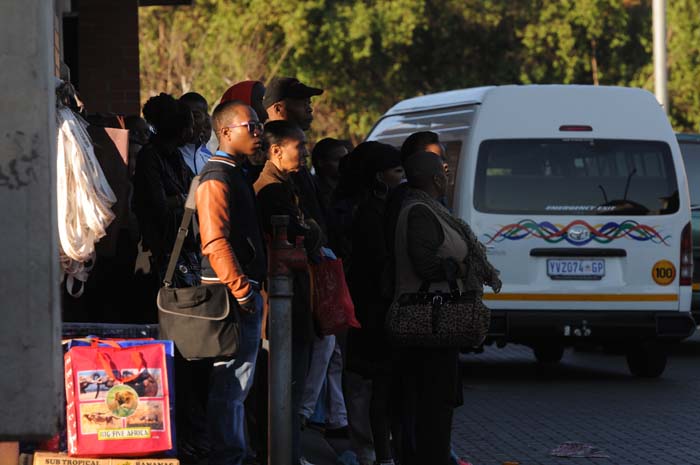
Commuters wait patiently for the taxi to arrive at Bara taxi rank in Johannesburg. Picture: Nigel Sibanda

NOTE: Article first appeared in The Citizen newspaper on June 3, 2014. 

Rushed commuters greet one another in passing, buy combo’s of coffee and magwinya (fat cakes), while others get their daily paper and those with time wait for grilled giblets on a sosati stick. All done in just under five minutes before lining up to catch a bus or taxi, or walk over to the hospital.

This is the Baragwanath taxi rank – 1.4km-long and 50-metres wide – one of the biggest and busiest in Gauteng. At least 1 000 taxis, managed by 12 associations, 20 bus bays and 500 street traders serve the thousands of feet that make their way through the rank every day.

Passing the plethora of stalls you will find your way to a makeshift casino in the form of young men and women playing cards and ma dice – all hoping to win some money.

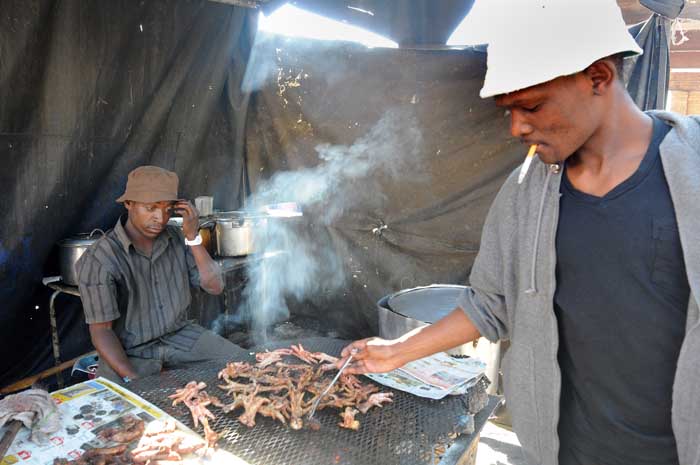
Just behind them is braai master Musa Bhengu, who has been working at the rank for 15 years. Bhengu braais a variety of meats. “I sell everything from skop (sheep’s head), to chicken feet, mogodu (sheep’s intestines) and pap,” he said.

As one of the only traders at the rank braaing meat, Bhengu said his business grows every year. Along with this, Bhengu’s stall is not directly on the taxi rank property so he does not pay rent, which makes his business all the more profitable.

He also does not have to worry about crime. “They target the big stores like Cambridge, not me,” he said. A short walk across a street to the rank leads to traders who reside on rank property and have to pay rent.

Musa Bhengu looks on as the customer picks the braaied chicken feet at Bara taxi rank, 28 May 2014. Bhengu has been supplying hungry commuters since 1999. Picture: Nigel Sibanda

Second-hand clothes seller Fatima Nyambo said she pays R500 rent a month for her stall. She said it was worth it because “you get safe storage space and there’s security in here”. The single mother of an eight-year-old in Mozambique set up her stall to be her own boss and “provide for my son”, she said.

The orderly stalls inside the rank provide hot food, clothes, phone repairs and some quick hairstyles for customers.

A few holding bays away, Sipho Sobantu is busy repairing a “talking shoe”. He has been repairing and making shoes at the rank for 10 years. Sobantu uses cardboard and leather cut-offs and uses his creativity to make brand new sandals – costing R50.

He pays R100 rent a month for the stall he occupies.

He lamented the stiff competition at the rank: “Lots of unemployed people have come here to open businesses. It’s very competitive now and a lot of people sell the same things.”

Just outside, occupying a space in between some of the bays, stands a blue and white gazebo with promoters selling cheap medical care. “Hello doctor” is a cellular subscription service. “People just have to SMS their symptoms and a doctor will reply with a diagnosis or a prescription of medicine to buy. If people can’t afford that, he can even help you make something from ingredients you have at home. All for R2.70,” said Pamela Ntsume. She said the service will help people who can’t afford traditional healthcare.

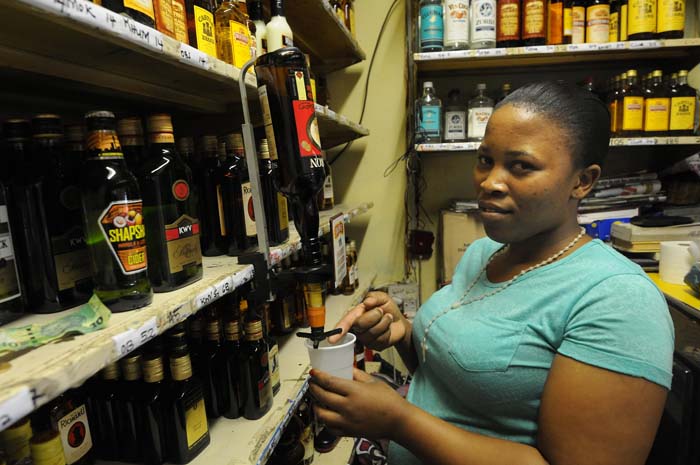
Joalane Mokoena pours launch time drinks at a tavern known as ” ga Magogo” opposite Bara taxi rank in Johannesburg, 28 May 2014. The tavern has been serving patrons for over 40 years. Picture: Nigel Sibanda

Meeting in the cramped storeroom of her tavern at the rank, “Magogo” said her customers hated the noise from outside. “Older people come here to have a quiet drink. We don’t even have music.” Magogo did not want her photo taken or name published because people have already targeted her family business.

As she said this she pointed to a safe with a hole in the middle. “They took so much money. They knew there was money here over the Easter weekend,” she said. Crime has followed the family over the years, she said. Magogo also complained about the competition in the area. “In the past it used to be so busy here people could barely get in. Now people don’t have money and permits are handed out so freely there are taverns on every street and corner.”


Infuse religion in law making: Mogoeng

NOTE: Article first appeared in The Citizen newspaper on May 29, 2014. 

In sound clips and video footage aired yesterday, Chief Justice, Mogoeng Mogoeng suggested infusing religion into “law making practices” would make for a more moral society.

FILE PICTURE: Chief Justice Mogoeng Mogoeng. Picture: Werner Beukes/SAPA

Speaking at the annual Religion and Law Conference in Stellenbosch on Tuesday evening, Mogoeng said that South Africa’s degenerated morality could be, “effectively turned around if religion were to be factored into law making practices”.

Mogoeng went further: “I hope to support this conclusion with particular reference to principles drawn from the Christian faith. I do so, not because I have no regard for other religions, but because it is the only faith in which I have invested a lot of time and energy to familiarise myself with.”

Lulama Luti, spokesperson for the judiciary said: “The Chief Justice believes there is a need to drive moral regeneration more forcefully and to develop a national moral code based on the foundational values of our Constitution and all other religious principles …”

His comments were the topic of numerous timelines on Twitter yesterday, based on short snippets of the speech they saw or heard. What the public gallery did not comment on was what Mogoeng said after that, which effectively negated his initial view somewhat. He said religion in the law could have negative effects, “the law influenced by dominant faith has at times been adulterated to serve as a tool for the extinction of smaller religions”.

He urged those in attendance to think about what religious intolerance was doing to people in places like the Central African Republic and Sudan as examples.

Shadrack Gutto from the University of South Africa said: “The Chief Justice needs to clarify what he meant by religion. Many people are spiritual but not religious for instance.”

New NWest rector will inspire women

NOTE: Article first appeared in The Citizen newspaper on May 27, 2014.

Professor Mashudu Maselesele is “unapologetic” about the “special attention” she will pay to developing young black women in her office as the new campus rector at the University of the North West (UNW).

Maselesele was recently appointed as the first black, female campus rector and will remain in the post for the next six years, in these years she hopes to champion and spearhead the advancement of black students, female students in particular.

IN CHARGE. Mashudu Maselesele was recently appointed as the first black, female campus rector at the University of the North West. Picture: Supplied.

“I am aware of the challenges that black women go through in an academic environment as I have experienced them,” shared Maselesele.

She sees her appointment as an effort for transformation by UNW, but doesn’t consider it as an affirmative action appointment. Instead Maselesele views her appointment as a shift from the male-dominated academic environment, “the culture is changing, women are now preparing to take up the challenge,” she said.

Along with this she believes that, if anything, it makes her “a role model” for the young people she wants to support.

In 2012, when Maselesele received an award for being one of the top eight women in higher education, she realised “how few women are in leadership positions in academic institutions in South Africa. We are currently in the majority yet a small fraction is in decision making process”.

Coming from a nursing background Maselesele recalled when she first realised where she wanted her career to go.

“I was inspired by the uniform that nurses wore when I was still a young girl from Balanganani village in Ha-Davhana: Limpopo Province.” This led to her studying nursing and becoming a profes-sional nurse.

As a working mother and one who was still studying part-time towards her Master’s degree, Maselesele thanks her late parents for their help in “playing the parent role” when she could not.

Maselesele’s academic career started when she taught at the University of Venda in Limpopo. “At this stage I completed my doctoral degree at the University of Johannesburg and post-doctoral studies with University of California,” she said.

Along with this she has supervised masters and doctoral students and been published widely on the topic of “sexual and reproductive health, as well as caring for the caregivers (nurses) in the context of HIV and Aids”.

Her CV is just a sign of what one can do, “no matter where they come from”, said Maselesele.

Two-year backlog clogs post office depot

FILE PICTURE: A post office sign. Picture: Tracy Lee Stark
FILE PICTURE: A post office sign. Picture: Tracy Lee Stark.

NOTE Article first appeared in The Citizen newspaper on May 19, 2014. 

small post office depot is chock -a-block with thousands of letters, many of which may have gone undelivered for two years, according to a source at the Post Office.

The Post Office last week ordered an internal investigation after an employee at the affected branch blew the whistle.

The whisteblower insisted that colleagues not be allowed to “hide this thing” by dumping the mail in an effort to save face and “not face the customers affected”.

The Post Office branch in Wesselsbron, Free State, doubles as the postal depot for the area.

“The mail has been sitting there since 2012, we don’t have space to move,” the whistleblower is reported to have said.

Following the whistleblower’s efforts, the matter ended up at the Post Office’s headquarters in Pretoria.

Janras Kotsi, spokesperson to the group executive of Mail Business, said two senior investigators had been assigned to conduct a “thorough investigation into the undelivered mail that was discovered in Wesselsbron”.

However, the source alleged that members of the investigation team had wanted to hide the incident. “They wanted to convince the manager to not publish the report, which is just wrong.”

Only some of the delayed mail would be required by the SA Police as evidence for prosecution, Kotsi said. Most of it was “ordinary mail” which would be delivered as soon as possible.

He added that the Post Office has a “zero tolerance” policy on postal crime.

“A disciplinary procedure and suspension which may lead to dismissal.” If criminal acts are uncovered, they would be referred to the police for criminal prosecution.

Mamelodi painted yellow as Sundowns celebrates PSL league win

WE ARE THE CHAMPIONS. PSL champions Mamelodi Sundowns drive past children from Nellmapius Primary during their victory parade in Tshwane yesterday. Picture: Refilwe Modise.

NOTE: Article first appeared in The Citizen newspaper on May 17, 2014. 

More than 1 500 primary and secondary school learners in Nellmapius, Mamelodi, screamed their lungs out as an open double-decker bus filled with Mamelodi Sundowns players made its way through the township.

The victory parade didn’t stop for the excited learners, but this did little to dampen the enthusiasm.

Sundowns – also called the Brazilians for their club colours – won this year’s Absa Premiership league for the first time in the seven years and hosted the parade yesterday to celebrate.

“It’s the first time our kids (Sundowns) bring the cup home. We are proud of them for flying Pretoria’s flag high,” said Peggy Basaya, a cleaner at Nellmapius Secondary School.

The primary school’s pupils were in high spirits before the parade, running to the sides of the street in anticipation, singing and dancing as they waited.

Sundowns gave T-shirts to pupils in the school’s netball and football teams, but the pupils from both schools got an opportunity to watch the parade.

Led by metro police officers on motorbikes, the bus made its way down the street. Players waved and held the trophy over the side of the bus.

Grade three teacher Louise Phakula said she was extremely “happy and proud” to be a Sundowns supporter and could not wait to see Teko Modise. Modise came up as a crowd favourite. Fifteen-year-old Mpho Modiba said: “I wish I could marry him. Did you see how good he looked on that bus?”

With over 50 places on the parade route, the team could not stop to interact with fans, leading to many running after the bus once it had passed them by.

Mosebo Sethoga found this regrettable: “I wish they had stopped. My kids were so excited and wanted to meet them.”

The only stops the parade bus made were at the Tshwane University of Technology and the last stop, Sammy Marks Square, where the championship trophy was handed over to the executive mayor of Tshwane, Kgoosientso Ramokgopa.

My vote cost me my job

Mynhardt-Black-602x398
Mynhardt Black (right) speaks to The Citizen whilst his wife Debbie feeds her ten month old baby, Giovanni, 14 May 2014, at his house in Brixton, Johannesburg. Mynhardt, a tow truck driver, was fired when he failed to show up to work on Election Day to go vote. Picture: Alaister Russell

NOTE: Article first appeared in The Citizen newspaper on May 15, 2014. 

All tow-truck driver Mynhart Black wanted to do was vote for a better life – instead he lost his job because he took time off to vote.

Yesterday, Black, 47, said that on the eve of the elections his boss at A1 Assist, Robbie De Freitas, refused to give him time off to vote.

But Black was determined to make his mark so he ignored his boss and took time off to cast his ballot – that decision to exercise his right to vote cost the tow-truck driver his job.

At least 18 million citizens voted last Wednesday.

“He (De Freitas) called me to say I must bring back his truck because I was now fired,” Black said angrily yesterday.

Black, who earns R1 300 a week and has a wife and four children, said he was upset by the turn of events.

Seated next to his wife in their modest Brixton home in Johannesburg, Black described the events leading up to the loss of his job.

“They called me to say I had to work, but I said I can’t work on the public holiday because I had to vote,” Black said.

Even though last Wednesday was declared a public holiday to allow eligible citizens to vote, Black said that his boss De Freitas had told him that he alone would decide who would be allowed to have time off.

“He likes to fire people, but this time he took on the wrong person – I’m a Dutchman, I’ll stand up for my rights,” said Black.

He was even more infuriated two days later when he discovered that his boss had withheld his wages.

Distraught and disappointed Black’s wife, Debbie, 40, said: “We need the money. I don’t see how people can be this cruel to just fire someone.”

Contacted for comment yesterday, De Freitas’s secretary who only identified herself as Bianca, initially said he could not respond because he was in a meeting.

Later De Freitas declined to comment, saying he was still in consultation with his lawyers.

But Black insisted the matter was far from over.

He has been advised by the Independent Electoral Commission to approach the Commission for Conciliation, Mediation and Arbitration for help with his situation.

Mine agrees to talks on Bekkersdal land

Municipality workers erect a road between the land and the mine in Bekkersdaal in Johannesburg, 12 May 2014, which residents want to occupy by force. Picture: Nigel Sibanda

NOTE: Article first appeared in The Citizen newspaper on May 13, 2014. 

Rand Uranium mine on the West Rand will enter into talks with concerned residents in Bekkersdal this week over unused land in the area.

The land close to the mine, which is owned by the mine, has been standing empty for nearly 30 years.

Residents in Bekkersdal attempted to occupy the land earlier this year but were stopped when the mine issued an interdict against their action in January.

Thabang Wesi, spokesperson for the Greater Westonaria Concerned Residents’ Association, said “they (Rand Uranium mine) withdrew the charges because they understand that we need this land”.

Residents were not stopped by the interdict but by “other pressing issues”, said Wesi.

“We need that land. It’s vacant and there’s no development happening there. Bekkersdal must grow like other townships.”

The only residents seen by The Citizen on site yesterday were miners leaving to go home and municipality workers paving a new road to connect the mine to the township.

Wesi described the vacant land as being as big as Bekkersdal itself. “The mine is in the township but doing nothing for the people who live there. They are only developing the land and not the people,” said Wesi.

The current management of the mine also stands accused of not contributing to the community trust fund.

“They have to contribute – if not they must go” said Wesi.

SA NGO fighting crime in the UK

NOTE: Article first appeared in The Citizen newspaper on May 12, 2014. 

OPERATING IN LONDON AND KZN: A participant in a Khulisa Social Solutions art workshop in London. Picture: Provided.

 South African non-profit organisation is helping to fight crime in the United Kingdom through specialised programmes.

Gugulethu Shezi, marketing and communications manager at Khulisa Social Solutions, said inner-city London and semi-rural townships in KwaZulu-Natal had much in common. They were both “communities where the youth frequently see drugs, crime and gangsterism as their only redemption”, said Shezi.

The NGO uses the commonalities between the two to implement programmes that help, “youngsters transform their lives”.

In South Africa, Khulisa focuses on marginalised youngsters in some of “the poorest, riskiest townships”, and the same formula is being used in the UK.

Some of the life skills interventions used by Khulisa include art and drama-therapy workshops, said Lisa Rowles from Khulisa’s UK branch.

“Each programme is tailored to the needs of the client group,” said Rowles, meaning that some programmes are day-long “taster sessions” while others are year-long intervention programmes.

Established in 1998 in KwaZulu-Natal with financial assistance from British donors, the NGO only opened its second branch as a charity in the UK in 2007.

NEW WAYS TO LIVE: Art workshop in London.

A lot of fundraising and responding to government bids is done to keep it afloat, said Rowles.

In the UK, the “holistic” programmes the NGO uses include crime reduction programmes at schools and juvenile and adult correctional facilities which have been tracked by several academic institutions for possible successes and failures.

A report by Dr Tim Pascoe, criminologist and researcher, found that of all participants in Khulisa’s programmes, 98% progressed positively.

Some of the participants cited “anger management and conflict resolutions” as some of the benefits they had received from the programmes said Shezi.

This year and in 2015 the NGO plans to host programmes that focus on domestic violence, parents and children and looking at “the streets we walk with new eyes”, according to Rowles.

Practical, fun apps to help you vote

Screen grabbed photo's of the IEC SA app, available for download on both Play Store and App Store.
Screen grabbed photo’s of the IEC SA app, available for download on both Play Store and App Store.

NOTE: Article first appeared in The Citizen newspaper on May 6, 2014. 

While  some have criticised political parties of not doing enough on social media to campaign for the elections, the Independent Electoral Commission (IEC) has two different apps in place to help voters through the electoral process.

The Citizen downloaded the apps to their level of usefulness. The fun app, “IXSA” (I vote South Africa) is a 3D digital game that will require 62.64 megabytes of data to download. But that’s all forgotten once you start playing. There are three different missions, with challenges in each to complete. Using a virtual rotary dial you move your 3D avatar around to get to each challenge.

That’s when all the fun begins – you have to get your avatar from their home to a voting station and cast your ballot successfully. The game is a simulation created to take voters through the process in a fun and interactive way. If you have ever played Sims, you will enjoy it.

The practical “IEC SA” app is available for download on Android’s Play Store and Apple’s App Store for a data friendly 4.06 megabytes. The app provides users with access to their voting details.

Along with this, the app lets users find alternate voting stations, look up previous election national and provincial results and a frequently asked questions tab to answer any questions voters may have. It’s an easy to use way of getting important personal information.

Anyone with a smartphone or tablet can be up-to-date with election results and processes at the swipe of a finger.

Coverage of parties, poll topics

NOTE: Article first appeared in The Citizen newspaper on May 6, 2014. 

The top three topics covered in the media during the election campaigns were, election campaigning, party politics and corruption – with a particular preoccupation with the Nkandla saga.

In contrast, the top three marginalised topics were: voter education, election results and election funding, Media Monitoring Africa (MMA) said in an interim report on media coverage about the elections released yesterday.

According to MMA, of the 50 media outlets covered over a seven-week period, 85% of all their coverage focused on five “big” parties, namely and in order: the ANC, DA, Economic Freedom Fighters (EFF), Agang South Africa and Congress of the People. This left 24 parties a tiny share of 15% of all coverage.

MMA director William Bird said in Rosebank, Johannesburg, it was also found that the biggest cities received the most coverage, with smaller areas and smaller parties being left out of the loop. The voices most largely represented were President Jacob Zuma (ANC), Juluis Malema (EFF), Helen Zille and Mmusi Maimane (both DA).

Looking at the overall range of coverage, MMA found that only 15% of all coverage was biased.