#teamvuvu: Ray Mahlaka

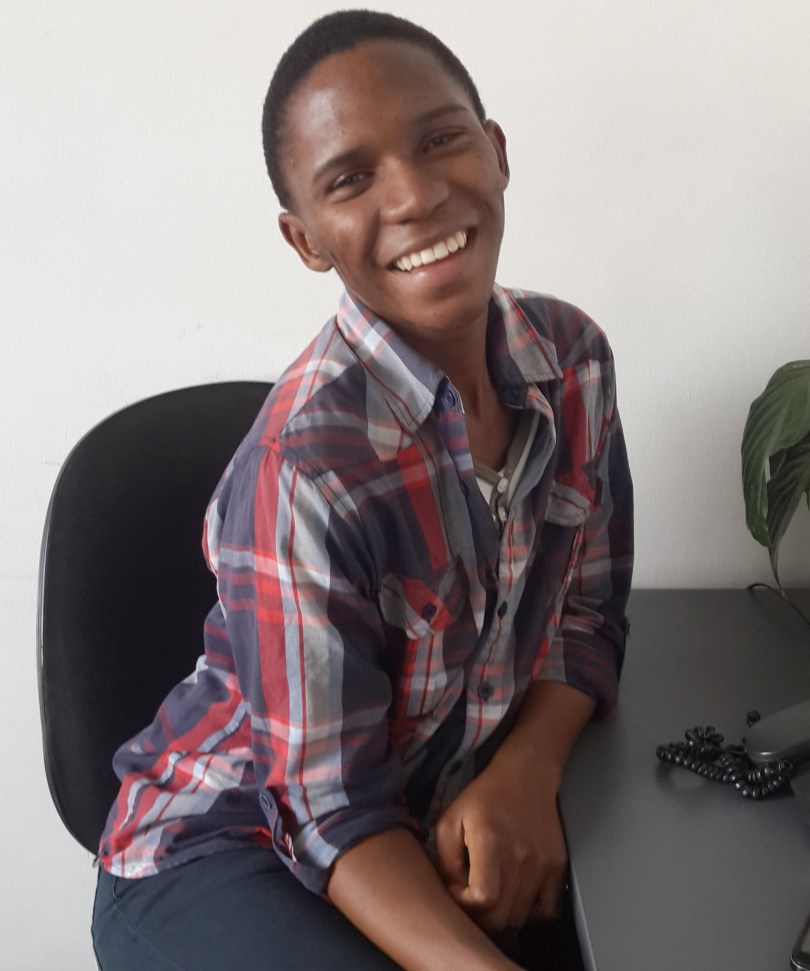
Always ready with a pose. Photo: Pheladi Sethusa

While there was relative calm in the newsroom yesterday , I stole Ray for a few minutes to have a wee chat.

*Disclaimer: “Ray” is not his government name…

Me: How would you describe your outfit/style for the day? 

Ray: I usually go for a professional/workplace look but today I had to get dressed really fast, so I have a relaxed and casual look. 

Me: How would you describe your style in general?

Ray: I dress in a way that’s adaptable to many social situations, as a rule I always try to go for a professional look. 

Me: On to the more serious, are you sure about this journalism thing?

Ray: Yes, I’m in it for the long haul. Journalism teaches you about this country and it’s nuances. I’ll only leave the industry in 20 years or so to settle down.

Me: If you weren’t doing what you doing this, what would you be doing?

Ray: I’d be a certified gold digger *laughs* No, I would be probably be an economist, I really like finance and business so ya. 

Me: How have you found your honours year?

Ray: It has been an intense year but it’s also been very pleasurable. I’ve learnt valuable and priceless skills this year and now I can honestly say we’re competitive journalists. This course has enabled us to call ourselves journalists and I’m sure that that there’s a place for me in the industry now. 

Me: What’s been the most challenging thing and the most rewarding thing for you this year?

Ray: Challenging: Time management, balancing my personal and work life has been tough. My work dominated my schedule to the point that it consumed my life. 

Rewarding: Seeing our work making a difference. With our sexual harassment stories we helped how people view this institution and it’s structures, the VC award we got is proof of that. 

Me: Where will you be next year and what will you be doing?

Ray: I can’t say specifically where, I’m still considering my offers but I it will definitely be in this industry, financial journalism to be specific. 

Me: How would you describe #teamvuvu in three words?

Ray: Fucking awesome (that’s two but whatever), diligent and family. 

Me: A word of advice for the incoming team for 2014?

Ray: Hmmm, they shouldn’t have any expectations coming in and they should always try to work with what they have. In this course what you put in is what you’ll get out. And lastly they should just have fun. 

Literary Post-mortem: Mockingjay

Finished reading the third and final book in the Hunger Games series in the wee hours of yesterday morning and was in tears.

Had to re-read the last paragraph because it was so perfect. I bow down at the greatness that is Suzanne Collins.

I never imagined that I’d ever read an action novel, but I kind of did with this third installment. There’s always been a fair amount of adrenaline and action in the previous books but it all reached a whole new level in Mockingjay.

To say what happened without saying what happened,  I’ll say this:

I was not prepared for all the things that happened. This book picks up right where Catching Fire left off. So I still had the same indignant feels where Peeta was concerned.

For a long while Katniss goes on living a semi – normal life while preparing for what’s to come. For me she became someone I couldn’t look up to anymore. I don’t know if this has to do with her now being a flawed person, a real person. Who’s irrational, unforgiving and selfish. Which in retrospect was actually endearing and made everything all the more believable.

Even though she may have ‘shrunk’ somewhat for me because of the above she also grew a little. She finally found the words to describe what she felt for the men in her life and the words she used to describe her feelings were nothing short of beautiful. Because she knows what she feels she can find it in her to finally make a decision on who she loves and who she wants.

While the drama was a little extra, it was necessary and like I said very plausible for the most part. The narrative about war and freedom required it actually. Reading all the prep that went into training soldiers, the sacrifices that people had to make made me realise that I am nowhere ready for such fundamental change in my life. I do feel that change is needed in the world, but the magnitude of sacrifice required just never clicked. Perhaps it’s not even sacrifice as such but giving up small comforts for total and unequivocal freedom.

By the end of Mockingjay a lot has been lost but tremendous gains have also been won, both in the personal and political realm. Even though things have gone tits up, it does bring Katniss closer to the man she loves loves (<—-not an error). The epilogue reminded me of Harry Potter – both how it ended and how reading those books made me feel.

The Hunger Games trilogy felt like going back in time, to being that girl I was in high school who stopped living in this world for a few days and being right there at Hogwarts, or rather Panem.

In short, it was brilliant.

Ducking and diving to get the story

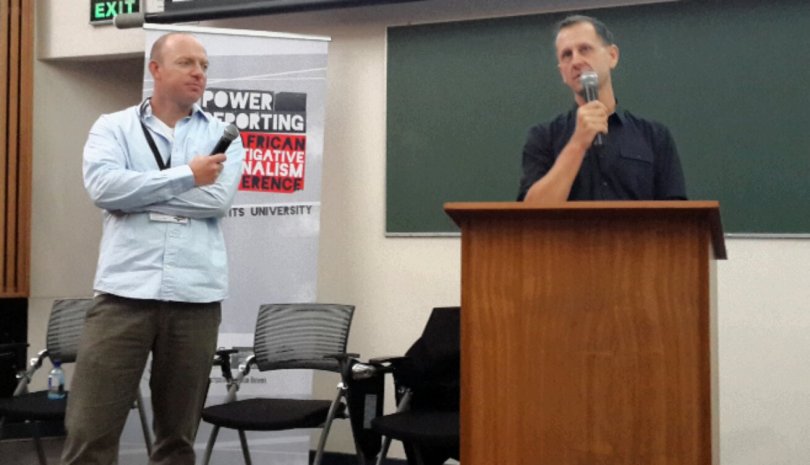
Reporting in war zones of conflict areas can be dangerous for any investigative journalist or photo journalist. Stephen Hofstatter and James Oatway presented ways to stay safe and navigate such areas in ways that will help to get the story a journalist is looking for and stay alive at the same time.

Sunday Times journalists James Oatway (left) and Stephan Hofstatter (right) shared their personal experiences on reporting in conflict areas on the continent. Photo: Prelene Singh

Hofstatter and Oatway have worked together in the Democratic Republic of Congo and in the Central African Republic (CAR) on stories that have seen the two dodging bombs and confronted by armed rebels. Their presentation on Covering Resource Conflict in Africa started off with Hofstatter outlining the essential and practical considerations they had taken when they went into conflict areas. He said that in conflict areas it’s difficult to sift between fact and fiction because of the amount of propaganda punted by opposing sides. A lot of wire services fall prey to misinformation because they rely on once source in many cases, added Hofstatter.

The pair used their stories to highlight some of the do’s and don’ts involved in covering conflict areas:

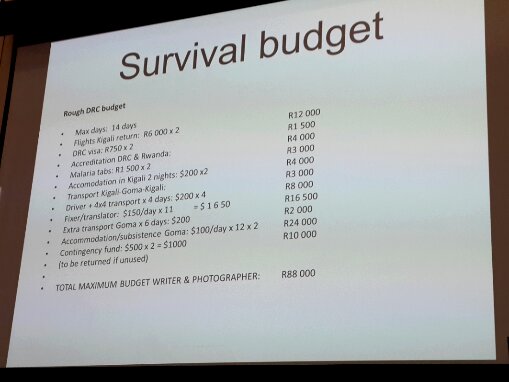
The budget that they worked on for their trip to the Democratic Republic of Congo. Photo: Pheladi Sethusa

• Budget: The most essential things on the budget include money for a fixer, a driver and accommodation. Hofstatter said that they used up to $250 a day on a trip. Oatway added that while some news agencies had big enough budgets to include security, this presents a challenge when trying to get close to sources and getting a more in-depth story.

• The right fixer: A dependable and professional fixer is essential to survival in conflict areas said Oatway. Fixers are people who can put you in touch with military commanders and bureaucrats because they have nurtured relationships with these people. Fixers can help in attaining exclusive footage because they can navigate around difficult situations and people. · Background: “It’s difficult to get information when you get there,” this is why journalists need to do all their homework beforehand said Hofstatter. A lot of senior officials and business officials from other African countries live in South Africa, they can be very useful sources.

• Angles: While it is important to present a South African angle when reporting, it is equally important to avoid being insular by ignoring international angles. Hofstatter used an anecdote of their experience with rebel commanders in the CAR to illustrate this. “We didn’t just cover the conflict there (in CAR)…We had to show what kind of regime our government was propping up,” said Hofstatter.

Ethical considerations: In such volatile areas, one can witness grave human rights abuses. The pair tried where they could to make ethical and morally sound decisions where both information and images were concerned. Oatway vividly recalled a situation where they pleaded with rebels to release a prisoner they had in their custody after he had taken the shots he needed but added, “I have no idea what happened to him after we left.”

• Balanced reporting under fire: Again Hofstatter stressed the importance of avoiding falling for propaganda. “Where you can highlight unverified information and highlight where you got that information.” Images and information with grey areas can create false negative narratives.

• Safety first: Oatway said that even though he itched for “iconic photos” when there is a lot of action happening, he sometimes has to ignore scratching that itch by staying away from extremely risky situations. Hofstatter went on to list things to do in the face of gunfire or hand grenades going off, “make yourself as small as possible and lie on your back,” he said.

REVIEW: Marikana movie Filmmaker Rehad Desai tells the story of the Marikana tragedy in a real time film

In the same way that Shaka bearing his spears was not on an equal footing with the British colonialists and their rifles, the Marikana miners with their machetes and knobkerries could not have been a true threat to the police.

They were met with nyalas, revolvers, stun grenades and hundreds of police officers. A line was crossed on August 16 2012. That line was the blurry line between self-defence and murder. The Wits Club on West Campus was transformed into a movie theatre on Monday night for a screening of a rough-cut of Rehad Desai’s film, which has the working title of Countdown to Marikana Massacre.

The ”roughness” of the version shown was evident but the story being told was so compelling that there were no grunts and groans when those parts came or technical glitches interrupted viewing. Desai’s version of events shows new evidence that seems damning. The police had footage of the area they now refer to as “scene two”. At this smaller koppie, miners were shot down after the initial shooting.

The police footage was one of the most horrifying yet gripping scenes of the film. It showed just how power had crossed a line and put its rubber boot on the throats or necks of ordinary miners. “Scene two” shows miners’ bodies at the bottom of the koppie. From the way their bodies fell it looks like police officers went after miners who were hiding. Police in the footage are heard congratulating one another for using “nice skills” where their shooting was concerned.

That scene is the climax to the message Desai had been trying to convey throughout the entire showing. He was saying something about the police and their collusion with Lonmin and perhaps even politicians. He pointed out that this kind of collusion was to blame and showed us what a force it was. This sentiment was further reinforced when new footage was shown of how the shooting on August 16 started. Miners no longer look as if they are charging at the police like in most of the footage circulated in the media, but are rather walking slowly towards the Wonderkop informal settlement.

Suddenly, a shot comes from behind one of the police vans, followed by a return shot by one miner armed with a gun and then the story we have seen before plays out.  The film is much like eNCA’s Through the Lens and Seven Days of Night two-part documentary in the way the story unfolds but different because it is clear that one side has been chosen and is favoured by Desai and the commentators he chose to interview.

Journalists are taught to have balance in whatever story we tell and, as we know, there is no such thing as objectivity. As a filmmaker, Desai has chosen the side he believes and backs up his evidence. More evidence has surfaced indicating that on the day of the massacre a call was made to a mortuary ordering four vans, each with the capacity to carry eight bodies. Four-thousand rounds of ammunition were also ordered by our police force.

Even if we tried to put ourselves in the shoes of Lonmin, the government or the police, it is becoming increasingly difficult to believe that self-defence was the reason for 34 miners dying.

#teamvuvu: Dineo Bendile

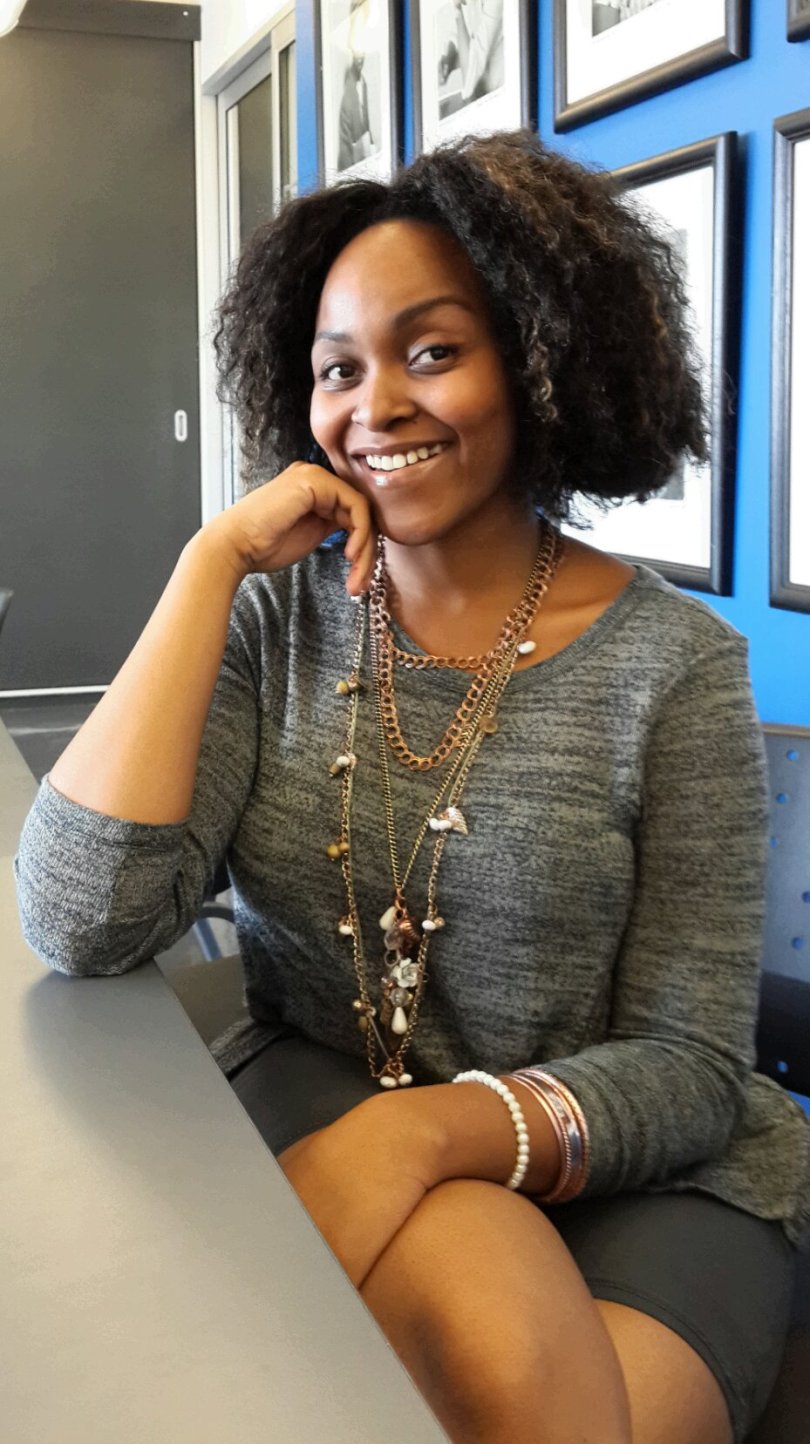
This lovely lady is one of my classmates from the  Bushbuckridge section of the class, who let me crawl under her Diana Ross hairstyle for a few minutes to do a quick interview with her.

Dineo in her Beyonce inspired outfit today. Photo: Pheladi Sethusa

Me: How would you describe your outfit/style for the day?

Dineo: I saw a picture of Beyonce last night wearing shorts and a loose fitting jersey and it inspired me. So basically Beyonce on a Budget.

Me: How would you describe your style in general?

Dineo: My style is very versatile. Right now I’m entering a new chapter of my life, so my style is more more laid back right now but trust me I am glam all the way otherwise. 

Me: On to the more serious, are you sure about this journalism thing?

Dineo: I’m sure that I wanna work in the media. I don’t want to be a reporter on the field forever but I do want to work as a journalist for a year or so to start off with. 

Me: If you weren’t doing what you doing this, what would you be doing?

Dineo: Leeching off some rich man. Seriously though, I studied drama so I’d probably be doing something in the arts. Or actually what people don’t know about me is that I love accounting, so maybe I’d be doing that. 

Me: How have you found your honours year?

Dineo: It’s been spectacular. With my last degree there were days when I hated what I was doing. This year I have never dreaded coming to school. This confirmed that I didn’t make a mistake choosing this course. I’ve also met amazing people, even when I’m having an offish day I know seeing them will change that. 

Me: What’s been the most challenging thing and the most rewarding thing for you this year?

Dineo: The most challenging thing has been listening to lecturers advice. We work in a very creative environment, as such I thought we would be allowed to do whatever we want. So ya consulting people has been difficult for me because I like to do my own thing. 

The most rewarding thing has been seeing the work we do impact people’s lives and being recognised by outsiders. Earlier this year two guys stopped me in their cars, I thought they were trying to be fresh and were trying to make but they just said: “We like you in the Vuvuzela.”

Me: Where will you be next year and what will you be doing?

Dineo: I have no idea, all I know is that I’m ready. I want to be anywhere that will allow me to use what I’ve learnt this year. 

Me: How would you describe #teamvuvu in three words?

Dineo:  All I’ll say is more personalities, more problems and more fireworks. 

Me: A word of advice for the incoming team for 2014?

Dineo: They should really cherish every moment of it, especially the moments of interaction with people. They should also be prepared to set aside their ‘set lives’ to explore and try different things. 

In-depth wrap up [4/4]

It’s OVER! We’re done.  It’s over.

I have been looking forward to writing this final in-depth blog post for the longest time.

It has by no means been an easy journey to this semi-blank text box. This week was the most trying week of the whole year.

On Monday we were given one last opportunity to fix and fine tune our features. Most of us staying put in our seats from 7a.m to 7p.m. Coffee and durry breaks being our only escape that day.

Then Tuesday came along. All features were done so there was a little less pressure on us (or so we thought). Multimedia production began that day. We had to start putting together video’s, maps, and, and, and.

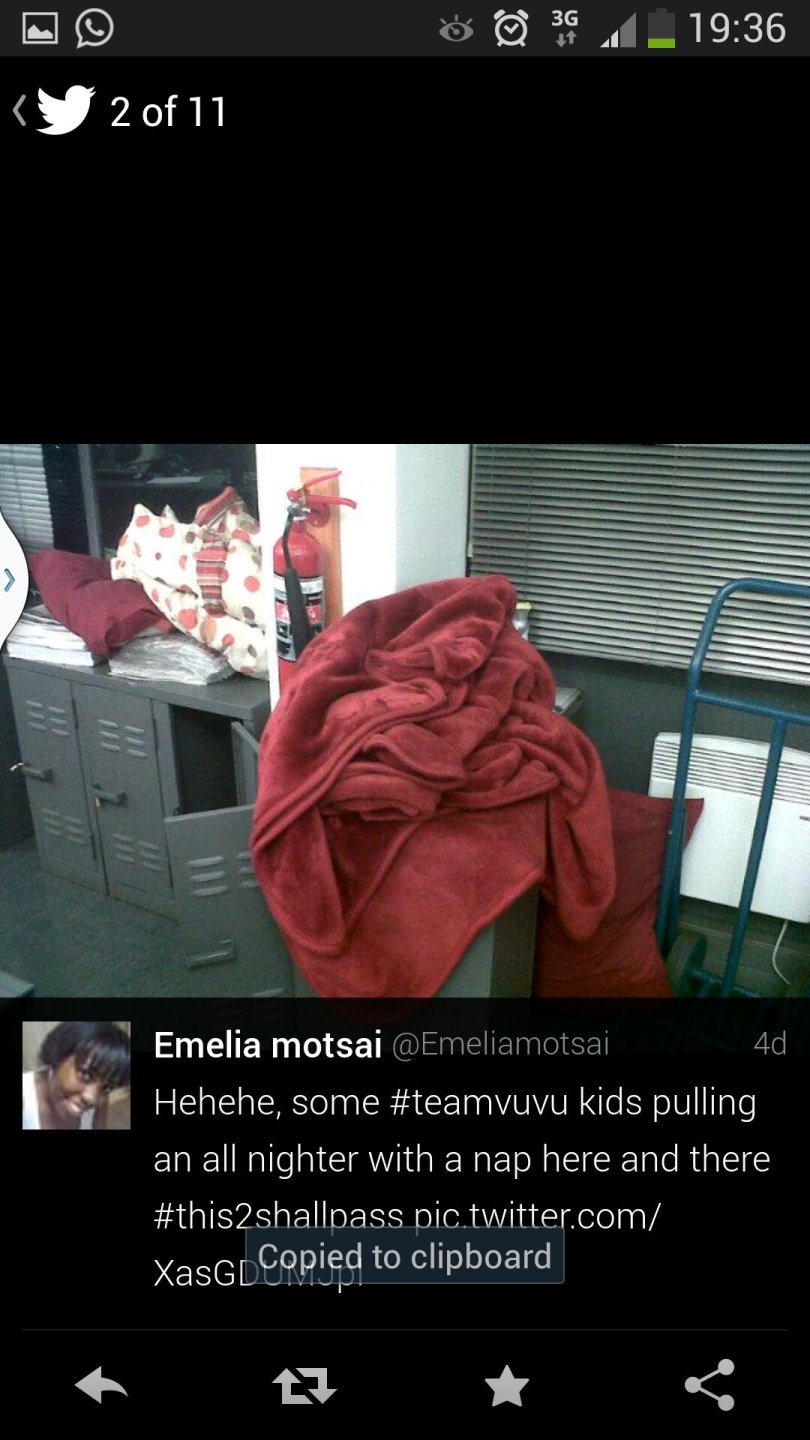
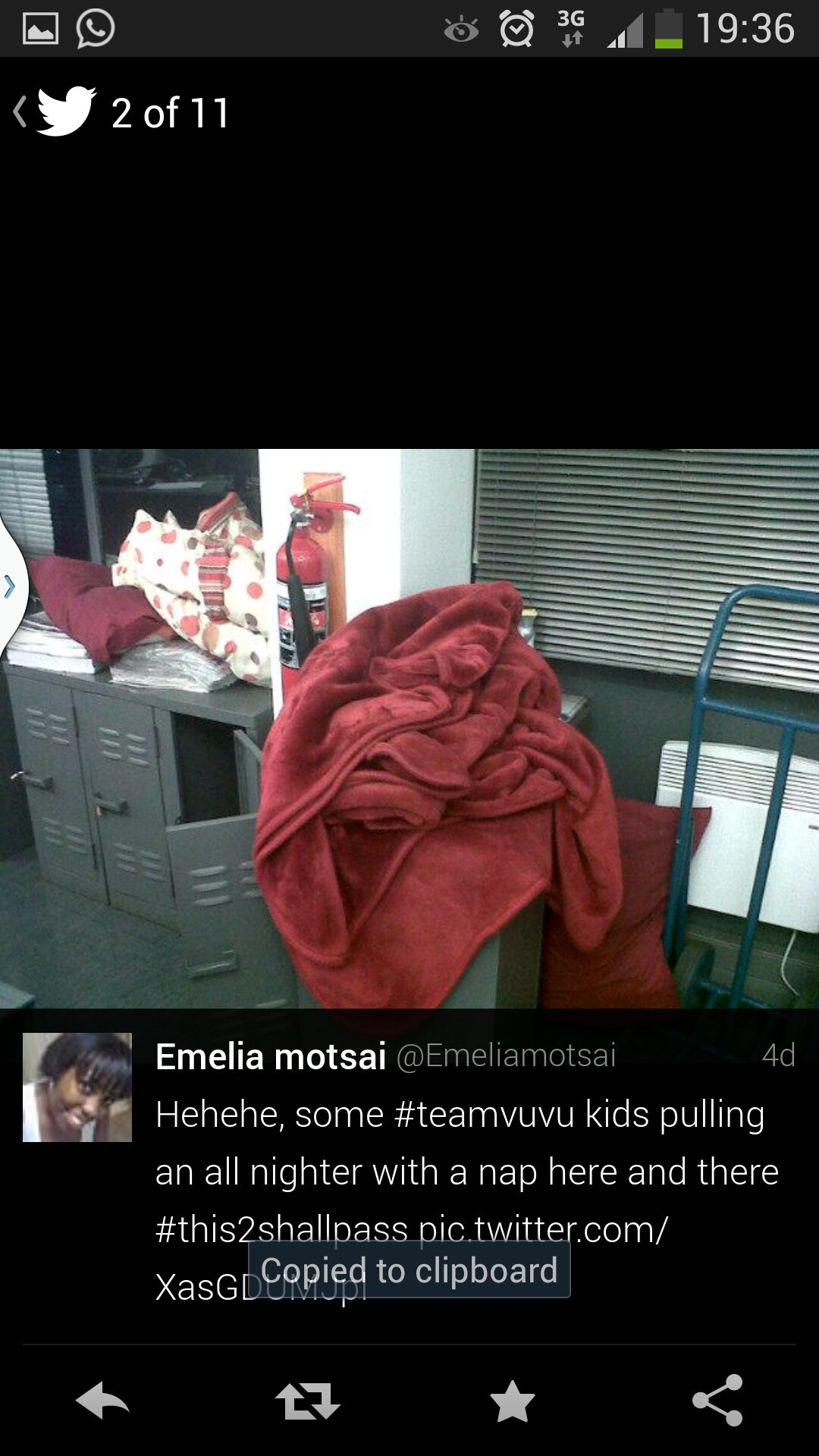
By 3p.m that day I realised that I would not be done in time. So a few of us decided to pull an all nighter.  I went out and bought a toothbrush and Shandu lent me a blankie and a pillow.

image

The excitement of the “sleepover” started to wane at about 11p.m when I realised how real putting together an audio package was. I had never put sound together but I decided to teach myself that night. Pride isn’t the word I would use to describe the end product but ya. I did what I could.

To go with that I put together an infographic and a ThingLink, both of which I had a little experience with. When I was finally done with that a day later, I thought I had reached the finish line but was told there was one last lap to run.

Putting up all our elements on our new website for the project. The new back end looked a lot like our Wits Vuvuzela website but it was nothing like it at all. It took us a whole day to get our things up on the site. But the storm is over. We made it (somehow).

Now to cross fingers and hope people like what we’ve come up with. Read my feature piece here. 

#teamvuvu: Prelene Singh

So I’ve decided to do little profiles on the team. I keep talking about these people and might have pictures up of some, but want everybody to get to know the awesome individuals I have shared the year with.

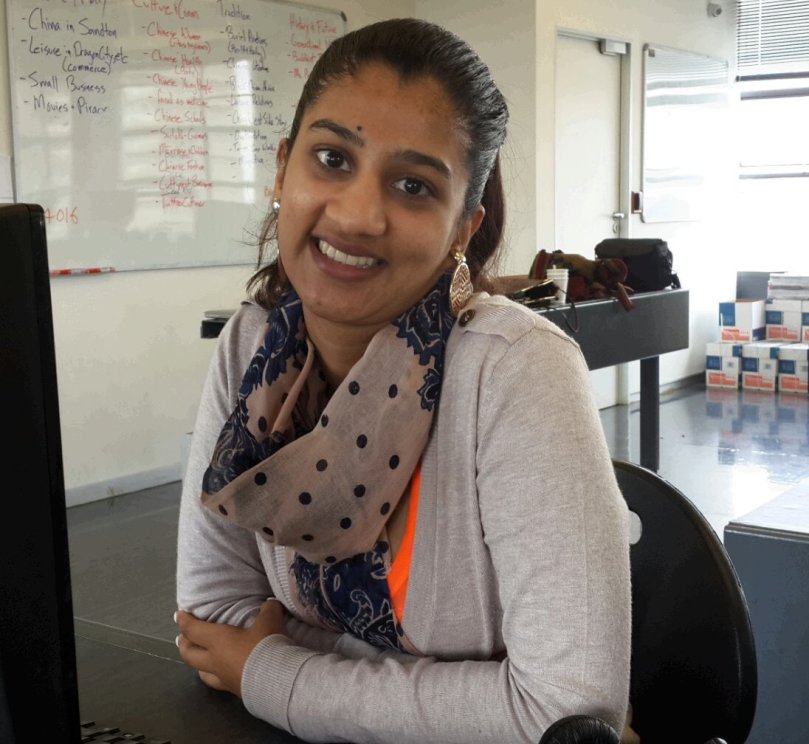
It’s a bit tense in the newsroom right now, with most people finishing off their in-depth projects. I managed to find one focused lady who was done and dusted to humor me.  Miss Prelene Singh (aka Pre or Pre-Pre when we’re feeling extra silly).

The lovely "Pre-Pre" in the newsroom. Photo: Pheladi Sethusa
The lovely “Pre-Pre” in the newsroom. Photo: Pheladi Sethusa

*Disclaimer from Prelene: “If you had told me about this interview I would probably have different answers. people are going to think I’m so dumb.”

Me: How would you describe your outfit/style for day?

Prelene: This morning I actually thought about what I would wear. I was happy and relieved to be done with my in-depth so I’m wearing orange to show that.  Before this course style used to be important to me but it’s just gone down the drain, 10 steps back this year. 

Me: On to the more serious, are you sure about this journalism thing?

Prelene: Yes. As a journalist you get to experience the world as no one else can or ever will. 

Me: If you weren’t doing what you doing this, what would you be doing?

Prelene: *laughs* Um if I could come back as another person, I’d totally come back as Guiliana Rancic. Jokes. I’d come back as a writer, just an entertainment writer. 

Me: How have you found your honours year?

Prelene: Let’s put it this way, I would have lost more if I had not done this course. 

Me: What’s been the most challenging thing and the most rewarding thing for you this year?

Prelene: The most challenging would have to be keeping my perseverance and dealing with the different personalities on the daily. 

The most rewarding is being recognised for the hard work I’ve done. 

Me: Where will you be next year and what will you be doing?

Prelene: I have no idea *laughs*

Me: How would you describe #teamvuvu in three words?

Prelene: Talented, loud and unique. 

In-depth wrap up [3/4]

The end is so close yet so far. Yesterday we spent the entire day indoors. Writing and re-writing (mostly re-writing) the drafts of our features. We also read and re-read one another’s features.

It was crunch time, time to make two weeks of running around Joburg looking for sources, being put on hold and having our emails pied over and over again. It was a day of reckoning, a day to do what you could with what you had. A day to take in all the criticism with your sensitivities set aside.

The week that was saw us trying desperately trying to fill the gaping potholes in the tarred road of our stories. Yesterday was about finding the nearest bucket of something to fill that hole no matter what or in some cases off-ramping just before the hole onto another path completely.

This morning we came in bright and early with one stressor put firmly behind us, ready to tackle another – Multimedia production.  We have less than 48 hours to put together the multimedia elements that will accompany our features.  I have not been looking forward to this part of the game.

Being a person who likes photo’s I originally intended to do a photo essay but I realised a very long time ago that my topic does not allow for that and I just didn’t want to deviate from my topic to accommodate my initial plans.

I now have an alternate plan – one that has to come together very quickly. I can only hope it does, let me get to it.