Sunday Scribble #12: oh boy, here we go again

A cyclical conversation rules the tl and fyp yet again – boys are still being left behind.

The congratulatory cheers and claps for the matriculating class of 2025 have been somewhat drowned about by the familiar lament of the year before and the year before and the year before, that says “good going girls, but why does your progress seem to be stifling that of our boys?” Less question, more accusation when reflected on from behind podiums and worried column space. Disintegrating and straying even further from the point when ‘debated’ in fragmented, ill-considered comment sections on social media timelines.

There was a lot of commentary that tried to contemplate the idea of boy children falling behind with compassion and care, but overwhelmingly there was also a lot of finger-wagging and blame levelled in various directions. Everything from absent fathers, red pill content, boy moms, patriarchy and hyper-masculinity were laid out as possible contributors by those discussing the matter out loud. What was absent on my timeline, was the voices and thoughts of men, particularly those not after engagement via rage bait, but those who grapple and internalise what our society is, based on their subjective experiences.

The scholarly insights from educational psychologists, researchers, teachers and those in civic society tell us that social conditioning, emotional repression, and the lack of positive role models are some of the core contributors. That ‘abandonment, marginalisation, and exposure to abuse’ make children even more vulnerable than they already are (Jaure and Makura, 2025). That girls learn to read earlier and this proficiency equips them with a better foundation than boys. That girls exhibit behaviours and social norms conducive to the current schooling system (Broekhuizen and Spaill, 2017). That a possible solution lies in socialising boys in ways that promote accountability and ‘positive masculinity’. These findings are widely accepted and valid. But I was interested to hear from those who had been either been groomed or spat out by the selfsame system, to briefly glean the past, present and possible future.

So I reached out to some of the men in my life to find out what they made of the growing chasm between boys and girls academically and otherwise. For context and transparency, these men are all 30+, black, some married, some single, some fathers, all employed. And I granted them anonymity, so they will be labelled Gent 1 through 4, respectively. This is what they had to say:

Boys live up to their unearned labels

There was a common thread between three of the four gents that spoke to one of the root causes being how boys, black boys in particular are regarded and thus treated straight out of the gate. Gent 2 said he grew up having to fight off labels erroneously ascribed to him. “If you were black and misbehave, like other kids, you would be labelled troublesome or problematic and that label would stick,” he shared. As a result teachers would be reluctant to help or invest in you because “uyahlupa vele” (you are troublesome). He added that seeing black girls and white boys and girls not experience this, meant that the label was internalised and leaving the door open to live up to it, especially when that was seen as cool/manly in later grades. Black men live in a society that “criminalises and infantilises” them, which deeply damages their personhood, added Gent 1.

The legacy of Apartheid, colonialism and capitalism

The “tragic fact” is that men continue to be taken out of the home for economic survival, said Gent 3. “We come from a history of broken households, the deep structure of the society of the past and a structure which endures today,” he said. This presents the obstacle of a positive role model who is present, and “successful” by virtue of employment, good habits and hobbies he said. But parents, where they are present, often don’t advocate for their boys early on or attempt to undo the social engineering which labels black men negatively, lamented Gent 2. The solve? “More employment and a bigger economy that is able to provide a bigger social safety net to support households, so they have a wider spectrum of options that influence a young persons early life,” said Gent 3.

A dollop of positive discrimination?

“Children exist in a world that they have very little control over,” said Gent 1, we are their custodians and need to correct any imbalances that present themselves. Speaking to the early-2000s ‘Take a Girl Child to Work day’ campaign, he joked that clearly that kind of empowerment is effective and could be used again. “Some positive discrimination is necessary for the boys right now, emotionally (speaking),” he said. He thinks boys need help with navigating and cultivating healthier inner emotional worlds. Gent 3 said investment in “other forms of expression” outside of sports is necessary, he thinks more diverse extracurriculars across the board is vital to showing boys that tapping into healthier alternatives.

Boys are lagging behind, not deliberately being left behind

Standing as an outlier, Gent 4 said: “Not only is the boy child being catered for, boys actually have a much easier and safer pathway through school than girls do. A girl’s journey through school is not only more dangerous, it is often more burdened. The girl child must do chores, fend off the advances of predatory men, exist in a world where men dominate leadership positions in every sector.” Girls’ academic advancement often means little in their professional and personal lives.

“Although South African women are better educated than South African men, they remain underrepresented in the labour market (Spaull and Makaluza, 2019), particularly in higher skilled occupations. South Africa is not alone. All over the world women have lower labour force participation rates compared to men.”

Rebekka Rühle (2022)

Alongside having to negotiate and fight through the gender pay gap, we routinely have to negotiate and fight for our physical safety and survival. So who is leaving who behind when the consequences are meted out against the supposed victors?

Role models are few and far between

For me, said Gent 3, the adult men I saw growing up were heavy drinkers, obsessed with chasing girls, hyper-masculine and lacked the “normal markers of success”. “They seemed happy and content in their pursuits, and this kind of example gets hardwired early on as being aspirational.

Gent 4 suggested that the deeper issue lies in toxic masculinity and the assumed spoils of adhering strictly to patriarchal scripts. “Toxic masculinity breeds complacency. The boy child believes that they can fall back on their future as a man with an easy path. Things like Forex trading, sports and content creation are seen as alternative paths to take instead of education,” he said. Thus, education as a viable path, has become optional. Not just in South Africa, but the world over. Making it big and quick through avenues like trading, content creation and others, drive boys opting out of education. “There seems to be this need to blame the failures of boys on some mysterious issue in our society or education system. The truth is that famous men are propagating anti-intellectualism on social media at alarming rates, and boys are responding in kind by not taking education as seriously as girls,” added Gent 4. On this point, Gent 1 was of the opinion that both boys and girls aspirations have been affected by late-stage capitalism and value systems driven by material gain over all else.

It was really refreshing to have these back and forth conversations with this small group of men, and it reminded me that much clarity is gained from slowing down to listen intentionally. This is a conversation and issue that deserves the appropriate attention because remedying some of the foundational issues that emerge early on, may be one way to root out some of the seemingly inevitable consequences that present themselves later on.

Sunday Scribble #1: Sonic slop

Slipping further and further from the light.

This week, I listened to an AI-generated voice recording masquerading as a completed university assignment. The initial task was for students to piece together a news bulletin for a radio show and record a voiceover for their script. At first, I thought maybe I had accidentally clicked something which started an automated reading of the student’s script. I paused. Went back to the beginning. Pressed play, and there it was again. A staccato mess, made up of ones and zeros, “reading” the script to me with all the flair of an instruction manual. I paused again. Surely not. Surely this student had not run their completed script through a programme that generates an AI voiceover. Surely. Why would a curious university student do that? No, why would a curious media student do that? What is the point of them being here if they don’t even want to hear the foibles in their voice, the rhythm of their own words, which should have been carefully constructed to fit into the three minute time limit? Then the take one, take two, take three and maybe take six of it all? “This is the end…” the line from Skyfall started to echo from a distant corner of my mind. Shit. This is it isn’t it? This is the new normal. Forget original thoughts, even original voice is on a slippery slope now.

“Where will we get our ideas?” – been haunted by this quote for months but I have been looking for three days and just can’t find the professor who posted this about a student of his responding to why they use AI to curate their assignments.

For some students, coming up with ideas and academic writing may be tough – and using AI may assist in getting an idea started or help refine a draft – that much or rather that kind of use seems somewhat justified to my mind. But subverting your actual voice, for whatever reason – not wanting to hear your own voice, not wanting to record your own voice or not being bothered to try – seems an incredible waste of an experience. One’s experience as a university student for one, particularly in a country where less than 10% of the total population even has access to a viable shot at higher education. Secondly, one’s experience as a creative (we all have the capacity and need for creativity/play), even more wasteful when your grades are embedded in playful and practical assignments that aim to nurture that trait, what could possibly push towards a machine-assisted “no thanks”? The chilling reality of it is that for many, critical thought and navigation are a chore to be avoided. While I recieve the point that people are overworked, overwhelmed and are just trying to get through ‘it’ as quickly and easily as possible, this seemingly convenient choice stands in the way of the kind of authentic grappling we all need for growth.

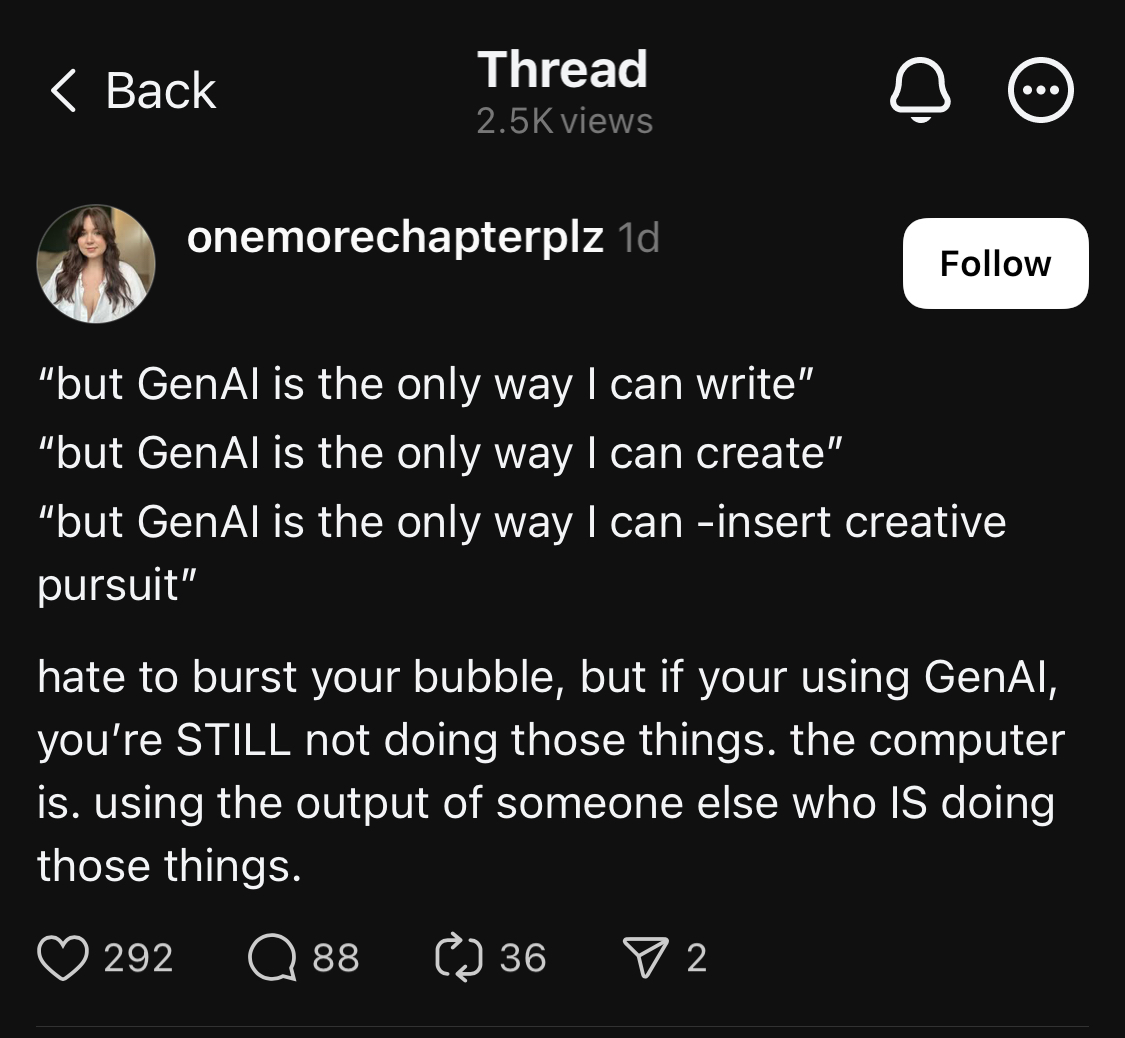
It brought back to mind a video clip I saw on Threads earlier that week, where the creator of an AI music prouction app was claiming that making original work takes up “too much time” and is “too hard” for the average joe to tap in to making music – “yes, it’s meant to be” was the welcome and resounding retort from people responding to the post. Their point being that the process of creation is meant to be developmental, it’s meant to be challenging and all the more rewarding when you ‘figure it out’, and the figuring out in this sense is a finding of oneself through that process. Creating anything worthy of reading, listening to or looking at requires this process. Perhaps what perturbs me most is that ultimately, I think the use of AI in the way mentioned above shows a level of disdain for what it means to be human. It considers the human brain as slow, unoriginal and ultimately not worthy of the effort/investment required to keep it vital through the exercise of reasoning, reading, failing and meaning making.

Podcasting and Stories from Katlehong Township

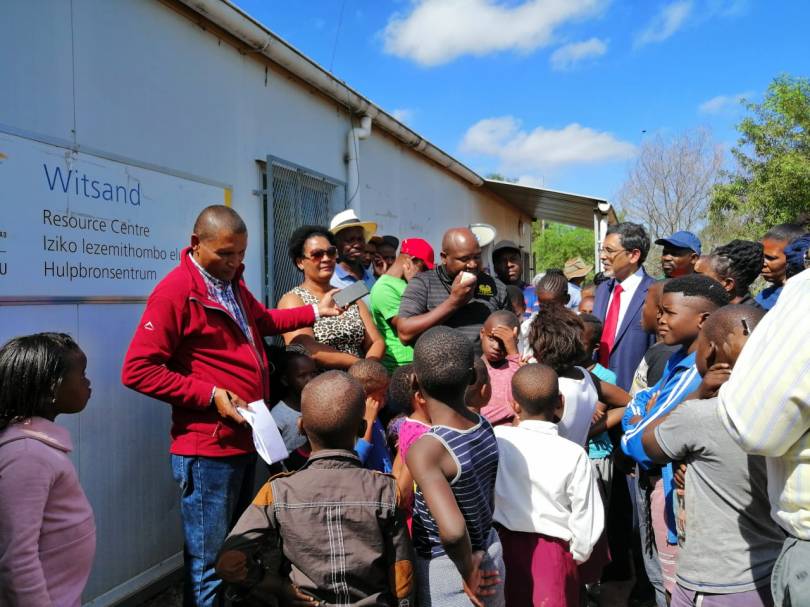
A couple of months ago I consulted on a project that would see me meet and work with a group of interesting and interested young people from Katlehong on an experimental podcast project.

In collaboration with the African Centre for Migration at Wits University and Frame45, the project used podcast training and production as a means to achieve authentic storytelling. From start to finish we only had about three weeks to fit in the training, pre and post-production – not helped by the daily load-shedding schedule we had to work around throughout.

As an educator, it was a challenging and exciting exercise, as I was teaching a group that had to be taught the basics of storytelling and writing from scratch, introduced to podcasting as a form and then a few days later produce one of their own. In some instances this made for much more robust engagement and I appreciated that. The story ideas and themes that came out of our sessions were really interesting, although not all of our participants managed to produce a full episode by the end of it, I am still very chuffed with what this group was able to produce in a very short space of time.

Read and listen to the work produced on Frame45 or simply use the QR code below.

Atlantis residents say education will drive their economic zone

Cape Town, April 9, 2019 – Atlantis residents in Cape Town are sceptical after the area has been declared a special economic zone. They believe actually making the area economically viable for investment, is a tall order. The community says until issues like housing, unemployment and education are improved, nothing else will change. eNCA’s Pheladi Sethusa has this story.

Turning things around at NSFAS is going to take some doing

Cape Town, December 4, 2018 – Turning things around at NSFAS is going to take some doing. The bursary and loan scheme was placed under administration back in August, in order to address the state of its finances and how it was run. But NSFAS bosses don’t have time on their side. There are already 400-thousand applications in, that they have to deal with. eNCA’s Pheladi Sethusa reports. Courtesy #DStv403

Pupil on teacher attacks are increasing in the Western Cape

Cape Town, September 21, 2018 – Pupil on teacher attacks are increasing in the Western Cape. And worryingly, it’s primary school children who are mostly the culprits. A shocking 60 incidents have been reported since the beginning of the year. There’s a fear of mass resignations if the situation isn’t handled effectively. A warning that some of the visuals you are about to see are graphic. eNCA’s Pheladi Sethusa has more.

untitled

Some people are not allowed to dream. Some people are not granted the space to think beyond their circumstance and no amount of “hard work” in too many people’s cases can fix that. Some people are only given enough space to think to 6pm that evening when they have to pull off another miracle  to feed all five mouths waiting for  them at home. This thing of living just to survive another day is not okay, that’s what I hear the young lions saying and I don’t see how anyone else can hear anything but that obvious truth.

The country has been burning, things have been falling, people have been arrested, charged with treason, many assaulted but thankfully no longer ignored. Placated in some places with some concessions made, abhorred by others, attacked still, but no longer ignored.

#RhodesMustFall #FeesMustFall #OutsourcingMustFall #AccessMustRise #AfrikaansMustFall

Fallists will probably be my people of the decade. They did what those before them dared not to, in fear of shaking things up too much and as a result possibly losing their promised place in relative comfort. They stood up for not only themselves but everyone else too. Which is why it’s so difficult to hear voices of dissent from their peers, their teachers, their parents and (most disappointingly) the people who are tasked with telling their stories to people on the continent and around the world. 

I don’t deserve to write about the fallists, but I think I am allowed to say I am so proud and continue to support them in their efforts. Yes, there have been very unfortunate instances of waywardness, reports about sexual assault and the like along the way – a reflection of the society we live in because academic spaces are mere microcosms of the larger world, not separate special entities where having a degree exempts one from being sexist, homophobic, racist etc –  This doesn’t excuse the messiness at all, rather contextualizes it and mirrors who we all are. 

**Quote: Andile Mthombeni, student at Wits

Born free, but still in chains

Last week I gave an impassioned speech to a group of young, soon to be journalists at my alma mater. I told them that this might possibly be the best time to be a young journalist, the opportunities are endless, and other such brochure stuff.

They believed me. Hell, I believed me. And a part of me still does – there is so much we can do, yes we’ll run into and slog under organisations that are counter-revolutionary but it can be done. We can be authentic to ourselves and each other while running on this side of the tracks.

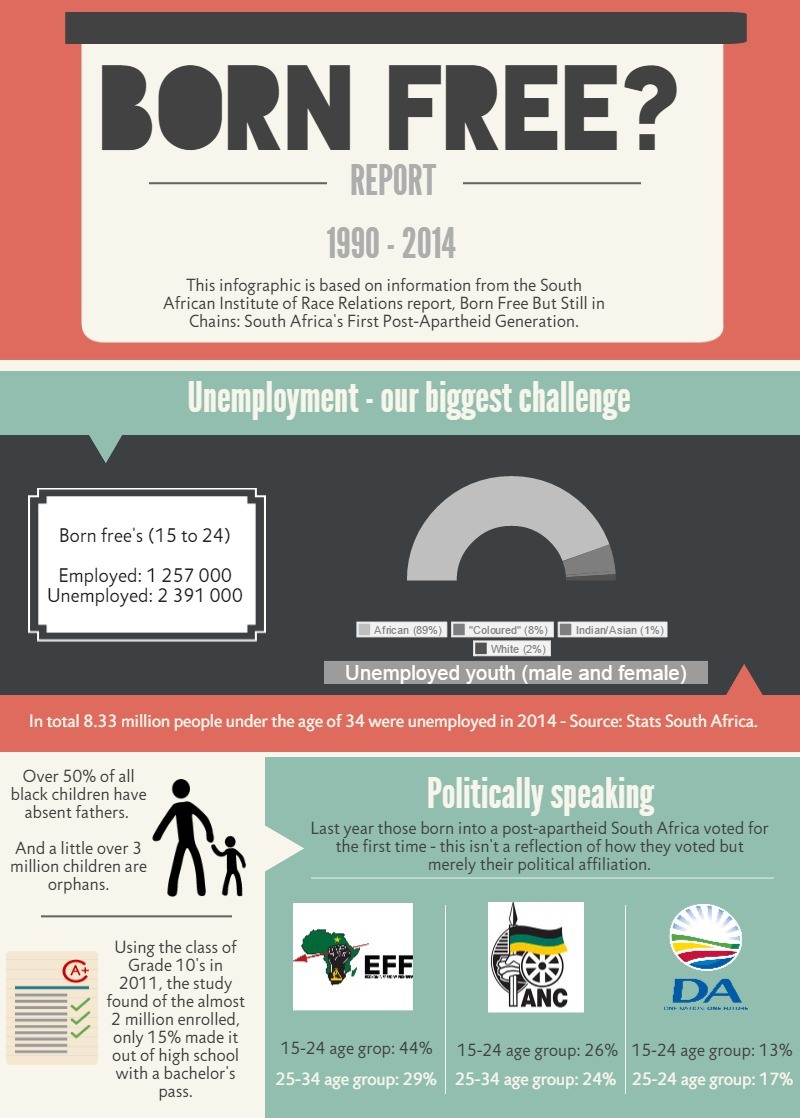
But a part of me faltered and scoffed at the hypocrisy of that talk we had when I read a report with statistics on everything “born free” and my oh my do the numbers look bleak.

The report, Born Free But Still in Chains: South Africa’s First Post-Apartheid Generation, was released by the South African Institute of Race Relations last week. Luckily their definition of a young person is different from Stats SA (which includes everyone between the ages of 15 and 34), in this report Born Free’s are defined as people under the age of 25.

There were many graphs and numbers broken down and presented in the 39 page report, some of the more jarring (personally), are in this quick infographic I made:

Born free graphic

The statistics aren’t new but I thought about the numbers a lot more personally this time – they are alarming, they are dire, they speak to a crisis even. They speak to the brazen young men we see and speak to at protests, the young girls who want my details so they can get a job (even if it is just carrying my camera bag). They speak to the anger on timelines and the rage that breaks into our homes and smashes windows.

The numbers mattered more now because I see the faces behind those numbers every day and that realisation makes it all so real.

In the report unemployment and education are highlighted as the two biggest concerns we have – unsurprisingly the former is often caused by the latter but not always. The bulk of those unemployed did not complete their secondary (high school) education, and on the other hand almost 400 000 varsity graduates sit without work – so who’s to say having a degree helps these days.

I have no answers at all, but I do know that the columns and warnings about us being a ‘ticking timebomb’ are true. We’re the generation that won’t let the empty promises be the hope we cling on to, we want answers and action and it makes me so happy to know that we are inching ever closer to making ourselves heard. It’s already happening, it’s already here. Like Fanon said we just have to collectively fulfil our mission, I think we have already discovered it.

These statistics cannot continue to rise. That there are people in positions of power who are blase about them (if I’m being polite) is sickening. They should know that their protection now is temporary, if we have to destroy to build they might be collateral – something to think about while they can.

There was a wealth of information in that study that also spoke to how many children are orphans, how many (overwhelmingly black) are child headed households, how HIV/Aids has affected them,  how many have never received any early childhood development, how their living conditions haven’t changed in 21 years (sleeping on the floor, washing and relieving themselves in buckets).

Read it. Gain some perspective before you run around telling people they are “lazy” – there are millions of children who have to fight every single day just to stay alive, be cognisant of that.