Literary Postmortem: The Secret Life of Bees

downloadI finished reading the novel (The Secret Life of Bees by Sue Monk Kidd) last week and have been having a bit on an internal debate about whether I should write about it or not. A gap in my schedule presented itself so here I am.

Recently started a book club with some friends and this was the book I got in our first swap. I chose it as soon as I saw it on the table because I vaguely remember liking the movie when it came out a few years back.

Sometimes I do enjoy reading the book after the movie because I don’t have to create characters in my own head that I will probably be disappointed in when I see the movie after the fact. But only sometimes – this time for sure. I could see the action in the book more clearly because of it this time.

It was a good read, short and engaging – one of those page turners we always yearn for. It was full of colour and emotion. There were quite a few things I had forgotten from the movie that caught me by surprise, which was fun.

The only thing I found unpalatable was the main character – Lily Owens. I understand that she was young and my impatience with her was probably unwarranted. I also understand that the book is set in a certain time and political climate in America, but I still couldn’t reconcile with some of her racism and selfish behaviours.

I enjoyed the Boatwright sisters and Rosaleen the most because I could relate to all of them in different ways. Through them I got to feel a kind of hope for change that I didn’t get from Lily – even though she “dated” a black guy. But her love story was also another highlight for me – the way she spoke about Zachary Taylor was the only times I felt a bit of connection with her.

I would recommend it but I don’t rate it as something you must read before you die.

Literary Post-mortem: Intimate Enemy

Intimate Enemy: Images and Voices  of the Rwandan Genocide

It has taken me a few weeks to get through this book. Not becaause I was bored or at all disinterested but because it was difficult to read what had actually happened.

image

The Rwandan Genocide is something I learnt about from Hollywood and a worksheet or two back in high school. I’ve known for a while now that I needed to school myself further on the subject.  To broaden the narratives I’m privy to on this tragic moment in African history.

Before I started this I had read To See You Again: The Betty Schimmel Story, a remarkable and heartbreaking account of living through the Holocaust. I imagined that reading that had readied me for another tragic and positively horrifying read, I was sorely mistaken.

An Intimate Enemy is a joined effort by Scott Straus and photographer Robert Lyons.

Combined then testimony and images offer a largely unmitigated and intimate view of the Rwandan genocide.” ~ Scott Sraus

Straus explains his mission and objectives in an emotive and rather educational introduction.  In short, he wanted to start to figure out who and what had led to the genocide. His interviews in the book are with men who were both perpetrators and victims during that time. He stressed that his aim was not to other anyone but to begin to understand ordinary human beings were turned into killers literally overnight.

The images and testimony present in the book are from prisoners in a number of prisons in Rwanda, mostly male because women only made up 3% of the prison population at the time.

image

Before the advent of colonialism in Rwanda, Hutus and Tutsis lived side by side in relative harmony. Colonialists exploited the slight differences between the two groups to sow divisions of which they would reap the benefits. The usual thuggery of making one group feel superior and another inferior, affording opportunities, jobs et cetera to the superior group of people.

Straus does a good job of making the historical context of the genocide very clear. As a South African the genocide in Rwanda is particularly harrowing because of the stark change that was happening at home, while others were being hacked to death.

The interviews he conducts with the prisoners and the testimonies they give are worse than any movie or any one thing I’ve ever read. About three interviews in I had been shocked to the core, heartbroken and utterly defeated.  In most cases people literally became killers overnight, some killing their own family members for their own survival. The speed at which things happened is what struck me the most, it always has even where the Holocaust is concerned.  People can turn on one another in a heartbeat and that more than anything scares me about my species.

As I said I went through the testimonies very slowly, as a way of reading them as historical documents and committing them to my meomory.

Robert Lyons work starts to come up more often towards the end of the interviews.  All black and white photographs, mostly portraits. His aim was to capture a side of the genocide that wasn’t sensationalised and didn’t frame a particular narrative.  The exclusion of captions is an extention of that aim.

“I felt that somehow there must be a way to show the horror of genocide without making sensationalistic imagery.  I wanted to explore the space between the victims and perpetrators.” ~ Robert Lyons

Looking through his photographs brought home Straus’ point. I tried but there wasn’t a person I could point out as a killer, I saw mothers, fathers, brothers and sisters. Old and young, male and female. Having the knowledge of those testimonies made it all the more trying.

Hands down the toughest thing I’ve read this year.

I’m going to be a writer

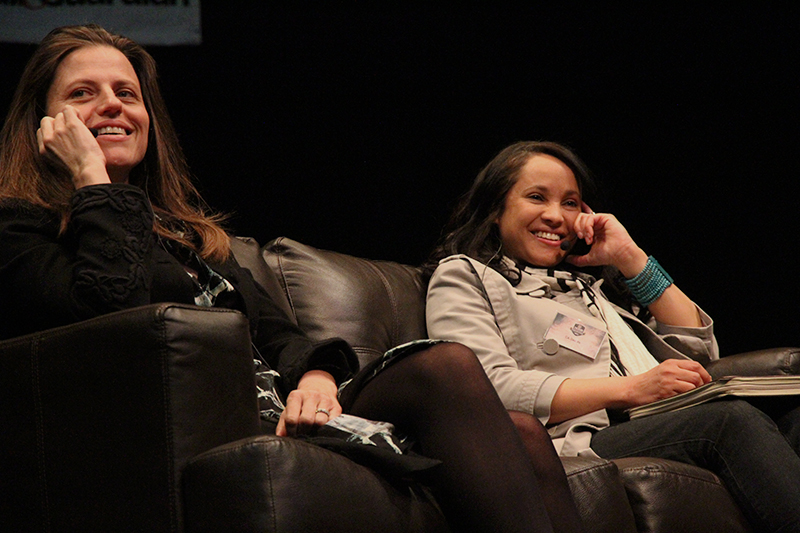
Writers Dominique  Botha and Carol-Ann Davids were two of the 'new' authors on the panel. Photo: Pheladi Sethusa
Writers Dominique Botha (left) and Carol-Ann Davids (right) were two of the ‘new’ authors on the panel. Photo: Pheladi Sethusa

“I know I’m going to be a writer one day. I don’t think it in my brain but I know it in my heart,” I have not been able to look back since I read this Chris Van Wyk quote three years ago. It provided me with the resolve to do exactly what I’m doing in my life right now.

This past weekend a colleague and I went to the 2013 Mail & Guardian Literary Festival, to bask in the presence of some of South Africa’s literary giants.

The Market Theatre was the historically apt venue picked to host the festival. Couches in the middle of a black stage in the main theatre providing the speakers with their literal platform.

We sat in one session after another, furiously typing out tweets, scribbling notes and snapping photos. Between all of this we had to process what was being discussed on the various panels.  All of which were interesting and engaging in their own ways.

One recurring statement made by writers like Nadine  Gordimer and Craig Higginson, was that writing is a calling of sorts. One doesn’t write because they want to but because they have to. Craig  went on to say that it simply isn’t worth the pain and effort otherwise.

I want to be like them

I was lucky to sit in on a panel discussion with a theme of ‘fact and fiction’ luckier still to listen to the first panel of women only, all of whom are first time published authors.

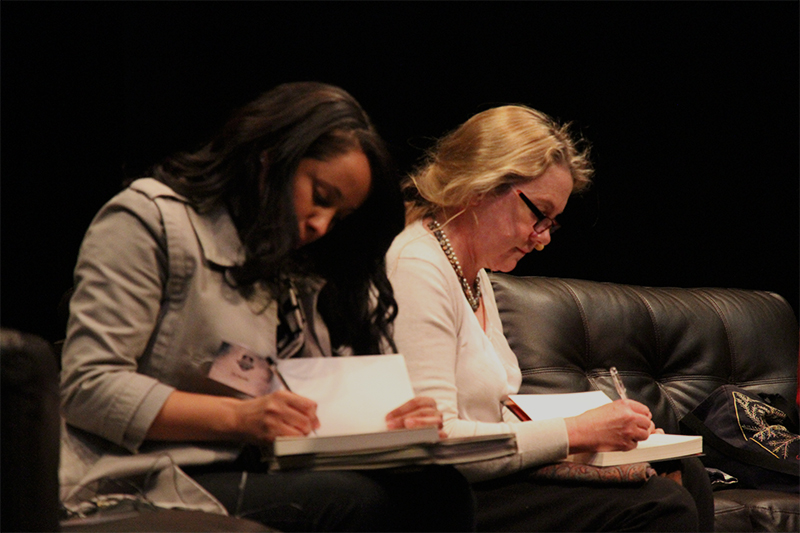
Carol-Ann davids and Claire Robertson sign copies of their books for fans. Photo: Pheladi Sethusa
Carol-Ann Davids (left) and Claire Robertson (right) sign copies of their books for fans. Photo: Pheladi Sethusa

I have ambitions of being in their shoes one day. I’m doing journalism in a mission to be on the right side of history and because I really do enjoy writing. I want to be a journalist because I imagined at some point when I am too old or too tired of being on the field, I would magically turn into a writer. Well not magically but all that training will come in handy.

Anyway long story short, becoming a writer is the end goal.

So this panel discussion provided enough information for me to be inspired to keep on keeping on where this dream is concerned.

Journalism and writing

Claire Robertson provided some insight on how she managed to use her experience as a journalist  to help her write her book, The Spiral House.

She said that she tried to avoid writing about her personal life, because in journalism reporting on oneself just isn’t done.  “I’m not brave enough to write too intimately about my life,” confessed Claire. Clearly I have no such inhibitions, one browse on my tumblr blog is evidence of this.

However, she did insert herself in the places were she deemed it necessary because it was unavoidable. Her background helped her to write much faster than some of the other women on the panel, in this moment she was thankful for the demanding deadlines.

Fact versus fiction

A little fact, mixed with some fiction or do you have to one or the other. Author, Dominique Botha said the truth is incredibly hard and can never really be 100% in that regard. This makes for a problematic relationship between memoir and fiction she added.

“To retrieve memory is the first act of fiction,” she said. Botha added that memory relies on the act of imagination, in an effort to illustrate that memory is compromised and can’t be considered as 100% accurate.

Carol-Ann Davids, author of The Blacks of Cape Town said that one needs a little bit of both (fact and fiction) to tell a story.

Storytelling

The women on the panel emphasised that what they were doing was telling stories. Claire went as far as to say being a good writer is not enough, one has to be a good storyteller to write something of substance.

Maren Bodenstein , said that by way of storytelling and using details you can get a little closer to the ‘truth’ Dominique said was illusory. She said that this was the magic of, “dealing with the theory of literature”.

When asked by chair, Craig how they all managed to write such mature and deep books on their first try, the women unanimously agreed that they got to that point through enduring a lot of rejection and humiliation. “After chipping away at yourself you have no option but to write from your gut,” added Dominique.

The discussion then opened up to the floor in which time questions about getting published and being mothers were asked. Basically it difficult, it’s difficult to get published – to get someone to believe in your story. On being a mother while writing her first book, Carol-Ann said it was challenging but not impossible.

I learnt a thing or two about the journey I am yet to travel and was encouraged to press on.

Johannesburg: The migrant city that is anti-migrants

This slideshow requires JavaScript.

Gallery by Mfuneko Toyana

The Market Theatre’s main stage was the platform where six diverse minds gathered to discuss migration, a topic central to all of their individual work.

The last day and the last panel discussion of the Mail & Guardian Literary Festival helped to make audience members and authors alike reflect on the movement of people in and out of cities and countries.

The poor accommodating the poor

Wandile Zwane from the City of Johannesburg’s Migrant Helpdesk, used an interesting anecdote from a conversation he had had with a woman, illustrating a point made earlier about migration being a situation where the poor are accommodating the poor.

The woman talked about the hierarchy that existed when it came to where one slept in her house. As a young child one was in the main bedroom, the older one got you would move to the dining room and the kitchen to make space for the younger ones. Eventually one would land up in the outside room and from there move on to their own house with a spouse.

Unfortunately her marriage had not worked out so she had to move back to the outside room with her kids, but because there was an immigrant living in that room she had to go back to the kitchen. The story points to one explanation of the animosity that exists around migration in South Africa.

Migration

Chinua Achebe’s book ‘There was a Country’ was the theme around which the conversation around which migration had to bend itself.

The panel consisted of writers who had threaded together stories and books, all zooming in on migration and themes central to resettlement. The panel discussion was largely based on the different writers’ works and their experiences of bridging political and personal narratives in their storytelling.

A young writer making waves in the literary world, NoViolet Bulawayo, said emergent personal narratives are based on political events, and that it was not possible to separate the two in one’s writing.

While the works of the six on stage were central to the discussion, engagement with audience members opened up the dialogue and brought up issues that were left out in the initial conversation.

Photographer and self-proclaimed book lover, Victor Dlamini (@victordlamini) made a poignant point from the floor, which steered the conversation to a meaningful point. He commented on people who are migrants themselves taking issue with people who migrate. He used Johannesburg as an example, saying most people who are in this city are not even from this city. “Johannesburg is a migrant city,” he added.

Panelist and writer, Achmat Dangor responded by saying that he agreed with Dlamini and pinned negative attitudes around migration on mechanisms of ‘othering’. He added that people migrate to places with a gravitational pull because of new ideas in that specific place. This is always the case with ‘big cities’, the activity and promise of economic emancipation lure people in, be it across borders or provincial lines.

Caroline Wanjiku Kihato, author of The Bookseller of Kibera, added to Dangor’s response, saying that human beings had a tendency of finding one another’s differences and using them to oppress one another.

Another audience member asked why was it that only Africans were considered immigrants. He did not understand why the Chinese and Europeans who come to this country were not treated with the same hostility that “our brothers” were.

In response Kwanele Sosibo (@KwaneleSosibo), journalist at the Mail & Guardian, simply said “we do it to ourselves”. He went on to narrate an anecdote about how people in an Eastern Cape community believe in measuring people according to certain pedigrees. Mining house recruiters divided them up according to body size, using pedigree determine who’d make best workers, exemplary of systematic ‘othering’.

Writing Invisibility

The Writing Invisibility e-book was launched. Some of the writers on the panel were contributors in the book which was a project done in collaboration with the Wits African Centre for Migration & Society.

The book is available for free download here.

RELATED ARTICLES:

Literary Post-Mortem: A Bantu In My Bathroom

Disclaimer: I wouldn’t really call this a book review – just don’t dig the term. Also don’t feel like I’m qualified to write such yet. I’m just telling you that I read this book, how it made me feel and why or why not one should give it a read. That’s all. Let’s rather call it a ‘Literary Post-Mortem’ (I like that)

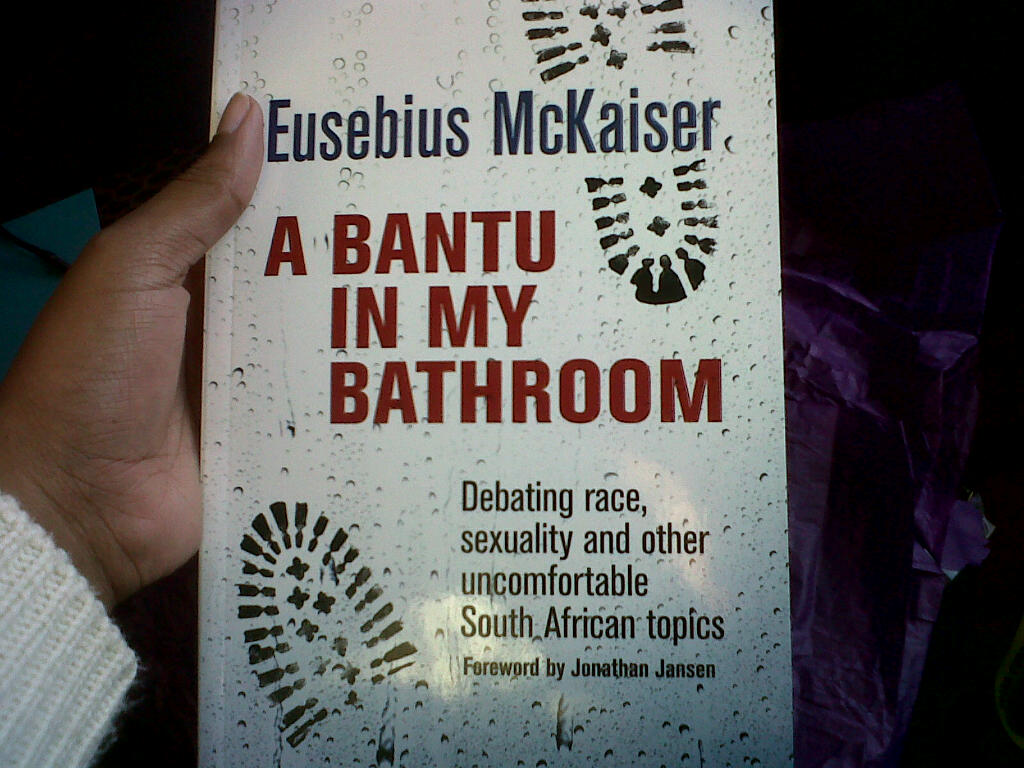
IMG00724-20130613-1623.jpg

Onwards with A Bantu in My Bathroom by Eusebius McKaiser then. Been wanting to read this book for some time, but being the broke student I am it just never happened. Umtil I got this as a gift, yays.

Before I tell you how awesome a read it was, I must mention that I am a fan of the man. At some point in my second year at Wits I considered taking up Philosophy in the hopes of being lectured by him at some point. However, reason and a passion for what I was already doing steeled me. Anyway back to why I’m a fan – I love his insights and the way he chooses to deal with difficult topics that many are reluctant to. Along with this I find him quite relatable – not all the time but I mostly get him/what he’s saying.

The book is basically a collection of essays based on a variety of topics. Namely race, culture and sexuality. Under each section there are about four to five essays, which aim at tackling various aspects of the ‘big issue’ at hand. Unsurprisingly, my favourite essays were  in the race section. I think that it is still important to look at and understand why race is still an important contributing factor to the lived South African experience. He mentioned that we can’t pretend we don’t see race just to avoid being labelled ‘racist’.

McKaiser highlights some of the most important race related challenges South Africans face. He explains why Affirmative Action is necessary, discusses white privilege, tackles the issue of whether or not black people can be racist and much more. Even though one might disagree in places, I did find myself agreeing with him 80% of the time – not just in this section but throughout the rest of the book.

In the sexuality section he spoke about ‘coming out’, love and even rape. This part of the book was the most personal for me and as such riveting to read. When it came to culture he looked at ploygamy, divisions present in our society and the advantages and disadvantages of being a so-called coconut. The range of issues raised in his essays is quite big. I was not left wanting when I was done reading – I legit felt like he discussed everything one could in 209 pages.

We should instead accept that we are deeply divided – spatially, linguistically, culturally, ideologically – and reflect on how we might live in each other’s space while disagreeing deeply with each other. The alternative, fake national unity, is simply childish. (excerpt from the book)

What I enjoyed the most were the little anecdotes that coloured his essays. For me it helped to bring home his points and also offered an unique peep into his personal life. I have often seen McKaiser on tv, attended seminar’s that he spoke at and listened to his show on radio. This book felt like the literary incarnation of those experiences. Not the content but with regards to style. It was easy read and understand because he was just being himself (or so I assume). He did stress how important authenticity is to him so I imagine he wrote in a way that would reflect that.

I also liked and admired the fact that he didn’t ‘other’ people. He didn’t speak about racists, homophobes and misogynists in a distanced manner. He made it clear that we are these people, that we are our biggest problem in many cases. Also highlighting that change can only begin with us.

If I had the money I would go out of my way to buy a few people a copy. The idea’s put forward are of great import and I feel that the more people they reach the better.

PS**

Flowers in the Attic by Virginia Andrews

[*disclaimer: my book reviews are not really book reviews, just my thoughts after I have read something particularly moving]

This novel has been one of the most interesting and riveting I have ever read. I know I have said the same about other novels – excuse me for having great taste 😛 I even feel bad that I bought it for a mere R3. Well that’s what hospice bookshops are for right?

Shucks I don’t even know were to start. I finished reading about an hour ago and I’m still reeling. The novel did come full circle but I still can’t get over the things that happened to us (the characters and I). I really did feel like I went through the things they did, goodness knows I cried just as much as they did.

From page one I was hooked. Andrews wrote a  prologue that told me that her and I were on the same wavelength. It’s one of the most honest and earnest one I’ve read. My favourite part reads “…in this work of ‘fiction’ I will hide myself away behind a false name, and live in fake places, and I will pray to God that those who should will hurt when they read what I have to say.” She said fiction like that because this book is based on a true story, which made me all the more sad.

I don’t know how to talk about what lay between the covers of this novel without giving the story away. It really is what the front cover said it would be: “the compelling story of a family’s betrayal and heartbreak, love and revenge.” That is quite literally what happens from chapter to chapter.

What I can say that isn’t a spoiler is that the novel is magnificently written. It transported me to the attic, made me feel every blow that these children were dealt, made me fall in love with yet another man and made me see the lengths that we as a species will go to to ‘survive’.

To touch on the latter – there is a theme in the story that focuses on avarice and the love of money. It is disgusting to see how money and the pursuit thereof can change a person, even a loving mother. I don’t think it’s fair to pin all the blame on her, but it is a huge catalyst that leads to the unraveling of a family.

I suppose I can’t ignore the ‘big’, overarching theme in the novel – incest.  I don’t want to dwell on it because then people form their opinion on the matter immediately and it could affect how you receive the rest of the novel. I didn’t let my so called morals colour my thinking – I gave myself to the love story that was presented to me.?

I was actually left traumatised by this read, to think that this actually did happen will make me shudder for some time to come.