Sunday Scribble #5: What the vlog?

I’m old enough to remember the very early iterations of vlogs which were exclusively on YouTube or natively uploaded to blog sites. These vlogs (videoblogs) were usually either shot strictly on a tripod (or atop a makeshift stand) in someone’s bedroom or a chaotic bunch of selfie-style clips shot in various locations, at random times, culminating in a video montage. The immediacy, editing perfection and commercial imperative of modern vlogs, entirely absent from their narrative. When they first became popular in the 2010s, I only went to YouTube to watch TedTalks, interviews, music videos, stand-up comedy and covers of my favourite songs. The allure of watching other ordinary, unknown people’s lives, escaped me. Now, that’s the entire foundation and popularity behind them.

Blogs at the time were places for online connection through documentation, commentary and engagement that went beyond what was possible in limited social media posts. Personal publishing online was still in its infancy and therefore novel to those of us dipping our toes into this ocean of possibility (now simply, content, yuck).

Five main blogging motivations were identified in Nardi et al. [2004]: documenting one’s life; providing commentary and opinions; working out emotional issues; thinking by writing; and promoting conversation and community. Blogs have become an increasingly important way of learning about news and opinions not found in mainstream media, and blogging has become a popular social activity for establishing and maintaining online communities.

In Gao, Wen & Tian, Yonghong & Huang, Tiejun & Yang, Qiang. (2010). Vlogging: A survey of videoblogging technology on the web.. ACM Comput. Surv… 42.

So naturally, one would assume that vlogs would be the visual extension or interpretation of the above motivations and uses. While there weren’t set formulas on how to vlog technically and structurally, vlogs in the 2010s were efforts at brief glimpses into personal events, how-to do ABC or short clips from concerts, performances, in class etc. They were shaky and oft grainy testaments to the mundanity of being a high school or university student, or candid travelogues shot in another country on a handycam or small digital camera. To my memory, unlike video essays, vlogs were (and are) used for personal documentation more than outright analysis or commentary.

In the present, vlogs flood our timelines day in and out, and have been reduced to overly produced ‘get ready with me’ or ‘come with me to the grocery store’ slop that has no soul or capacity to engage with human life as it is. What I mean by this, is not that these aren’t activities that people are genuinely engaged on a daily basis, but the performance of them by creators whose lifestyles are monetised can reduce our very existence to one of imbibing the consumerist loop of buy, use, buy, use as natural, desirable and aspirational. The slow voiceovers, perfectly timed After Effects text and product placements – a sales pitch which makes products of people’s very lives. I suppose, like almost everything else, its a result of living in a capitalistic hellscape. Perfectly curated, nothing placates and numbs audiences in search of constant entertainment, no matter its substance.

Obviously, the above examples are limited and do not speak to the entire scope of diversification within the genre; for instance, there are professionals like chefs, athletes, teachers and more whose insights into their daily routines are eye-opening and illuminating. Their vlogs often are about ‘thinking out loud’ and opening up conversation with their audiences, more than they are a representation of living within the confines of certain aesthetics. Further, vlogs do not account for the countless video essays, explainers and straight-up rants that some people post as their online counter-mainstream outlet.

I often think about how for many, a first time viewing of The Truman Show (1998) would not in fact present as the psychological thriller it is, but as an unappreciated opportunity on his part (limitless camera angles, lighting and cooperative supporting cast members for the ‘main character’, come on, Truman). People’s ‘real’ lives are content, their misfortune and joy alike consumable and open for monetisation. But unlike Truman, they are both the creator and star of their own shows, willingly.

Stuff is less exciting without Twitter

“Turn the lights off!” Before May 21, 2025 that phrase had much sexier connotations in my head, now, unfortunately, it is a reminder of the very strange ‘meeting’ between President Cyril Ramaphosa and that guy in the Oval Office. While I have appreciated and gobbled up all the analysis that followed that strange encounter in the last few weeks, something was still amiss. Memes, gags and retweets about the encounter, to be specific. This event was the first time I sincerely missed the bird app since deleting it from my phone last year.

Have I known peace, absolutely. It has been freeing to be rid of the watered-down, oft-triggering and anti-intellectual ‘discourse’ that had come to dominate my Twitter feed. Since the Musk takeover, the algorithm on that app has become most unhelpful and uninformative, making an occasionally toxic and divisive environment, perpetually so by boosting the accounts and thoughts of the most harmful actors in the swamp (himself included).

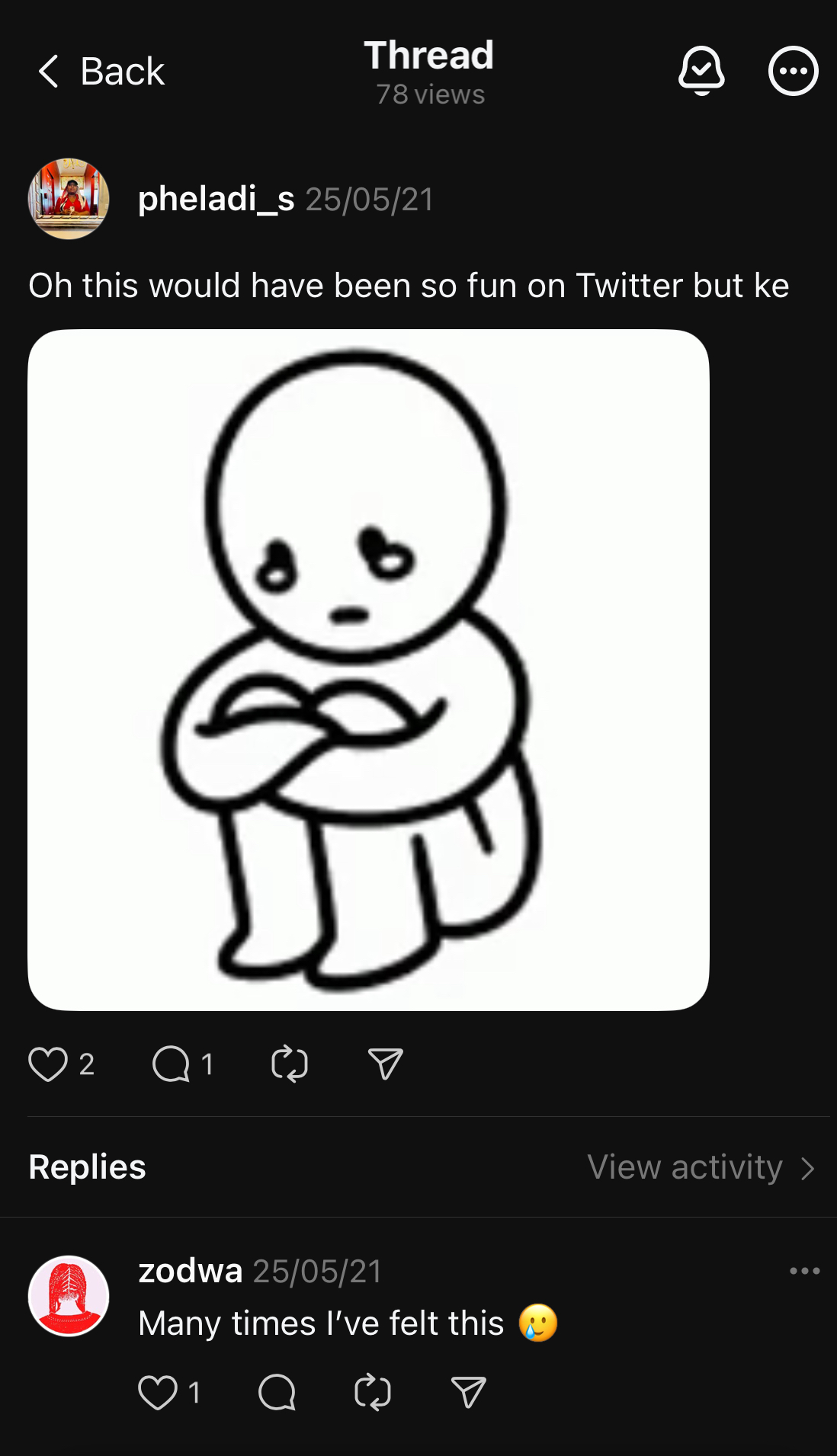
Anyway, that wasn’t the point of this little scribble. The point was, on that chilly Wednesday evening, I sat listening, enthralled by the shenanigans with no public place to live tweet and banter about the increasingly bizarre events coming through my speakers all the way from Washington DC. I was glued to the radio live feed in my car and couldn’t risk running out of the car, into the house to catch the visual feed in fear of missing even one second of the special episode of WWE. Itching to say something, anything, I turned to my almost inactive Threads account to cash in on the adrenaline that was coursing through me. I made a handful of posts, forgetting in my glee-come-horror at what I was hearing, to actually thread my posts together. But minutes passed with not a like, a retweet, a reply or GIF-only response. That’s when it hit me, that damn, Twitter is really gone and the live back and forths I had become accoustomed to during particulaarly important socio-political events and moments, could not simply be replicated on a different app. Sure, my following and level of activity on Threads probably plays a role, but that used to be the beauty of Twitter, you didn’t have to be ‘somebody’ to hop in on a trending conversation and simply by being vocal be seen by others interested in that conversation.

As someone who had been on Twitter for 14 years, using it professionally as a journalist and socially as a loudmouth, the relative silence during a live news event left me a little sad. Selfishly, for entertainment’s sake. But there was also magic in the way we collectively processed the world around us. As South Africans, primarily through laughter and making light of what is often too heavy. Threads did eventually ‘catch up’ the next day, filling my timeline with more post-meeting reactions, but the moment was gone, and my thumbs were at ease.

Because, the interweb

I  took part in a blog-a-thon a few weeks ago. This is what I came up with in the hour and a half we were given. I chose the topic “digital nomad” and employed free writing principles to get the post done in that time frame. 

Hi I’m Pheladi and I’m an  interweb slore.

It started at the tender age of 16 when I was persuaded to open up a Facebook account in 2007. I didn’t really know what it was but the more I gave of myself the more I liked it. I moved there permanently a month later when I uploaded my first album. I did it on the sly in the computer room at the school’s library.

Soon enough I invited people over to live with me and when I got a new phone my new shelter went everywhere with me. The other places on the interwebs just didn’t have the same allure. Emails were cold, Hi5 left an abandoned building along with MySpace once FB took over.

When rent became cheaper circa 2009 my parents finally smelt the roses of the millennia and got us internet at “home”. This is when my relationship status changed, to “in a relationship” for the first time.

The first thing I did when I woke then was check for new FB activity. In the car on the way to school I ignored my dad’s random unfunny jokes to see how many new likes I had since I posted my hilarious yet tragic new status. At school we posed for photo’s behind what now seems like ginormous camera’s to be posted later that night. We picked on each other via comments – someone’s humiliation bringing out the snark that I suppose was always brimming on the surface.

Until then I had really only cheated on FB once, with Mxit – but I’m not sure that that counts, I used that for my private life, not my interwebs life (there’s a difference).

I became a real slore when I went to varsity. I was a media student, a gateway drug to the interwebs. I had clearly left Kansas and even learnt what an interweb slore is via the wireless tentacles that kept pulling me in.

Let me school you

  • Interweb(s) – Derived from the real word ‘internet’. I learnt this word on black twitter. Timeline unknown (unremembered really).
  • Slore – An adjective of sorts, combines the word “slut” and “whore” to mean ultra promiscuous. First heard on an episode of Keeping Up With the Kardashians, streamed live via free varsity data.

FB was my main chick, but I had an insatiable appetite that needed to be filled. I saw YouTube on the way to lunch with a friend, I introduced myself and we hit it off. I had just gone through a bad break up on FB which made it difficult to stay loyal (don’t get me wrong I was on everyday – it just hurt) – so YouTube provided all the happiness I required, especially the musical kind.

Twitter was love at first site, I was shy at first because (s)he was already with so many of my other friends, that and the fact that I think everything is lame until I try it. We took it slow at first (aka I trolled other people’s timelines for “research”). I made the first move as @sista_rebz – 5 months later and 5 000 tweets later we were practically married. At which point my slightly advanced Nokia got stolen by two white “plumbers” and I got degraded to tweeting from twitter for mobile. I spent about R200 on airtime a week to keep up the all-consuming union.

I also suffered a tremendous blow to my twitter image, everyone was tweeting from “twitter for Blackberry” by then. But there I was tweeting “via mobile” but who said socks with sandals isn’t cool – not me because I still managed to keep up with the BB kids hitting the 10 000 tweet mark in under year of joining.

The exposure to things and stuff on other people’s timelines pushed me into a digital wormhole I may never escape from. It started with starting something new with some new .com every other month. I began IM’ing, skyping, tumblring, checking in on foursquare, feeding my brain with wiki leaks (or forced spills if you will), listening to sounds on the clouds, trying to be “profesh” by linking in and and and.

All these things I am now on (with) help me in my professional life as a journalist. I’ve since lost contact with what was my first love – I keep FB close, an app on my homepage even but that’s about it. The need for likes wore off when I got to know him/her better. Juggling these other loves is difficult and data consuming but I stay stumbling upon, flipping boards, sending grams and +1’ing because, the interweb.


The Newsroom 5.5

This week we had no print edition of the paper, so we had to up our game online (well at least that was the plan going in).

Photo: Shandukani Mulaudzi

I was the lucky one who got to be online editor during this week. I was very excited to do so because online things tickle me. I got to run my first ever news conference which I must say I did quite well, delegating has always been a strong point of mine.

Once that was done, I typed up the diary of the week – which set out who was doing what and when they were doing it for. I wouldn’t say that my deadlines where unrealistic, but I came to learn that they actually meant nothing to a lot of people. Some things came in two hours late and others two days late. I still rate I did what I could to make sure that the most important deadlines where adhered to.

Our guest speaker for the week was Justice Malala, from 24 hour news channel eNCA. I opted to do something a little alternative this week when it came time to hand in our guest speaker report. Right after he spoke to us we learnt about content curation via Storify. So I took it upon myself to incorporate what I had learnt and went the alternative route when writing up my report/article – I am not sure how well that went down with my lecturer though.

I had so much fun with my test run on storify mission that I went ahead and put together another with a colleague later in the week. It is the ultimate stalker tool on the interwebs, I am slowly becoming a wee bit obsessed with it.

We had a public holiday right in the middle of the week, that holiday was Worker’s Day. Vuvu journalist, Dineo Bendile wrote a great article on the day – she covered the staff at Wits who work nights to keep campus safe and clean. It made me realise how hard some people have to work and how little recognition these people get.

Thursday and Friday were business as usual, which saw me running around asking people to submit their articles online. I went to a lecture/talk hosted by Eusebuis McKaiser on the importance of the intimacy required in student-staff relationships, to make them beneficial to the students. I must admit I am a fan of his and tend to agree with a lot of things he has to say, that said he made some great points.

I also had a lot of fun putting together and just watching the daily video vox’s on our site, it is always a treat to get to hear other student’s thoughts and opinions on current issues. Which is another reason I had a blast being the editor this week.

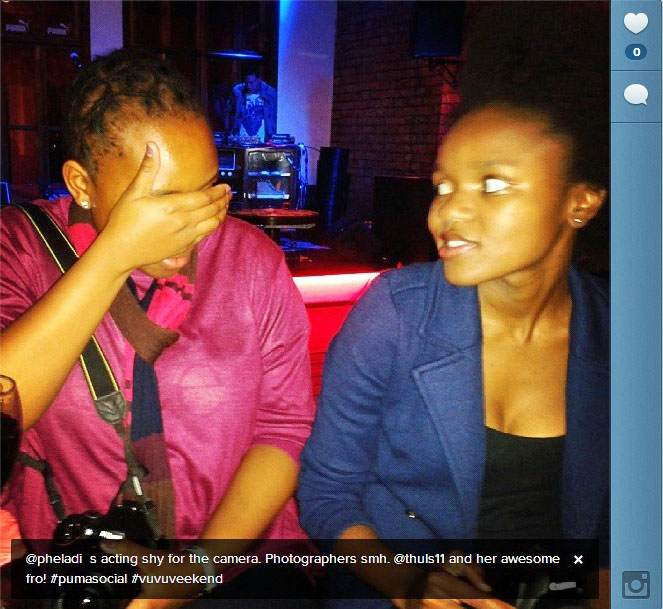
On the weekend I was part of the #vuvuweekend team, we went around various joints in Braam to check out the vibe. We managed to get some amazing shots, no “grin and grabs”. We will be using the photo’s in a photo spread next week – in our very first 12 page paper *excitement*

So all in all I had a great week, busy but quite chilled (hence the .5 numbering in my title) in comparison to what is coming our way this week.

Another blog… Really…

Well yes, I have started another wee blog. Why? To separate my different selves I suppose. I will use this one to document my journey through my honours year. What I consider to be the year that makes me the writer and journalist I should be.

I will refrain from being overly emotional (or try to) and try to keep things as ‘PG’ as possible.

I am two weeks into the Journalism programme at Wits and already I can tell it is going to be a very long year. Long but fulfilling. It has already been a lot of fun because of the amazing classmates I have. I really cannot wait to get to know them better and form lifelong friendships.

I look forward to this new part of my life and hope you don’t mind that I’m sharing it with you.

Ok-thanks-bye 🙂

Pheladi Sethusa 

Digital Apartheid

exPress imPress hosted its second roundtable discussion on the 11th of May 2012. The topic for discussion was: ‘Digital Apartheid: Is the smartphone age segregating or uniting South Africans?’.

nathalie-225x300
Nathalie Hyde-Clarke.

The Graduate Seminar Room was not as full as we had anticipated but there was an eager audience present and ready to engage with the topic at hand. The first speaker was the ‘headliner’ if you will: Nathalie Hyde-Clarke. She is an ex-Witsie who is now the Head of the School of Communication at the University of Johannesburg. Her presentation was based on a research study she had recently done on trends of mobile phone usage in the Greater Johannesburg area. Her findings were very illuminating and served to debunk some assumptions about mobile phone and smartphone usage that I had.

Her findings could be summarised as follows. In 2010, 85 percent of the South African population owned a cell phone, with around 35 percent of those using their phones to go online. By 2012, there was a major increase in these numbers with 35 million people owning cellphones and 36 percent of those being smartphones. She found that people do not really use their smartphones to their full capacity. Most people use it for social networking and entertainment purposes which is problematic as a large number of people who own phones do not really know how to use them properly – smartphone or otherwise. Hence, the lack of mobile phone literacy was a problem that she identified in her research. There are no classes to learn how to use a phone. Most people just learn as they go along which is not an altogether bad thing but for example for someone who lives in a rural area and is illiterate, this could prove to be a trying task.

Nathalie made a statement about the teenagers and kids of today missing out on the world due to their preoccupation with their phone. It was only fitting to have a representative of the youth to challenge this. Leenesha Pather, a fellow exPress imPress blogger and Media Studies Honours student, attributed the growth of smartphone usage to affordability. Blackberries often come with a R60 internet bundle which effectively soothes the airtime woes of many ‘broke’ youngsters. She did mention that while accessibility had increased, smartphones serve to segregate people on a physical level in the sense that people would rather text, BBM or tweet one another than actually go out for a coffee together, hereby not quite countering Nathalie’s point (as I had hoped) but supporting it. But in the same breath, Leenesha mentioned that perhaps if everybody had access to smartphones, race and class divisions could be bridged.

roundtable2-300x225Following Leenesha, Wendy Willems, a lecturer and now Head of Department of Media Studies at Wits University, spoke. She has been doing research in Zambia on mobile phone usage. She mentioned that patterns of ownership and cost are very similar to the earlier mentioned South African case. People who cannot afford these technologies are ‘left behind’ and this creates a burgeoning digital divide. In Zambia, people attribute mobile phones to a number of social problems like adultery. A lot of people seem to think that mobile phones break up happy homes.

In the discussion held afterwards, the debate echoed ease of access in Africa and questioned how reflective the findings actually are of places outside Greater Johannesburg. Along with this, there was a shared sentiment that smartphones need to be made more affordable, used as more than accessories and used to their full potential. If this happened they could be used as educational tools and really help to put the world at everyone’s finger tips.

**NOTE: Post first appeared on exPress imPress on May 28 2014.