2Cents: The #Generation16 and cultural activism

The past two weeks have been the stage on which a wage dispute has turned into a full on cause to change the entertainment industry as it pertains to artists working in broadcast television.

Sixteen gatvol Generations actors decided to withhold their services (not strike they say) until their production company and the national broadcaster, SABC entered into wage negotiations with them.

They were given an ultimatum to return to work or get fired – the latter was chosen for them or by them depending on which “side” you’re on.

Since headlines have been abuzz with stories of inflated salaries, new talent, forlorn stars etc. This past Tuesday, for the first time in two weeks everyone got a big ol’ dose of perspective.

Initially when Mfundi Vundla spoke last week dropping the R55 000 bomb – I was like, well that is some good money, why are these guys kicking their toys about. But I immediately chided myself – the 21 year old soapie probably makes more money than any production of its kind in the country. Yesterday I learnt they make R500 million a year now.

That they cannot sit down to negotiate a way to cut the actors a piece of that pie seems unreasonable, to me at least. Apparently they have only received R3000 in royalty fees for the past 11 years.

Some of the dismissed cast members highlighted what was wrong, what they wanted and broke down in tears when doing so – illustrating to me that I actually have no idea how the “industry works”. Then Dr Johan Kani explained for us all.

“We carry the residue of the apartheid era master/servant relationship,” he said. Kani expanded on this saying that actors are not employed by their production companies, they are in a contractual relationship with them. Adding that actors should not be treated in the disposable manner that the dismissed 16 were treated.

He spoke at length about he had used his art to help bring down an oppressive system, yet here sat 16 people, 21 years later who were being treated in a way that resembled that past regime. He said that as an academic entity in society, artists should be valued and now was the time for them to stand up to say they are worthy of more.

He called on them to make the Generations set unworkable, much like the miners in Rustenburg had done to Lonmin for five months. Block the doors, barring clening staff, writers and the like from going to work until their demands are met.

His speech was the ultimate ah-uh moment. His son, Atandwa Kani then took to the podium. He was fired along with the 16 after only being a part of the team for three weeks, he had not even been on screen yet.

He admitted that he came on board wanting to “ascend his status as an actor”, acting alongside some of the country’s best.  However, “this was a battle I could not turn my back on,” he said.

“I come from a family where I was raised by a father who spent most of his life, and dedicated his life to the emancipation of this country – as a political activist through the arts. Now, I cannot having his blood running through my veins sit back and be silent.”

What they had to say, what everyone had to say on Tuesday afternoon made me realize the dire need for cultural activism of this kind in South Africa.It also made me realise that this is no longer just about the 16, but about something much bigger.

I really do hope their cause catches on and that they do stand as firm as they have promised to. Pay back the royalties maan. 

Race (still, probably always will) matter(s)

In light of the blackface incident involving two Tuks students last week, I asked TO Molefe a few quick questions on the matter. He indulged me with the most enlightened and thorough answers anyone has ever left in my inbox. As such, I figured I should share and let his words hit you with some knowledge.

Image: Twitter
Image: Twitter


Q:The two girls have now been expelled from res but not the University. Do you think this action was appropriate? If so why and if not why?

A: I think the university needs to follow due process as such decisions on individual students’ fates can’t and shouldn’t be arbitrated based on public sentiment. Hopefully UP already has in place an objective process to assess infringements of its student code of conduct and to assign the appropriate sanction(s). I personally do not believe punitive measures like expulsion are necessarily the best way to handle things, but like I said, the university should be following whatever pre-established protocols it has in place to deal with these situations.

The unfortunate thing about UP’s response to this incident is, as I said in my column, is that it singles out the two young women’s behaviour as an exception. They should definitely be held individually accountable, but the university, too, needs to examine its role in allowing such behaviours and attitudes to go unchecked among its student body. The university needs to use this example as the motivation for a compulsory education programme that uses South African history to teach about prejudice and oppression, particularly racism, sexism and sexuality. Right now they seem to be panicking because of all the public scrutiny directed towards them.

Q: In your opinion what was problematic about the girls dress?

A: For me it is pretty clear cut: If, when you think “domestic worker”, the first thing that comes to mind is black women with big lips and behinds, you’re playing on a racist stereotype of black women’s bodies and a long-held belief in that such bodies are the ones best suited to domesticity. Your intention is to poke fun at black women. It is racist and sexist. It is what queer scholar Moya Bailey calls misogynoir (anti-black misogyny).


Q: Some have said they the girls were having harmless fun, much like Leon Schuster. What are your thoughts on that line of thinking?

A: I think anybody who thinks the girls were having harmless fun has chosen not to think at all about what their performance tells us about the cycle of servitude millions of black women are trapped in, many from birth. The two young UP students probably grew up in a house where a black woman cleaned up after them and took care of them. That woman has daughters of her own who, without some kind of intervention, will probably have few work options other than to become domestic workers, too. And chances are that woman’s mother was also a domestic worker. We’ve seen this in the mines where low-paying manual-labour jobs ensnare generations of a single family.

Yet, these two girls, when asked to imagine a domestic worker, a figure that has been a feature of their whole lives, they imagined a stereotype instead of a real human being. These two girls will probably go on to hire domestic workers for their own homes when they grow up. And I imagine it will be difficult for them to find it within themselves to pay their domestic workers a living wage if they can’t imagine them as human beings in all their complexity.

What I’m saying is that the dehumanising way in which the girls imagined domestic workers is how many people imagine domestic workers. And that dehumanising imagining is directly linked to why many domestic workers in this country have never been and are not paid a living wage.


Q: Black comedians make it a point to talk about race in their sets – do you think the way they do it is helpful or harmful?

A: I think it’s great when black comedians talk about race. I think it’s great when anybody talks about it. However, for something that is so divisive, race is generally poorly understood. And even those of us who read, write and think about it every day have to keep our wits about us when dealing with it out of a fear that we might be reinforcing misconceptions about race and promoting racial prejudice. I’m not sure how many South African comedians and satirists exercise this kind of thoughtfulness or care.

This might be a bit utilitarian of me, but the objective of talking about race should be to expose its contradictions, and to subvert people’s deeply held misconception that race has no social significance. (I think most of us by now are comfortable with the idea that race isn’t a biological reality in the sense that it was once believed to determine traits such as intelligence, athletic ability and creativity.) Comedy is a great way to challenge people’s ideas about themselves and the world, but only if the comedian has stopped to think about whether they are repeating and reinforcing stereotypes, or subverting it. There are too many comedians doing the former because it’s easy and because the latter is hard and takes tremendous skill to pull off while being funny.


Q: Lastly, have you seen the trailer for Dear White People set for release later this year. Do you think the South African audience has the capacity to engage with the movie meaningfully?

A: I have seen the trailer. I am ambivalent about the movie’s relevance in South Africa. I mean, we will definitely see parallels to situations here. But, although related, the contexts and histories are a little different. Because of that, I am hesitant to adopt American (or other) anti-racist narratives wholesale. We have a rich history of anti-racist thought and activism here that I think we’re making too little use of. So, I don’t think there is a need here for black people to address white people as this movie does. Instead, I think what this country needs right now is a “Dear Black People” written, directed and produced through an immersion in black consciousness thought.

Boom. Basically.

Where I’m at

That headline is probably a grammatical sin of note but I’m 23 and kind of cool so let’s just be strong.

So I have been a working girl for a few months now and figured it’s time to say something about that.

The Job

I am currently working at The Citizen newspaper, as you can tell from the infrequent posts I manage to put up. I’m an intern at the daily paper and I rate so far so good.

I have managed to end up on the front page a few times – which is really very flattering. I’m fortunate to be working somewhere where I am allowed to do that – most interns don’t really get the opportunity to write as frequently as I do. Most people do the things senior journos are “above doing” – making phone calls, rewriting press releases that kind of thing.

I almost feel guilty that I have all this freedom to do pretty much any and everything while some of my friends are on the press release end of the spectrum (note: I have nothing against press releases I use them as well just not enough to want to die yet).

On the other hand I feel like I was NEVER ready for a daily newspaper – life here is really fast. Sometimes it feels like I’m on a rotating conveyer belt – type, file, type, file, type, file – on and on. What doesn’t kill you right?

The money

Being in the working world, paying my own way through life has taught me a few things about myself. Initially I was like “who would ever use this much money in a month? Losers.”

In the beginning I could not spend it all, I saved some, spent more and carried over the rest. Then I decided it was time to invest in things I really needed, a new camera and laptop. It didn’t seem like that much money at the time but soon that coupled with careless social spending, ever increasing petrol prices brought me back to reality.

Last week I ended up with R40 and only enough petrol to go to work before pay day – it was the worst feeling (I’m very liberal with hyperbolic speech). I suppose I have to learn how to budget now. Having money is nice but it makes everything look shiny and like something I “need”.

The social/not so social life

Coming into journalism everyone warned me about not having a life. Something which I experienced a bit last year when I was doing my honours at Wits – I became the friend who cancelled plans last minute and was always late to things. I suppose last year I didn’t feel it as much because my classmates became a huge part of making up for the nonexistent social life.

This year, without them things are different. I do go out when I can but I mostly just want to sleep. Everyone works now so making plans, finding times that fit is another struggle – because you know they have boyfriends and things.

Then I go to stories and other journos know eachother and I just play candy crush to pass time. I suppose I didn’t count on the loneliness when I decided I want to work in the media (to paraphrase Fitzgerald Grant).

‘This parliament robbed our democracy’

FILE PICTURE: A general view of President Jacob Zuma's private Nkandla home. Picture: AFP PHOTO / Stringer
FILE PICTURE: A general view of President Jacob Zuma’s private Nkandla home. Picture: AFP PHOTO / Stringer

NOTE: Article first appeared in The Citizen newspaper on May 1, 2014. 

The decision to dissolve the parliamentary ad hoc committee tasked with investigating the Nkandla debacle is unlawful and unconstitutional, a constitutional law expert said yesterday.

Professor Shadrack Gutto, constitutional law expert at the University of SA, said the decision to dissolve the committee and defer the matter to the new parliament appointed after the elections is “not legal and not constitutional”.

Gutto said the current sitting committee “does not have the powers to defer the matter. They can’t order the new parliament to do their work”.

ANC MPs voted as a majority on Monday to dissolve the parliamentary ad hoc committee, stating there was not enough time for the committee to investigate the matter before election day.

Gutto bluntly said: “The ad hoc committee had simply decided not to do the work it should be doing.”

He said this decision would not make the matter go away, as “serious maladministration and unjust enrichment from public funds by the president and his family” needed to be investigated in Parliament.

Members of opposition parties have said they will pursue the matter.

Gutto said: “This Parliament will go down in history as one that robbed our democracy by not complying with legal and constitutional regulations.”

He said the reasons why the committee had to be dissolved were “irrelevant and wrong.”

The newly elected members of Parliament will sit for the first time on May 21.

SLICE OF LIFE: I’m a flaming feminist, yeah I said it

“I don’t mind women in general wearing crop tops or short shorts, but I don’t want my girlfriend wearing those things because they make me feel uncomfortable,” said a male friend.

He considers himself sympathetic to feminism. This conversation occurred after I had accepted the label, feminist. If it had happened two or three years ago I might have “understood” where he was coming from, now I don’t. It took me quite a while to come to terms with feminism, to understand it and identify with it. To me feminism simply means the freedom to choose who I want to be.

I’m out

In the past I’ve labeled myself as a “laissez-faire feminist” and described myself as such in social conversations. What I meant was that I do recognize that patriarchy is real and is at work 24/7 to undermine people of my gender. What I was saying along with this at the time is that I prescribed to the gender roles dictated to us by society, and that I was comfortable with this status quo.

The attitude has fallen away to be replaced by a more precise concept “black feminism”. I am out. Loud and proud. I have successfully rid myself of the fear of discrimination for being vocal about feminism.

A lot of people have a stereotypical image of an unshaven, angry, man-hater when they think of the word “feminist”. I was scared to associate with the feminist struggle because of this negative stereotype.I now realize one can shave, like to cook, love men and still be a feminist.

The problem with patriarchy 

People are uncomfortable with accepting certain truths, especially if they somehow benefit from whatever it is you are speaking out against.

Men, whether they like it or not benefit from the patriarchal shield that makes their lives a little sweeter. God forbid he cook and clean, domestic chores are for girls. He should sit on the couch, have beers and snacks delivered as he shouts at the TV in front of him. This kind of behavioural conditioning in the media and in our homes provides a breeding ground for the next generation to play into the same kind of zombie like fixation with gender roles.

The problem with patriarchy is that it makes men believe they are rightfully entitled to certain things where women are involved, women’s fashion choices among them. It makes women believe that they have to do certain things, look a certain way, say certain things to win them the “real women” label. Being desirable trumping other pursuits, overshadowing other attributes of their womanhood.

Patriarchy is the reason we have a rape culture here and elsewhere, it allows for the pathological thinking that says a woman can be owned, domineered and conquered at will.  That a woman’s body can be seized, forcefully if all else fails.

What feminism says 

Feminism stands up and shouts “NO!”. It says women are more than their boobs and their bums, more than the scrubbing their hands can endure, are more than the nappies they can change. It says women are capable of more than they are given credit for. It says that women deserve to be treated justly, that they have a place outside of the kitchen. It says gender roles are bullshit, archaic and oppressive.

Feminism has taught me to ignore the cues given to me by society about what kind of woman I should be, because they say so. I should be the kind of woman I choose to be, because I say so. I don’t have to cook and clean to be “wifey material”, a man who thinks like that has no business looking for a wife because clearly all he needs is domestic assistance, which is fairly easy to find in a want ad.

Feminism has also taught me that I don’t have to be an emotionless “bitch” to be respected, that independence is not about being alone, that my sex life is no one’s business but mine. It’s taught me that justice and equality aren’t the same, that sometimes justice does mean giving someone an opportunity based on their gender or race – because equality tends to ignore the existing imbalances between two people when handing out the so called same opportunity or advantage.

EDITORIAL: Twisted love affair

It starts  with some subtle courting, then a proposal for a dinner date. You plan the outfit carefully a week before, pick the right shoes and accessories? The day before you get a call to confirm your date, along with it an sms that night saying: “I’m really looking forward to our date tomorrow, sleep tight.”

You arrive on time –15 minutes before, in fact, just to be safe. You ask for a table right in the middle of the restaurant so your date can spot you immediately and so that  the two of you can be seen. After an hour you start to worry, your call is met by voicemail, you text incessantly but in vain. You start to notice patrons whispering about you.

The waiter is optimistic, says he’ll arrive any minute now. The manager has seen this happen before. She is sure you’ve been stood up and should probably just head home. She comes over and says: “These things never work out, don’t do it again.” After waiting 2 and 1/2 hours you admit defeat and head home, maybe it will work out next time, you think.

Voting in our beloved country has become much like the above scenario for many discouraged South Africans. We continue to show up, allow ourselves to trust, to hope and make our mark. Only the other side doesn’t show up. They leave us all dressed up with nowhere to go.

The upcoming elections present an opportunity to make our voices heard, or so they say. There are millions of voices trying to have their say, our government can only do so much, right? They may listen but it’s hard to believe they actually hear us. My generation has only just entered the arena as citizens with a voice, but already so many of us are weighed down by an overwhelming apathy because of the disconnect we can see in the promises made and the promises kept.

We fill our heads with countless readings, hours of roundtable discussions and engage with one another on theinterwebs trying to find a way. Just trying to find someone and something to believe in, someone and something bigger than the various constraints of our supposed privilege and contrasting poverty. There’s not much consensus between our leaders and us, the youth and the future. We don’t believe their lies, but we know it’s all  part of a bigger  game – if they don’t do it someone else will. We don’t believe there’s any point in choosing the lesser evil either, picking a side just to pick a side. The whole thing smells like a convoluted fishy mess to me.

But what choice do we have? If we keep quiet, we’ll have to watch it all burn. If we make a spoiled mark we may be accused of dishonouring those who shed blood to give us this right. If we agree to just pick a side as an act of “democracy”, we would willingly be hopping aboard  “The Assimilation”, a ship destined for failure.

We don’t have the answers, we may never have them. They don’t have them either but they think they do. We have a choice to make, an important one.

It’s up to us to make the one that says the plan isn’t working, one that says let’s revise the plan, let’s turn the plan on its head if need be.

Our inked thumbnails do mean something and will mean something either good or bad for those to come. As the architect in the Matrix said: “Hope, it is the quintessential human delusion, simultaneously the source of your greatest strength, and your greatest weakness.”

I’m going to be a writer

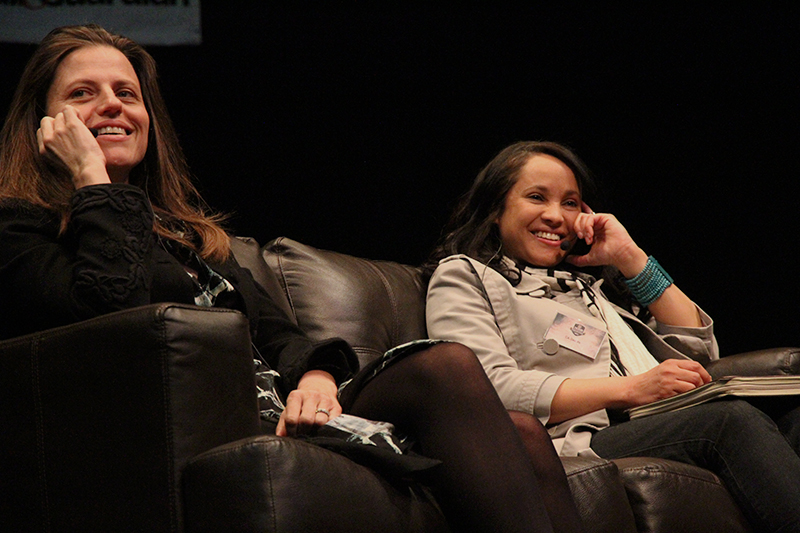
Writers Dominique  Botha and Carol-Ann Davids were two of the 'new' authors on the panel. Photo: Pheladi Sethusa
Writers Dominique Botha (left) and Carol-Ann Davids (right) were two of the ‘new’ authors on the panel. Photo: Pheladi Sethusa

“I know I’m going to be a writer one day. I don’t think it in my brain but I know it in my heart,” I have not been able to look back since I read this Chris Van Wyk quote three years ago. It provided me with the resolve to do exactly what I’m doing in my life right now.

This past weekend a colleague and I went to the 2013 Mail & Guardian Literary Festival, to bask in the presence of some of South Africa’s literary giants.

The Market Theatre was the historically apt venue picked to host the festival. Couches in the middle of a black stage in the main theatre providing the speakers with their literal platform.

We sat in one session after another, furiously typing out tweets, scribbling notes and snapping photos. Between all of this we had to process what was being discussed on the various panels.  All of which were interesting and engaging in their own ways.

One recurring statement made by writers like Nadine  Gordimer and Craig Higginson, was that writing is a calling of sorts. One doesn’t write because they want to but because they have to. Craig  went on to say that it simply isn’t worth the pain and effort otherwise.

I want to be like them

I was lucky to sit in on a panel discussion with a theme of ‘fact and fiction’ luckier still to listen to the first panel of women only, all of whom are first time published authors.

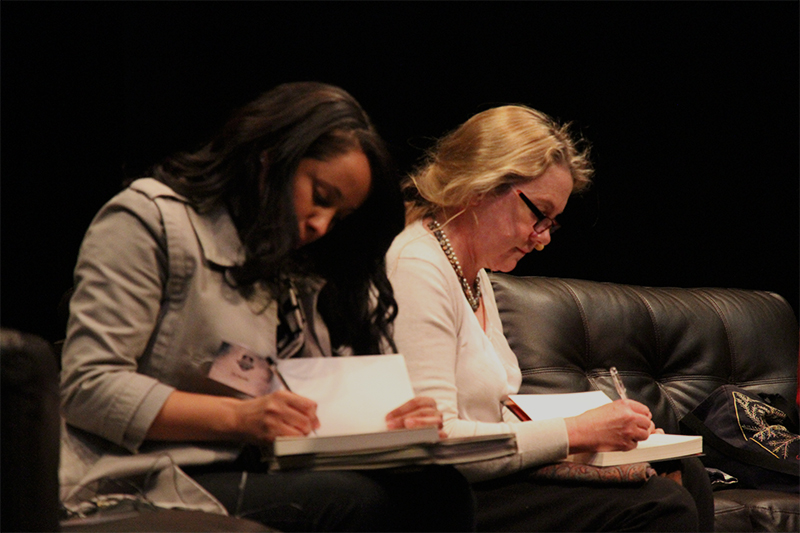
Carol-Ann davids and Claire Robertson sign copies of their books for fans. Photo: Pheladi Sethusa
Carol-Ann Davids (left) and Claire Robertson (right) sign copies of their books for fans. Photo: Pheladi Sethusa

I have ambitions of being in their shoes one day. I’m doing journalism in a mission to be on the right side of history and because I really do enjoy writing. I want to be a journalist because I imagined at some point when I am too old or too tired of being on the field, I would magically turn into a writer. Well not magically but all that training will come in handy.

Anyway long story short, becoming a writer is the end goal.

So this panel discussion provided enough information for me to be inspired to keep on keeping on where this dream is concerned.

Journalism and writing

Claire Robertson provided some insight on how she managed to use her experience as a journalist  to help her write her book, The Spiral House.

She said that she tried to avoid writing about her personal life, because in journalism reporting on oneself just isn’t done.  “I’m not brave enough to write too intimately about my life,” confessed Claire. Clearly I have no such inhibitions, one browse on my tumblr blog is evidence of this.

However, she did insert herself in the places were she deemed it necessary because it was unavoidable. Her background helped her to write much faster than some of the other women on the panel, in this moment she was thankful for the demanding deadlines.

Fact versus fiction

A little fact, mixed with some fiction or do you have to one or the other. Author, Dominique Botha said the truth is incredibly hard and can never really be 100% in that regard. This makes for a problematic relationship between memoir and fiction she added.

“To retrieve memory is the first act of fiction,” she said. Botha added that memory relies on the act of imagination, in an effort to illustrate that memory is compromised and can’t be considered as 100% accurate.

Carol-Ann Davids, author of The Blacks of Cape Town said that one needs a little bit of both (fact and fiction) to tell a story.

Storytelling

The women on the panel emphasised that what they were doing was telling stories. Claire went as far as to say being a good writer is not enough, one has to be a good storyteller to write something of substance.

Maren Bodenstein , said that by way of storytelling and using details you can get a little closer to the ‘truth’ Dominique said was illusory. She said that this was the magic of, “dealing with the theory of literature”.

When asked by chair, Craig how they all managed to write such mature and deep books on their first try, the women unanimously agreed that they got to that point through enduring a lot of rejection and humiliation. “After chipping away at yourself you have no option but to write from your gut,” added Dominique.

The discussion then opened up to the floor in which time questions about getting published and being mothers were asked. Basically it difficult, it’s difficult to get published – to get someone to believe in your story. On being a mother while writing her first book, Carol-Ann said it was challenging but not impossible.

I learnt a thing or two about the journey I am yet to travel and was encouraged to press on.

THEATRE REVIEW: The Line

peuf_20120514_26-247x300This year the Wits Arts and Literature Experience (WALE) had a number of interesting events on offer. Of all the events I managed to attend, one in particular stood out. I wouldn’t call this piece a review but rather an abstruse comment on the play.It was a fairly warm and pleasant afternoon, the 10th of May 2012. This changed completely when we were ushered into the Nunnery. A Wits theatre space which has quite an eerie feel to it. It felt like we had just walked into a dungeon. This was cemented when the huge black doors where bolted shut for the performance to begin. The lights were dimmed, all whispers faded and The Line began.

It was an amazing play to watch. Even though it only ran for 50 minutes, one was not left wanting. The storyline was robust, intricate and full of devastating truths. Truths about who we are as so called South African citizens. Citizens who are so caught up in the ideas of their superior nationality that they burn, torture and destroy the lives of their fellow brothers and sisters. The play was primarily about the heinous acts committed during the xenophobic attacks in South Africa in 2008.

The script and most of the dialogue in the play was made up by a number of interviews conducted by the director, Gina Shumulker. This made for a far more transparent and sincere opportunity to identify with the characters. There were only two actors (Khutso Green and Gabi Harris) on stage but they managed to tell the stories of several interviewees. Ms Green played five vastly different characters. Just by changing her voice and mannerisms, she managed to play each character with spellbinding conviction. Her physical appearance was but a mirage on that stage. We ‘saw’ a different character every time she opened her mouth.

We got an insight into the kinds of people who propelled the violence, in this case an ANC councillor, a young thug and a Johannesburg-20120510-00071-300x225woman who was a victim of the hype incited by mob mentality. We got to see people who just stood by and watched, stopping only to take photographs (people like us). But most importantly we got to see the victims of the xenophobic violence. The innocent people we all let down.

There was a discussion after the play. Most of the audience members were moved by the performance. Moved in that they had never taken the xenophobic attitudes and actions seriously up until this point. There was a common feel around the room that the time of shifting the responsibility of dealing with such issues to government is over. The onus is on us as individuals to say to one another that ‘this is wrong and we will not tolerate it’. We can’t stand back anymore and watch such atrocities take place right under our noses. There are a lot of things that we put up with and ‘let slide’. The killing of innocent people should not be one of them.

The Line left me feeling guilty and ashamed. Ashamed of being a South African citizen and guilty in my complicity of inaction. However, there was a trickle of hope in all of this. There was a character who was involved in the violence who was rather remorseful after the fact. Her guilt is a sign that our people haven’t completely lost their humanity. That we still have the ability to feel for others, that all is not lost.

**NOTE: Post first appeared on exPress imPress on May 22 2014.