Best reads

This week’s paper came out a little later than usual, hence that lead to delayed reading of all the copy.

But now that I have, here are this week’s best reads:

  • Cheers, I’ll drink to that by Liesl Frankson. This was one of the first ‘fun’ front page stories we have had all year. It was a refreshing read and I’m glad it got to go on the front page. Also love the picture that went with it.
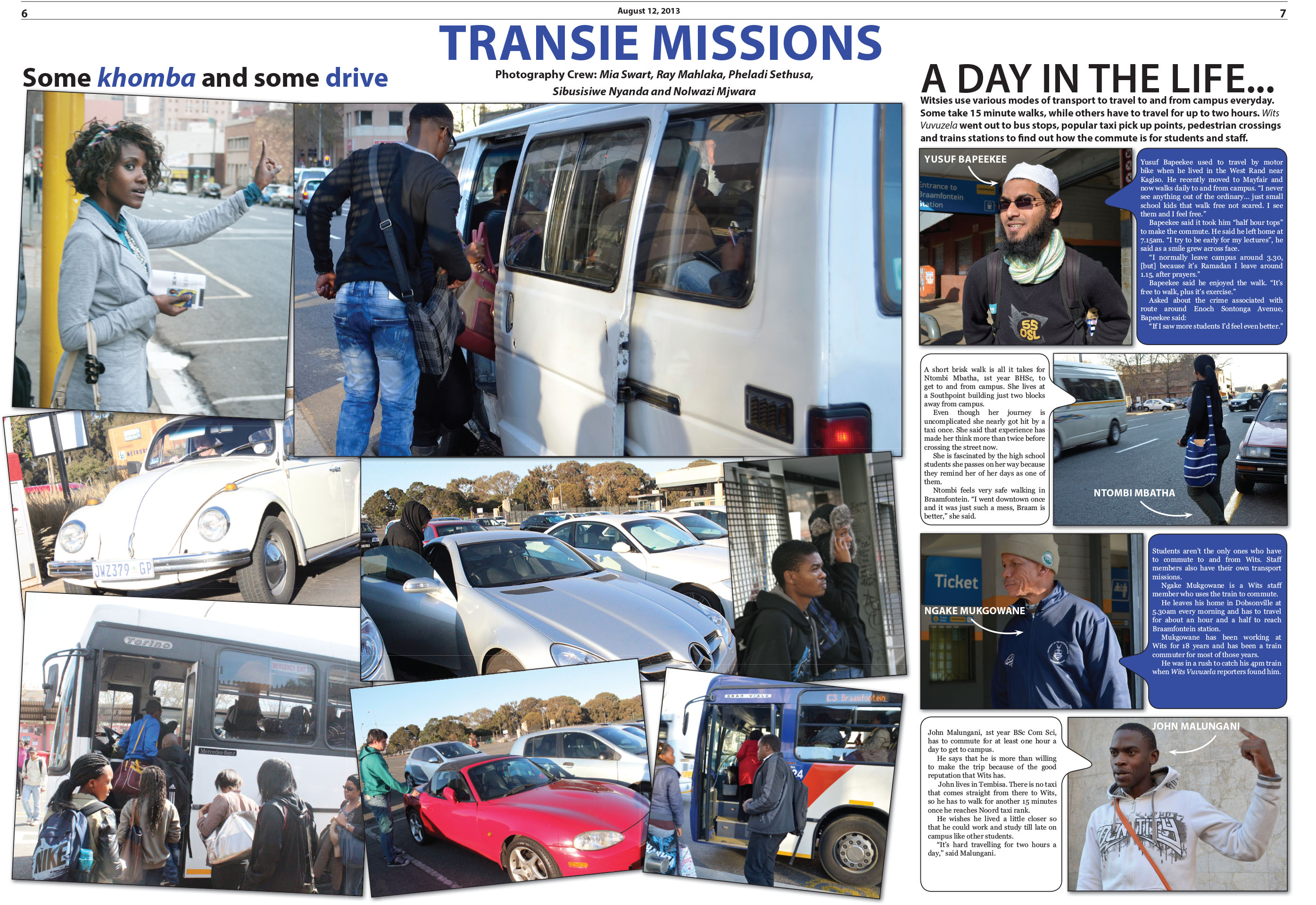
  • Transie Missions by many (lol). This was a collaborative photo spread done by a few of us in the newsroom. I love any and all photo spreads that go in the paper because I’m down with photos like that :p
  • The power of woman by Prelene Singh. This piece spoke to the other side of the Vavi scandal. Probably an unpopular debate to have with it being women’s month but an important one I rate.
  • Supreme Failure by Emelia Mostai and Shandukani Mulaudzi. This breaking news story looks at a high school across the road from us; parents and students complained about the lack of teaching staff for grade 12 learners. The publishing of the story has led to the Department of Education promising to visit the school tomorrow to assess the situation. The efforts of great journalism.

The Newsroom 8.5

The past seven days have been jam packed and felt more like two weeks than one.

Our lives got much busier when we were told that we had to put another 12 page paper together.  Personally I was excited, a 12 pager gives us more room to ‘play’ and deliver more copy. Were it not for the 12 pager we would not have been able to do this photo spread:

PAGE 6&7 (Aug 12).indd

PORTABLE LOO: With no garages in sight, my car doors were turned into a restroom. Photo: Pheladi Sethusa

OPPIKOPPI: Made it out alive

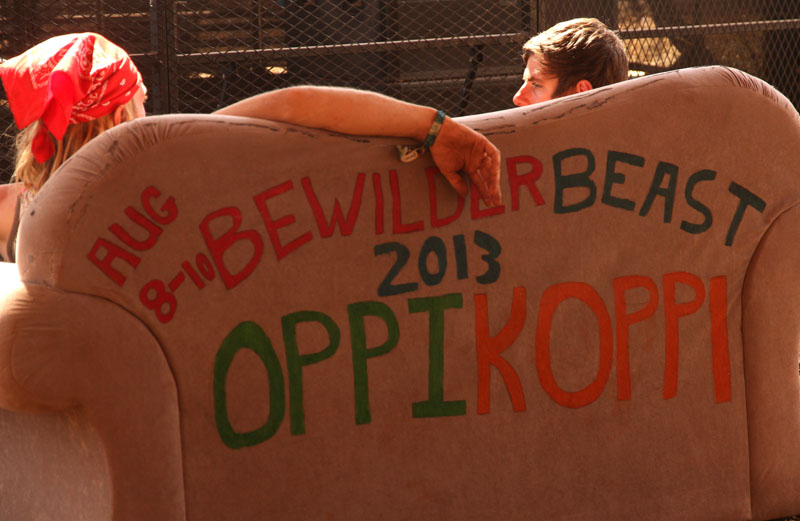
CHILL OUT: Oppi goers taking time out on a couch on the last day of the festival. Photo: Pheladi Sethua

By Pheladi Sethusa and Shandukani Mulaudzi

While one of us sits with a heaving chest and the cough of death, the other found the cure to her cold at Oppokoppi.

The last day of the festival could not have come soon enough, we were exhausted, dirty, dehydrated and hungry – but we had survived.

#InDustWeTrust

We had the time of our lives and we screamed our lungs out for our favourite acts as the dust made its way into our ill-prepared bodies.

The first thing to remember for next year is that Oppi is also known as “Dustville”. Have something to cover your nasal cavities and mouth. It will save you rocky tastes in your mouth and sandy lip gloss.

Now that we are no longer Oppi virgins, we thought it fitting to provide a few survival tips for those looking to go next year.

BAKING: Fans braving the sun to watch a show. Photo: Pheladi Sethusa

 How to make it out alive

We had bought enough food and booze to sustain our little bodies for three days in the bush. But on the last day, dry hot dogs with no margarine on the bun or sauce on the Vienna no longer seemed appealing.

The second thing to remember, the festival runs on a cashless system. Those who wish to buy food and drink on the farm have to buy pre-loaded debit cards.

We opted not to do this, knowing it would lead to frivolous spending. We had packed enough food but the smell of boerie rolls and hot chips accosted our senses by the last day, we were dying for a hot meal.

We were also so dehydrated at that point that seeing people’s water bottles had us salivating. Pack enough water, even enough is not quite enough – pack more than enough just to be safe.

In addition energy drinks would have been beneficial. We could barely keep our eyes open by the third day, this would have been cured by a kick and wings from one of those special drinks.

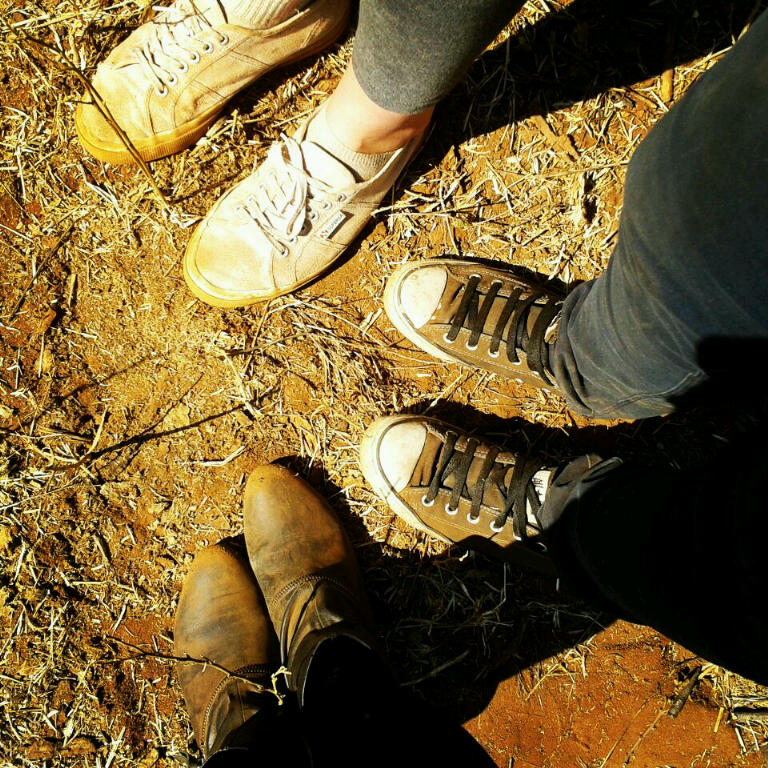
RUINED: Three pairs of shoes that will probably never be clean again. Photo: Shandukani Mulaudzi

 Clothes and shoes

We were so scared of the cold that we only packed winter clothes, big mistake. During the daytime we wanted to cry as the hot Limpopo sun scorched our fully covered bodies. It was as if the devil himself was sitting on the hill by the stages letting his heat out on everybody.

Do not bring shoes you hope to wear ever again and only bring one pair. You are going to be filthy by the end of the festival, so rather go with the general theme and take scrappy clothing.

On your way in and out

On the way to and from Oppi try to choose the route with the toll gates, it will set you back R21 but big, open, un-potholed roads await you. This way you won’t have to battle it out with trucks that are struggling to stay on the narrow, windy lanes.

Most importantly though we had a of fun, we enjoyed all that Oppi had to offer and made memories to last a lifetime.

A little wisdom and stuff

Toby Shapshak. Photo: conferences.ted.com

I knew Toby Shapshak was awesome when he said he might not make it to our guest lecture because he would be “fucking dead” after having to walk up ten flights of stairs to our department.

He was our guest speaker last week, tasked with teaching us a thing or two about technology feature writing. As the editor of Stuff  magazine, he was the perfect man for the job.

Toby mostly weaved in-between technology talk and general journalism talk. A lot of what he had to say has been replaying in my mind over the week.  So I figured it would be a good idea to jot some of his most memorable quotes down.

Toby’s pearls of wisdom

  • On agenda’s and agenda setting: “Everyone’s got bullshit filters”
  • On dodge politicians: “If you lie, cheat or steal – you will get caught. It’s just a matter of when”
  • On life: “You get to a point in life where you deserve aircon, power steering and electric windows” :’D
  • On readers/audience: “Never underestimate the stupidity of your reader”
  • On being a journalist: “It’s like a calling, you don’t do it for the money,” he went on to stress that we do what we do because we are compelled to; “The great thing about being a journalist is that you don’t have to be an expert, you can just call one”.
  • On practicing writing: “You must practice, practice, practice. In the East repetition leads to enlightenment”.
  • On people as “brands”: “I hate that so much. Just be good at your job” 
  • On magazine covers: “I would drop that [white] woman in a heartbeat if I could”

Same music, different people

By Pheladi Sethusa and Shandukani Mulaudzi

Pulling the short straw is something that happens a few times in your life. Sometimes you may be lucky and you won’t, this is life.

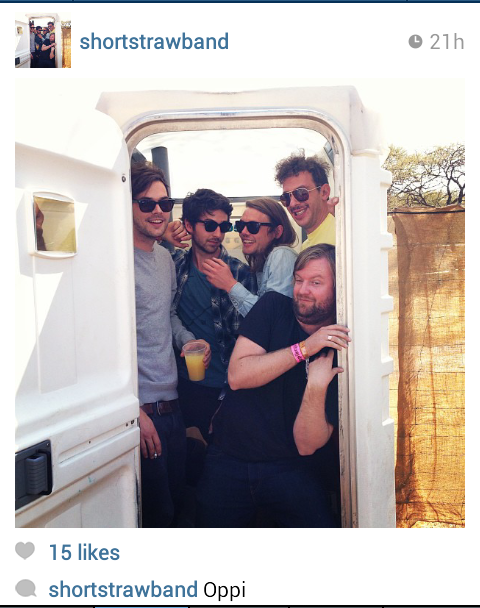
Screenshot_2013-08-10-12-10-21-1 ShortStraw

For the five man band ShortStraw, it was about the beginning of their career. They started out playing for no one then moved on to crowds of about 40 and now, they have two shows on the best Oppikoppi stages.

In an interview with the band, we told them ofour sad racist encounter the night before.

“That’s fucking bullshit. It’s fucking 2013 you can only laugh at people who still think that way,” said Russel, bass player for ShortStraw.

Russel told Wits Vuvuzela that one of the first black bands to play at Oppi was Kwani Experience and that was what sparked a cultural change at Oppi.

“Black bands used to be apprehensive. But once they played and were received well they changed their minds about the fest.”

Tom added that music is an experience for everyone and something that should bring all people together.

After pulling the short straw on day one, we were on a mission to find some diversity at Oppikoppi.

Traditional music moves

FIRST OPPI: Bongeziwe Mabandla plays his first set at the festival. Photo: Pheladi Sethusa

The Ray-Ban stage, where the incident happened the night before was where we found a new enlightening Oppi experience.

The act was, Bongeziwe Mabandla, who enchanted the crowd with his sweet traditional melodies in isiXhosa. His sound was one we cannot put our finger on but it made us feel like we were watching a male Thandiswa Mazwai.

The crowd, representative of South Africa’s overrated rainbow nation, more than half of whom did not understand the lyrics, stood and danced along with him.

People lost their minds when he jumped off the stage into the crowd and beckoned him to jump onto the table, which he did without protest.

AO JIKA: Mi Casa’s frontman, J Something setting the stage alight. Photo: Pheladi Sethusa

 Oppi’s cultural shift

Bittereinder, who are veterans to Oppi said the festival has gotten bigger and better with more variety in music than ever before.

Jaco van der Merwe, rapper in three man band used the Vusi Mahlasela tribute last year as an example of Oppi’s diversity.

Mi Casa is a great example of diversity, it’s just beautiful. They also have random black people at our show, who have no idea what we are saying, but they jam anyway,” Jaco chuckled.

Later that evening we jammed to crowd favourites Zakes Bantwiniand MiCasa. At these performances, the crowds were just as diverse and responsive. As J’Something asked us to jika, we turned and saw different people jika along with him.

Op pad na Oppi

OPPI PAD: The long and windy road. Photo: Shandukani Mulaudzi

By Pheladi Sethusa and Shandukani Mulaudzi

Three camera bags, two spare batteries for each camera, sleeping bags, tent, camp chairs, bags and booze all squeezed into the back of a Polo hatchback.

Even though the day had been coming for a month, two Oppikoppi virgins were scrambling to get their things together at the last minute.

Rosebank Mall was full of people getting last minute supplies, mostly of the liquid variety.

The journey begins

Within the first 30 minutes of the drive, a wrong turn made it clear that it would be a long journey to Northam Farm, Thabazimbi.

The scenic route made up for the potholes and narrow roads which made for a bumpy ride and also provided plenty of photo opportunities.

After two hours of driving a toilet break was needed but no Engen, Shell or Totall garages were in sight – only kilometre after kilometre of dusty road and the odd bush. The only solution to this problem was found inbetween the two car doors of the little Polo.

We’re here!

A wrong turn gone right led directly to the Oppikoppi gates.

ENTER HERE: Oppikoppi 2013. Photo: Shandukani Mulaudzi

Thorn bushes and dust in the air welcomed the first-timers to what would be their home for the next three days. Setting up a tent and easing into the campsite took no longer than 30 minutes.

After settling in, it was time to explore the festival they didn’t know but had heard so much about. Having heard rumours about poor to non-existent sanitation, drunken mosh pits and rampant racism – only first-hand experiences could tell.

Rumours turned true-mours

A performance by band, CrashCarBurn proved the mosh pits true, leaving a rocky taste in our mouths.

A bird’s eye view of the ShortStraw performance from the shoulders of a strong man proved the racism claims.

While many sat on shoulders and waved their hands to the music, it was not a fun experience for one.

As soon as she was lifted to the gracious man’s shoulders, pushing and shoving came from the girls in the front. It could have been a matter of jealousy however, we learned differently.

The guy let our reporter down, and apologised for the failed experience.

His friend, known only to us as Francois, told Wits Vuvuzela journo Caro Malherbe: “I’m sorry. I really would like to talk to them (the black colleagues) but the girls won’t like it. They are of a different race classification.”

With shock and disappointment, the short straw was indeed pulled: by us. We went back to our tents feeling disheartened, but still hopeful.

That hope was quickly snuffed out by comments that came from a neighbouring tent. To our left was a tent with two black men who were very chatty, to our right were two white, Afrikaans men who were also very vocal.

We overheard the white campers saying “Ag, ek gaan nou iemand klap as hulle nie stil bly. Ons sal sommer die nuwe Waterkloof 2 wees”, this was followed by the two men laughing.

That was within a few hours of being on the farm, two more days to go.

BOOK REVIEW: Catching Fire

Catching Fire by Suzanne Collins. Photo: Provided
Catching Fire by Suzanne Collins.

This is the second book in the Hunger Games series and boy does it deliver.

I imagined that The Hunger Games was some sick, fantasy story – which it is, but it is also a whole lot more. My general attitude led to me opting to watch the movie instead of reading the book I thought was some dodge teenage craze.

I loved the movie and have watched it several times over. I have loved Josh Huctherson since his movie Little Manhattan and have been hoping to see more of him ever since. And now here he is all grown up, playing the role of Peeta Mellark, the young man who is besotted with Katniss Everdeen (played by Jennifer Lawrence). Katniss is the heroine, the alpha female of the novels and movies.

Sometimes it can be good to watch the movie before reading the book, because in this case I believe the characters were perfectly cast. I might have cast the ‘wrong’ people in my mind’s eye and would have been left disappointed when I saw the people cast in the movie.

For a bit of background:

In the first Hunger Games book/movie Katniss and Peeta’s names are drawn during the reaping, which means that they have to represent their district at that years Hunger Games. A little like soldiers being drafted for war. In the games one girl and one boy from each district are picked to enter an illusory arena in which they fight to the death – the last one left alive being the victor of the games.

Things get a little complicated when Peeta declares his undying love for Katniss (which to me was super romantic) just before they enter the arena. Halfway through the games it is decided that to win a pair from a district need to be alive. Katniss then finds Peeta and as they are the only way of keeping one another alive they team up. Katniss pretends to be in love with him for the cameras. Long story short, they win and have to carry on with their charade of being lovers.

Cut to the second book, Catching Fire. It begins with showing us how life has progressed in the past few weeks after the games. They are both well to do and can afford to give their families everything they need and want.

It is evident that some of the love we saw between Katniss and Peeta in the games has since dissipated. They kiss and hold hands when the cameras are on, and this disgusts Katniss. Because she is actually in love with her best friend Gale, who she now has to pretend is her cousin.

Katniss and Peeta have to lead very particular lives because the Capitol is watching them. The president of the Capitol pays Katniss a visit to force her to make her relationship with Peeta more believable, especially when they go on their Victor’s tour through all the districts. Peeta can feel her coldness all the time and pleads for them just to be friends, at least.

On the tour it becomes evident that they have become symbols of defiance throughout the districts. This brings the two together and leads to an actual bond being formed. Things take a turn for the worse when both are forced to go back to the Hunger Games for the 75th anniversary of the games.  A twist that no one could have expected. In the arena a number of daunting and shocking things happen – but amidst all of the life threatening dangers, the two fall in love. Peeta becomes her rock, not Gale.

I’ve given way too much away but I couldn’t help myself. I could hardly stop myself from reading the book at all hours of the day and night. I was truly captivated from the first word in the first paragraph, to the last word in the last paragraph.

I love the metaphors about how cruel and calculated the powers that be can be and in fact are. I also love the powerful way in which in the people in the districts choose to risk their lives to try and rid themselves of the shackles of their oppression. But most of all, I love that Katniss finally gives Peeta a chance. That she finally sees the man he is and can be with her by his side. In other words, it was an amazing read and I cannot wait to start the third book.

Court Reporting Party

Our social media lecturer, Dinesh Balliah took some great photo’s at our little partay last week.  man I love my team #teamvuvu

Best reads

Decided to start this new little section, to promote what I thought were the best reads from the newspaper.

Obviously none of my work will feature in this section because that’ what the rest of this blog is dedicated to.

I’ll just share some of the best work from #teamvuvu that week and hope others enjoy it as much as I did.  So here goes:

  • Academia lost in translation by Nolwazi Mjwara. Fasctnating piece on monolingualism in South Africa. I felt like I was at the talk and agreed with everything the speaker had to say.
  • A coffee shop that’s stirring things up by Mfuneko Toyana. A write up about HEI Cafe, i may be a little biased considering my vested interests in HEI but regardless it was a well written piece with beautiful imagery.
  • Dismissed “sex pests” speak… by Prelene Singh and Emelia Motsai. Our front page this week, the quotes in this article are priceless. This article also represents something much bigger though. It’s about showing that the collective efforts of our team, the University and the brave girls and boys who came forward have been effective.
  • Habib No money for in-house cleaning by Emelia Mostai. Outsourcing has been and continues to be a serious problem at Wits. Readings
  • I did not report my harasser by Shandukani Mulaudzi. In my humble yet not so humble opinion there has not been one ‘Slice of Life’ written that isn’t compelling. The section lets us truly speak in our voice, Loved that this read like a conversation. Literally though, Shandu and I discussed this matter a few weeks ago and now here it is on paper (well on screen here).
  • Letter to SRC president by Saul Musker. He is not a teamvuvunite but his letter made the opinions section of the paper. Shucks if ever there was a response to an open letter, this was it. I could hardly believe that I was reading the words of a first year. His response was clear and left me with a lot to think about.