5 arrested for Gauteng mall robberies

NOTE: Article first appeared on The Citizen website on Septemper 9, 2014. 

On Tuesday morning Gauteng police made their first arrests in connection to a recent spate of mall robberies in the province.

Five men aged between 24 and 44 years of age were nabbed in a police raid in Brixton and Doornfontien at 4am this morning, . The five are suspected to be involved in at least two mall robberies in the province.

Provincial commissioner of police, Lesetja Mothiba told a media briefing in Parktown that so far 11 mall robberies have rocked Gauteng.

On 22 August, a gang of robbers struck an iStore at Centurion Mall, escaping with over R1 million worth of goods. A week before a group of men robbed an iStore at Cresta shopping mall , taking an undisclosed number of cellphones and iPads. As they fled the scene they started shooting randomly, injuring an elderly man in the parking lot.

That same week a group of men robbed an iStore at Glen Shopping Mall in Glenvista, Johannesburg, shooting and injuring a security guard before they fled the scene.
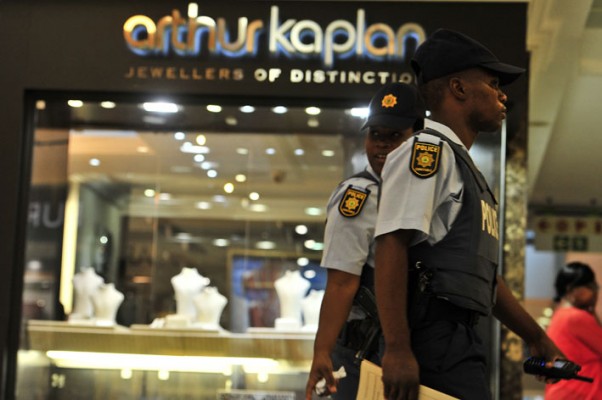
FILE PIC. Members of the police walk outside the jewellery store that was robbed on 14 November 2013 in Menlyn Park shopping centre. Picture: Christine Vermooten

A man was killed last week at Black Chain Shopping Centre in Soweto when five suspects stole a cash box.

On Monday evening, a cellphone store at the Glen shopping centre in Ormonde, Johannesburg, was robbed with the suspects fleeing with cellphones.

Increased Security

Mothiba said lax mall security made the robberies easier for criminals,  “some mall security is very relaxed. Some have CCTV camera’s that aren’t working or are of poor quality”.

Police are now offering a reward of R200 000 for people with information on those involved in mall robberies.

General Tebello Mosikili, deputy provincial commissioner for detective services. She revealed that police spend between R1 million and R1,5 million on rewards annually.

Police plan to work hand in hand with mall security,  management and private security companies in the coming weeks to access various malls’ security.

Mothiba said police have identified at least 12 malls that they say are “high risk”. There will be increased visibility at these malls but he did not want to scare people by identifying them.

Generations dispute far from over

NOTE: Article first appeared on The Citizen website on September 3, 2014.

There is no end in sight to the ongoing Generations drama as the popular soapie enters the fourth week of no filming.

MMSV Productions owner and Generations producer, Mfundi Vundla threw a spanner in the negotiation process with the 16 fired actors when he reportedly jetted off to Mackinac Island in Michigan, the United States of America over the weekend.

Vundla reportedly said he was going away to think of the new direction the show would take, adamant that he would not be taking back the 16 who “betrayed” him.

Seemingly following in Vundla’s footsteps, actor Thato Molamu, who plays Nicholas Nomvete has also taken steps to change his situation. He has landed a hosting job on SABC 2 show, What’s Behind The Wall? 

Sophie Ndaba during a press conference held by the Generations stars that were fired recently at the Market Theatre in Newtown, 26 August 2014. Picture: Neil McCartney

He was reportedly on leave like a pregnant Katlego Danke when he got fired.

The last move made in this standoff between the actors, their production company and the SABC came last week Thursday. The actors sent a letter to the SABC requesting a time and date to meet again to possibly start negotiations.

The actors legal representative, Desmond Brown said some of the other fired actors had also started looking for “other gigs” while waiting to solve their dispute.

Winnie Modise, Sophie Ndaba and Nambita Mpumlwana did just that when they attended the Women in Sport awards evening hosted by the department of sports and recreation last week.

Ministerial spokesperson, Anda Qhama Bici said the three “were invited as guests, they weren’t making an appearance”.

Last week the fired actors received partial salaries because they have not been at work since August 11. They are demanding a cut of the show’s royalties and three year contracts.

At the moment pre-recorded episodes of Generations are still being aired, but there are only two to possibly four weeks’ worth of episodes left that are ready to air.

Cops exploit law – Roux

 NOTE: Article first appeared in The Citizen newspaper on August 28, 2014. 

The country’s criminal justice system was being “exploited” by police inefficiency, Paralympian Oscar Pistorius’ lawyer Barry Roux said yesterday.

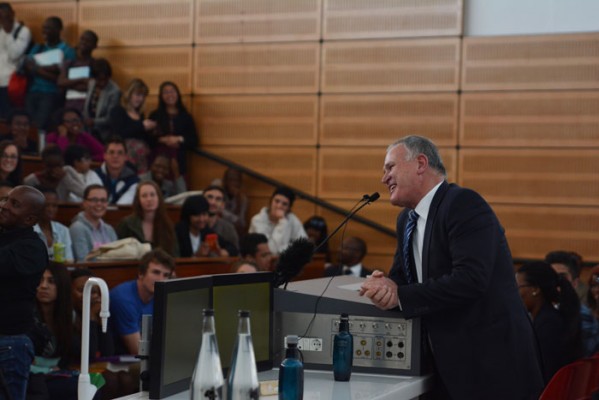
EXPERT ADVICE. Barry Roux speaks to law students at the University of the Witwatersrand yesterday, where he discussed the lack of efficacy of the SA criminal justice system. Picture: Valentina Nicol

“There’s tardiness; they don’t take the docket to court – sometimes they don’t take it because they sold it. Or sometimes they don’t take it because they have misfiled it,” said Roux. He blamed 80% of those in the police force, calling on them to “wake up”.

He also criticised some of the procedures in courts that led to delayed justice, saying “if justice is delayed long enough” people don’t show up any more or simply forget what happened.

He was speaking at a Wits University auditorium, filled to capacity with future lawyers, about the topic “Does our criminal justice system work as it should – from when a crime is committed through to the trial?”

Roux said the biggest problem in South Africa was that people who committed crimes did so knowing “there’s a fair chance they won’t get caught – or if arrested, won’t get tried”.

Roux, with 30 years’ experience behind him, was introduced as a “master cross-examiner”, something the entire country has had the opportunity of witnessing during the trial of Pistorius.

Roux became a celebrity overnight because of the case, with memes and a parody account to match on Twitter.

The room cracked up with laughter when Roux talked about witnesses who claimed they “don’t remember” events when testifying on the witness stand.

Roux added that testimonies based on what people said they saw could be unreliable because their versions would be reproductions of what happened based on their perception.

No work until demands met – Generations actors

NOTE: Article first appeared on The Citizen website on August 27, 2014. 

Sixteen actors from the cast of Generations came out strong on Tuesday afternoon, insisting they will not go to work until “their demands are met”.

At a media briefing held at the Market Theatre in Johannesburg, the 16 dismissed actors banded together to finally give their side of the story.

Nambitha Mpumlwana who acts as Mawande Memela gave a brief financial run down of what a “supposed R55 000″ salary would look like after deductions.

She said after tax, agent fees and retirement annuity payments the actors would get a little over R19 000 – with which they would have to “pay rent or a bond, a car payment” and more.

Sophie Ndaba during a press conference held by the Generations stars that were fired recently at the Market Theatre in Newtown, 26 August 2014. Picture: Neil McCartney

A meeting with SABC, production company MMSV and the minister of Arts and Culture, Nathi Mthethwa yesterday did not prove fruitful.

Patrick Shai – who acts as Patrick Tlaole – announced they were told further talks would only happen if the actors agreed to do so without their legal representatives. 

A week of mass strike action has seen 16 principal actors from Generations supported by the ANCYL and department of Arts and Culture.

Now Dr John Kani has asked the nation to support their cause.

A number of the actors who stepped up to the podium to address the media broke down in tears when speaking of their working conditions. Menzi Ngubane who acts as Sibusiso Dlomo came out as the person Mfundi Vundla had paid hospital fees for. 

https://www.youtube.com/watch?v=qY31Tt99mdc

Ngubane was hospitalised for kidney failure. He said he spent seven weeks at Helen Joseph public hospital and Vundla would not have him moved to a private hospital. After being discharged he paid R30 000 back to a friend for his medical fees.

“I was discharged on a Thursday and had to go back to work the following Monday. Sitting down on a chair between the six to 10 scenes we shot a day,” said an emotional Ngubane, who had others on stage in tears.

Pre-recorded episodes of the show are currently keeping the soapie on air but these recordings will only last for a few more weeks.

The direction of the show is unclear at the moment with Vundla alluding to “new talent” as a strategy that may be used to take the show forward should matters with the 16 not be resolved.

​To this Sophie Ndaba who acts as Queen Moraka said: “Artists looking to audition must first think about what we are trying to do here.” ​


Marshall arts

NOTE: Article first appeared in The Citizen newspaper on August 14, 2014. 

Sitting on a black leather couch in a tent on a farm in Limpopo, 42-year-old singer-songwriter Chan Marshall – also known as Cat Power – shared some intimate details of her life.

Marshall had just come off stage after her first appearance at Oppikoppi on Saturday, a performance on the Bruilof stage that saw fans shout words of encouragement when the sound equipment was not working properly.

Cat Power (Chan Marshall) on the Bruilof stage at Oppikoppi Odyssey on 09/08/2014
Cat Power (Chan Marshall) on the Bruilof stage at Oppikoppi Odyssey on 09/08/2014. Picture: Pheladi Sethusa

Between constantly apologising for the staccato nature of her performance, Marshall had to change the sound on the amplifier, sing into two microphones and figure out how to work a keyboard she had never played by herself – a visibly nerve-racking experience.

“I always have stage fright,” she says.

It’s a situation that’s not entirely foreign to Marshall, though in the past her erratic performances have been attributed to problems with alcohol and drugs. “People used to say ‘Oh, did you go see the train wreck?’” she says.

She does admit to having had a drug problem a while ago after her partner passed away.

“I chose it every day and I knew what I was doing every day. It wasn’t me being oblivious. I was riding that train because I couldn’t take the pain of losing the love of my life.”

Marshall wished the women in the audience a happy Women’s Day while on stage, and spoke about feminism afterwards.

“A lot of times women don’t have the simple, casual dignities that men have as their birthright,” she says.

“I’m called a feminist because I protect myself from someone else trying to get something from me,” she says.

Marshall’s latest album, Sun, was produced independently, using the singer’s life savings.

“I had to make a choice between what the label wanted me to do and what I knew I could do myself, and the album made the top 10,” she says.

She performed at the Baxter Concert Hall last week, a performance she had asked for in December when she came back after Nelson Mandela passed and she witnessed “social change” that inspired her.

Marshall intends to return to Cape Town next January to write about the experiences she has had in the city over the years.

Taegrin Morris laid to rest

NOTE: Article first appeared on The Citizen website on July 26, 2014. 

A funeral service fit for a hero was given to Taegrin Morris this morning at W. J Clement stadium in Reigar Park, Boksburg.

Teagrin Morris's (4) coffin at Reiger Park Stadium, Johannesburg, 26 July 2014, before it was laid to rest at Van Dyk Cemetries. Picture: Nigel Sibanda
Teagrin Morris’s (4) coffin at Reiger Park Stadium, Johannesburg, 26 July 2014, before it was laid to rest at Van Dyk Cemetries. Picture: Nigel Sibanda

The community gathered in their numbers to mourn the boy. Many wearing t-shirts with little Taegrin’s smiling face on the front of them, with the words “genoeg is genoeg” in red print.

Taegrin died after being dragged from a car for several kilometres when his mother’s car was hijacked last Saturday evening.

His tiny brown coffin was guarded by classmates from Geppetto Pre Primary school, who held lit candles in honour of him.

Gauteng Premier, David Makhura uttered the phrase “enough is enough” several times during his address.

“We’re deeply hurt by the manner in which the heartless killers took his life,” he said.

Makhura drew much cheer and applause when he promised the community that the criminals responsible would be found and driven out of the community.

He added that “coloured communities have been marginalised for too long,” saying a change in that paradigm was needed in Reiger Park.

Lizzie Phike – whose son was kidnapped last week when her husband was hijacked in Bronkhorstspruit – was in attendance to support the Morris family.

“They weren’t as lucky as me and I am to say sorry for that. I am hurt by what happened because the same thing could have happened to my boy,” said Phike.

In a final show of strength Taegrin’s mother, Chantel Morris decided to make the vote of thanks on behalf of her family. “If it were not for your prayers this week, we would not have made it,” she said.

Taegrin was laid to rest at the new cemeteries in Van Dyk Park in Boksburg. The entire service was paid for by provincial government.

Household transport costs too high

NOTE: Article first appeared in The Citizen newspaper on July 19, 2014. 

Even though government spends more than R5 billion a year subsidising public transport, 30% of all households use the bulk of their salaries on transport, according to Minister of Transport Dipuo Peters.

Peters said there was an urgent need to make transport accessible and affordable to vulnerable and marginalised groups who most need these services.

FILE PICTURE: Taxis use the Rea Vaya Lanes for parking to pick up passengers on Empire Road, Johannesburg, 13 October 2013. Picture: Tracy Lee Stark

“Today public transport costs and the distances involved prevent the poor from taking full advantage of opportunities offered by cities and such exclusion contributes to high unemployment rates,” she said.

Peters was speaking in Hatfield, Pretoria yesterday where the National Household Travel Survey of 2013 was announced.

The survey, which was compiled by Stats SA, looked at the patterns of transport and travel nationally using data collected from a sample of 51 341 participants over the past 10 years.

The survey found that the number of children who walk to school every day had increased from 4.8% to 5.7% and a further 6.6 million children walk as their first mode of transport.

Peters said this meant pupil transport was an urgent problem that needed to be addressed .

Children should not be walking or hitchhiking long distances when there was so much violence against children, the minister said.

Peters cited the Bus Rapid Transit system and the Gautrain as successful projects.

However, Peters added that the Gautrain buses were not being used as effectively as they could be.

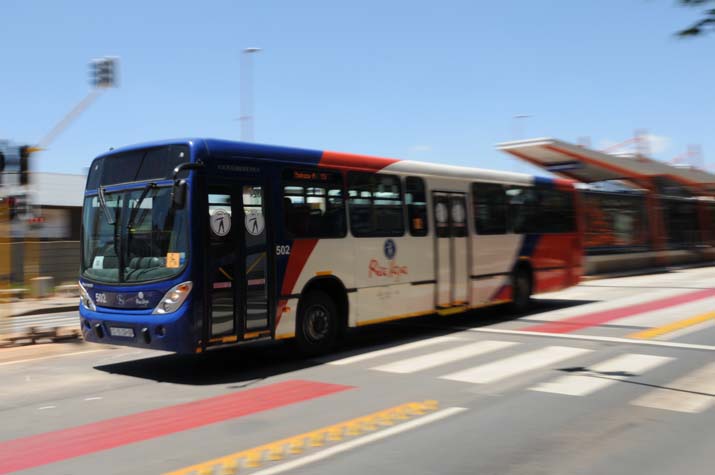
FILE PICTURE: A Rea Vaya bus passes its terminal. Picture: Alaister Russell.

“Gautrain buses are becoming wasteful expenditure.

“People use private transport to get to stations and cause congestion. We need to start using them.”

The most popular form of public transport to go to work was taxis, with private vehicles coming a close second.

Peters said the taxi industry provided 300 000 direct jobs and contributed R40 billion to the economy annually.

Statistician-general Pali Lehohla noted that while taxis were popular because of their speed and relatively low prices, “people are unhappy”.

He attributed some of the discontent to the issues of safety, comfort, unreliability and increased fares.

The good ol’ days of racing at Kyalami

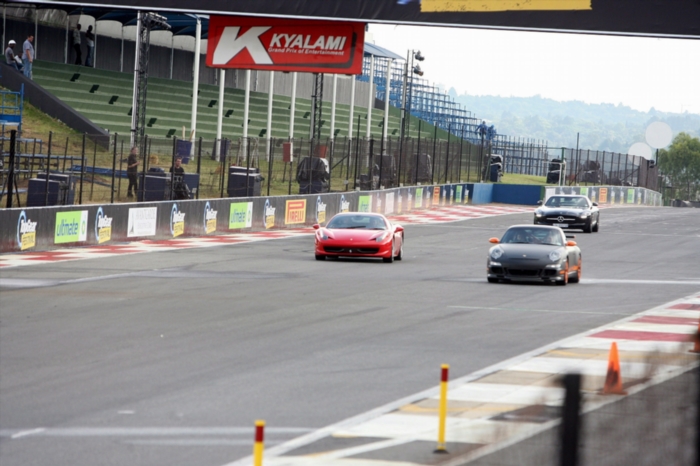
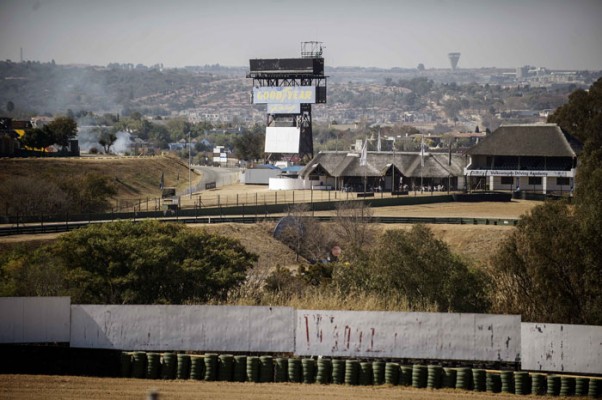
A general view of the Kyalami race track on July 23, 2014 a day before it will go up for auction in Johannesburg, South Africa. The circuit hosted its last international competition in May 2010 with the sixth race of the World Superbike Championship. AFP PHOTO/GIANLUIGI GUERCIA

NOTE: Article first appeared on The Citizen website on July 27, 2014. 

Back in the good old days, people overseas related to four things regarding South Africa: the Springboks, heart pioneer Chris Barnard, golfer Gary Player – and Kyalami.

An auction in Hyde Park, Johannesburg, yesterday saw the historic Kyalami race track sold to Porsche SA for a whopping R205 million.

Lead auctioneer Joff van Reenen took no longer than two minutes to wrap up the sale of the property to a telephonic bidder. Porsche SA CEO Toby Venter was in Cape Town when the sale was made.

Lance Chalwin-Milton, joint managing director at High Street Auctions, said because the buyers were in the motoring industry, the race track would remain as is, with “possible development around the track”.

This sale is the highest auctioned price paid for a single property in South Africa – the previous highest being R120 million, said Van Reenen.

Piece of history

The Kyalami circuit was built in 1961, on a piece of land chosen by the late rally driver Francis Tucker, “because nobody would ever think of building anything there”.

It was completed the same year and its first major race, the Rand Grand Prix, was won by Jim Clark in a Lotus Climax.

FILE PICTURE: The Kyalami Racetrack in Johannesburg. Photo by Gallo Images/Sowetan/Tshepo Kekana

Over the years, the circuit was widened, becoming a regular host of the F1 Grand Prix world championship.

It was revered as one of the fastest circuits in the world, with F1 cars reaching higher speeds than on tracks like Monza, Spa and Silverstone.

In 1988 it was cut in half and redesigned to its current shape.

Its last F1 took place in 1993, won by Alain Prost in a Williams Renault, leading home Ayrton Senna (McLaren) and Michael Schumacher (Benetton).

In between, the venue also hosted international sports car and truck races, superbike events and manifold rounds of SA championships for single seaters and saloon cars.

Its last major international event was the final round of the 2010 World Superbike championship.

By Andre de Kock and Pheladi Sethusa 

EFF feels legislature wrath

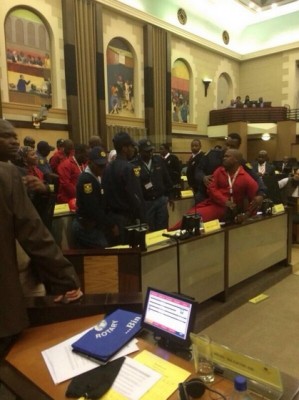
EFF MPs are removed by police from the Gauteng Provincial Legislature for wearing red overalls, 1 July 2014. Picture: @EconFreedomZA via Twitter

NOTE: Article first appeared in The Citizen newspaper on July 2, 2014. 

Two  EFF MPLs were injured yesterday after being thrown out of the Gauteng Provincial Legislature for wearing overalls.

Economic Freedom Fighters (EFF) spokesperson Omphile Maotwe who siad Benjamin Disolwane and Mgcini Faku were “manhandled” by security when they were being removed from the legislature.

“Our chief whip (Faku) had his arm broken during the forced removal,” said Maotwe.

The members and six others were asked to leave the legislature when they came dressed in their red overalls.

The Speaker of the provincial legislature, Ntombi Megkwe said EFF MPLs were asked to “excuse themselves” after she explained to them that they were dressed inappropriately.

When they refused to do so, she invoked Legislatures Act 4 of 2004 which gives her the power to evict members of the legislature from the proceedings.

Parliamentary spokesperson Luzuko Jacobs said the National Assembly operated separately from any other Legislature.

The National Assembly therefore allowed the EFF to attend the proceedings wearing their overalls.

Party insignia and symbols are allowed in Parliament, he said.

“Every legislature is empowered by law to impose its own rules,” said Jacobs.

Deputy provincial speaker Uhuru Moiloa said they could “not allow anarchy to happen” by allowing any members to behave inappropriately by not sticking to the Guateng legislature’s rules and regulations.

“The gimmicks of the EFF are an attempt to divert the legislature…Today was a waste of the nation’s time,” he said.

Mekgwe shared her thoughts on the EFF’s red overalls, saying “this is not a garden”.

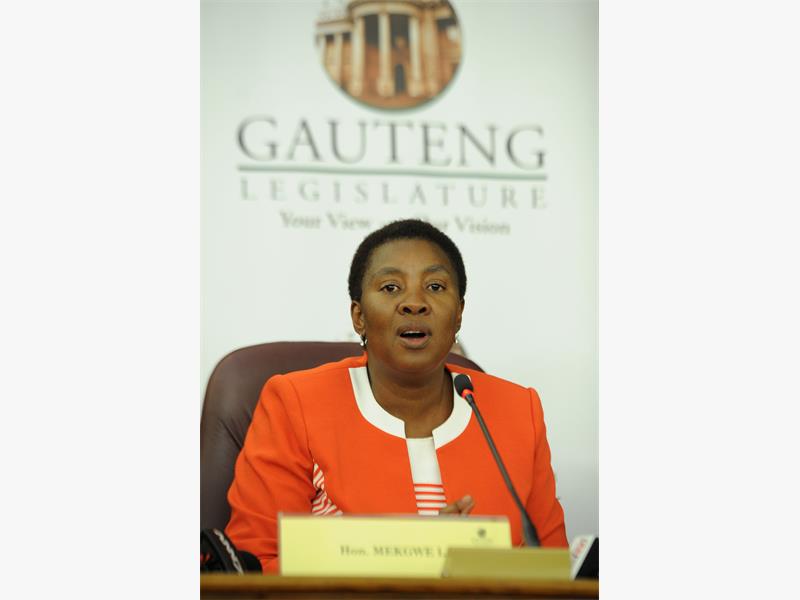
Speaker in the Gauteng Legislature Ntombi Mekgwe addresses a press briefing on the removal of EFF members from the legislature during a sitting in Johannesburg.

She added that the legislature was a noble house and as such required appropriate dress code.

She said “minimal force” had to be used to remove the two members.

Mekgwe claimed she did not see any excessive force being used, she only saw one of the EFF members hitting a female security personnel with a “hot klap” during their eviction. She said this violence would be dealt with.

Mekgwe said during the two week orientation that all MPLs were taken through earlier this year, the standing rules outlined matters of conduct and participation in the legislature and the EFF members had failed to abide by those rules.

The EFF MPLs have not been expelled from legislature, however Mekgwe said the members would just need to dress appropriately to be allowed back into legislature in the coming days.

Maotwe said the provincial branch of the EFF would be consulting “head office and will take the matter from there”.

Late yesterday Mekgwe said the integrity commissioner would investigate the incident.

“We are referring the matter to the integrity commission. They will advise us on how to move forward,” Mekgwe said.

Gauteng police spokesperson Leutenant-Colonel Lungelo Dlamini said he would respond to the allegations only once a case had been opened.


The man behind the youth

NOTE: This article first appeared in The Citizen newspaper on June 21, 2014.

It has been a little over a year since Yershen Pillay became the executive chairperson of the National Youth Development Agency (NYDA) – and while he has been in charge, the agency has reached over two million young people through its programmes.

“Matching our reach with the 7.5 million youth who needs support in the country makes what we’ve done seem small,” said Pillay. “The R400 million we get in funding cannot reach them all, but we set realistic targets to reach as many as we can.”

The 30-year-old comes from a political background, having majored in politics and economics at the University of Cape Town in 2002.

In his first year he joined the ANC Youth League and “from there things just took off”. Pillay’s involvement in politics at the university made him realise the need for transformation at the institution – and the need for social justice in the country.

He started out as the deputy chairperson of the Young Communist League’s UCT branch and is now the national chairperson of the league. “I believe in the principles and values of communism. More than anything, socialism is about building a more humane society, bridging gaps and providing access to basic services for all.”

He described his work with the youth as a natural and “subconscious” continuation of the youth movement that started during apartheid. “We don’t always take note of it, but our youth is very vocal.” He cited a 2013 Youth Development Index Survey which found South African youths are the fourth-most politically active in the world.

The NYDA is a “political institution; a part of the presidency and constituted by Parliament,” explained Pillay. Because of this, it does not surprise him that he is at the helm.

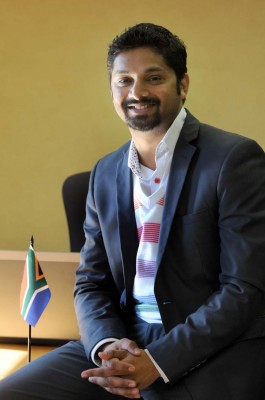
National Youth Development Agency Chairperson Yershen Pillay speaks to The Citizen in Midrand, Johannesburg, 19 June 2014. Picture: Nigel Sibanda

He became chair of the NYDA in March last year – and said firmly the agency has been on an upward trajectory over the past year. “The agency repositioned itself to become more capable, credible and visible.

“We have to be honest with ourselves: we were not the most efficient or effective organisation. But that era is gone. We’re now spending money on young people and not on ourselves,” said an earnest Pillay of the agency’s checkered past.

“Young people are hungry for jobs and hungry for opportunities, irrespective of who brings that to them. The nature and character of the youth movement is changing to become more in line with socio-economic needs. This reflects the maturity of our democracy.”

The NYDA runs a number of programmes which focus on skills development and entrepreneurial support.

Speaking on youth unemployment, he said: “There are jobs – but we don’t have the skills to match” – and he uses the example of Korean welders contracted to work at Eskom’s Medupi power plant because there is a shortage of those skills in this country. This is one of the reasons the agency places an emphasis on career guidance programmes.

But Pillay said 20 years of democracy is too short a time to expect everything to have changed in South Africa. “It is not enough time to eradicate over 300 years of colonialism and subjugation.”

However, the youth needs to channel the anger and frustration they have and focus on solutions to their problems instead, he said.

His job has changed him – and the success stories of some of the NYDA beneficiaries keep him going.

“We are changing lives, one life at a time. There is reward in service,” he said as a smile spread across his face.