The Newsroom 8.6

(My random numbering now coincides with the month we are in so hey, so why not stay with the 8 point something’s?)

I woke up five minutes before my alarm was due to ring last week Monday. I couldn’t keep in the excitement any longer I guess. I swung my wee legs out of the warm cocoon that was my bed and braved the cold all smiles to get ready for my week ahead as editor.

I welcomed everyone on the 19th voyage upon the Vuvuzela express at news conference later that morning and just like that the week was in full swing.

We had our first feature workshop on that same day, an hour or two dedicated to criting our feature writing work. I loved this process because gaps I might have never even seen where pointed out and will make for a better feature when I re-write it.

In an odd turn of events we had to distribute the newspaper on Monday because of the public holiday the Friday before. 1pm came, 3pm strolled in and by 5pm we still had no Vuvuzela’s to hand out. Distribution then turned into a two day mission but it got done in the end.

We had two other guest speakers on Tuesday morning, meaning our Vuvu day only started at about lunch time. There we were typing and chatting away in the newsroom, when someone ran in telling us that there was a fire on the 15th floor.

 SMOKEY: Elevator technician trying to extinguish the flames in Lift B on 14 floor, University Corner. Photo: Pheladi Sethusa
SMOKEY: Elevator technician trying to extinguish the flames in Lift B on 14 floor, University Corner. Photo: Pheladi Sethusa

Being the people we are, two of us grabbed our cameras, the other a notebook and off we ran to try and get the story. By the 14th floor we were inhaling the smoke fumes but still trying to get closer for that perfect shot. We were chased away but came back about 5 minutes later. Found out that there had been a fire in one of the lifts. You know, the one we take every day. The evacuation made for an unproductive afternoon.

Wednesday morning saw 7 team vuvu members  heading to Orange Farm to help out with something the Wits Justice Project was doing in the area. That plus two people off sick, made for a very empty newsroom. Copy came in very slowly, causing a few tempers to flare.

As usual I dibsed the photo spread page, the lack of fast copy got us the Oppi page we wanted *boogies*
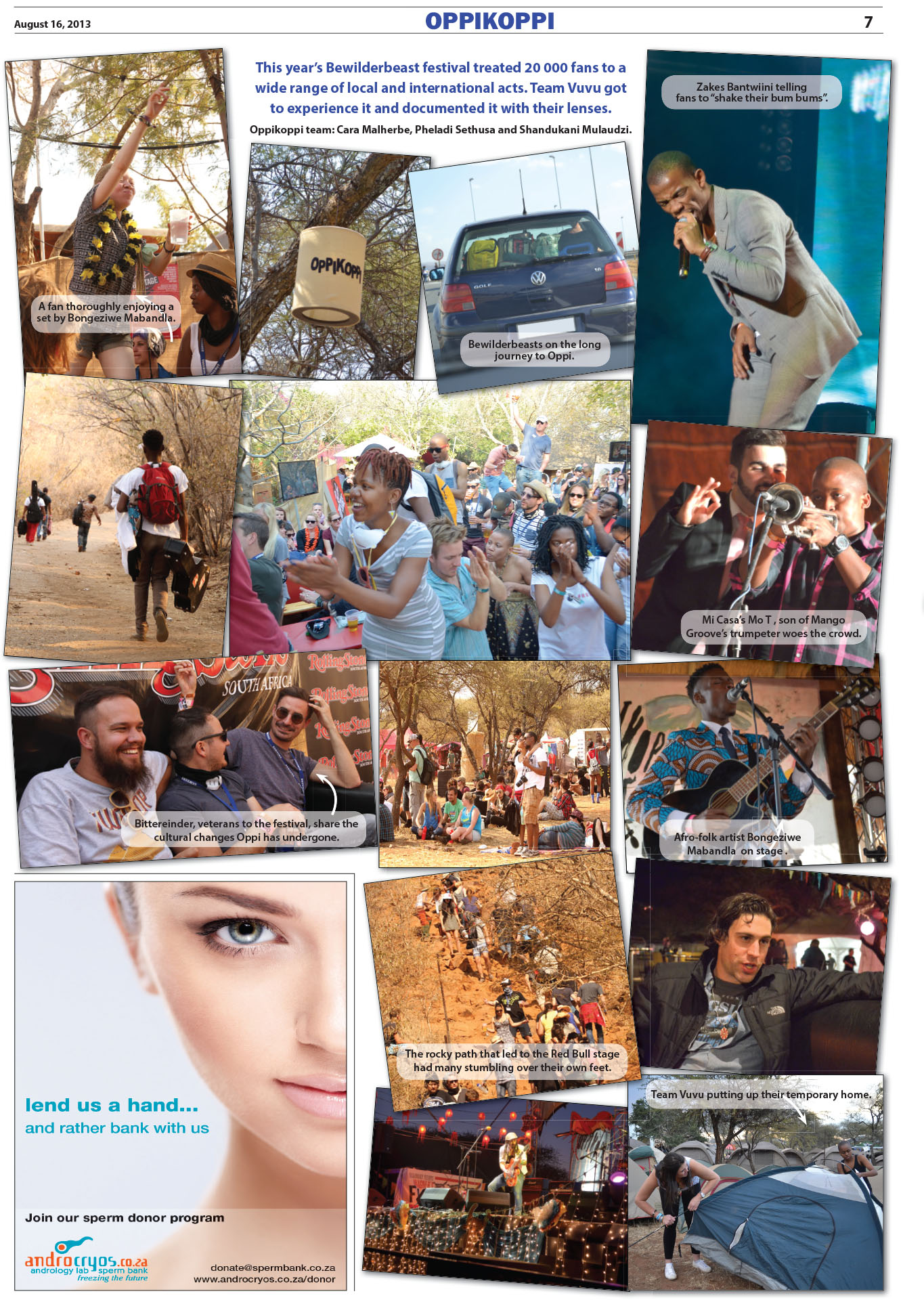
Oppikoppi photo spread

Production did not run smoothly at all but as usual it all came together in the end. The following morning we had a bit of a design workshop with Irwin Manoim, I found it quite helpful.

Later that night I went off to the “We are going to kill each other today: The Marikana Story” – a collection of photographs and stories by a group of journalists and photographers. The event was held at the Old Fort at Constitutional Hill, on the exact date that marked a year since the massacre happened. It was quite overwhelming seeing the photographs taken at Marikana while standing in what used to be an apartheid jail. Death was all around us.

On Saturday a bunch of us headed off to Soccer City for the Nelson Mandela sports day. We got complimentary tickets to watch Bafana Bafana take on Burkina Faso and later the Springboks take on the Argentinians. Both of our teams won leading to much merriment in the stands.

I wanted to leave early to see my parents off but decided to stay on to watch some of the concert. I did for a while but the cold got to me and managed to catch a ride back to campus. I was really excited to go home to a hot meal and my warm bed.

Those thoughts all came to an abrupt halt when a black figure decided to break my car window and steal my backpack. The backpack with my DSLR camera and wallet in it. In the moment I froze and couldn’t accelerate like my mind was telling me to.

Long story short, I picked up new bank cards and got a new window fitted today. What a way to end what was an amazing week.

EDITORIAL: The real is on the rise

Last week we took a decision to change the colour of our masthead to a bright pink. This was done to celebrate Women’s Day. Just a small token on our part.

The public holiday was spent with some people attending high teas, getting breakfast in bed or perhaps a bunch of flowers. For Team Vuvu, however, it was spent in the Limpopo heat, deciding which band to listen to.

Oppi

The only signs of Women’s Day at this year’s Oppikoppi Bewilderbeast festival were in the random shout-outs by artists and bands on stage.

Maybe the signs were all around us: women were drinking their livers dead, laden with dirt and screaming their lungs out, with no visible judgment against them. We saw a beautiful lesbian couple wrapped in each other’s arms, listening to Bongeziwe Mabandla’s set on the top of a hill.

They epitomised some of the freedom women enjoy today.

The Wits Vuvuzela team exercised their own kind of freedom. We pitched our tent where we wanted, showered when we could and got to pick and choose from some of the best performers the festival has ever seen.

The experience was soured by a minor racist incident, something we had been waiting for. What we hadn’t anticipated was that it would come from a tiny hipster-looking girl. Looks can be deceiving like that.

Oppikoppi has a reputation for being an Afrikaans rock festival, but that in no way describes the entire festival. The programme was defined by diversity.

We watched a set done entirely in isiXhosa, swayed to the “indie-bele” sounds of ShortStraw and danced like we were on Jika Majika when Mi Casa and Zakes Bantwini performed. We didn’t even get to attend half the things on offer.

We left on a high note, having experienced something new and survived the wilderness.

Back to reality

On the way back, reality sent shivers down our spines when we drove past a sign marking the entrance to Marikana. Today marks the one-year anniversary of what is now called theMarikana massacre, in which 34 families lost fathers, brothers, sons and husbands.

Under apartheid, we had a police force that we believe was put in place to drive fear into the hearts of people. Post-1994, we expected a police service that would serve and protect its people. On August 16 2012, we started to question whether we don’t perhaps have a police force instead of a police service.

Driving past the place where so much blood was split and where people are still being killed brought us back to the “real” South Africa. The one beyond the 20 000 people choosing to slum it for the experience, and pretending to get along despite the drunken slurs.

How much for a dozen?

CHEATED: Khanyi Ntsenge spoke candidly about her experience. Photo: Pheladi Sethusa

From being on the pill for a month, to injecting herself every day, twice a day for two weeks, to having one simple operation that she couldn’t even recall, one Witsie has given the gift of life to a couple.

The money

Young women can make up to R6 000 by giving their eggs to couples who cannot produce on their own, said Colleen Oates from Baby Miracles.

“Some couples pay the clinic up to R60 000 for treatments and they have a 55% success rate,” said Oates. Clinics make 90% more than the girls donating their eggs. “We have a set fee of R6 000, but I feel it needs to go up a bit,” said Oates. She said people commit themselves and make others’ dreams come true, which should count for something.

The Injections

Girls who donate have to inject hormones that make their eggs larger, which can and often does change their hormones before and after treatment. Some feel bloated, sluggish and get enlarged breasts as side effects, like Witsie Khanyi Ntsenge.

Ntsenge, a 22-year-old honours student in demography, said the money was never a motivating factor for her to donate. She just knew she had nothing to lose. “After the operation I ate and signed an indemnity form to get my R6 000. But I hardly remember that because I was so drugged up,” said Ntsenge.

Dr Trudy Smith, a gynaecologist at Charlotte Maxeke Academic Hospital, said the consequences of donating don’t really make sense to her. “You are on drugs that make you fat and moody,” said Smith.

She said donations made should not be motivated by money but rather out of genuine care for helping a childless person, preferably one you are close to. Ntsenge said she wouldn’t have donated if she hadn’t passed the psychological test that checks if you are able to deal with donating your eggs.

No satisfaction

Ntsenge did however feel “cheated” when the process ended in no more than 30 minutes. “You don’t get to see the fruits of your labour – it’s horrible,” said Ntsenge. She said she was shocked by how quickly things came to end once her eggs were harvested. She said if you wanted to be a martyr for donating, you would be left disappointed.

Ntsenge met a woman who was there to receive an egg on the day Ntsenge donated.

Hearing the woman’s story helped lessen Ntsenge’s anti-climatic feelings. But she still stressed that “logic is not the same as emotions” so it took time to accept what had happened. Oates said women who donate are not taking any eggs away from their “store”. The hormones they inject only help women to produce more eggs than they normally would.

“It wouldn’t be legal if we were making people infertile,” said Oates. Oates said that to be eligible to donate girls need to be between the ages of 21 and 32. She said 21 years of age is old enough to make such a decision and 32 is the cut-off age because “the quality of eggs deteriorate when women reach about 35 years of age”.

Big five in the posts

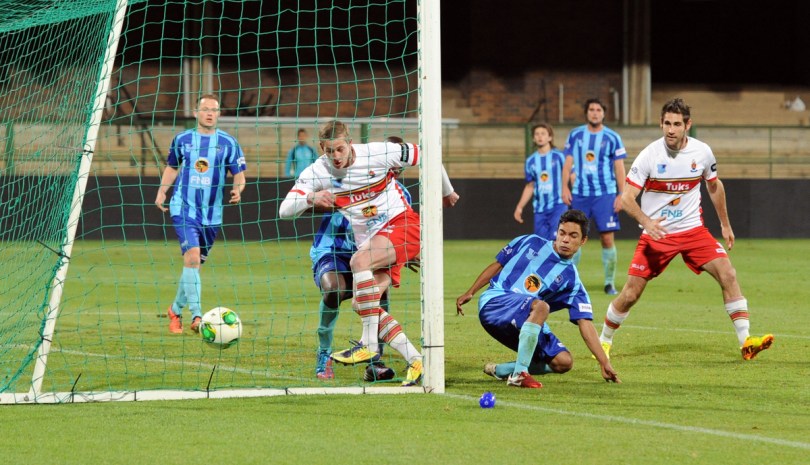
Keegan Boulle, Tuks reserve, scores the fourth goal in their game against UCT on Monday. Photo: Provided

A RESOUNDING defeat on Monday night took away any hopes the University of Cape Town (UCT) team had of moving up from the bottom of the Varsity Football log.

Goal after goal, it became obvious that the University of Pretoria (Tuks) players were not going to let the UCT team squeeze in one redeeming goal for themselves.

The team from the coast were at a slight disadvantage as Tuks played on their home ground, the Ama Tuks Stadium, with their fans cheering them on every step of the way.

UCT goalkeeper Bevan Adonis showed some promise in the fifth minute of the game with an impressive diving save. The opening goal by Tuks’s Desmond Khuzwayo was the catalyst that kept Adonis diving and sliding in the goalposts.

Man of the match Dean Wilkinson then scored a clean shot on goal, which made it obvious that Tuks were out to win.

Mbongeni Masilela put his boot in with a third goal.

Keegan Boulle, a reserve put on late in the game, added two more goals to Tuks’s tally. By the 90th minute the outwitted UCT team had watched five flashes of fire go off, signalling five goals at their goalposts.

Back home

More disappointment took place on the field closer to home at Milpark Stadium. Wits were beaten by the visiting team from the University of the Western Cape (UWC).

The 2-0 victory pushed the Wits team down to seventh spot on the log after the gains they had made last week with their 1-0 win over UCT.

Best reads

This week’s paper came out a little later than usual, hence that lead to delayed reading of all the copy.

But now that I have, here are this week’s best reads:

  • Cheers, I’ll drink to that by Liesl Frankson. This was one of the first ‘fun’ front page stories we have had all year. It was a refreshing read and I’m glad it got to go on the front page. Also love the picture that went with it.
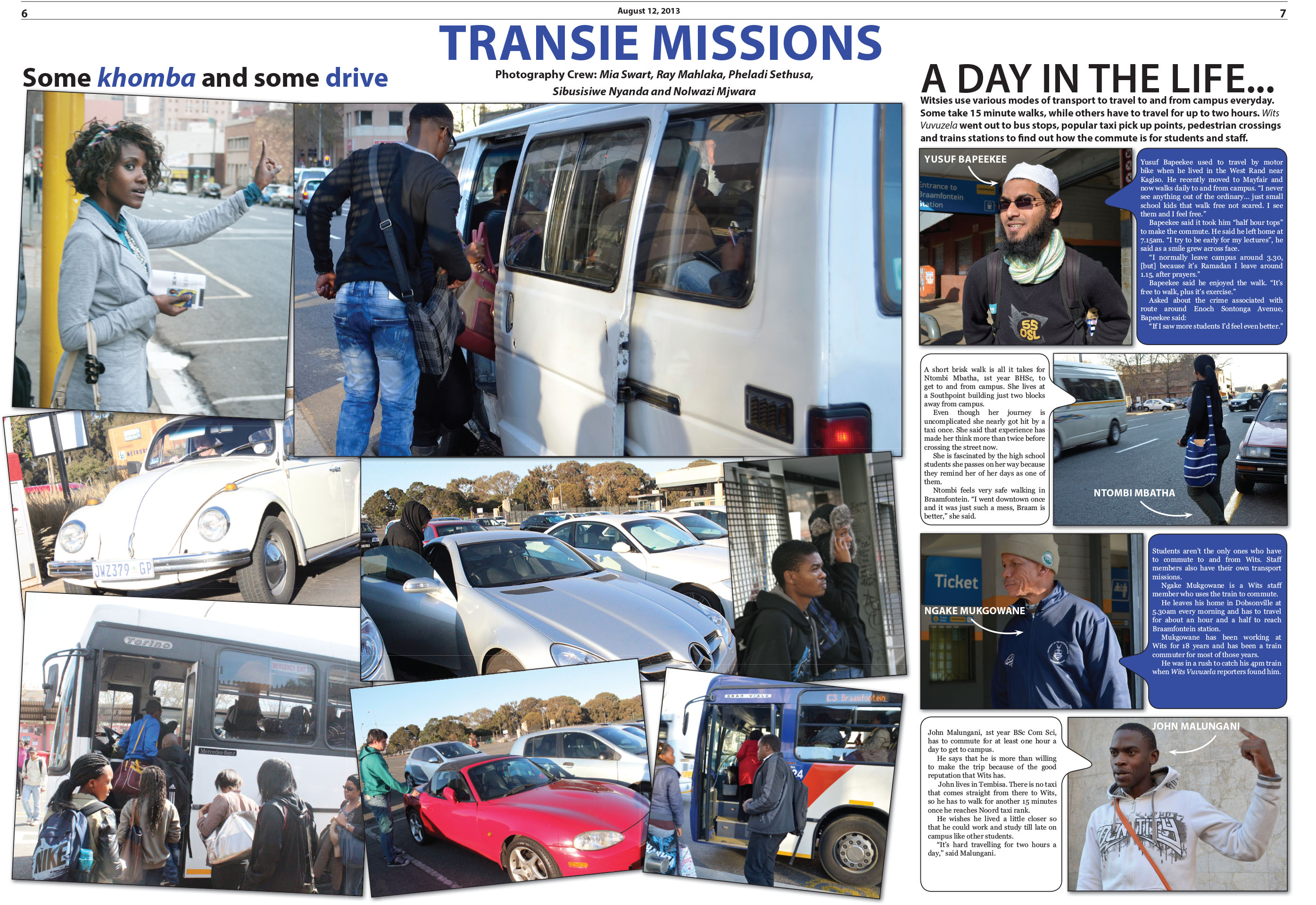
  • Transie Missions by many (lol). This was a collaborative photo spread done by a few of us in the newsroom. I love any and all photo spreads that go in the paper because I’m down with photos like that :p
  • The power of woman by Prelene Singh. This piece spoke to the other side of the Vavi scandal. Probably an unpopular debate to have with it being women’s month but an important one I rate.
  • Supreme Failure by Emelia Mostai and Shandukani Mulaudzi. This breaking news story looks at a high school across the road from us; parents and students complained about the lack of teaching staff for grade 12 learners. The publishing of the story has led to the Department of Education promising to visit the school tomorrow to assess the situation. The efforts of great journalism.

The Newsroom 8.5

The past seven days have been jam packed and felt more like two weeks than one.

Our lives got much busier when we were told that we had to put another 12 page paper together.  Personally I was excited, a 12 pager gives us more room to ‘play’ and deliver more copy. Were it not for the 12 pager we would not have been able to do this photo spread:

PAGE 6&7 (Aug 12).indd

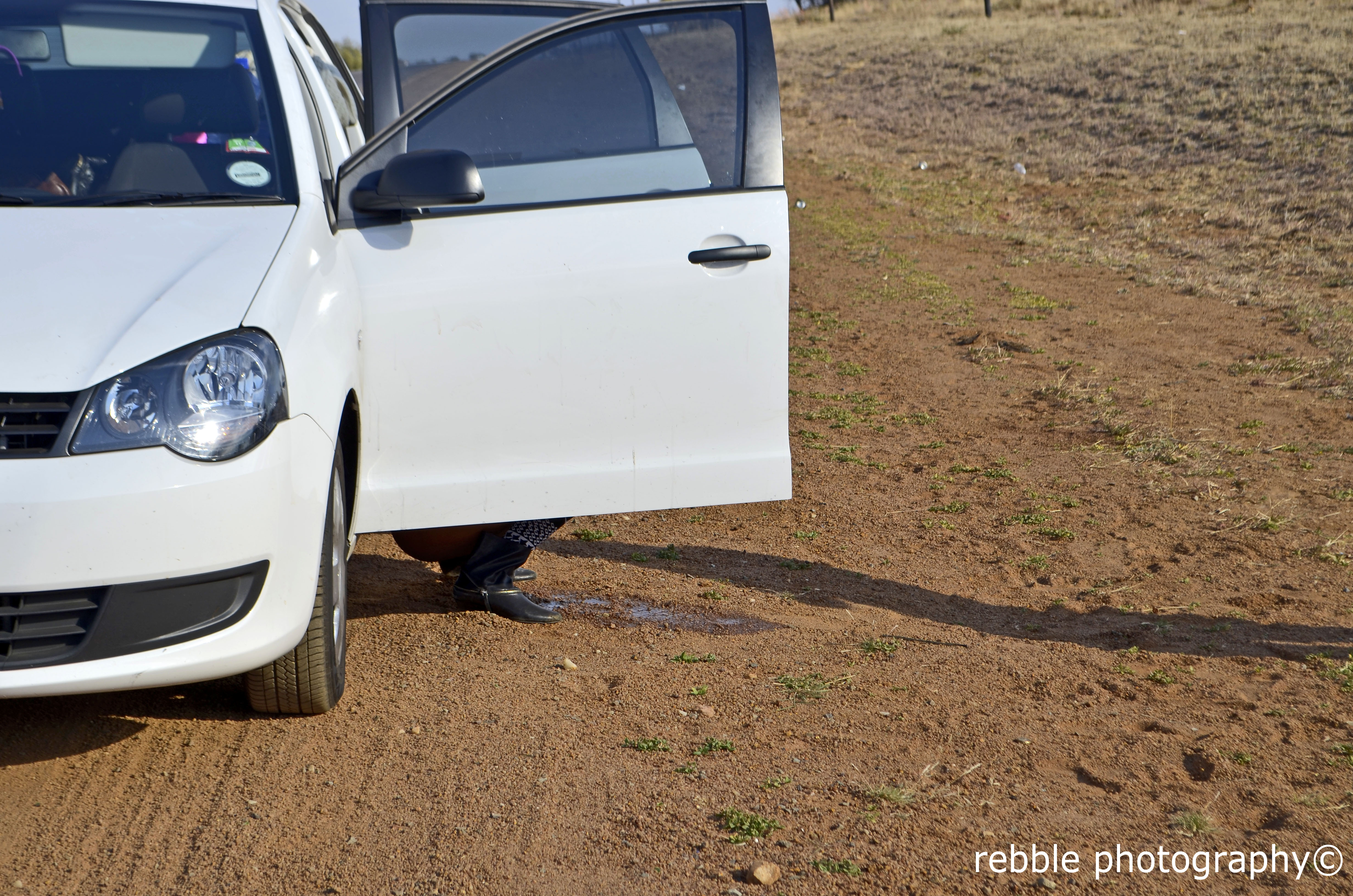
PORTABLE LOO: With no garages in sight, my car doors were turned into a restroom. Photo: Pheladi Sethusa

OPPIKOPPI: Made it out alive

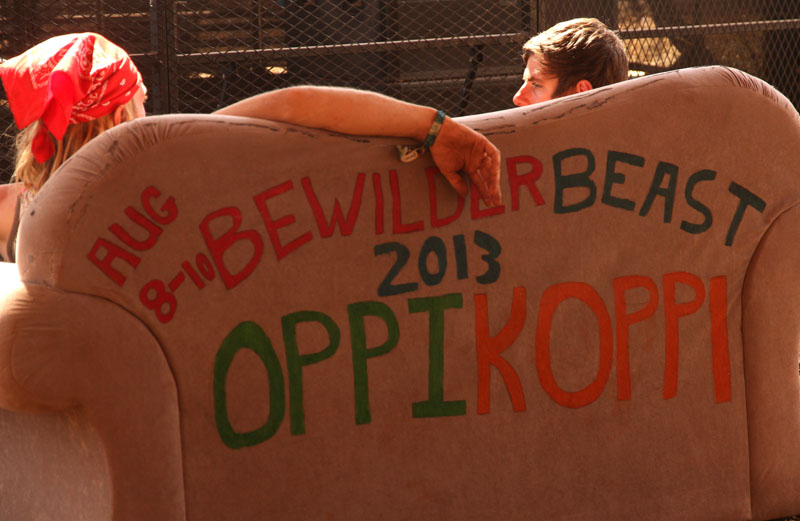
CHILL OUT: Oppi goers taking time out on a couch on the last day of the festival. Photo: Pheladi Sethua

By Pheladi Sethusa and Shandukani Mulaudzi

While one of us sits with a heaving chest and the cough of death, the other found the cure to her cold at Oppokoppi.

The last day of the festival could not have come soon enough, we were exhausted, dirty, dehydrated and hungry – but we had survived.

#InDustWeTrust

We had the time of our lives and we screamed our lungs out for our favourite acts as the dust made its way into our ill-prepared bodies.

The first thing to remember for next year is that Oppi is also known as “Dustville”. Have something to cover your nasal cavities and mouth. It will save you rocky tastes in your mouth and sandy lip gloss.

Now that we are no longer Oppi virgins, we thought it fitting to provide a few survival tips for those looking to go next year.

BAKING: Fans braving the sun to watch a show. Photo: Pheladi Sethusa

 How to make it out alive

We had bought enough food and booze to sustain our little bodies for three days in the bush. But on the last day, dry hot dogs with no margarine on the bun or sauce on the Vienna no longer seemed appealing.

The second thing to remember, the festival runs on a cashless system. Those who wish to buy food and drink on the farm have to buy pre-loaded debit cards.

We opted not to do this, knowing it would lead to frivolous spending. We had packed enough food but the smell of boerie rolls and hot chips accosted our senses by the last day, we were dying for a hot meal.

We were also so dehydrated at that point that seeing people’s water bottles had us salivating. Pack enough water, even enough is not quite enough – pack more than enough just to be safe.

In addition energy drinks would have been beneficial. We could barely keep our eyes open by the third day, this would have been cured by a kick and wings from one of those special drinks.

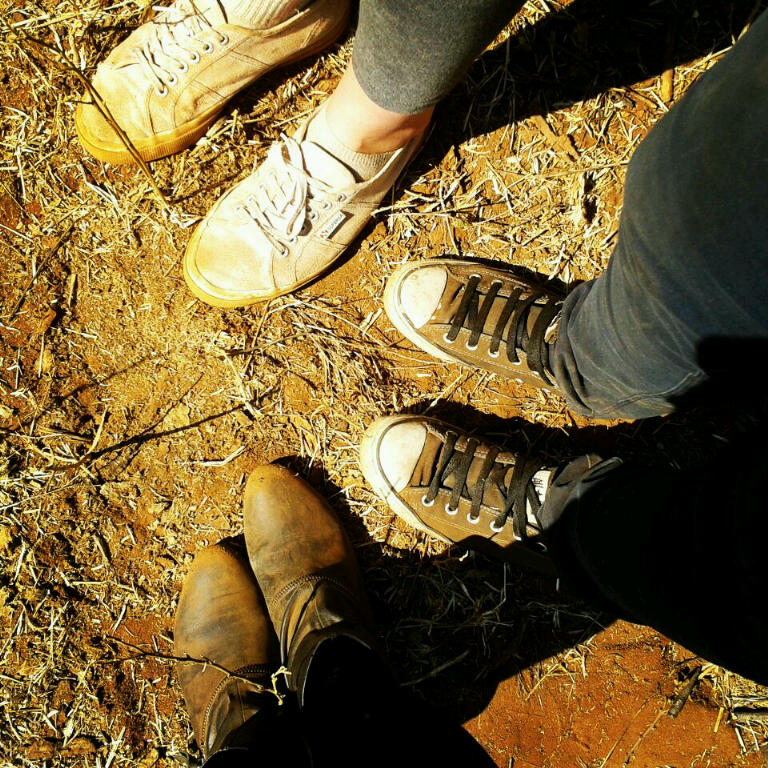
RUINED: Three pairs of shoes that will probably never be clean again. Photo: Shandukani Mulaudzi

 Clothes and shoes

We were so scared of the cold that we only packed winter clothes, big mistake. During the daytime we wanted to cry as the hot Limpopo sun scorched our fully covered bodies. It was as if the devil himself was sitting on the hill by the stages letting his heat out on everybody.

Do not bring shoes you hope to wear ever again and only bring one pair. You are going to be filthy by the end of the festival, so rather go with the general theme and take scrappy clothing.

On your way in and out

On the way to and from Oppi try to choose the route with the toll gates, it will set you back R21 but big, open, un-potholed roads await you. This way you won’t have to battle it out with trucks that are struggling to stay on the narrow, windy lanes.

Most importantly though we had a of fun, we enjoyed all that Oppi had to offer and made memories to last a lifetime.

A little wisdom and stuff

Toby Shapshak. Photo: conferences.ted.com

I knew Toby Shapshak was awesome when he said he might not make it to our guest lecture because he would be “fucking dead” after having to walk up ten flights of stairs to our department.

He was our guest speaker last week, tasked with teaching us a thing or two about technology feature writing. As the editor of Stuff  magazine, he was the perfect man for the job.

Toby mostly weaved in-between technology talk and general journalism talk. A lot of what he had to say has been replaying in my mind over the week.  So I figured it would be a good idea to jot some of his most memorable quotes down.

Toby’s pearls of wisdom

  • On agenda’s and agenda setting: “Everyone’s got bullshit filters”
  • On dodge politicians: “If you lie, cheat or steal – you will get caught. It’s just a matter of when”
  • On life: “You get to a point in life where you deserve aircon, power steering and electric windows” :’D
  • On readers/audience: “Never underestimate the stupidity of your reader”
  • On being a journalist: “It’s like a calling, you don’t do it for the money,” he went on to stress that we do what we do because we are compelled to; “The great thing about being a journalist is that you don’t have to be an expert, you can just call one”.
  • On practicing writing: “You must practice, practice, practice. In the East repetition leads to enlightenment”.
  • On people as “brands”: “I hate that so much. Just be good at your job” 
  • On magazine covers: “I would drop that [white] woman in a heartbeat if I could”