NOTE: Article first appeared in The Citizen newspaper on September 20, 2014.
The contingency plan the SABC had in place to deal with the lack of new Generations episodes will come into full effect on October 1 – when the show is pulled off the air.
Kaizer Kganyago, SABC spokesperson, confirmed last night the show would no longer be on air as of next month.
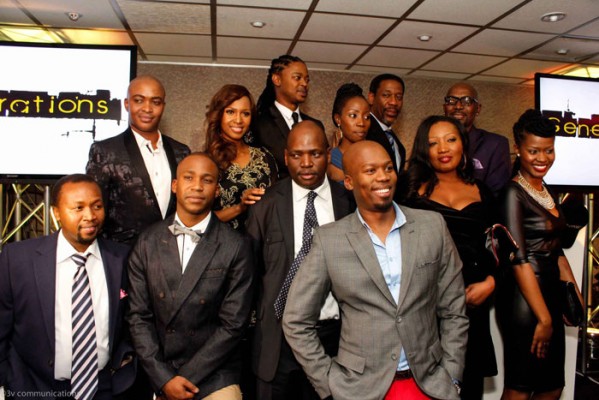
The cast of Generations. Image courtesy of Facebook.com/GenerationsTVShow
“There are no new episodes … Generations will be off air until December,” he revealed.
Filming of the popular soap stopped on August 11 when 16 principal actors started withholding their services. The 16 demanded higher salaries and a cut of R500 million in royalties.
Kganyago said SABC1 would juggle their scheduling to move SePedi drama Skeem Saam from its 6.30pm timeslot to the coveted 8pm slotGenerations used to occupy.
Earlier this week, Generations producer and creator Mfundi Vundla said he was rewriting the entire show, presumably without the 16 actors, who were axed after being given an ultimatum to return to work or be fired a week after their strike action started.
On Tuesday morning Gauteng police made their first arrests in connection to a recent spate of mall robberies in the province.
Five men aged between 24 and 44 years of age were nabbed in a police raid in Brixton and Doornfontien at 4am this morning, . The five are suspected to be involved in at least two mall robberies in the province.
Provincial commissioner of police, Lesetja Mothiba told a media briefing in Parktown that so far 11 mall robberies have rocked Gauteng.
On 22 August, a gang of robbers struck an iStore at Centurion Mall, escaping with over R1 million worth of goods. A week before a group of men robbed an iStore at Cresta shopping mall , taking an undisclosed number of cellphones and iPads. As they fled the scene they started shooting randomly, injuring an elderly man in the parking lot.
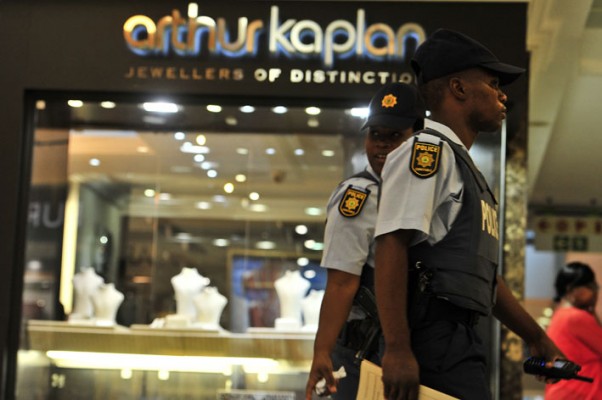
FILE PIC. Members of the police walk outside the jewellery store that was robbed on 14 November 2013 in Menlyn Park shopping centre. Picture: Christine Vermooten
A man was killed last week at Black Chain Shopping Centre in Soweto when five suspects stole a cash box.
On Monday evening, a cellphone store at the Glen shopping centre in Ormonde, Johannesburg, was robbed with the suspects fleeing with cellphones.
Increased Security
Mothiba said lax mall security made the robberies easier for criminals, “some mall security is very relaxed. Some have CCTV camera’s that aren’t working or are of poor quality”.
Police are now offering a reward of R200 000 for people with information on those involved in mall robberies.
General Tebello Mosikili, deputy provincial commissioner for detective services. She revealed that police spend between R1 million and R1,5 million on rewards annually.
Police plan to work hand in hand with mall security, management and private security companies in the coming weeks to access various malls’ security.
Mothiba said police have identified at least 12 malls that they say are “high risk”. There will be increased visibility at these malls but he did not want to scare people by identifying them.
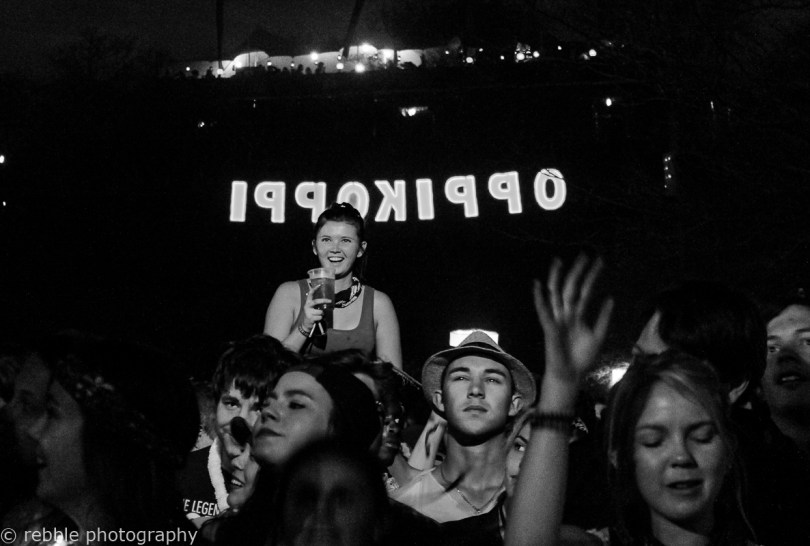
This year I headed out to camp out in the bush again for the 20th year of Oppikoppi. These are some of the photos I managed to take at some of the performances I watched.
In light of the blackface incident involving two Tuks students last week, I asked TO Molefe a few quick questions on the matter. He indulged me with the most enlightened and thorough answers anyone has ever left in my inbox. As such, I figured I should share and let his words hit you with some knowledge.
Image: Twitter
Q:The two girls have now been expelled from res but not the University. Do you think this action was appropriate? If so why and if not why?
A: I think the university needs to follow due process as such decisions on individual students’ fates can’t and shouldn’t be arbitrated based on public sentiment. Hopefully UP already has in place an objective process to assess infringements of its student code of conduct and to assign the appropriate sanction(s). I personally do not believe punitive measures like expulsion are necessarily the best way to handle things, but like I said, the university should be following whatever pre-established protocols it has in place to deal with these situations.
The unfortunate thing about UP’s response to this incident is, as I said in my column, is that it singles out the two young women’s behaviour as an exception. They should definitely be held individually accountable, but the university, too, needs to examine its role in allowing such behaviours and attitudes to go unchecked among its student body. The university needs to use this example as the motivation for a compulsory education programme that uses South African history to teach about prejudice and oppression, particularly racism, sexism and sexuality. Right now they seem to be panicking because of all the public scrutiny directed towards them.
Q: In your opinion what was problematic about the girls dress?
A: For me it is pretty clear cut: If, when you think “domestic worker”, the first thing that comes to mind is black women with big lips and behinds, you’re playing on a racist stereotype of black women’s bodies and a long-held belief in that such bodies are the ones best suited to domesticity. Your intention is to poke fun at black women. It is racist and sexist. It is what queer scholar Moya Bailey calls misogynoir (anti-black misogyny).
Q: Some have said they the girls were having harmless fun, much like Leon Schuster. What are your thoughts on that line of thinking?
A: I think anybody who thinks the girls were having harmless fun has chosen not to think at all about what their performance tells us about the cycle of servitude millions of black women are trapped in, many from birth. The two young UP students probably grew up in a house where a black woman cleaned up after them and took care of them. That woman has daughters of her own who, without some kind of intervention, will probably have few work options other than to become domestic workers, too. And chances are that woman’s mother was also a domestic worker. We’ve seen this in the mines where low-paying manual-labour jobs ensnare generations of a single family.
Yet, these two girls, when asked to imagine a domestic worker, a figure that has been a feature of their whole lives, they imagined a stereotype instead of a real human being. These two girls will probably go on to hire domestic workers for their own homes when they grow up. And I imagine it will be difficult for them to find it within themselves to pay their domestic workers a living wage if they can’t imagine them as human beings in all their complexity.
What I’m saying is that the dehumanising way in which the girls imagined domestic workers is how many people imagine domestic workers. And that dehumanising imagining is directly linked to why many domestic workers in this country have never been and are not paid a living wage.
Q: Black comedians make it a point to talk about race in their sets – do you think the way they do it is helpful or harmful?
A: I think it’s great when black comedians talk about race. I think it’s great when anybody talks about it. However, for something that is so divisive, race is generally poorly understood. And even those of us who read, write and think about it every day have to keep our wits about us when dealing with it out of a fear that we might be reinforcing misconceptions about race and promoting racial prejudice. I’m not sure how many South African comedians and satirists exercise this kind of thoughtfulness or care.
This might be a bit utilitarian of me, but the objective of talking about race should be to expose its contradictions, and to subvert people’s deeply held misconception that race has no social significance. (I think most of us by now are comfortable with the idea that race isn’t a biological reality in the sense that it was once believed to determine traits such as intelligence, athletic ability and creativity.) Comedy is a great way to challenge people’s ideas about themselves and the world, but only if the comedian has stopped to think about whether they are repeating and reinforcing stereotypes, or subverting it. There are too many comedians doing the former because it’s easy and because the latter is hard and takes tremendous skill to pull off while being funny.
Q: Lastly, have you seen the trailer for Dear White People set for release later this year. Do you think the South African audience has the capacity to engage with the movie meaningfully?
A: I have seen the trailer. I am ambivalent about the movie’s relevance in South Africa. I mean, we will definitely see parallels to situations here. But, although related, the contexts and histories are a little different. Because of that, I am hesitant to adopt American (or other) anti-racist narratives wholesale. We have a rich history of anti-racist thought and activism here that I think we’re making too little use of. So, I don’t think there is a need here for black people to address white people as this movie does. Instead, I think what this country needs right now is a “Dear Black People” written, directed and produced through an immersion in black consciousness thought.
A funeral service fit for a hero was given to Taegrin Morris this morning at W. J Clement stadium in Reigar Park, Boksburg.
Teagrin Morris’s (4) coffin at Reiger Park Stadium, Johannesburg, 26 July 2014, before it was laid to rest at Van Dyk Cemetries. Picture: Nigel Sibanda
The community gathered in their numbers to mourn the boy. Many wearing t-shirts with little Taegrin’s smiling face on the front of them, with the words “genoeg is genoeg” in red print.
Taegrin died after being dragged from a car for several kilometres when his mother’s car was hijacked last Saturday evening.
His tiny brown coffin was guarded by classmates from Geppetto Pre Primary school, who held lit candles in honour of him.
Gauteng Premier, David Makhura uttered the phrase “enough is enough” several times during his address.
“We’re deeply hurt by the manner in which the heartless killers took his life,” he said.
Makhura drew much cheer and applause when he promised the community that the criminals responsible would be found and driven out of the community.
He added that “coloured communities have been marginalised for too long,” saying a change in that paradigm was needed in Reiger Park.
Lizzie Phike – whose son was kidnapped last week when her husband was hijacked in Bronkhorstspruit – was in attendance to support the Morris family.
“They weren’t as lucky as me and I am to say sorry for that. I am hurt by what happened because the same thing could have happened to my boy,” said Phike.
In a final show of strength Taegrin’s mother, Chantel Morris decided to make the vote of thanks on behalf of her family. “If it were not for your prayers this week, we would not have made it,” she said.
Taegrin was laid to rest at the new cemeteries in Van Dyk Park in Boksburg. The entire service was paid for by provincial government.
NOTE: Article first appeared in The Citizen newspaper on July 19, 2014.
Even though government spends more than R5 billion a year subsidising public transport, 30% of all households use the bulk of their salaries on transport, according to Minister of Transport Dipuo Peters.
Peters said there was an urgent need to make transport accessible and affordable to vulnerable and marginalised groups who most need these services.
FILE PICTURE: Taxis use the Rea Vaya Lanes for parking to pick up passengers on Empire Road, Johannesburg, 13 October 2013. Picture: Tracy Lee Stark
“Today public transport costs and the distances involved prevent the poor from taking full advantage of opportunities offered by cities and such exclusion contributes to high unemployment rates,” she said.
Peters was speaking in Hatfield, Pretoria yesterday where the National Household Travel Survey of 2013 was announced.
The survey, which was compiled by Stats SA, looked at the patterns of transport and travel nationally using data collected from a sample of 51 341 participants over the past 10 years.
The survey found that the number of children who walk to school every day had increased from 4.8% to 5.7% and a further 6.6 million children walk as their first mode of transport.
Peters said this meant pupil transport was an urgent problem that needed to be addressed .
Children should not be walking or hitchhiking long distances when there was so much violence against children, the minister said.
Peters cited the Bus Rapid Transit system and the Gautrain as successful projects.
However, Peters added that the Gautrain buses were not being used as effectively as they could be.
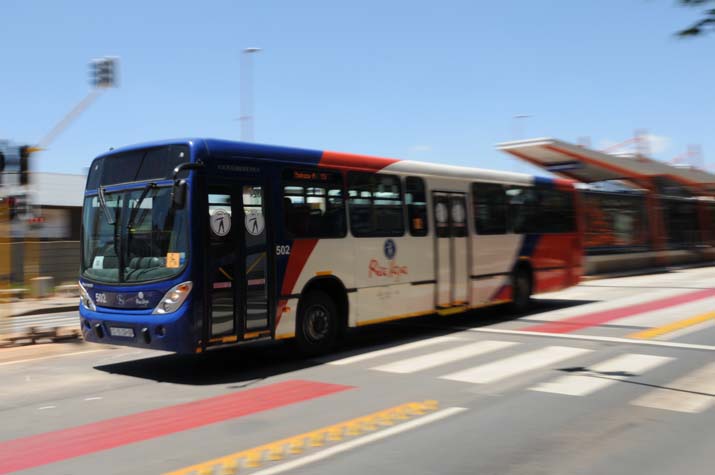
FILE PICTURE: A Rea Vaya bus passes its terminal. Picture: Alaister Russell.
“Gautrain buses are becoming wasteful expenditure.
“People use private transport to get to stations and cause congestion. We need to start using them.”
The most popular form of public transport to go to work was taxis, with private vehicles coming a close second.
Peters said the taxi industry provided 300 000 direct jobs and contributed R40 billion to the economy annually.
Statistician-general Pali Lehohla noted that while taxis were popular because of their speed and relatively low prices, “people are unhappy”.
He attributed some of the discontent to the issues of safety, comfort, unreliability and increased fares.
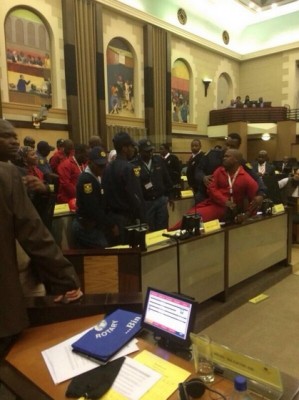
EFF MPs are removed by police from the Gauteng Provincial Legislature for wearing red overalls, 1 July 2014. Picture: @EconFreedomZA via Twitter
NOTE: Article first appeared in The Citizen newspaper on July 2, 2014.
Two EFF MPLs were injured yesterday after being thrown out of the Gauteng Provincial Legislature for wearing overalls.
Economic Freedom Fighters (EFF) spokesperson Omphile Maotwe who siad Benjamin Disolwane and Mgcini Faku were “manhandled” by security when they were being removed from the legislature.
“Our chief whip (Faku) had his arm broken during the forced removal,” said Maotwe.
The members and six others were asked to leave the legislature when they came dressed in their red overalls.
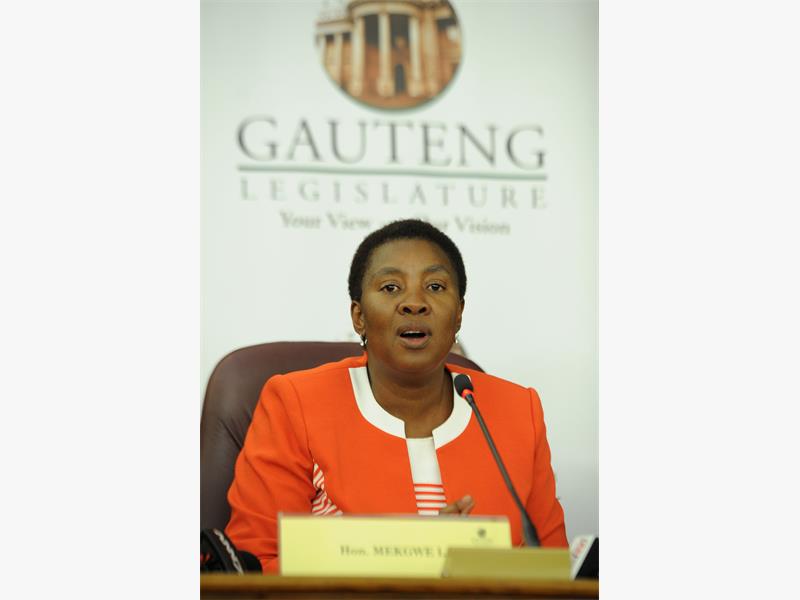
The Speaker of the provincial legislature, Ntombi Megkwe said EFF MPLs were asked to “excuse themselves” after she explained to them that they were dressed inappropriately.
When they refused to do so, she invoked Legislatures Act 4 of 2004 which gives her the power to evict members of the legislature from the proceedings.
Parliamentary spokesperson Luzuko Jacobs said the National Assembly operated separately from any other Legislature.
The National Assembly therefore allowed the EFF to attend the proceedings wearing their overalls.
Party insignia and symbols are allowed in Parliament, he said.
“Every legislature is empowered by law to impose its own rules,” said Jacobs.
Deputy provincial speaker Uhuru Moiloa said they could “not allow anarchy to happen” by allowing any members to behave inappropriately by not sticking to the Guateng legislature’s rules and regulations.
“The gimmicks of the EFF are an attempt to divert the legislature…Today was a waste of the nation’s time,” he said.
Mekgwe shared her thoughts on the EFF’s red overalls, saying “this is not a garden”.
Speaker in the Gauteng Legislature Ntombi Mekgwe addresses a press briefing on the removal of EFF members from the legislature during a sitting in Johannesburg.
She added that the legislature was a noble house and as such required appropriate dress code.
She said “minimal force” had to be used to remove the two members.
Mekgwe claimed she did not see any excessive force being used, she only saw one of the EFF members hitting a female security personnel with a “hot klap” during their eviction. She said this violence would be dealt with.
Mekgwe said during the two week orientation that all MPLs were taken through earlier this year, the standing rules outlined matters of conduct and participation in the legislature and the EFF members had failed to abide by those rules.
The EFF MPLs have not been expelled from legislature, however Mekgwe said the members would just need to dress appropriately to be allowed back into legislature in the coming days.
Maotwe said the provincial branch of the EFF would be consulting “head office and will take the matter from there”.
Late yesterday Mekgwe said the integrity commissioner would investigate the incident.
“We are referring the matter to the integrity commission. They will advise us on how to move forward,” Mekgwe said.
Gauteng police spokesperson Leutenant-Colonel Lungelo Dlamini said he would respond to the allegations only once a case had been opened.
NOTE: This article first appeared in The Citizen newspaper on June 21, 2014.
It has been a little over a year since Yershen Pillay became the executive chairperson of the National Youth Development Agency (NYDA) – and while he has been in charge, the agency has reached over two million young people through its programmes.
“Matching our reach with the 7.5 million youth who needs support in the country makes what we’ve done seem small,” said Pillay. “The R400 million we get in funding cannot reach them all, but we set realistic targets to reach as many as we can.”
The 30-year-old comes from a political background, having majored in politics and economics at the University of Cape Town in 2002.
In his first year he joined the ANC Youth League and “from there things just took off”. Pillay’s involvement in politics at the university made him realise the need for transformation at the institution – and the need for social justice in the country.
He started out as the deputy chairperson of the Young Communist League’s UCT branch and is now the national chairperson of the league. “I believe in the principles and values of communism. More than anything, socialism is about building a more humane society, bridging gaps and providing access to basic services for all.”
He described his work with the youth as a natural and “subconscious” continuation of the youth movement that started during apartheid. “We don’t always take note of it, but our youth is very vocal.” He cited a 2013 Youth Development Index Survey which found South African youths are the fourth-most politically active in the world.
The NYDA is a “political institution; a part of the presidency and constituted by Parliament,” explained Pillay. Because of this, it does not surprise him that he is at the helm.
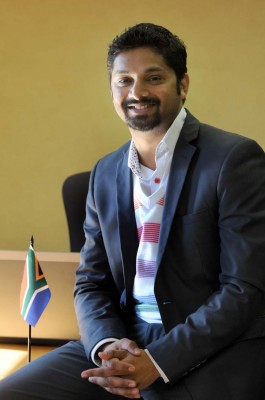
National Youth Development Agency Chairperson Yershen Pillay speaks to The Citizen in Midrand, Johannesburg, 19 June 2014. Picture: Nigel Sibanda
He became chair of the NYDA in March last year – and said firmly the agency has been on an upward trajectory over the past year. “The agency repositioned itself to become more capable, credible and visible.
“We have to be honest with ourselves: we were not the most efficient or effective organisation. But that era is gone. We’re now spending money on young people and not on ourselves,” said an earnest Pillay of the agency’s checkered past.
“Young people are hungry for jobs and hungry for opportunities, irrespective of who brings that to them. The nature and character of the youth movement is changing to become more in line with socio-economic needs. This reflects the maturity of our democracy.”
The NYDA runs a number of programmes which focus on skills development and entrepreneurial support.
Speaking on youth unemployment, he said: “There are jobs – but we don’t have the skills to match” – and he uses the example of Korean welders contracted to work at Eskom’s Medupi power plant because there is a shortage of those skills in this country. This is one of the reasons the agency places an emphasis on career guidance programmes.
But Pillay said 20 years of democracy is too short a time to expect everything to have changed in South Africa. “It is not enough time to eradicate over 300 years of colonialism and subjugation.”
However, the youth needs to channel the anger and frustration they have and focus on solutions to their problems instead, he said.
His job has changed him – and the success stories of some of the NYDA beneficiaries keep him going.
“We are changing lives, one life at a time. There is reward in service,” he said as a smile spread across his face.
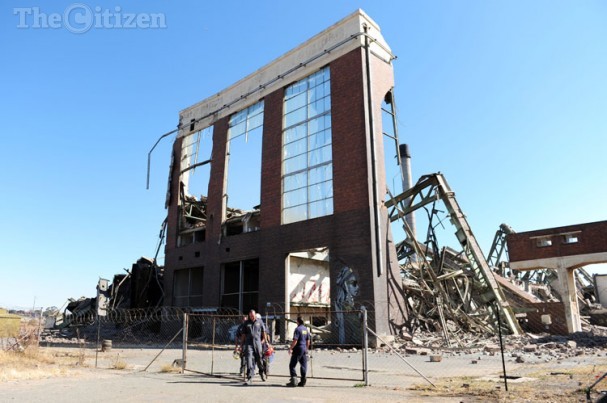
Rescue workers stand in front of the collapsed power park building, Soweto, 26 June 2014. The building collapsed yesterday morning. Picture: Tracy Lee Stark
NOTE: This article first appeared in The Citizen newspaper on June 26, 2014.
A body was recovered and five injured men suspected of stripping metal and cables from a decommissioned power station, in Orlando, Soweto, were last night rescued several hours after they had been trapped when the building collapsed on them.
“The men sustained head and body injuries, but they were stable,” said Johannesburg Emergency Management Services (EMS) spokesperson Nana Radebe. She said the body of the unidentified man was recovered late last night.
Police suspect that the men were trying to strip the dilapidated building of metal fittings and cables when the building caved in and trapped them under rubble.
“These guys came in the middle of the night, it’s obvious that they were stealing,” said Kay Makhubela from the South African Police Service.
However, last night after the rescue no arrests were made, instead the five men were taken to Chris Hani Baragwanath hospital for treatment.
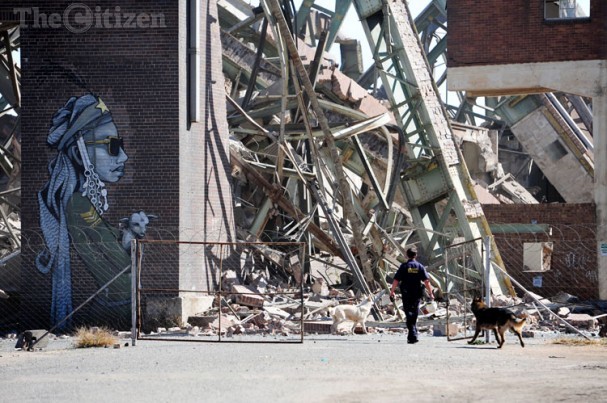
Rescue workers take sniffer dogs into the collapsed power park building, Soweto, 25 June 2014. The building collapsed early this morning after suspected metal thieves were in the building possibly causing the collapse and trapping 4 of them. Picture: Tracy Lee Stark
Orlando resident Maria Matsinhe recalled how her husband telephoned her in the early hours yesterday to alert her of his ordeal.
Matsinhe said her husband Simon Pacul told her that there had been an accident involving himself, her brother and her nephew.
“I don’t know what they were doing there or how they got there, my husband was meant to be going back to work in Rustenburg,” said a visibly distraught Matsinhe.
Her husband is a miner and was supposed to return to work on the platinum belt, where the devastating five month strike finally ended this week.
The decommissioned power station at Power Park in Orlando, which was commissioned at the end of the Second World War and served Johannesburg for more than 50 years, collapsed at around 4am yesterday morning.
Monwabisi Tyani, who lives just behind the building, said: “I heard a sound like a bomb at about half past four.”
EMS spokesperson Radebe said Pacul, who was injured, called them for help.
Rescue workers in front of the collapsed power park building, Soweto, 26 June 2014. The building collapsed yesterday morning. Picture: Tracy Lee Stark
“We received a call at about 7am and when we got here we found him,” said Radebe.
Radebe said Pacul was taken to Chris Hani Baragwanath Hospital for treatment. He suffered injuries to his legs, arms and hands.
“He is in a serious but stable condition,” Radebe said.
She suggested that the alleged theft of metal and cable could have caused the old building to collapse.
“Maybe they removed small quantities over time, which weakened the building,” said Radebe.
Soweto police spokesperson warrant officer Kay Makhubela said investigations to find out what the rescued men were doing at the building were in progress.
“We must find the owner of the building to see if he gave these people permission to be here,” said Makhubela.
NOTE: Article first appeared in The Citizen newspaper June 14, 2014.
The traditional initiation season started yesterday and many young boys are heading to initiation schools countrywide to take part in this cultural rite of passage during their winter holiday.
In an effort to curb the deaths that result from circumcisions done at some of these schools, R180 million has been set aside by the Department of Health to assist initiation schools. Minister of Health Aaron Motsoaledi said every province will be given R20 million. This money can be used to hire help or buy necessary aids at initiation schools.
Some of the problem areas identified include the Eastern Cape, Limpopo and Mpumalanga, where some illegal schools are in operation. Motsoaledi said the problem in the Eastern Cape was “complex” because people are allowed to open up initiation schools without the consent of their traditional leader. This is why parents need to ensure the school they take their child to is legal – and report illegal schools.
Health Minister Dr Aaron Motsoaledi addresses a joint media briefing held in Pretoria on the initiation cultural practices. (Photo: GCIS)
“We can’t let these thugs kill our children,” said Motsoaledi.
Obed Bapela, deputy minister of traditional affairs said a “zero tolerance” stance would be taken on “bogus operators” of illegal initiation schools. “The loss of life that occurred over the years prompted government and the traditional leadership to embark on a drive to restore the integrity and dignity of the practice.”
Bapela gave an example of the 32 deaths last year in Mpumalanga, saying the Hawks were investigating the matter.
Motsoaledi said while some traditional leaders may be resistant to help, they need to understand that “things have changed”. Diseases such as diabetes have become more prevalent and require initiation schools to take more precautions.
The money provided is part of R385 million set aside by the department for the medical male circumcision programme, which will provide free circumcisions. The department will provide further support through assisting with health screening, providing medicines and technical help. Motsoaledi said health screening was vital in preventing deaths. “We need to pick up prior medical conditions” to avoid the inevitable.








 Write. Snap. Click.