Wrote something earlier today for Wits Vuvuzela in an effort to cover Nelson Mandela’s funeral, here it is:
Tag: South Africa
Ducking and diving to get the story
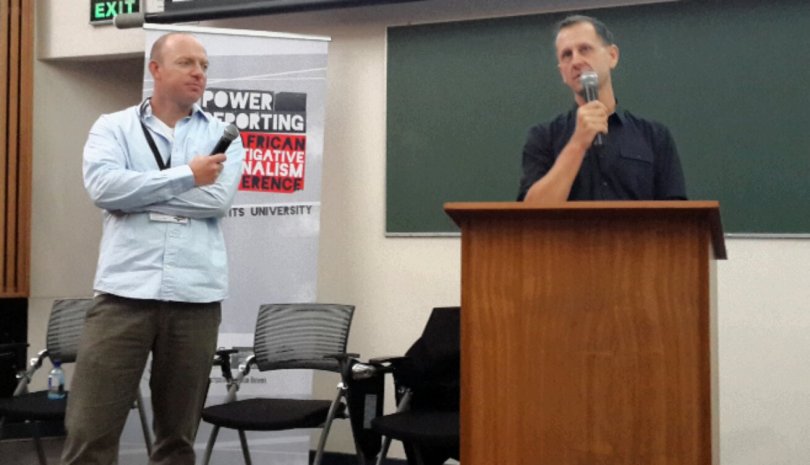
Reporting in war zones of conflict areas can be dangerous for any investigative journalist or photo journalist. Stephen Hofstatter and James Oatway presented ways to stay safe and navigate such areas in ways that will help to get the story a journalist is looking for and stay alive at the same time.

Hofstatter and Oatway have worked together in the Democratic Republic of Congo and in the Central African Republic (CAR) on stories that have seen the two dodging bombs and confronted by armed rebels. Their presentation on Covering Resource Conflict in Africa started off with Hofstatter outlining the essential and practical considerations they had taken when they went into conflict areas. He said that in conflict areas it’s difficult to sift between fact and fiction because of the amount of propaganda punted by opposing sides. A lot of wire services fall prey to misinformation because they rely on once source in many cases, added Hofstatter.
The pair used their stories to highlight some of the do’s and don’ts involved in covering conflict areas:

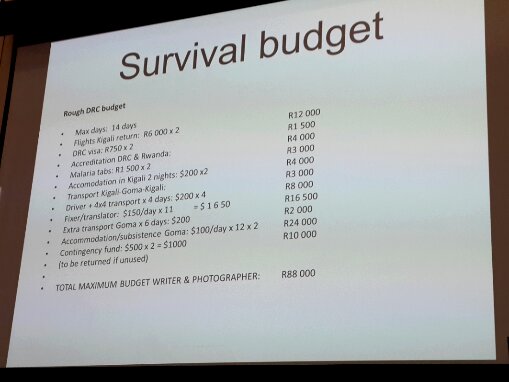
• Budget: The most essential things on the budget include money for a fixer, a driver and accommodation. Hofstatter said that they used up to $250 a day on a trip. Oatway added that while some news agencies had big enough budgets to include security, this presents a challenge when trying to get close to sources and getting a more in-depth story.
• The right fixer: A dependable and professional fixer is essential to survival in conflict areas said Oatway. Fixers are people who can put you in touch with military commanders and bureaucrats because they have nurtured relationships with these people. Fixers can help in attaining exclusive footage because they can navigate around difficult situations and people. · Background: “It’s difficult to get information when you get there,” this is why journalists need to do all their homework beforehand said Hofstatter. A lot of senior officials and business officials from other African countries live in South Africa, they can be very useful sources.
• Angles: While it is important to present a South African angle when reporting, it is equally important to avoid being insular by ignoring international angles. Hofstatter used an anecdote of their experience with rebel commanders in the CAR to illustrate this. “We didn’t just cover the conflict there (in CAR)…We had to show what kind of regime our government was propping up,” said Hofstatter.
• Ethical considerations: In such volatile areas, one can witness grave human rights abuses. The pair tried where they could to make ethical and morally sound decisions where both information and images were concerned. Oatway vividly recalled a situation where they pleaded with rebels to release a prisoner they had in their custody after he had taken the shots he needed but added, “I have no idea what happened to him after we left.”
• Balanced reporting under fire: Again Hofstatter stressed the importance of avoiding falling for propaganda. “Where you can highlight unverified information and highlight where you got that information.” Images and information with grey areas can create false negative narratives.
• Safety first: Oatway said that even though he itched for “iconic photos” when there is a lot of action happening, he sometimes has to ignore scratching that itch by staying away from extremely risky situations. Hofstatter went on to list things to do in the face of gunfire or hand grenades going off, “make yourself as small as possible and lie on your back,” he said.
In-depth wrap up [1/4]
This past week has been one of the most challenging of the whole year. On Monday morning we officially started working on our in-depth research projects.
Up until that point we had only been told how intense it would be and how difficult it may be to connect with sources. It took no more than a full day for us to realise this ourselves. Day after day, colleague after colleague would walk into the newsroom at the end of the day with nothing but defeat written all over their faces.
Our biggest challenge was definitely the language barrier we bumped into in almost 80% of our encounters with people from the Chinese community. There were some particular instances that stuck out that I talked about earlier in the week. Which is why it was so interesting to find out about a partnership with the Chinese Police Forum (CPF) in Cyrildene and the South African Police Service (SAPS) in the area. They are working together to combat the language barrier so that the police in that area can do their jobS as effectively as possible.
The video above was taken at a Mandarin lesson held at the CPF offices on Thursday morning. In attendance are members of the local SAPS. These lessons take place weekly. It was interesting to me because one has come to expect foreigners to adapt to local ways of doing things when they migrate to a particular place. In this instance things are happening vice versa. The locals are finding ways to adapt to a foreign language to help migrants in that area.
While I understand that being a foreigner in any country is challenging, we have all stumbled upon one recurring theme within the Chinese community. I use the word community loosely here because the five or so examples I’m drawing from are by no means representative of the community at large. A lot of the English speaking people we encountered described the Chinese community, especially those living in Cyrildene as being very insular. To me the example above is evidence of that.
So our challenge this week was two fold. Not only could we not communicate effectively but we also had minimal success in trying to break down the walls built up by some of the people we encountered. But on the whole I get that as a foreigner in a place you consider especially dangerous, one would take to keeping to themselves to avoid landing up in any kind of perilous situations. My job is to figure out how to work around this well enough to make a connection and get the information I need,
Well I suppose that’s not my job in this particular instance because my topic doesn’t rely too heavily on individuals on the ground, but who knows it might in a few days.
Related articles
- In-Depth Project: Chinese in Joburg (mfuneko.wordpress.com)
- Day 2: More stops than starts (zinezikababa.wordpress.com)
- Sink or swim (thejourneytoadream.wordpress.com)
Sink or swim
[Yes these titles are reference’s to the Kate Cann‘s book]
Today was the day I had to get my act together. Today was the day I had to decide what I was doing and how I was going to do it. Today is the day things started making sense.

Headed back to Cyrildene this morning to chat with someone from Marais Attorney’s, one of the only places that aren’t run or owned by Chinese people in the area. I had a chat with a 24 year old clerk, Ou Jia. He was born in Shanghai and decided to move to South Africa when he was 12. He said he just couldn’t live with his parents (yes, you read right). “Don’t get me wrong I like my parents, I just couldn’t live with them anymore,” he said.
He has been working at Marais Attorney’s for two years now and feel they help to bridge the Chinese community in Cyrildene to the “outside world”.
He said what they do is important because most Chinese migrants who are in South Africa come from rural backgrounds and have very little education, “they have a poor understanding of the law and how things work here.”

After my interview with him the two encounters that followed were a highlight of the day.
First we walked into a restaurant trying to have a chat with the owner. The three people we spoke to called a chef from the kitchen to come translate for us. We explained who we were and what we wanted to do to this young black man, he then relayed our message in what seemed like fluent Mandarin.
When he wasn’t getting his point across he started speaking in English, very slowly. Then the they went on to have a whole conversation about their stock and lunch time and we had to slowly retreat from the whole thing.
Then we went to the cultural centre, which turned out to be a library. A young woman, Hubi told us a bit about the library and even started opening up about her personal life. While she was speaking her colleague shouted at her in her mother tongue then said to us (very sternly at that) “We’re working here! You go outside”. So that’s what we did. What a day indeed.
A labour of luck innit?
Related articles
- In the deep end (thejourneytoadream.wordpress.com)
- Day 2: More stops than starts (zinezikababa.wordpress.com)
- In-Depth Project: Chinese in Joburg (mfuneko.wordpress.com)
In the deep end
Last week I had all this unconstrained excitement for our in-depth project to begin. All the preparatory and introductory speakers and an outing made me super keen to dive in, to get in there.
Then Friday came along and took at least 50% of the built up excitement away. We had pitch meeting’s in our groups and then went on to pitch our story idea’s to the rest of the class. I was really excited about the two idea’s I had come up with until I heard them being pitched by other groups. Shit. That word became the opening for my pitch, the pitch I had imagined would be all fresh and original. I suppose that’s what happens when there are other geniuses in the room 😉
Anyway after some discussion I then settled for a new story altogether. Development or under development of Chinese spaces/infrastructure in the city, a look into the future of Chinese spaces in the city.
I woke up with no plan and no direction. Yes I had a topic but what I’d do with it was my worry and the biggest challenge of the day. At first I figured it might be a good idea to work backwards by going down to Old Chinatown, to get a little historical context and all. But that idea didn’t really tickle me.

So I read up a little bit in the morning and found some great research done by Dr Yoon Jung Park, a senior research associate at Rhodes University and the University of Johannesburg. Her research focuses on Chinese migrants in South Africa. Her work looks into perceptions, ethnicity, identity, class/power dynamics and more. Upon reading she highlighted “new” spaces that Chinese people are occupying to branch out (in lack of a better phrase). This then made me do a little noodle dance that saw me heading out to Rivonia.
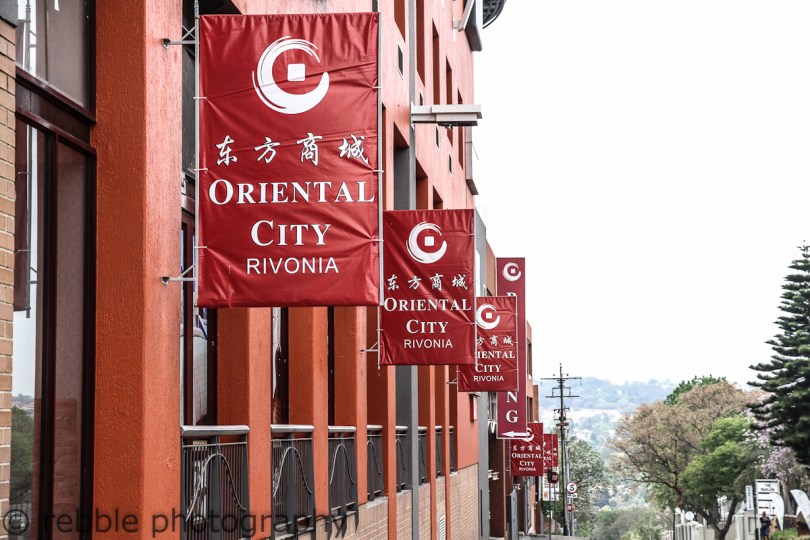
Rivonia Oriental City opened up just over a year ago. It’s not a ‘typical’ Chinese mall as there is a lot of integration and diversity. There are a hybrid of different stores including commercial South African staples like Pick n Pay and Truworths, we also saw a Kenyan coffee shop, well to say Kenyan is a stretch, they had pap and vleis as the meal of the day, but I digress. There was also a black hair salon next to a discount variety store.
However, there was not much difference in the Chinese stores present in the mall. There were clothing stores and gift and variety stores that sold the same merchandise. Interestingly there was a corridor next to the Pick n Pay that lead to the kind of oriental stores we have become accustomed to. Something about the low lighting and lack of activity making it not so ‘typical’.

Speaking to people at the mall proved challenging, a strong language barrier being the catalyst. The people we did manage to speak to had been in the country for some time and as a result could speak English. It was interesting to hear one guy Nathan Cai say he had “too little” Chinese friends and only wanted more, while someone else, Rose Zheng said she had “too many” and wanted to diversify her friend group.
Rose also said that she liked that this mall was different to China Mall: Dragon City, where she had worked previously. She liked the diversity of shops and people she was surrounded by, pointing out that all the businesses are not all Chinese owned and run. “It’s nice because we are in South Africa,” she added.
Being at the mall and getting insight from some of the people there did not make my angle any clearer but it did give me direction, I was heading North and now in a more North Easterly direction. Ooh suspense.
I’m going to be a writer

“I know I’m going to be a writer one day. I don’t think it in my brain but I know it in my heart,” I have not been able to look back since I read this Chris Van Wyk quote three years ago. It provided me with the resolve to do exactly what I’m doing in my life right now.
This past weekend a colleague and I went to the 2013 Mail & Guardian Literary Festival, to bask in the presence of some of South Africa’s literary giants.
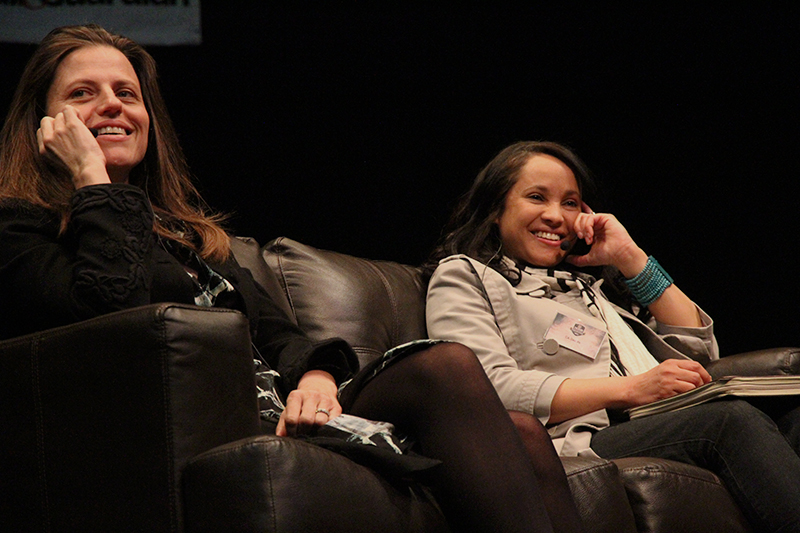
The Market Theatre was the historically apt venue picked to host the festival. Couches in the middle of a black stage in the main theatre providing the speakers with their literal platform.
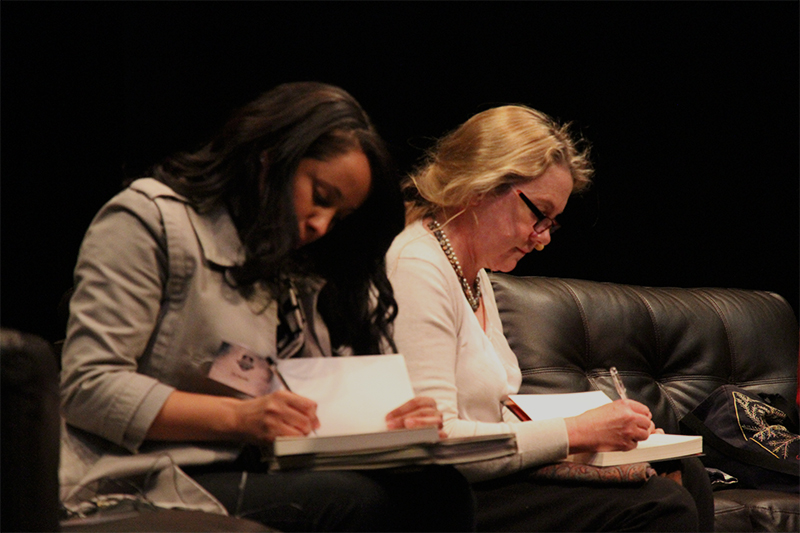
We sat in one session after another, furiously typing out tweets, scribbling notes and snapping photos. Between all of this we had to process what was being discussed on the various panels. All of which were interesting and engaging in their own ways.
One recurring statement made by writers like Nadine Gordimer and Craig Higginson, was that writing is a calling of sorts. One doesn’t write because they want to but because they have to. Craig went on to say that it simply isn’t worth the pain and effort otherwise.
I want to be like them
I was lucky to sit in on a panel discussion with a theme of ‘fact and fiction’ luckier still to listen to the first panel of women only, all of whom are first time published authors.

I have ambitions of being in their shoes one day. I’m doing journalism in a mission to be on the right side of history and because I really do enjoy writing. I want to be a journalist because I imagined at some point when I am too old or too tired of being on the field, I would magically turn into a writer. Well not magically but all that training will come in handy.
Anyway long story short, becoming a writer is the end goal.
So this panel discussion provided enough information for me to be inspired to keep on keeping on where this dream is concerned.
Journalism and writing
Claire Robertson provided some insight on how she managed to use her experience as a journalist to help her write her book, The Spiral House.
She said that she tried to avoid writing about her personal life, because in journalism reporting on oneself just isn’t done. “I’m not brave enough to write too intimately about my life,” confessed Claire. Clearly I have no such inhibitions, one browse on my tumblr blog is evidence of this.
However, she did insert herself in the places were she deemed it necessary because it was unavoidable. Her background helped her to write much faster than some of the other women on the panel, in this moment she was thankful for the demanding deadlines.
Fact versus fiction
A little fact, mixed with some fiction or do you have to one or the other. Author, Dominique Botha said the truth is incredibly hard and can never really be 100% in that regard. This makes for a problematic relationship between memoir and fiction she added.
“To retrieve memory is the first act of fiction,” she said. Botha added that memory relies on the act of imagination, in an effort to illustrate that memory is compromised and can’t be considered as 100% accurate.
Carol-Ann Davids, author of The Blacks of Cape Town said that one needs a little bit of both (fact and fiction) to tell a story.
Storytelling
The women on the panel emphasised that what they were doing was telling stories. Claire went as far as to say being a good writer is not enough, one has to be a good storyteller to write something of substance.
Maren Bodenstein , said that by way of storytelling and using details you can get a little closer to the ‘truth’ Dominique said was illusory. She said that this was the magic of, “dealing with the theory of literature”.
When asked by chair, Craig how they all managed to write such mature and deep books on their first try, the women unanimously agreed that they got to that point through enduring a lot of rejection and humiliation. “After chipping away at yourself you have no option but to write from your gut,” added Dominique.
The discussion then opened up to the floor in which time questions about getting published and being mothers were asked. Basically it difficult, it’s difficult to get published – to get someone to believe in your story. On being a mother while writing her first book, Carol-Ann said it was challenging but not impossible.
I learnt a thing or two about the journey I am yet to travel and was encouraged to press on.
Related articles
- Johannesburg: The migrant city that is anti-migrants (thejourneytoadream.wordpress.com)
- Nadine Gordimer helped me see how fiction writing can illuminate reality | Aminatta Forna (theguardian.com)
Johannesburg: The migrant city that is anti-migrants
Gallery by Mfuneko Toyana
The Market Theatre’s main stage was the platform where six diverse minds gathered to discuss migration, a topic central to all of their individual work.
The last day and the last panel discussion of the Mail & Guardian Literary Festival helped to make audience members and authors alike reflect on the movement of people in and out of cities and countries.
The poor accommodating the poor
Wandile Zwane from the City of Johannesburg’s Migrant Helpdesk, used an interesting anecdote from a conversation he had had with a woman, illustrating a point made earlier about migration being a situation where the poor are accommodating the poor.
The woman talked about the hierarchy that existed when it came to where one slept in her house. As a young child one was in the main bedroom, the older one got you would move to the dining room and the kitchen to make space for the younger ones. Eventually one would land up in the outside room and from there move on to their own house with a spouse.
Unfortunately her marriage had not worked out so she had to move back to the outside room with her kids, but because there was an immigrant living in that room she had to go back to the kitchen. The story points to one explanation of the animosity that exists around migration in South Africa.
Migration
Chinua Achebe’s book ‘There was a Country’ was the theme around which the conversation around which migration had to bend itself.
The panel consisted of writers who had threaded together stories and books, all zooming in on migration and themes central to resettlement. The panel discussion was largely based on the different writers’ works and their experiences of bridging political and personal narratives in their storytelling.
A young writer making waves in the literary world, NoViolet Bulawayo, said emergent personal narratives are based on political events, and that it was not possible to separate the two in one’s writing.
While the works of the six on stage were central to the discussion, engagement with audience members opened up the dialogue and brought up issues that were left out in the initial conversation.
Photographer and self-proclaimed book lover, Victor Dlamini (@victordlamini) made a poignant point from the floor, which steered the conversation to a meaningful point. He commented on people who are migrants themselves taking issue with people who migrate. He used Johannesburg as an example, saying most people who are in this city are not even from this city. “Johannesburg is a migrant city,” he added.
Panelist and writer, Achmat Dangor responded by saying that he agreed with Dlamini and pinned negative attitudes around migration on mechanisms of ‘othering’. He added that people migrate to places with a gravitational pull because of new ideas in that specific place. This is always the case with ‘big cities’, the activity and promise of economic emancipation lure people in, be it across borders or provincial lines.
Caroline Wanjiku Kihato, author of The Bookseller of Kibera, added to Dangor’s response, saying that human beings had a tendency of finding one another’s differences and using them to oppress one another.
Another audience member asked why was it that only Africans were considered immigrants. He did not understand why the Chinese and Europeans who come to this country were not treated with the same hostility that “our brothers” were.
In response Kwanele Sosibo (@KwaneleSosibo), journalist at the Mail & Guardian, simply said “we do it to ourselves”. He went on to narrate an anecdote about how people in an Eastern Cape community believe in measuring people according to certain pedigrees. Mining house recruiters divided them up according to body size, using pedigree determine who’d make best workers, exemplary of systematic ‘othering’.
Writing Invisibility
The Writing Invisibility e-book was launched. Some of the writers on the panel were contributors in the book which was a project done in collaboration with the Wits African Centre for Migration & Society.
The book is available for free download here.
RELATED ARTICLES:
- Wits Vuvuzela. The great South African novel? Septemeber 1, 2013
Related articles
- Migrants decry South African police brutality (worldbulletin.net)
WITH GALLERY: The 1913 Land Act realised through photos
A crowd of eager art lovers could not resist the magnetism of the historical photographic archive dating back to the 1800′s and commemorating the 1913 Land Act.
The exhibition Umhlaba 1913-2013: Commemorating the 1913 Land Act opened this week at the Gertrude Posel Core Gallery in the Wits Art Museum.
1913 Land Act
This year marks 100 years since the 1913 Land Act was passed. The act helped to successfully disenfranchise indigenous South African’s in terms of land ownership and its repercussions are still felt today.
Curator of the Umhlaba Exhibiton, Bongi Dhlomo-Matloa said that the exhibition’s purpose was to help people remember their history. “Commemoration is a relative term here, we are remembering this act that left blacks with only 7% of the land,” she said.
Dhlomo-Matloa coincidentally wore a black and white ensemble matching the monochromatic nature of most of the photographs on display. She said it was merely a coincidence but nonetheless she carried the colours of our history around her neck and on her shoulders.
Remembering history
Next to the exhibition’s entrance was a plaque detailing the aims, limitations and history behind the curation. “No single photographic exhibition could illustrate the full diversity of our complex realities,” but this by no means, kept the artist/photographer from making an attempt to illustrate those complex realities.
This history could not only be seen, but was also heard as jazz, afro-soul and choral music ushered people up the ramp and along the walls of the gallery. It was quite jarring to hear the juxtaposition between Miriam Makeba’s voice sing Gauteng and then immediately after, a choir sing Die Stem, while standing at the wall with all the apartheid-era photography on it.
Photographic reality
Dlomo-Matloa went on to say that these photos were used as they “are very exact” and can therefore accurately depict the reality they captured. The first colour picture seen in the gallery was on the apartheid wall, a photograph by David Goldblatt. It was taken in 1987 at a resettlement camp in the Wittlesea district of the then Ciskei.
Fourth year photography student Melissa Bennett, said she loved how the photos told a story of overcoming boundaries. She was also particularly intrigued by the way the photos had been arranged according to a historical timeline.
Dhlomo-Matloa said that the exhibition was displayed in chronological sequence laid out in a timeline to reflect how things and people changed as time went on. Although a huge amount of images were available, budget and space constraints restricted how many photographs could be exhibited.
The photography on display showcases some of the most talented photographers in the country, like Peter Magubane, Paul Weinburg and Ingrid Hudson.
After a walk about the whole gallery, the reality of our history was more than apparent. The exhibition will be on display until January 2014.
Watch the video below in which curator Dhlomo-Matloa talks about the exhibition:
Menell13: Media freedom unpacked
Menell13: Media freedom unpacked A report on this media conference a colleague and I attended this past weekend.
Court Week [5/5]
Our last day in court was one of our slower days. I suppose that is what happens when you wait for a story to happen.
A group of us headed to a court we thought would have a lot of cases which we could write human interest stories on. When we got there one of the lawyers told us that she was going to have a really interesting assault case, so we stuck to that court.
We got the unique opportunity to go down to the court holding cells to speak to some of the people awaiting trial. Their stories were really sad. They told us about how one had to buy the bare necessities in jail just to get by.
They pay anything between R50 and R100 for a bed or blanket. One toilet is shared between 100 men (all sharing a cell meant for about 40), a toilet which has no partition to speak of. Their toilet paper is even rationed. It was really nice getting to speak to the men in such an informal manner, getting their side of the story.
The lawyer expressed her discomfort with the fact that prisoners awaiting trial get lumped with actual murderers and rapists. Some people awaiting trail wait for months and even years for a trial date to be set, that means a lot of time is spent mixing with hardened criminals.
Postponement, after postponement came but no mention of the assault. The person who had committed the assault , Anna was sitting right by us.
She had apparently stabbed her husband’s pregnant girlfriend with a broken beer bottle. This all transpired ko’Spotong in Newtown. We had no doubt that that would be our most interesting case. So we carried on observing with the hopes that our case would be next.
That never happened. One complication after another lead to the case being postponed. So this ended up being my last submission:
Grown man weeps for bed
Pheladi Sethusa
A prisoner’s plea for a bed fell on deaf ears yesterday in the Johannesburg Magistrates Court.
Doctor Gule (40) had tears in his eyes when he asked the court for a moment to speak after Magistrate Naseema Kahn had postponed his case to Tuesday May 28.
A visibly upset Gule immediately piped up after the announcement. He asked to be given some money if he was being sent back to prison. “I have to pay R50 for a bed if I go back there,” said Gule.
Kahn replied, “Tax payers pay to keep ya’ll in there. You need to take that up with correctional services.” She added that living conditions were not in her jurisdiction and that he should write a letter to the people whose concern it is.
His attorney, Charlotte Snell, explained that once a case had been heard for the first time, those in custody were moved from police station holding cells to maximum security prison, Johannesburg Prison (Sun City).
Gule has been in custody since May 10 for theft. He has been convicted for stealing iron-steel rods from a construction site in the Johannesburg CBD, the value of which was unstated.
As Gule carried on making his plea, his voice began to break and tears started rolling down his cheeks.
He explained that the conditions in prison have been unbearable and that they were treated “like animals in there”.
Up to 100 men live in his cell which is meant to house only 40. They share one toilet in the cell and their toilet paper is rationed.
“Sometimes I have to sleep next to the toilet,” cried out Gule. There were audible gasps in the gallery.
Nell said that those who had not yet been sentenced, like Gule are worse off when sent to prison because they got no privileges like sentenced prisoners.
The magistrate however, was unmoved. She repeated that there was nothing she could do to help him. Gule walked out of the court disappointed, heading into a dungeon of uncertainty.